- AirOps is the enterprise growth platform for AI search and AEO that connects visibility monitoring to content execution and measurement in one closed loop.
- Peec AI is a focused AI search analytics tool that tracks your brand's visibility and position across multiple AI engines with strong depth, but stops at strategic recommendations.
- Teams that need to monitor AI visibility and then execute content at scale will find AirOps covers both. Teams earlier in their Answer Engine Optimization (AEO) journey who want a dedicated monitoring dashboard will find Peec a capable starting point.
- Peec fits into your stack as a visibility monitor alongside separate content and publishing tools. AirOps replaces that fragmented setup with a single operating system covering monitoring through execution and performance tracking.
You can see where your brand stands in AI search results. The harder problem is doing something about it at scale. Monitoring dashboards show citation gaps and sentiment shifts, but acting on those signals still requires stitching together separate tools for content creation, brand governance, and publishing.
AirOps and Peec AI both sit in the AI search analytics category, and both help marketing teams track how their brand appears across answer engines. They show up in the same shortlists because enterprise content leaders are trying to solve the same problem: buyer journeys increasingly start inside AI tools, and your team needs a system that keeps pace.
This guide compares both platforms across features, architecture, pricing, and support so you can decide which Peec AI alternative matches your operating model and where your team sits on the spectrum from monitoring to full-cycle execution.
AirOps vs Peec at a glance
The core difference is operational scope. AirOps connects monitoring to execution so your team can move from insight to published content to measured outcome without leaving the platform. Peec delivers focused ChatGPT and Perplexity monitoring with strong AI engine coverage but requires your team to build the execution pipeline separately.
AirOps vs Peec: platform overview
AirOps is the growth partner for AI search, built for enterprise marketing teams who need more than a visibility dashboard. AirOps gives your team the system to act on what AI search data shows and prove what those actions drive. The platform's core philosophy centers on closing the loop between insight and action, then measuring what each action drives. Rather than stopping at a dashboard, AirOps gives your team the system to act on visibility data and track what it produces. It's built for content teams running operations at scale where governance and speed work together alongside clear accountability.
Peec is an AI search analytics platform built for marketing teams who want dedicated monitoring of how their brand appears across AI-powered search engines. Peec's philosophy is depth of monitoring coverage. The platform tracks visibility, position, and share of voice across seven to nine AI engines while also covering sentiment analysis. It's best suited for teams building their AEO practice who want a focused tool for understanding AI search performance before committing to a full execution stack.

Core features: how AirOps and Peec stack up
Both platforms track AI search visibility. The difference is what each one does with that data. AirOps pairs monitoring with execution tools that let your team create and refresh content from the same platform, then publish it directly to your CMS. AirOps Insights tracks citation rate, mention rate, sentiment, and competitive positioning across five AI platforms (ChatGPT, Gemini, Perplexity, Google AI Mode, Google AI Overviews), all included on every plan. Peec focuses on delivering detailed visibility reports and dashboards with strategic recommendations, leaving execution to your existing tool stack. Compared with standalone AI visibility tools and answer engine optimization tools, AirOps ties tracking to the content workflow that acts on it.
AirOps features:
Quill
Quill is AirOps' autonomous AI agent that executes content Playbooks across creation, refresh, brand monitoring, and AI search optimization. Your team sets the strategy. Quill runs the execution.
Peec's Actions module recommends next steps but doesn't execute them. Quill does.
Page360 unified view
Page360 connects AI citation data with Google Search Console (GSC), Google Analytics 4 (GA4), and content freshness signals in one view per page.
Peec doesn't integrate Search Engine Results Page (SERP) or analytics data. Cross-referencing metrics requires manual work.
Prompt Discovery from four intent sources
Prompt Discovery surfaces buyer questions across four sources: AI search queries, People Also Ask, community forums, and keyword data.
Peec's Prompt Suggestions pull from website content only, limiting discovery to questions your existing pages already address.
Grids for bulk operations
Grids let your team run AI-powered workflows across hundreds of rows simultaneously, from content briefs to metadata updates.
Peec has no bulk operations. Each recommendation requires individual follow-up outside the platform.
Brand Kits
Brand Kits encode your brand voice, writing rules, and audience definitions. Content your AI workflows produce follows these constraints automatically.
Peec doesn't include brand governance. Content quality from Peec's recommendations depends on whatever governance your separate tools provide.
Workflows
Workflows are multi-step AI content pipelines that chain research and drafting with review and publishing into repeatable sequences.
Peec doesn't offer content workflows. Moving from recommendation to published page requires coordinating separate tools.
AirOps MCP with 35+ tools
The AirOps Model Context Protocol (MCP) server exposes 35+ tools that let external AI agents read and write AirOps data programmatically.
Peec also offers an MCP server for visibility data. AirOps' MCP is broader, covering analytics, content operations, and Brand Kit management.
Offsite
Offsite manages third-party publisher placements and grows your brand's AI citation share through external sources.
Large Language Models (LLMs) look for consensus between what your brand says and what others say. Most AI search tools, including Peec, focus only on on-site content.
Query Fan-outs
Query Fan-outs reveal the sub-queries AI engines run behind each prompt, showing you the actual research path these models take before generating an answer.
Peec has introduced Query Fanouts in early access, currently limited to ChatGPT. AirOps' implementation is production-grade across tracked platforms.
Closed-loop execution
AirOps connects every stage of the content lifecycle: surface an opportunity in Insights, execute through Workflows or Quill, publish via native Content Management System (CMS) integrations, and measure the result in the same platform.
Peec's architecture ends at recommendations. Closing the loop requires your team to connect separate execution and measurement tools.

Peec features:
Multi-engine AI visibility tracking
Peec tracks your brand's visibility across seven to nine AI engines. Standard plans let you choose three models; Enterprise plans include all.
Per-model pricing means adding coverage comes at incremental cost, while AirOps includes all five tracked platforms on every plan.
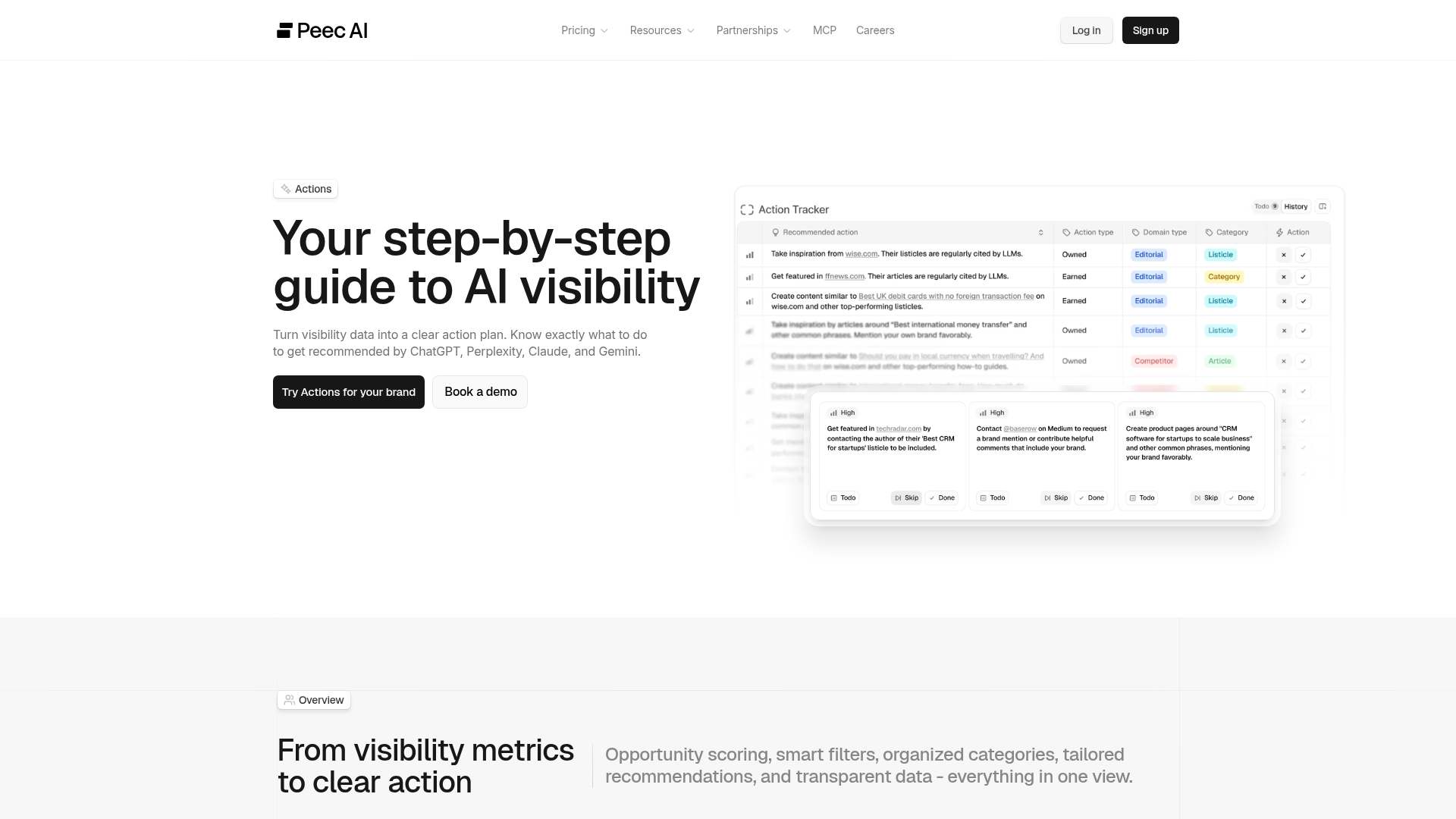
Actions module
Peec's Actions module generates strategic recommendations based on your visibility data, surfacing opportunities your team should pursue.
Actions bridges the gap between data and strategy. Teams still need separate tools to move from strategy to published content.
Agent Analytics
Agent Analytics tracks how AI crawlers interact with your site using server log analysis, showing which pages bots visit and how often.
AirOps approaches crawler visibility through Page360 content freshness signals and Publish Tracking rather than direct server log analysis.
Gap Analysis and Prompt Suggestions
Peec identifies gaps in your AI visibility and suggests prompts your brand should target based on your existing website content.
Because Prompt Suggestions pull from a single source (your website), they're limited to the question space your current content addresses.
The practical difference: AirOps is built so your team can act on insights, govern the content those actions produce, and measure whether it worked. Peec gives your team strong monitoring data with strategic direction, but executing on that direction requires assembling a separate tool stack.
Product architecture overview: AirOps vs Peec
AirOps is an end-to-end operating system where visibility data and content execution share the same infrastructure as brand governance and performance measurement. Peec is a specialized monitoring platform that delivers deep AI search analytics to inform decisions made in other tools.
Data sources and integrations
The scope of data each platform collects beyond AI search visibility differs significantly.
Data Sources and Integrations: AirOps pulls from five AI platforms, GSC and GA4 alongside 30+ native integrations spanning seven CMS platforms and five SEO tools. Peec connects to seven to nine AI engines (three on standard plans) with a Looker Studio connector on Advanced plans. Peec doesn't natively integrate with GSC, GA4, or CMS platforms.
Data Accuracy and Freshness: AirOps tracks content publish events and connects them to visibility changes, creating a direct timeline between actions and results. Peec provides regular monitoring updates without publish-event correlation.
Data Portability: AirOps exposes data through its MCP server (35+ tools) and native integrations with project management (PM) tools. Peec offers an MCP server for visibility data plus a Looker Studio connector.
AirOps connects AI visibility to the rest of your marketing stack. Peec delivers deep monitoring as a standalone signal.
Prioritization of opportunities
Knowing where you stand in AI search is step one. Knowing what to do about it is where platforms diverge.
Decision Engines and Scoring: AirOps includes an Opportunities Engine that categorizes actions into four types: Creation, Refresh, Outreach, Community. Each connects to a workflow your team can execute. Peec's Actions module surfaces recommendations without structured scoring against effort or business value.
AI-powered Recommendations: AirOps turns recommendations into published pages through Quill or Workflows. Peec's Actions deliver strategic guidance your team interprets and executes using separate tools.
Integration of Signals: AirOps combines AI citations, organic traffic, and content freshness into a single prioritization view through Page360. Peec focuses on AI visibility signals alone, requiring export and manual merging to correlate with SEO data.
AirOps bridges data to execution. Peec outputs prioritized recommendations for your team to act on elsewhere.

Workflow building and automation
Execution at scale requires automation. This is where the two platforms diverge most sharply.
Workflow Builder Capabilities and Flexibility: AirOps provides a visual workflow builder for multi-step AI content pipelines across different content types. Peec doesn't include a workflow builder.
Workflow Automation Features: AirOps automates research, drafting, compliance checks, and CMS publishing through Workflows and Quill. Peec automates monitoring and alerting only.
Workflow Conditional Logic and Triggers: AirOps Workflows support conditional logic and branching based on content scores or compliance results. Peec doesn't offer workflow-level logic.
Ease of Building vs. Complexity of What Can Be Built: AirOps balances a visual builder with the power to construct complex pipelines. Peec is faster to set up because its scope is narrower.
AirOps is built for teams that want to execute from the same platform they monitor in. Peec is built for teams that handle execution elsewhere.
Governance, context and brand control
As AI-assisted content scales, brand consistency becomes the constraint that separates sustainable programs from cleanup projects.
Brand Voice and Governance Features: AirOps Brand Kits enforce tone and terminology alongside compliance requirements across every piece of content your workflows produce. Peec doesn't include governance.
Knowledge Bases and Brand Kits: AirOps lets your team upload product documentation and brand guidelines into Knowledge Bases that AI workflows reference automatically. Peec doesn't offer knowledge management.
Customization vs. Templates: AirOps supports configurable content types, audience-specific rules, and regional guidelines. Peec provides standard monitoring views.
Brand governance is a core capability in AirOps. It's not in scope for Peec's platform.

Integrations and ecosystem
AirOps is the operating hub of your content stack. Peec is a specialized data source that feeds into it.
AirOps integrations:
CMS platforms (WordPress, Webflow, Shopify, Contentful, Sanity, Ghost, HubSpot):Native publishing integrations push content from AirOps directly to your CMS.
SEO tools (GSC, Ahrefs, Semrush, Screaming Frog, Sitebulb): Pull keyword data and ranking signals into your AirOps workflows.
Analytics and PM tools (GA4, Asana, Notion, Monday, Jira): Connect performance data and task management so content operations run in the tools your team already uses.
Peec integrations:
Looker Studio (Advanced plans and above): Export Peec visibility data into Looker Studio dashboards for custom reporting.
MCP server: Read and write Peec visibility data from MCP-compatible AI clients.
AirOps' 30+ integrations span the full content lifecycle. Peec's integrations focus on reporting.
Platform depth and scalability
The two architectures are designed for different operating scales.
Architectural Breadth and Depth: AirOps supports the full cycle from AI search monitoring through content creation and brand governance, then continues into publishing and measurement. Peec supports AI search monitoring with depth across multiple engines, plus emerging features in strategic recommendations and crawler analytics.
Scalability Across Teams and Content Volume: AirOps includes unlimited users on Pro plans, multi-brand Brand Kits, and Grids for bulk operations. Peec includes unlimited users on all plans but gates projects and country access by tier. AI model coverage also requires add-ons.
Long-Term Extensibility and Future-Proofing: AirOps' workflow architecture lets your team build new operations as AI search evolves. Peec's extensibility depends on the platform adding new features over time.
AirOps scales with your content operation's complexity. Peec scales with your monitoring coverage needs.
AirOps vs Peec: out-of-the-box services and solutions
AirOps provides more immediate operational value because it ships with execution capabilities alongside monitoring. Peec delivers fast time-to-value for monitoring but requires your team to build the execution pipeline separately.
Peec gets you to monitoring data faster because that's its sole focus. AirOps takes slightly longer to configure because you're setting up an operating system, but you're operational across monitoring and execution within days.
AirOps vs Peec: support, resources and community
AirOps provides hands-on implementation support backed by a growing Content Engineering community. Peec offers documentation-driven onboarding with direct support channels.
Execution and training
Implementation Support and Training: AirOps Enterprise plans include a dedicated account manager with custom onboarding. Pro plans include onboarding support. Peec provides documentation-based onboarding.
Managed Services vs. Self-Service Approaches: AirOps offers managed services for Enterprise customers. Peec is primarily self-service across all tiers.
Ease of use and onboarding
Onboarding Process: AirOps' onboarding covers monitoring, Brand Kit configuration, and workflow setup. Peec's onboarding focuses on connecting your brand and selecting AI engines, which is faster.
Ease of Use: Peec's interface is straightforward for monitoring. AirOps has a broader interface reflecting its broader capabilities. Both are designed for marketing teams.
Support and resources
Resources: AirOps offers a Learning Hub with documentation and webinars. It also offers the Content Engineering Certification. Peec provides product documentation and guides.
Community: AirOps hosts an active Content Engineering community where practitioners share workflows and results. Peec has a growing customer base of 2,000+ brands but doesn't offer a public community forum.
Customer Support: AirOps provides email, Slack channels for Pro and Enterprise, and dedicated Customer Success Managers (CSMs) for Enterprise. Peec offers email support with faster response times on higher tiers.
AirOps vs Peec: pricing and value comparison
AirOps offers a free entry point with custom pricing for scaled operations. Peec prices in euros with fixed tiers based on prompt volume, project count, and AI engine access.
Total cost of ownership is the real comparison. Peec's listed price covers monitoring only. Your team still needs separate content creation tools and a CMS publishing pipeline. With AirOps, those capabilities are included. A Peec Starter plan at €85/mo (~$95 USD) looks affordable until you add the tools required to act on what it shows you. Peec also charges €30 to €140/mo per add-on AI model depending on tier.
Real-world: when to use each platform
The right choice depends on your team's AI search maturity and operational needs. Peec centers on AI brand monitoring, and AirOps adds the execution to act on what you monitor.
AirOps
Workflow fit: AirOps fits teams that need to move from monitoring AI visibility to executing content programs at scale. If your team creates new content, refreshes existing pages, builds offsite visibility, and proves return on investment, AirOps provides the system to do it in one place.
Industry fit: Enterprise companies with complex content needs: financial services teams with compliance requirements, SaaS companies managing multiple product lines. AirOps is especially strong where brand governance at scale is a requirement.
Peec
Workflow fit: Peec fits teams focused on understanding their AI search presence before building an execution program. If your primary need is tracking how your brand appears across AI engines and identifying which questions to optimize for, Peec delivers that data clearly.
Industry fit: Mid-market and enterprise brands in the early stages of their AEO strategy. Companies with existing content operations who want a dedicated monitoring tool. Teams where Generative Engine Optimization (GEO) is a new initiative and understanding the landscape is the first priority.
AirOps vs Peec: strengths and limitations
AirOps
Strengths:
End-to-end execution: AirOps connects AI visibility monitoring to content creation and brand governance in one system, with publishing and measurement built in. Your team doesn't need to stitch together separate tools.
Brand governance at scale: Brand Kits enforce voice and rules across every piece of content your workflows produce. For enterprise teams managing multiple products or regions, this prevents quality drift.
Proven enterprise results: Customers like Carta (7x AI citations, 75% citation rate on new pages) and Chime (3x AI citations in 4 weeks, 89% time reduction per refresh) demonstrate measurable outcomes.
Limitations:
Setup investment: Because AirOps covers more of the content lifecycle, initial configuration takes longer than a monitoring-only tool. Brand Kit setup and workflow design require upfront time.
Custom pricing on Pro: Teams on a fixed budget may prefer Peec's transparent published pricing. AirOps Pro requires a conversation to scope costs.
Learning curve: The platform's breadth means your team needs to learn more capabilities. The payoff is operational efficiency, but the ramp-up period is real.
Peec
Strengths:
Deep AI engine coverage: Peec tracks seven to nine AI engines, offering broad monitoring visibility. For teams that prioritize monitoring breadth, this coverage is strong.
Agent Analytics: Server log analysis of AI crawler behavior is a distinctive capability giving your team direct insight into how AI bots interact with your site.
Fast time-to-value for monitoring: Peec's focused scope means your team can be tracking AI visibility within the first day of setup.
Limitations:
No execution capability: Peec recommends actions but doesn't execute them. Your team needs separate tools for content creation and publishing.
No SEO data integration: Without GSC or GA4 connections, your team can't correlate AI visibility changes with organic traffic inside Peec.
Per-model pricing: Standard plans include three AI models. Adding coverage requires purchasing add-on models at €30 to €140/mo each.
How does content refresh sustain AI visibility?
Content refresh sustains AI visibility because answer engines cite recently updated pages far more often than stale ones. This is where the difference between the two platforms shows up. Peec shows you when a page loses ground, and AirOps refreshes it through Grids, Workflows, and Quill.
AirOps research on more than 4,000 ChatGPT-cited pages quantifies the stakes:
More than 70% of pages cited by ChatGPT were updated in the past 12 months, according to AirOps research.
Pages left unrefreshed for over a year are more than twice as unlikely to be cited.
Over 60% of commercial-query citations come from pages updated in the last six months.
Monitoring alone cannot close that gap. Acting on it keeps your best pages cited as answer engines shift.
Bottom line
AirOps is the enterprise-grade Peec AI alternative for content teams that need to move from AI search monitoring to scaled content execution and governance in one platform. Peec is the right choice for teams that want focused AI visibility monitoring and already have a content execution stack they're satisfied with.
Choose AirOps if:
Your team needs to act on AI visibility data at scale, not see it alone.
Brand governance across content your AI workflows produce is a requirement, not a nice-to-have.
You want one platform where visibility data connects directly to content execution and measurable AEO and visibility ROI.
Choose Peec if:
Your primary goal is monitoring AI search visibility across many engines before building an execution program.
You already have content creation and publishing tools you're committed to.
You want a focused analytics tool with transparent published pricing and a fast setup.
Why teams choose AirOps
Among Peec AI competitors, AirOps wins this comparison for teams that need to do more than monitor. Peec delivers strong AI visibility analytics, but when your team needs to turn those insights into governed content, publish it to your CMS, and measure the result, Peec requires you to build that pipeline from separate tools.
AirOps customers see measurable results from the platform's connected approach. Carta achieved a 75% citation rate on new pages with content going from publication to citation in 3 days. Chime tripled AI search citations in four weeks while reducing per-refresh time by 89%. Docebo cut production costs by 50% while doubling content velocity.
Your AI search strategy deserves a platform that executes as well as it monitors. If you're ready to close the gap between visibility data and content outcomes, start the conversation with AirOps.
Book a call to see how AirOps turns AI search insights into measurable content results.
Frequently Asked Questions
FAQs
Can AirOps replace Peec for AI search monitoring?
Yes. AirOps tracks citation rate and mention rate across five AI platforms. It also covers sentiment and competitive positioning. It covers monitoring capabilities Peec provides and adds execution with governance and measurement on top.
Does Peec offer content creation or publishing features?
No. Peec is an AI search analytics platform focused on monitoring and strategic recommendations. Content creation and publishing happen outside the platform in your existing tools.
Which platform is better for enterprise content teams?
AirOps is built for enterprise content operations. It includes Brand Kits for governance, unlimited users on Pro plans, SSO (Security Assertion Markup Language, or SAML) and Role-Based Access Control (RBAC) on Enterprise, and Quill for autonomous execution. Peec offers unlimited users on all plans but doesn't include governance or execution features enterprise teams typically require.
How do AirOps and Peec handle AI engine coverage differently?
AirOps tracks five AI platforms (ChatGPT, Gemini, Perplexity, Google AI Mode, Google AI Overviews) with all included on every plan. Peec tracks seven to nine AI engines but limits standard plans to three models. Additional models cost €30 to €140/mo each.
Can I use Peec alongside AirOps?
You could, but there's significant overlap. AirOps covers AI search monitoring as part of its broader platform. Teams that start with Peec for monitoring often consolidate into AirOps when they're ready to add execution and governance capabilities.
What does AirOps' Quill do that Peec's Actions module doesn't?
Quill is an autonomous AI agent that executes content Playbooks: creating new content and refreshing existing pages while optimizing for AI search. Peec's Actions module generates strategic recommendations, but Quill executes them directly.
What visibility tracking features make AirOps different from other AI tools?
AirOps tracks citation rate, mention rate, sentiment, and competitive positioning across five AI platforms. It connects that visibility data to Page360, which ties AI citations to Google Search Console and Google Analytics 4 metrics. That link between visibility tracking and content execution is what separates AirOps from monitoring-only tools. Teams often call this LLM citation tracking, measured and then acted on in the same platform.
How does AirOps compare to other AI tools?
AirOps covers the full cycle from AI search monitoring to content execution and measurement in one platform. Most AI tools stop at visibility reports and dashboards. AirOps adds Quill, Brand Kits, and native CMS publishing so your team acts on the data without a separate stack.
What is Peec AI's cost relative to other SEO tools?
Peec AI pricing starts at €85 per month (around $95 USD) for 50 prompts, three AI models, and one project. Adding AI models costs €30 to €140 per month each. That price covers monitoring only, so content creation and publishing tools are separate costs.
Is Peec AI more effective than other tools?
Peec is effective for teams whose goal is monitoring AI search visibility across many engines. For teams that need to act on that data, AirOps is more effective because it pairs monitoring with content execution, brand governance, and measurement in one system.
Does Peec AI scrape data via UI or an API?
Peec collects AI visibility data through its own tracking and exposes it through an MCP server and a Looker Studio connector on higher tiers. API access is available on Enterprise plans. AirOps exposes its data through an MCP server with 35+ tools alongside native integrations.
Where can you find a Peec AI alternative that also produces content?
AirOps is a Peec AI alternative that both monitors AI search visibility and produces content. It pairs Insights and Page360 with Quill, Workflows, and native CMS publishing, so your team moves from tracking to published pages in one platform.
Can AirOps replace multiple point AI tools in one platform?
Yes. AirOps replaces separate tools for AI brand monitoring, citation tracking, content creation, and publishing with one platform. Point tools like Peec stop at monitoring, so your team still needs a content stack to act. AirOps combines Insights, Quill, Workflows, and native CMS publishing, so you consolidate the stack and act on what you track.
How does AirOps support large-scale content refresh for SEO and AI visibility?
AirOps refreshes content at scale using Grids, Workflows, and Quill. Your team updates hundreds of pages in parallel, then measures the lift in Page360. This keeps high-value pages fresh enough to hold their rankings and AI visibility as answer engines shift.
Get the latest on AI content & marketing
