- AirOps is the full-loop growth platform for AI search: it surfaces visibility data, gives your team the workflows to act on it, and measures what that action drives, so results compound over time.
- Scrunch is an AI visibility monitoring platform that tracks how brands appear across large language models (LLMs). Strong dashboards, limited execution tooling.
- Teams that need to monitor AI search performance and report on it will find Scrunch useful. Teams that need to monitor, act, govern, and measure in one system will outgrow a monitoring-only tool quickly.
- AirOps replaces the gap between your visibility data and your content management system (CMS). Scrunch fits alongside your existing stack as a reporting instrument.
Your team has AI visibility dashboards. Probably more than one. The data is clear: citation rates, mention rates, competitive positioning across ChatGPT, Gemini, Perplexity, and Google AI Mode. The bottleneck isn't information. It's turning that information into updated content, new pages, refreshed briefs, and published improvements, all at the speed your AI search performance demands.
AirOps and Scrunch both operate in the Answer Engine Optimization (AEO) space, and both help content teams understand how their brand shows up in AI search. The difference sits in what happens after the dashboard. AirOps closes the loop between insight and execution. Scrunch, now part of Sitecore's enterprise suite, gives you the signal and leaves the execution to your existing tools. By the time you finish this comparison, you'll know which approach fits your team's operating model and where your content program is headed.
AirOps vs Scrunch at a glance
The numbers tell part of the story. AirOps connects visibility data to content workflows, brand governance, publishing, and performance tracking inside one platform. Scrunch delivers solid AI visibility monitoring that now benefits from Sitecore's enterprise infrastructure, but teams still need separate tools to act on what the dashboards surface.
AirOps vs Scrunch: platform overview
AirOps is the growth partner for AI search, built to close the loop between visibility insight, content action, and measurable outcome. AirOps serves enterprise marketing teams navigating a fundamental shift in buying behavior: consumers are going directly to AI prompts rather than websites, which means the story AI agents tell about your brand has become your most important marketing asset. AirOps exists to help Search Engine Optimization (SEO), content, and marketing teams understand how their brand shows up in AI search, take action to improve it, and measure the results. That closed loop, run continuously, is the core value.
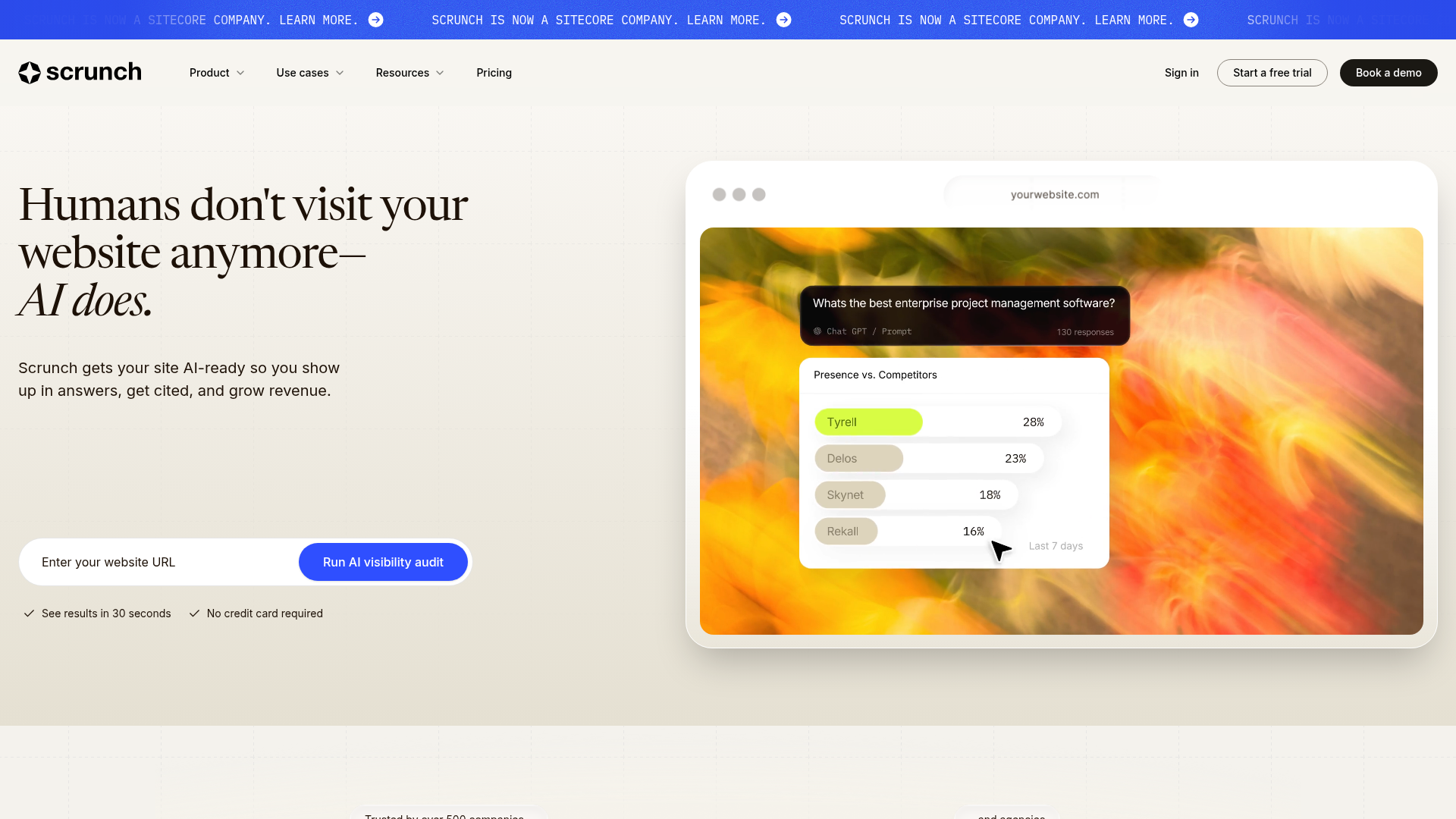
Scrunch, now a Sitecore company following a $225M acquisition in June 2026, is an AI visibility monitoring platform that tracks how brands appear across LLM-powered search engines. Scrunch gives marketing teams dashboards for citation tracking, mention rate analysis, competitor benchmarking, and sentiment monitoring. The Sitecore acquisition positions Scrunch within a broader enterprise content ecosystem, and its Agent Experience Platform (AXP) offers AI-optimized content delivery as an add-on to its monitoring capabilities.

Core features: how AirOps and Scrunch stack up
AirOps covers the full cycle from monitoring through execution and back to measurement. Scrunch concentrates its feature set on the monitoring and analysis phases. The gap matters most when your team needs to turn insight into published content at scale.
AirOps features
- Quill
- Quill is the AI agent captain that runs marketing playbooks continuously: content creation, content refresh, brand monitoring, all executed in brand voice with full Brand Kit and Knowledge Base context. Your team sets the strategy. Quill runs the execution.
- Content Directors managing large programs stop bottlenecking on manual production. Quill handles the volume while your team focuses on strategy, creative direction, and quality governance.
- No other AEO platform includes an autonomous execution agent that operates on the same visibility data the platform surfaces. Most competitors require you to export data and rebuild workflows elsewhere.
- Page360 unified view
- Page360 is a unified view connecting AI visibility signals to Google Search Console (GSC) and Google Analytics 4 (GA4) data so your team can tie content performance directly to AI search outcomes in one screen.
- Every content decision gets grounded in the full picture: organic search performance, AI citation data, traffic trends, and engagement metrics side by side. No more toggling between four tabs to understand one page.
- Scrunch tracks AI visibility in isolation. Page360 connects that signal to the traditional SEO and analytics data your executives already trust, making it easier to justify budget and prioritize refreshes.
- Prompt Discovery from four intent sources
- Prompt Discovery surfaces the questions your buyers are asking across four intent sources: search engine keyword mining plus People Also Ask extraction, ChatGPT query fan-outs, Perplexity related questions, and Voice of Customer mining from tools like Gong and Zendesk.
- Your content calendar shifts from guesswork to demand signals. You're writing what your audience is searching for across traditional search, AI answer engines, and direct customer conversations.
- Most monitoring platforms rely solely on synthetic prompts. AirOps builds a map of real buyer intent across channels, giving your team coverage that single-source tools can't match.
- Grids for bulk operations
- Grids provides a spreadsheet-like interface for running bulk content operations: audit hundreds of pages, generate briefs at scale, queue refreshes, and track progress across your entire content library.
- Teams managing thousands of pages can process, prioritize, and act on content at the portfolio level instead of page by page. What used to take weeks of manual work compresses into hours.
- Scrunch doesn't include bulk content operations tooling. Teams using Scrunch export data into spreadsheets and manage operations separately, adding time and friction to every content cycle.
- Brand Kits
- Brand Kits provides a living brand governance system built for AI-scale content operations: structured for AI to reason over, governed with versioning and approvals, and accessible everywhere your team works via the Model Context Protocol (MCP).
- Every piece of content your workflows create follows your brand voice, terminology, prohibited language, and formatting rules automatically. Your brand stays consistent even as content volume scales.
- Scrunch doesn't include brand governance tooling. Teams using Scrunch depend on separate style guides and manual review processes that break down as volume increases.
- AirOps MCP with 35+ tools
- AirOps MCP surfaces 35+ tools via the Model Context Protocol, connecting Brand Kit context, AEO analytics, Page360 data, Grids, and Reports to any MCP-compatible AI assistant your team uses: Claude, ChatGPT, Cursor, and more.
- Your team gets brand-governed AI output in every tool they already use without switching contexts or copy-pasting guidelines. The same Brand Kit feeds AirOps workflows and external assistants.
- Scrunch doesn't offer MCP integration. AirOps delivers brand intelligence and visibility data directly into the creative tools where content gets built, a capability no other AEO platform matches.
- Offsite
- Offsite manages third-party publisher placements and systematically grows your AI brand citation share through measured offsite visibility building with full attribution.
- The majority of brand discovery in AI search happens through third-party sources. LLMs look for consensus between what your brand says about itself and what others say about it. Offsite addresses both sides of that equation.
- Most AEO platforms, Scrunch included, focus exclusively on on-site content. AirOps is one of the only platforms connecting offsite citation discovery to placement execution to AI visibility measurement.
- Copilot
- Copilot provides conversational AI assistance within the AirOps platform, helping your team navigate data, build workflows, troubleshoot campaigns, and surface insights through natural language.
- New team members ramp faster. Experienced operators work more efficiently. Complex platform tasks that used to require documentation lookups become conversational.
- Scrunch doesn't include an in-platform AI assistant. Users navigate the interface and interpret data through traditional UI patterns alone.
- Query Fan-outs
- Query Fan-outs reveals the sub-queries AI engines run behind each prompt, showing you the exact decomposition path an LLM follows when answering a question about your brand or category.
- Your team sees not only which prompts mention your brand but why. Understanding the sub-query structure lets you optimize for the specific evidence signals LLMs seek when building answers.
- Most monitoring platforms show the top-level prompt and the final answer. AirOps exposes the reasoning chain, giving your team a structural advantage in content optimization.
- Workflows
- AirOps Workflows provides a no-code workflow builder for Content Engineering teams to design sophisticated AI content pipelines, manage production at scale, and keep humans in control of quality at every step.
- Your content team builds, tests, and runs complex content operations without engineering support. Workflows handle everything from brief generation to content drafting to quality checks to CMS publishing.
- Scrunch doesn't include workflow building or automation capabilities. The gap between identifying a visibility opportunity in Scrunch and publishing improved content remains filled by manual processes and disconnected tools.
- Closed-loop execution
- AirOps connects every stage of the content lifecycle in a single platform: visibility data surfaces opportunities, workflows and Quill execute improvements, Content Publish Tracking logs every change, and Insights measures the impact automatically.
- Your team stops working in cycles of "export, analyze, brief, produce, publish, wait, re-check." The platform runs that loop continuously, compounding results over time.
- Scrunch provides the first step of this loop (insight) and leaves the remaining steps to your existing tool stack. Teams using monitoring-only platforms consistently report that the gap between data and action is where performance stalls.

Scrunch features
- AI visibility monitoring
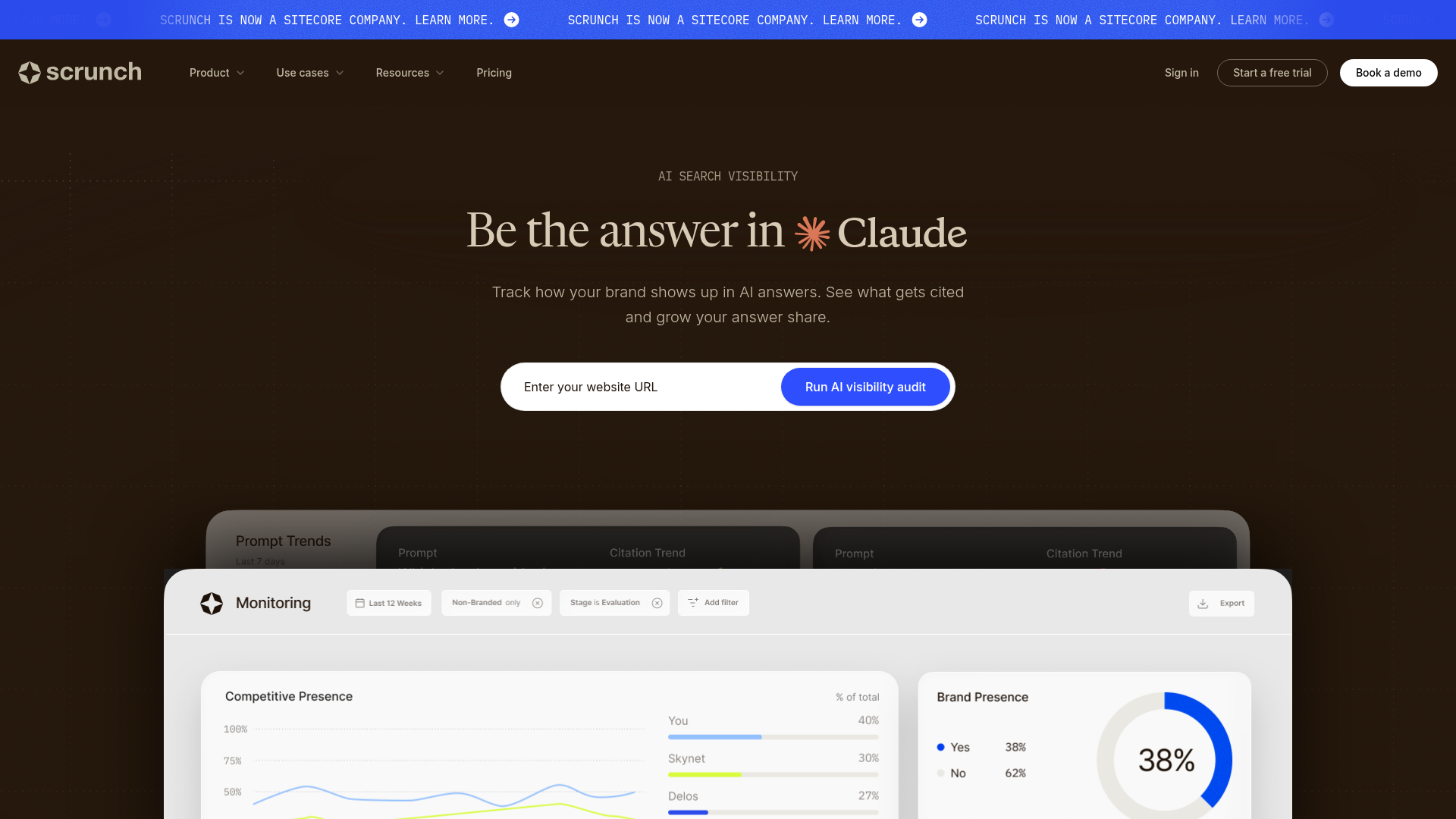
- Scrunch tracks how brands appear across LLM-powered search engines with citation tracking, mention rate analysis, sentiment monitoring, and competitive benchmarking across multiple AI platforms.
- Marketing teams get a clear read on where their brand stands in AI search results. The dashboards are well designed and the data refreshes regularly.
- Scrunch's monitoring depth is solid for teams that need a dedicated visibility dashboard. The limitation is that insights stay in the dashboard until someone manually acts on them.
- Competitor benchmarking
- Scrunch provides side-by-side AI visibility comparisons across competitors, tracking share of voice, citation rates, and mention frequency for your brand relative to your competitive set.
- Content Directors can report on competitive positioning in AI search with clear, presentation-ready data.
- AirOps also offers competitor benchmarking within Insights, but pairs it with the workflows to close competitive gaps rather than reporting on them alone.
- Agent Experience Platform (AXP)
- AXP is Scrunch's add-on for creating AI-optimized versions of web pages, delivered in parallel to your existing site through a separate rendering pipeline.
- Teams exploring AI-specific content delivery get an option for optimizing how LLMs consume their pages.
- AXP addresses content delivery optimization. AirOps addresses content creation, governance, and performance optimization across the full lifecycle.
- Sentiment analysis
- Scrunch tracks the sentiment of AI-generated answers that mention your brand, helping teams understand whether LLMs describe their brand positively, neutrally, or negatively.
- Useful for brand reputation monitoring in AI search. Teams can identify when AI answers misrepresent their brand or lean toward competitors.
- AirOps Insights also includes sentiment tracking, integrated with the same data that feeds content workflows and competitive analysis.
- LLM coverage breadth
- Scrunch Enterprise covers up to nine LLMs, giving teams broad visibility across the AI search landscape including ChatGPT, Gemini, Perplexity, Claude, and others.
- For teams whose primary need is breadth of monitoring coverage, Scrunch Enterprise provides wide LLM reach.
- AirOps covers the major AI search engines where the vast majority of consumer queries happen and pairs that coverage with execution tooling that Scrunch doesn't match.
The practical implication: AirOps teams move from visibility data to published content improvements inside one platform. Scrunch teams move from visibility data to a brief, then to a separate CMS, then to manual tracking of what changed and whether it worked. The difference compounds with every content cycle.
Product architecture overview: AirOps vs Scrunch
AirOps is built as an operating system for content teams: data collection, prioritization, workflow execution, brand governance, publishing, and performance measurement all live in one platform. Scrunch is built as an intelligence instrument: deep AI visibility monitoring that feeds data into your existing stack for action. Among AI search visibility tools, the real split is monitoring alone versus monitoring paired with execution.
Data layer
AirOps unifies AI search data, organic search analytics, web traffic metrics, CMS content, and proprietary knowledge into a single data foundation. Scrunch collects AI search visibility data from LLM-powered engines and pairs it with basic GSC integration.
- Data Sources and Integrations: AirOps pulls from AI search engines, GSC, GA4, CMS platforms (WordPress, Webflow, Shopify, Ghost), Voice of Customer tools (Gong, Zendesk), and proprietary data through Knowledge Bases, creating a unified foundation that feeds both analysis and execution through 35+ connected tools. Scrunch pulls from AI search engines for visibility monitoring with approximately four integrations, meaning most operational data lives outside the platform.
- Data Accuracy and Freshness: AirOps uses real user behavior data from GSC and GA4 combined with AI search monitoring, grounding every insight in actual performance signals. Content Publish Tracking automatically logs every content publish or update as a timestamped event overlaid on Insights charts, connecting actions to outcomes without manual tagging. Scrunch relies on AI search monitoring data, which is accurate for visibility tracking but doesn't include organic search or web analytics context, so correlating visibility shifts to specific content changes requires manual effort.
- Data Portability: AirOps data flows through MCP to any compatible AI tool, through Grids for bulk export and processing, and through native integrations to CMS platforms for publishing. Your data is accessible wherever your team works. Scrunch data primarily lives within its dashboards, with limited export capabilities. Teams typically screenshot or manually extract Scrunch data when building reports or briefing content creators.
The data architecture difference is structural. AirOps' unified data feeds both monitoring and execution. Scrunch's data serves monitoring well but requires manual extraction for any downstream use.
Prioritization of opportunities
Identifying which content to create or refresh is where monitoring platforms and execution platforms diverge most sharply.
- Decision Engines and Scoring: AirOps combines AI visibility signals, organic search data, web analytics, and content health indicators to surface prioritized opportunities. Page360 scores content by combining citation performance with GSC rankings, traffic trends, and engagement data, so your team sees which pages have the highest potential impact and can act immediately through workflows. Scrunch surfaces AI visibility data that your team can sort and filter to identify opportunities, but the prioritization logic and scoring happen in your team's heads or in external tools.
- AI-powered Recommendations: AirOps Prompt Discovery reveals demand signals across four intent sources, helping your team identify gaps in content coverage before competitors fill them. Quill generates specific content recommendations based on visibility gaps it detects. Scrunch tracks existing prompts where your brand appears (or doesn't) but doesn't systematically discover new buyer questions across multiple channels or generate content recommendations.
- Integration of Signals: AirOps merges AI citation data, organic rankings, traffic trends, engagement metrics, and Voice of Customer inputs into a single prioritization view through Page360. Scrunch presents AI visibility signals in isolation. Organic search context is available through GSC integration, but combining those signals with content health, audience behavior, and competitive gaps happens outside the platform.
AirOps' prioritization connects directly to execution workflows. Scrunch's prioritization output is a dashboard your team interprets and acts on elsewhere.
Workflow building and automation
Operationalizing content decisions is where the two platforms diverge most completely. AirOps treats AI content workflow automation as core, while Scrunch leaves production to your existing stack.
- Workflow Builder Capabilities and Flexibility: AirOps Workflows provides a no-code builder where Content Engineering teams design, test, and deploy sophisticated content pipelines: from brief generation through drafting, quality review, brand compliance checking, and CMS publishing. Scrunch doesn't include workflow building capabilities. The distance between a Scrunch visibility insight and a published content improvement is bridged entirely by your team's manual processes and external tools.
- Workflow Automation Features: AirOps automation runs continuously through Quill, which monitors AI search signals, executes content campaigns, and reports results back to Insights. Grids handle bulk operations across hundreds of pages simultaneously. Scrunch's automation is limited to scheduled monitoring and alerting, with no content production or publishing automation.
- Workflow Conditional Logic and Triggers: AirOps workflows support conditional logic, triggers, human review gates, and multi-step sequences that adapt based on data conditions. Teams build workflows that route content differently based on performance thresholds, content type, audience, or brand rules. Scrunch's platform architecture doesn't include workflow orchestration or conditional processing.
- Ease of Building vs. Complexity of What Can Be Built: AirOps' no-code interface keeps the learning curve manageable while supporting complex, multi-step content pipelines. Pre-built workflow templates and Copilot lower the entry barrier for new users. Scrunch is straightforward to navigate because its scope is focused on monitoring, not execution; there are no workflows to build.
AirOps gives content teams the tooling to operationalize every insight the platform surfaces. Scrunch leaves operationalization to your existing stack.
Governance, context, and brand control
Brand governance becomes critical when your team scales content production with AI. Ungoverned content at volume erodes brand trust faster than slow content ever did.
- Brand Voice and Governance Features: AirOps Brand Kits provide a living governance system: writing rules, tone guidelines, prohibited language, terminology requirements, formatting standards, audience-specific voice adjustments, and region-specific adaptations, all structured for AI to reason over and enforced automatically across every workflow. Scrunch doesn't include brand governance features. Teams using Scrunch rely on separate style guides, manual review processes, and editorial oversight that become harder to maintain as content volume scales.
- Knowledge Bases and Brand Kits: AirOps Knowledge Bases supply the factual material, reference data, and institutional knowledge that make content substantive. Semantic retrieval surfaces the right context automatically for each task. Combined with Brand Kits, every piece of content your team produces is both on-brand and factually grounded. Scrunch doesn't offer a knowledge management or brand governance system, so teams building content from Scrunch insights must manually gather supporting data and enforce brand standards through separate processes.
- Customization vs. Templates: AirOps supports deep customization across brands, audiences, regions, content types, and product lines within a single platform instance. Teams configure governance rules per dimension rather than relying on generic templates. Scrunch offers dashboard templates and report templates for monitoring but doesn't provide content-level customization or governance tooling.
AirOps treats brand governance as a platform capability. Scrunch treats it as the customer's responsibility.
Integrations and ecosystem
AirOps' 35+ MCP tools and native integrations position it as a connected hub within your marketing stack. Scrunch operates primarily as a standalone monitoring tool with limited integration points. Teams that want more than AI visibility tracking get the integration depth that turns insight into published work.
AirOps integrations
- CMS platforms (WordPress, Webflow, Shopify, Ghost): Content publishing directly from AirOps workflows means your team goes from insight to published page without switching tools.
- GSC and GA4: Page360 pulls organic search and web analytics data into the same view as AI visibility metrics, grounding every decision in performance data your executives trust.
- MCP-compatible AI tools (Claude, ChatGPT, Cursor): Brand Kit context and AEO data available in every creative tool your team uses, no copy-pasting required.
- Gong and Zendesk: Voice of Customer data feeds Prompt Discovery, connecting real buyer conversations to your content strategy.
Scrunch integrations
- Google Search Console: Basic organic search data integration for context alongside AI visibility monitoring.
- Sitecore ecosystem (post-acquisition): Integration with Sitecore's enterprise content platform is expected to deepen over time, potentially benefiting teams already running Sitecore.
AirOps' integration depth means data flows in both directions: insights inform workflows, and workflow outcomes feed back into reporting. Scrunch's integrations are primarily one-directional: data flows in for monitoring purposes. The Sitecore acquisition may expand Scrunch's ecosystem over time, but the current integration set is narrow.
Platform depth and scalability
Enterprise content operations demand platforms that scale across teams, brands, and content volume without degrading quality or governance. The best LLM visibility tools scale monitoring, and scaling execution alongside it is where content operations compound.
- Architectural Breadth and Depth: AirOps supports monitoring, prioritization, workflow execution, brand governance, CMS publishing, and performance measurement within a single platform. Scrunch provides deep monitoring and analysis capabilities but doesn't extend into execution, governance, or publishing. The architectural difference means AirOps replaces multiple tools while Scrunch complements them.
- Scalability Across Teams and Content Volume: AirOps supports multiple brands, regions, audiences, content types, product lines, and team roles within a single instance with consistent governance and shared workflows. Unlimited seats on paid plans mean growing teams don't hit per-user cost walls. Scrunch supports multiple workspaces and user seats ($25/user/mo add-on) but doesn't include the workflow, governance, or publishing infrastructure needed to scale content operations alongside monitoring.
- Long-Term Extensibility and Future-Proofing: AirOps' MCP integration and workflow extensibility position it to adapt as new AI engines, content formats, and distribution channels emerge. Scrunch's depth within the monitoring category is strong, and the Sitecore acquisition could bring broader platform capabilities over time, though the current product roadmap under new ownership is still taking shape.
AirOps' architecture compounds: every content action is tracked, measured, and fed back so the next cycle starts from a better baseline. Scrunch's monitoring depth scales well, but the operational gap between insight and action doesn't shrink as you add more users or more prompts.
AirOps vs Scrunch: out-of-the-box services and solutions
AirOps delivers immediate operational value through pre-built workflows, templates, and Quill campaigns that teams can deploy on day one. Scrunch delivers immediate monitoring value through preconfigured dashboards and competitor tracking templates. As an answer engine optimization platform, AirOps pairs those templates with the workflows to publish what the data recommends.
Scrunch gets you to your first AI visibility report faster. AirOps gets you to your first published content improvement faster. The difference depends on whether your team's bottleneck is understanding AI search performance or acting on it.
AirOps vs Scrunch: support, resources, and community
AirOps invests in hands-on implementation support because the platform covers monitoring through execution. Scrunch provides standard SaaS onboarding focused on getting teams productive with monitoring dashboards.
Execution and training
- Implementation support and training: AirOps offers dedicated implementation support including workflow design, Brand Kit configuration, and content strategy alignment. Enterprise customers work with dedicated customer success managers (CSMs) who help configure workflows, build Brand Kits, and design content programs. Scrunch offers onboarding support focused on dashboard configuration, prompt setup, and competitor tracking setup.
- Managed services vs. self-service approaches: AirOps offers Managed Services for enterprise teams that want AirOps experts to build and optimize content programs on their behalf. Scrunch is primarily self-service with enterprise support tiers available for larger accounts.
Ease of use and onboarding
- Onboarding process: AirOps onboarding involves more configuration because the platform covers more ground: Brand Kit setup, workflow design, integration configuration, Knowledge Base population, and team training. Expect a few weeks to full operational deployment for enterprise implementations. Scrunch onboarding is faster because the scope is narrower: connect your brand, set up prompts, configure competitors, and you're monitoring.
- Ease of use: AirOps' no-code workflow builder, Copilot assistant, and Grid interface keep the learning curve manageable despite the platform's depth. New users can run pre-built workflows before building custom ones. Scrunch's focused interface is intuitive for monitoring and reporting tasks. Users become productive with dashboards quickly.
Support and resources
- Resources: AirOps provides documentation, guides, webinars, customer stories, and the AirOps Academy for Content Engineering education. Scrunch provides documentation, help center articles, and product guides for its monitoring platform.
- Community: AirOps maintains an active Slack community where Content Engineering practitioners share workflows, strategies, and results. Scrunch participates in industry conversations around AI visibility but doesn't maintain a dedicated user community platform.
- Customer support: AirOps offers Slack-based support, email, dedicated CSMs for enterprise accounts, and priority support tiers. Scrunch offers email and chat support with enterprise support options for larger accounts.
AirOps vs Scrunch: pricing and value comparison
AirOps starts free and scales to custom enterprise pricing. Scrunch starts at $250 per month with per-user charges on top. The pricing models reflect different platform philosophies: AirOps prices for the full content operation, Scrunch prices for monitoring coverage.
Total cost of ownership is the critical comparison. Scrunch's entry price covers monitoring only. Your team still needs separate tools for workflow automation, content production, brand governance, and CMS publishing. AirOps' pricing covers the full loop. Teams that calculate the cost of their current monitoring-to-publication stack often find that consolidating into AirOps reduces both spend and operational friction.
Real-world: when to use each platform
The right platform depends on where your team spends most of its time: understanding AI search performance or acting on that understanding at scale. Teams weighing whether AirOps can replace a full stack of SEO and AI tools usually decide based on that split.
AirOps
Workflow fit: AirOps fits teams that need to move from AI visibility data to published content improvements continuously. Content creation, content refresh, competitive gap analysis, brand governance at scale, offsite citation building, and performance measurement all happen inside the platform. Teams running weekly or daily content operations get the most value.
Industry fit: Enterprise B2B SaaS, fintech, e-commerce, and professional services companies with large content libraries and dedicated content teams. Companies like Carta (7x citations, 75% citation rate on new pages), Chime (3x citations in 4 weeks), and Asana (93% ChatGPT citation increase) use AirOps to run full-loop content programs.
Scrunch
Workflow fit: Scrunch fits teams whose primary need is AI visibility reporting and competitive benchmarking. Marketing leaders who need to present AI search performance data to executives, track competitive movements, and identify monitoring trends will find Scrunch's dashboards useful. Teams that already have established content production pipelines and need a dedicated monitoring instrument alongside their existing stack.
Industry fit: Brands and agencies of varying sizes that want focused AI visibility intelligence. The Sitecore acquisition makes Scrunch particularly relevant for teams already running Sitecore's enterprise content platform, where deeper integration is expected over time.
AirOps vs Scrunch: strengths and limitations
AirOps
Strengths:
- Closed-loop architecture: The only AEO platform where visibility data, content execution, brand governance, and performance measurement live in one system. That loop compounds results over time, as teams like Venn (600% citation growth) demonstrate.
- Offsite coverage: Most AEO platforms focus only on on-site content. AirOps addresses offsite AI visibility building because LLMs weigh third-party consensus when constructing answers about your brand.
- Brand governance at scale: Brand Kits, Knowledge Bases, writing rules, audience-specific voice adjustments, and MCP distribution mean content your workflows create stays on-brand automatically as you scale. Teams like Docebo (2x content velocity with 25% share of voice lead) use this to scale without sacrificing quality.
- Integration depth: 35+ tools via MCP, native CMS connectors, GSC, GA4, Voice of Customer sources. Your data flows between tools instead of living in silos.
Limitations:
- Broader setup scope: More features mean more initial configuration. Teams that want quick monitoring without workflow setup will find AirOps' onboarding involves more decisions upfront.
- Learning curve for full capability: The no-code workflow builder and Brand Kit system are powerful but require investment to use fully. Pre-built templates and Copilot reduce this, but expect a ramp period for teams new to Content Engineering workflows.
- Enterprise-oriented pricing: While Solo is free, the full platform's value materializes at Pro and Enterprise tiers. Teams with very small content operations may not need the full stack.
- Depth requires commitment: AirOps rewards teams that invest in building workflows, populating Knowledge Bases, and configuring Brand Kits thoroughly. Teams looking for a quick-start monitoring dashboard will find the platform does much more than they need initially.
Scrunch
Strengths:
- Monitoring depth: Scrunch's AI visibility dashboards are well designed and cover citation tracking, mention rates, sentiment, and competitive benchmarking effectively. Enterprise tier covers up to nine LLMs.
- Sitecore backing: The $225M acquisition brings enterprise infrastructure, resources, and potential integration with Sitecore's broader content platform ecosystem.
- Fast time-to-monitoring: Focused scope means teams are up and running with dashboards quickly. Low configuration overhead for the monitoring use case.
- AXP innovation: The Agent Experience Platform offers an interesting approach to AI-optimized content delivery that teams exploring this space may want to evaluate.
Limitations:
- No content execution tooling: Scrunch tells you where you stand but doesn't help you do anything about it. The gap between insight and action is filled entirely by your team's manual processes and external tools.
- Limited integrations: Approximately four integrations means data largely stays within Scrunch's dashboards. Exporting data for use in content workflows, CMS publishing, or team collaboration requires manual effort.
- Per-engine prompt counting: Scrunch's 125 prompts at Core tier are counted per-engine, meaning roughly 31 unique queries across four LLMs. Teams tracking broad prompt sets may hit limits faster than expected.
- Acquisition uncertainty: Sitecore's acquisition is recent. Product roadmap direction, pricing changes, and integration priorities are still taking shape. Teams evaluating Scrunch should factor in transition period unknowns.
Bottom line
AirOps is the platform for content teams that need to move from AI visibility data to measurable content outcomes inside one system. Scrunch, now part of Sitecore, is the platform for teams that need a dedicated AI visibility monitoring instrument alongside their existing content production stack.
Choose AirOps if:
- Your team needs to close the loop between AI visibility insight, content execution, and measurable outcomes without stitching together separate tools for each step.
- Brand governance at scale is a priority because your content volume is growing faster than your editorial team can manually review.
- You need both on-site and offsite AI visibility building, not monitoring alone.
Choose Scrunch if:
- Your primary need is AI visibility monitoring and competitive benchmarking as a reporting instrument for executive stakeholders.
- Your team already has established content production workflows and wants a focused monitoring tool that doesn't replace your existing stack.
- You're running Sitecore's enterprise content platform and expect the acquisition to deliver deeper integration over time.
Why content teams choose AirOps over monitoring-only tools
AirOps gives content teams the system they've been building manually with spreadsheets, separate tools, and heroic coordination. Visibility data is valuable, but visibility data that automatically feeds content workflows, gets governed by Brand Kits, publishes through CMS connectors, and measures its own impact is a different category of value entirely. AirOps research on more than 4,000 ChatGPT-cited pages found that pages left unrefreshed for over a year are more than twice as unlikely to be cited, the exact decay a monitoring-only tool cannot fix.
The proof shows up in the results. Carta went from publishing new pages to earning citations in three days. Chime tripled citations in four weeks with an 89% reduction in production time, while Asana saw a 93% increase in ChatGPT citations and moved 58% of their pages from zero citations to cited. These results come from running the full cycle, not from dashboards alone.
Book a call to see how AirOps closes the loop between AI visibility insight and measurable content outcomes for your team.
Frequently Asked Questions
FAQs
Does AirOps replace Scrunch, or do teams use both?
AirOps covers the full loop from AI visibility monitoring through content execution and performance measurement. Teams that adopt AirOps typically don't need a separate monitoring tool because Insights provides citation tracking, mention rates, sentiment analysis, and competitive benchmarking within the same platform that powers their content workflows.
How does the Sitecore acquisition of Scrunch affect my evaluation?
Sitecore acquired Scrunch for $225M in June 2026. The acquisition brings enterprise resources and potential integration with Sitecore's content platform. For teams already running Sitecore, this could be valuable. For teams evaluating Scrunch independently, the acquisition introduces uncertainty around product roadmap priorities, pricing, and integration direction during the transition period.
What's the difference between AirOps' Quill and Scrunch's AXP?
Quill is an autonomous content agent that executes marketing playbooks continuously: creating content, refreshing underperforming pages, and monitoring brand context, all within your Brand Kit governance framework. AXP is an AI-optimized content delivery system that creates parallel versions of your web pages tuned for LLM consumption. Quill addresses content production and optimization. AXP addresses content delivery formatting.
Can AirOps track AI visibility across the same LLMs as Scrunch?
AirOps tracks AI visibility across the major search engines where consumer queries happen, including ChatGPT, Gemini, Perplexity, and Google AI Mode. Scrunch Enterprise covers up to nine LLMs. The practical difference is less about coverage count and more about what your team does with that data. AirOps connects visibility tracking directly to content execution workflows.
How does AirOps handle brand governance that Scrunch doesn't offer?
AirOps Brand Kits provide structured governance: writing rules, tone guidelines, prohibited language, terminology requirements, audience-specific voice adjustments, and region-specific adaptations. This governance is enforced automatically across every workflow and accessible via MCP in any AI tool your team uses. Scrunch doesn't include brand governance features, so teams using Scrunch depend on separate style guides and manual review processes.
What does "closed-loop" mean in the AirOps context?
AirOps' platform runs a continuous cycle: Insights surfaces where your brand stands in AI search, workflows and Quill execute content improvements, Content Publish Tracking logs every change, and Insights measures what those changes drove. Each round starts from a better baseline than the last, so results compound over time.
Is Scrunch's pricing competitive with AirOps for small teams?
AirOps Solo is free with 100 prompts and 20,000 tasks. Scrunch Core starts at $250 per month with 125 prompts counted per-engine (roughly 31 unique queries across four LLMs) and charges $25 per additional user. For teams that need monitoring only, Scrunch's pricing reflects that focused scope. For teams that need monitoring plus execution, AirOps' free tier provides more operational capability at a lower entry point.
What other LLM visibility tools are like Scrunch AI?
Scrunch AI belongs to a category of AI visibility and answer engine optimization platforms that track how brands appear across ChatGPT, Gemini, Perplexity, and Google AI Mode.
Profound focuses on visibility analytics and hands content execution back to your team.
Peec AI concentrates on AI visibility monitoring and competitive benchmarking.
Most LLM visibility tools in this group monitor citations and mentions, then leave the fixes to separate tools.
AirOps adds content execution and measurement on top of monitoring, so the loop from insight to published update closes in one platform.
Get the latest on AI content & marketing
