- Frase supports content briefs and writing, but doesn't handle large-scale updates or execution
- AI search visibility depends on turning insights into published changes across your content library
- Platforms like AirOps connect data, prioritization, and execution in one system
- Enterprise tools focus on crawlability, indexing, and technical SEO for large sites
- The right choice depends on whether your constraint is execution, data, or technical infrastructure
Frase has been a go-to tool for content briefs and writing. But many teams hit their limits as their content operations grow.
AI search has changed what "good content" looks like. It's no longer enough to publish optimized pages. Teams now need systems that connect insight to execution and improve visibility across both search engines and AI assistants.
This guide covers the best Frase alternatives in 2026, from content platforms to enterprise SEO systems. You'll learn what each tool does well, where it falls short, and which one fits your team's goals.
What is Frase?
Frase is a content optimization platform that combines research, brief creation, and writing into one interface. It helps teams create content designed to rank in search and appear in AI-generated answers.
Its core strengths include:
Automated content briefs based on SERP analysis
Built-in writing and optimization tools
A scoring system for SEO and AI visibility
Frase works best for:
Content marketers and freelancers
Agencies producing blog content at scale
Teams that need fast, structured drafts
Frase offers a free plan, but it caps you at a handful of documents per month. Most teams outgrow it within weeks. However, it focuses heavily on content creation. It offers limited support for execution, governance, and large-scale content operations.
Why look for Frase alternatives?
Teams usually start looking for Frase alternatives when they hit operational ceilings or need deeper technical capabilities. Most teams evaluating software like Frase want research, writing, and execution in one system, not three.
Limited execution capabilities: Frase provides recommendations. It doesn't execute changes across your site. Teams often need tools that can update internal links automatically, refresh content in bulk, and apply schema or structural improvements without manual intervention.
Teams that want to automate content optimization with AI tools like Frase quickly hit that execution ceiling, because Frase stops at the draft.
Growing stack complexity: Frase doesn't replace technical SEO tools or analytics platforms. Teams end up stacking rank tracking tools, crawlers, and analytics dashboards on top of it. That increases cost and slows down execution. Teams running both Surfer and Frase often want a single content optimization platform that handles research, writing, and execution together.
Governance and scale challenges: As teams grow, they need role-based permissions, brand consistency controls, and centralized knowledge systems. Frase offers limited support here.
Deeper AI search visibility needs: Tracking rankings is no longer enough. Teams now want citation tracking in AI assistants, share of voice across platforms like ChatGPT and Perplexity, and attribution from AI-driven traffic.
Does Frase have a free plan?
Frase offers a free plan that gives you access to the core research and writing tools, but with strict limits. You get a small number of document credits per month, and features like the AI writer and advanced SERP analysis are restricted. For freelancers testing the platform, the free tier is a reasonable starting point.
The issue is scale. Once your team needs more than a few documents per week, you will hit the cap quickly. Paid plans start at $15 per month for a single user, but the feature set remains limited compared to full content optimization platforms. Teams that need execution capabilities, AI search tracking, or brand governance will find that a more comprehensive platform like AirOps delivers more long-term value.
Frase pricing starts low, but a free Frase alternative rarely covers execution or AI search tracking at scale. AirOps offers sales-led plans that grow with your content operations.
What to look for in a Frase alternative
Start with the job you need done, not the tool. The best Frase alternative fits your content workflow, your team size, and your AI search goals.
Weigh these criteria before you switch:
Research and briefs: Look for SERP analysis and outline generation that match how your writers work.
Execution, not just advice: The strongest AI content optimization tools update internal links, refresh pages, and apply schema, instead of stopping at recommendations.
AI search visibility: Pick a content optimization platform that tracks citations in ChatGPT, Perplexity, and Google AI Overviews, not just Google rankings.
Governance and scale: Brand controls, permissions, and bulk workflows matter once more than one writer touches your content.
Pricing that grows with you: The best alternatives to Frase for SEO content writing stay affordable as your output climbs.
Frase covers research and drafting well. If you also need execution, AI search tracking, and governance in one system, a broader platform like AirOps closes the gap.
The best Frase alternatives in 2026
1. AirOps
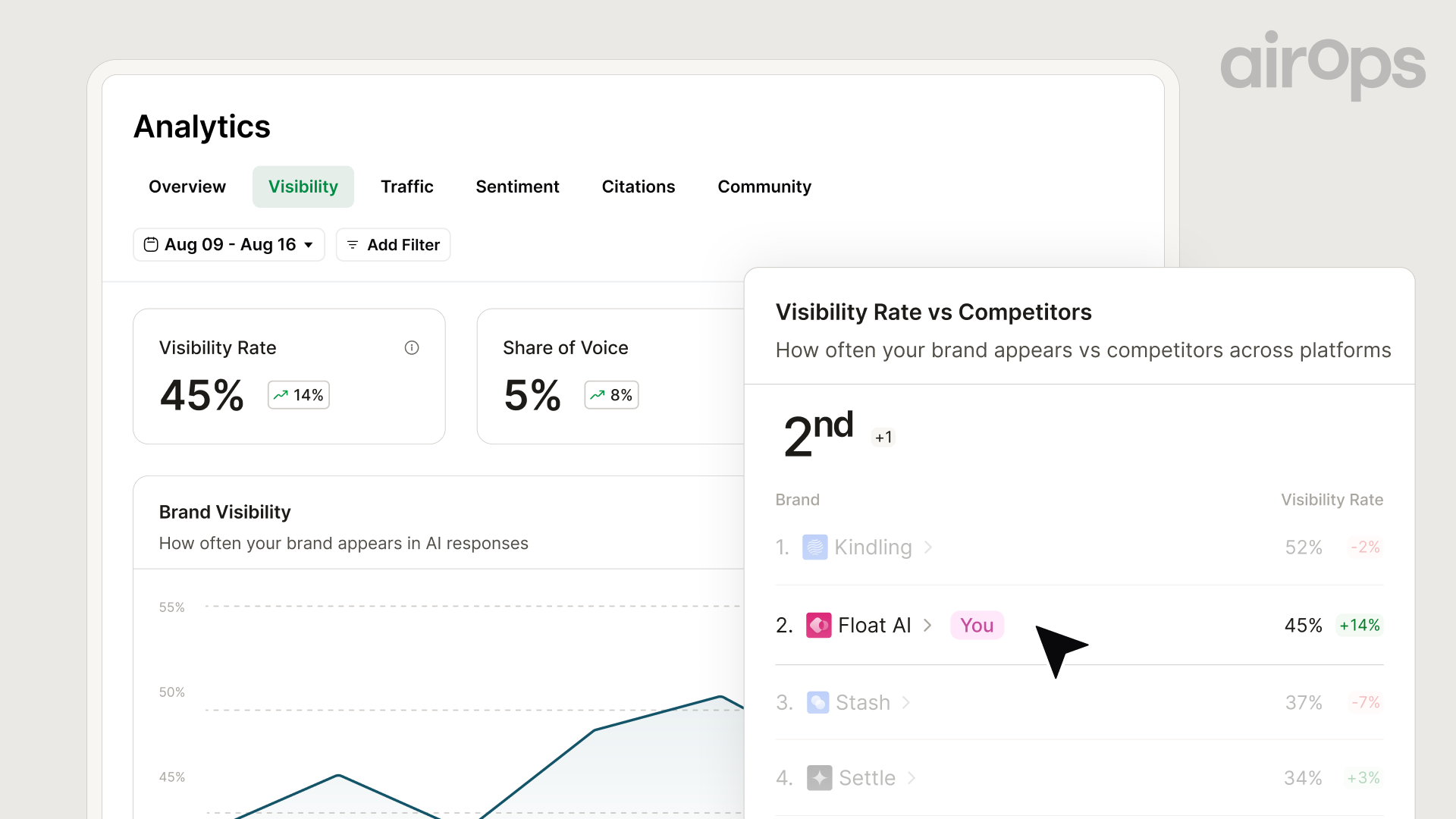
AirOps is the enterprise growth partner for AI search and AEO, built to close the gap between insight and execution. Most tools stop at generating text or surfacing recommendations. AirOps connects your data directly to automated workflows. For teams that want to measure AI search performance and actively win it through programmatic action and large-scale content operations, AirOps is the strongest choice on this list.
AirOps is the partner for this work, not just software to log into: the platform, the media mix, and a hands-on team together, building and running the strategy alongside yours and tying it back to pipeline and revenue.
 Key features
Page360: A unified data layer that combines SEO metrics from Google Search Console (GSC), AI search signals, and Google Analytics 4 (GA4) engagement data to surface high-impact refresh opportunities in one view.
Playbooks: Customizable automation templates that handle research, drafting, and optimization with configurable Human Review checkpoints for quality control at every stage.
Quill: An AI writing assistant that generates high-quality content aligned with your brand voice and SEO requirements.
Offsite Capabilities: Tools to discover and influence third-party citations, across Reddit threads, publisher sites, and other domains, that drive AI assistant responses.
Internal Linking: Automated internal link analysis and recommendations that surface linking gaps across your content library, a capability Frase does not offer.
Brand Kits: Deep governance features that ensure every AI-generated output reflects your actual brand voice, style, and product positioning.
Grids: A collaborative workspace for running Playbooks in bulk and managing content operations across teams at scale.
Best for
Growth leaders and Content Directors who need to scale high-quality, on-brand content production and systematically improve visibility in ChatGPT, Perplexity, and Google AI Overviews.
Pros
Turns insights directly into automated action via workflows
Unified view of SEO and AI metrics eliminates data silos
Scalable Grid interface handles bulk operations without friction
Strong governance controls keep brand consistency intact at volume
Flexible pricing that grows with your team's needs
Cons
Requires a shift in mindset from "writing tool" to "content engineering platform"
More than a solo freelancer needs for basic writing tasks
Pricing
Sales-led pricing
Paid plans scale by team size and usage
2. Search Atlas
Search Atlas positions itself as an all-in-one platform focused on doing rather than auditing. Its OTTO SEO agent deploys fixes directly to websites, aiming to replace fragmented marketing stacks with a single dashboard.
Key features
OTTO SEO: An autonomous agent that scans websites and executes optimizations like meta tag updates and schema injection.
Content Genius: A semantic SEO suite using AI microagents for research and drafting.
LLM Visibility: Tracks brand mentions and sentiment across major AI models.
GBP Galactic: Automation tools for managing Google Business Profiles.
Best for
Agencies and multi-brand enterprises looking to automate technical fixes and content production at high volume without heavy developer reliance.
Pros
Direct execution of technical fixes via pixel installation
Consolidates SEO, PPC, and content tools into one platform
Strong agency-focused features including white-labeling
Cons
Execution depends on a company-specific pixel, creating platform dependency
User reviews flag inconsistent support responsiveness
Pricing
Starter: $99/mo
Growth: $199/mo
Pro: $399/mo
Agency: $999/mo
3. Botify
Botify is an enterprise platform built to ensure large websites get crawled, rendered, and indexed by both search bots and AI agents. For sites with millions of pages, it provides a depth of technical infrastructure that content-focused platforms can't match.
Key features
Unified Data Model: Combines crawl data, log files, and GSC metrics in one system.
Botify Activation: Uses PageWorkers and SpeedWorkers for automated implementation of SEO changes.
AI Visibility: Tracks brand presence across AI search platforms.
Botify Intelligence: Prioritizes tasks based on estimated business impact.
Best for
Large e-commerce or publisher sites where technical crawl budget and indexation are the primary bottlenecks.
Pros
Handles massive data volumes at petabyte scale
Automated execution bypasses engineering backlogs
Deep technical insights into crawl behavior
Cons
High cost puts it out of reach for smaller teams
Steep learning curve for new users
Pricing
Essential, Pro, Enterprise: Custom pricing (typically high)
Learn more about Botify alternatives.
4. seoClarity
seoClarity offers unlimited scale for data and analysis, positioning itself as a complete platform for enterprise data, insights, and execution. It removes artificial limits on crawls and keywords, which can be a differentiator for large organizations that have hit ceilings with other tools.
Key features
Clarity Grid: Infrastructure capable of processing real-time analysis at enterprise scale.
Clarity ArcAI: A dedicated solution for AEO and GEO optimization.
ClarityAutomate: No-code execution of SEO changes and split testing.
Rank Intelligence: Daily and hourly rank tracking across global markets.
Best for
Large enterprises requiring unlimited keyword tracking, crawl capacity, and competitor comparisons without overage fees.
Pros
No artificial limits on data or users
Strong execution capabilities with ClarityAutomate
Dedicated client success support
Cons
UI can be complex and overwhelming
High entry price point
Pricing
Core Packages: Starting around $2,500/mo
Learn more about seoClarity alternatives.
5. Profound
Profound is a specialized analytics platform built exclusively for AEO. Its "consumer-first" data capture approach shows teams exactly what users see in AI assistant responses, making it one of the most precise measurement tools in this space.
Key features
Answer Engine Insights: Tracks visibility across 10+ engines, including regional AI models.
Agent Analytics: Server-side tracking of AI crawler behavior on your infrastructure.
Prompt Volumes: Demand intelligence based on real user conversations, grounded in actual usage data rather than modeled inputs.
Workflows: An automation layer for content audits and refreshes.
Best for
Teams that need a dedicated source of truth for AI visibility and want to track technical bot behavior directly on their servers.
Pros
Comprehensive coverage across AI engines
Server-side observability for bot traffic
High data integrity via front-end capture
Cons
Doesn't replace traditional SEO rank tracking
Operational setup can be time-consuming
Pricing
Starter: $99/mo
Growth: $399/mo
Enterprise: Custom pricing
See how AirOps and Profound stack up.
6. Scrunch
Scrunch combines AI monitoring with an Agent Experience Platform (AXP) that serves specially prepared content directly to bots. It gives teams visibility into how AI engines represent their brand and control over how content gets delivered to those systems.
Key features
Multi-Platform Monitoring: Tracks performance across 8+ AI engines.
Agent Traffic Intelligence: Distinguishes between training, indexing, and retrieval bots.
AXP: A delivery layer that serves AI-optimized content versions to agents.
Granular Data Access: API access to raw AI response text.
Best for
Marketers and agencies wanting to measure share of voice in large language models (LLMs) and technically optimize how their site is served to AI agents.
Pros
Unique delivery layer for serving optimized content to AI agents
Detailed traffic analysis that distinguishes between bot types
SOC 2 Type II compliance
Cons
Historical data access is limited to 90 days
Reporting features can be difficult for non-technical users
Pricing
Explorer: $100/mo
Growth: $500/mo
Enterprise: Custom pricing
See how AirOps and Scrunch stack up.
7. AthenaHQ
AthenaHQ is a GEO platform focused on action in AI search. It combines analytics with an execution layer for content optimization, with a specific emphasis on brand voice enforcement and citation probability scoring.
Key features
Athena Citation Engine (ACE): Scores content based on citation probability in AI responses.
Query Volume Estimation Model (QVEM): Estimates prompt volumes to help teams prioritize their GEO strategy.
Action Center: Automates content drafting and refreshing based on citation data.
Brand Voice Enforcement: Ensures AI-generated content stays on-brand.
Best for
Brands and agencies that need specific metrics on citation probability and estimated prompt volumes to prioritize their GEO strategy.
Pros
Specialized metrics for GEO (ACE and QVEM)
Integrated action layer for content updates
Rapid reporting capabilities suited for agency use
Cons
Credit-based pricing can lead to rapid consumption
API documentation is limited
Pricing
Self-Serve: Approximately $95–$295/mo (credit-based)
Enterprise: Custom pricing
Learn more about AthenaHQ alternatives.
8. Conductor

Conductor is a premium enterprise SEO and AEO platform that unifies company processes from insight to impact. It prioritizes high security, API-first data collection, and dedicated support, making it a strong fit for organizations where those factors drive platform decisions.
Key features
AI Search Performance: Tracks mentions and citations across major AI engines.
AI Topic Maps: Visualizes content opportunities using semantic clustering.
Technical Monitoring: Real-time alerting for site health issues.
Unified Data Engine: Connects SEO, content, and technical data in one place.
Best for
Large organizations, including Fortune 500 companies, that prioritize security (ISO 42001/SOC 2), dedicated support, and a unified view of SEO and content performance.
Pros
High security standards including ISO 42001 certification
Excellent customer support and training resources
Unified platform eliminates data silos
Cons
Rank tracking is weekly by default
Daily tracking costs extra
High cost barrier for smaller teams
Pricing
Enterprise: Custom value-based pricing
9. BrightEdge
BrightEdge is a legacy enterprise platform running on its massive Data Cube and DataMind AI engine. It focuses on real-time data and automation for global brands managing large, complex sites.
Key features
AI Catalyst: Tracks brand presence in generative AI engines.
BrightEdge Autopilot: Zero-touch automation for SEO fixes.
BrightEdge Instant: Real-time rank tracking.
Data Cube X: A massive proprietary dataset for research and discovery.
Best for
Global brands and agencies that need real-time data at scale and automated SEO capabilities across large site portfolios.
Pros
Proven scale for massive enterprise sites
Real-time data capabilities
Automated optimization features
Cons
UI can be complex and slow
Very high cost
Pricing
Enterprise: Custom pricing (typically high)
10. Adobe LLM Optimizer
Adobe LLM Optimizer is designed to shift marketing from rankings to relevance. It integrates deeply with the Adobe ecosystem to optimize content for AI discovery, which is a natural fit for organizations already running Adobe Experience Manager (AEM).
Key features
GEO Scoring: Benchmarks how AI systems present your brand across engines.
Projected Traffic Value: Attributes dollar value to AI visibility changes.
One-Click Implementation: Deploys content changes directly via AEM.
Off-Domain Analysis: Tracks third-party sources including Wikipedia.
Best for
Existing Adobe Experience Cloud customers who want seamless integration between their CMS and AI visibility optimization.
Pros
Seamless integration for AEM users
Financial attribution metrics connect AI visibility to revenue
Analyzes off-domain sources that influence AI responses
Cons
Opaque pricing and packaging
Significant deployment friction for teams not on Adobe's CMS
Pricing
Custom: Tied to the Adobe ecosystem
Learn more about Adobe LLM Optimizer alternatives.
11. Daydream
Daydream is a hybrid growth engine that combines proprietary software with expert-led execution. It focuses on programmatic SEO and product-led growth strategies for high-growth companies that need to build content at serious scale.
Key features
Programmatic SEO (pSEO): Scalable page generation from structured data.
Reviewer Agent: An AI agent for quality control and brand consistency.
Generative Engine Optimization: Optimizes content for AI visibility.
Expert-Led Execution: Hands-on support from growth leads included in the model.
Best for
High-growth startups at Series B and beyond, and enterprises looking for a done-with-you partner to build large programmatic SEO engines.
Pros
Proven ability to scale content volume
Advanced architecture for quality control at scale
Hybrid model ensures expert oversight throughout
Cons
No pricing transparency
No self-serve trial available
Pricing
Custom: Partnership model
Frase alternatives compared
How to choose the right Frase alternative
Pick a content optimization platform based on what's actually blocking your team right now:
Choose AirOps when execution at scale is your priority. Page360 and automated workflows turn insights into action.
Choose Botify or seoClarity when crawl budget is your real problem. Massive sites need their technical depth, and content platforms can't compete here.
Choose Search Atlas if you're running an agency. White-label reporting and multi-client automation make it built for your workflow.
Choose Conductor or BrightEdge when your enterprise-level needs, security, compliance, and dedicated support matter more than price.
Choose AirOps when AI search visibility is the priority. It tracks citations across ChatGPT, Perplexity, and Google AI Overviews, then turns those insights into content updates.
How Frase compares to Surfer SEO and Clearscope
Surfer SEO vs Frase is one of the most common comparisons in the content optimization space. Surfer focuses on real-time content scoring with deeper SERP analysis and more NLP term suggestions. Frase bundles research, briefs, and writing in one interface, which makes it faster for first drafts but shallower on optimization signals.
Clearscope charges a premium for its content grading accuracy, while Frase bundles research and writing at a lower price. Clearscope is stronger for teams that prioritize precision scoring. Frase is better for teams that want an all-in-one drafting workflow.
MarketMuse is another Frase-style optimizer built around topic modeling and content briefs. A MarketMuse vs Frase choice still leaves you without AI search tracking or automated execution, which is where AirOps pulls ahead.
Neither Surfer nor Clearscope offers AI search visibility tracking, automated content execution, or brand governance. Teams that need those capabilities alongside optimization find that platforms like AirOps cover the full workflow without stacking separate tools. In an AirOps vs Surfer SEO vs Frase comparison, AirOps is the only one of the three that pairs content optimization with AI search tracking and automated execution.
From content creation to content systems
Frase still works well for content creation. But most teams need more than a writing tool.
AI search has changed how visibility works. Growth teams need systems that connect insight to execution and show what actually drives performance across both search and AI assistants. The gap is no longer ideas. It's the ability to act on them consistently and at scale.
AI search has changed how visibility works. Growth teams need systems that connect insight to execution and show what actually drives performance across both search and AI assistants.
The gap is no longer ideas. It's the ability to act on them consistently and at scale. Whether you need an AI content brief for a single page or a full-funnel refresh, the right platform turns that clarity into published content.
The strongest alternatives solve that gap in different ways. Some focus on technical SEO. Others specialize in AI visibility analytics. Platforms like AirOps bring it together, helping teams connect data, prioritize opportunities, and execute updates across their entire content library in one system.
The teams that win in 2026 treat content as a system they continuously improve and scale over time. An AirOps vs Frase comparison comes down to one question: do you need a writing tool, or a system that acts on what it finds?
Book a demo to see how AirOps helps teams turn AI search insights into scalable content execution and measurable visibility gains.
Frequently Asked Questions
Can AirOps replace Frase?
Yes, for most teams. AirOps replaces Frase's briefing and writing tools with customizable Power Agents that give you more control over quality and structure. Where Frase focuses on document-level optimization, AirOps connects research, drafting, and publishing into end-to-end Workflows with built-in brand governance.
You also get Page360 and offsite citation tracking, which are capabilities Frase doesn't offer. If you're only using Frase for occasional writing tasks, they can work together. But if you're running content at scale, AirOps is the better consolidated choice.
Do I need a separate tool for AI search tracking?
Not if you pick a platform like AirOps, Search Atlas, or Conductor. Each includes AI visibility tracking, so you can monitor ChatGPT, Perplexity, and Google AI Overviews alongside your SEO metrics in one place. Add a specialized tool like Profound only if you need deep server-side bot analytics beyond standard tracking.
Is Frase better for small teams?
Frase's pricing works for freelancers and very small teams. The free plan gives you a starting point, and paid tiers begin at $15 per month.
But it hits a ceiling fast. You'll run into limits around governance, integrations, and workflow customization as you grow. AirOps scales with you, the pricing adjusts as your team expands, and you get the features you actually need to run content operations efficiently.
What's the difference between SEO and AEO tools?
SEO tools help you rank in Google's traditional search results. AEO tools help you get cited in AI assistant answers from ChatGPT, Perplexity, and similar platforms. The best modern platforms, including AirOps, handle both, so you can improve search rankings and AI visibility from one system instead of juggling separate tools.
Can I use AirOps to replace both Surfer and Frase?
Yes. AirOps combines research, writing, and execution in one system, so you can retire both Surfer and Frase instead of paying for two tools. You also get AI search tracking and brand governance that neither one offers.
Does Frase offer free GEO tools?
Frase's free plan focuses on content briefs and writing, not generative engine optimization (GEO) tools. For free GEO features, look at platforms built for AI search, because Frase does not track citations or AI visibility.
What's the best free Frase alternative?
AirOps is the best free Frase alternative for teams that want more than drafting. Its free tier covers research and content creation, then adds Page360 and AI search tracking that Frase's free plan does not include. If you only need occasional drafts, Frase's own free plan works as a starting point, though it caps documents quickly.
Does AirOps give better internal linking recommendations than Frase?
Yes. AirOps analyzes your whole content library and surfaces internal linking recommendations automatically, while Frase offers no internal link automation. That makes an AirOps vs Frase internal linking comparison straightforward for teams managing large sites.
AirOps for Frase alternatives
Frase helps you draft. AirOps helps you act, connecting research, writing, and execution across your whole content library in one system.
Book a demo to see how AirOps turns Frase alternative research into published, AI-ready content at scale.
Get the latest on AI content & marketing
