AirOps vs Clearscope: What's Right for AEO & GEO?
- AirOps is the growth platform for AI search, built to help enterprise teams move from LLM visibility data to published content inside a single AEO system.
- Clearscope is a content grading tool with Natural Language Processing (NLP) scoring and AI visibility tracking across three AI engines.
- AirOps fits enterprise content teams that need to act on AI visibility data at scale with workflow automation and brand governance built into Content Management System (CMS) publishing.
- Clearscope fits teams focused on individual page optimization and content quality scoring without needing production-level automation.
Your content team can see where AI search visibility is slipping. The harder question is what happens next: who builds the brief, who writes the refresh, who checks brand voice, and who publishes it before the window closes.
AirOps and Clearscope both help marketing teams track how their brand appears in AI answers. They approach the problem from different starting points and with different ambitions for what follows the data.
This guide compares AirOps vs Clearscope across features, architecture, pricing, and real-world fit so you can decide which platform matches your team's actual bottleneck in 2026.
AirOps vs Clearscope at a glance
AirOps gives your team a system that moves from visibility data to published content in a single platform. Clearscope gives your team a grading and monitoring tool that surfaces content quality signals. The practical difference shows up in time-to-value: AirOps shortens the gap between identifying an opportunity and shipping the fix, while Clearscope helps you diagnose content quality but leaves execution to other tools in your stack.
AirOps vs Clearscope: platform overview
AirOps is the growth platform for AI search, built to help enterprise marketing teams understand how their brand shows up in AEO, take action to improve it, and measure the results. It serves teams at companies who need a system that connects Answer Engine Optimization (AEO) insights to content production and performance measurement. Your team gets a platform that treats visibility data as the starting point for execution, not the endpoint.
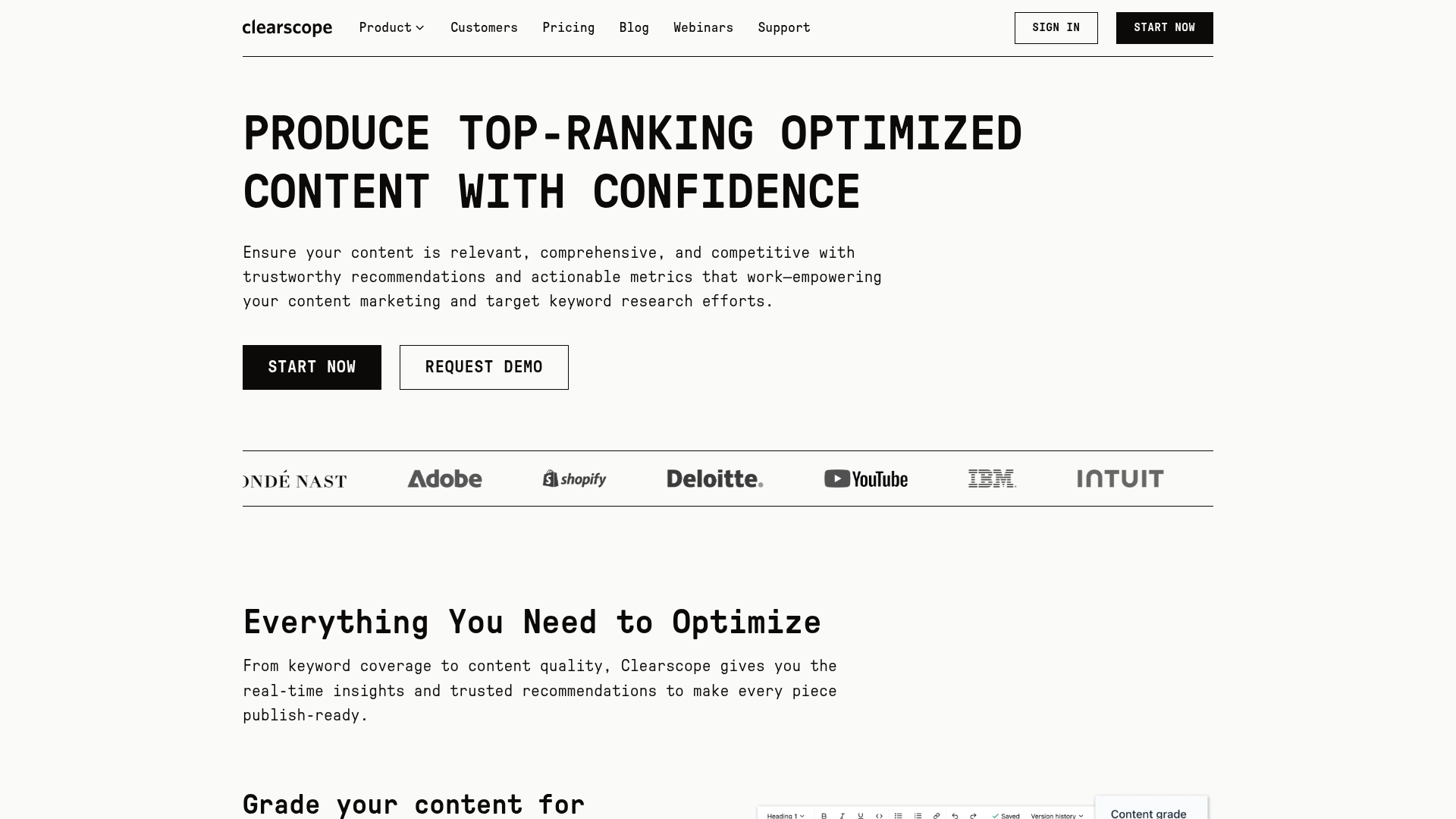
Clearscope is a content optimization and discoverability platform that helps teams grade individual pages against NLP-driven benchmarks and track brand visibility across AI search engines. It serves content teams that need a reliable quality-scoring system for individual articles and want to monitor how their brand appears in ChatGPT, Gemini, and Perplexity. Your team gets a grading tool with a monitoring module attached.
Core features: how AirOps and Clearscope stack up
Both platforms track AI search visibility, but they diverge sharply in what happens after the data lands. AirOps connects insights to execution through automation and governed publishing. Clearscope focuses on content scoring and visibility monitoring, leaving production workflows to the rest of your stack.
AirOps features
- Autonomous AI agent
- Quill is the execution arm of the AirOps system, running Playbooks across content creation and refresh cycles. Your team sets the strategy. Quill runs the execution.
- Your content team reclaims hours spent on manual refresh cycles and brief creation, freeing them to focus on strategy and editorial judgment.
- Clearscope doesn't offer an autonomous agent, so every action triggered by its data requires manual coordination across your team.
- Unified page-level view
- Page360 combines AI citation signals, Google Search Console (GSC) data, and Google Analytics 4 (GA4) engagement metrics in a single page-level view.
- Your team evaluates content performance across traditional search and AI search without toggling between dashboards or exporting spreadsheets.
- Clearscope's Expand module tracks AI visibility separately from its content grading, so your team stitches together the full picture manually.
- Prompt discovery
- Prompt Discovery surfaces the questions buyers are asking AI engines from four distinct intent sources, revealing demand signals your team can't find in traditional keyword tools.
- Your team builds content around the prompts that actually drive AI-generated answers, targeting visibility where buyers are already searching.
- Clearscope's Discover module focuses on topic research for traditional Search Engine Optimization (SEO) content rather than AI-specific prompt intent.
- Bulk operations
- Grids let your team process 1,000+ URLs at once in a spreadsheet-style interface where each row can trigger a full content workflow.
- Your team executes large refresh campaigns across entire site sections in hours instead of weeks, maintaining velocity without sacrificing quality.
- Clearscope processes pages individually through its Optimize reports, so scaling to hundreds of pages requires repetitive manual effort.
- Brand governance
- Brand Kits let your team define tone, persona, and writing rules as structured constraints that every workflow respects.
- Your team maintains voice consistency across dozens of writers and thousands of pages without relying on manual style-guide checks.
- Clearscope doesn't offer a brand governance system, so voice consistency depends on your team's editorial review process.
- AI connectivity
- AirOps MCP provides 35+ tools that connect to Claude and other AI assistants through the Model Context Protocol (MCP), making your brand data accessible wherever your team works.
- Your team uses AirOps data and workflows inside the AI tools they already rely on, removing context-switching between platforms.
- Clearscope doesn't offer MCP integration or external AI tool connectivity, keeping its data inside its own interface.
- Third-party visibility management
- Offsite manages third-party publisher placements to grow your brand's AI citation share across the sources Large Language Models (LLMs) trust most.
- Your team builds the external consensus signals that LLMs weight heavily when deciding which brands to cite, addressing visibility beyond your own site.
- Clearscope focuses exclusively on your owned content, leaving offsite mention building entirely outside its scope.
- Conversational AI assistance
- Quill provides conversational AI assistance within the AirOps platform, helping your team navigate data, build workflows, and troubleshoot without leaving the interface.
- Your team gets answers about their own data and processes in natural language, reducing the learning curve for new team members.
- Clearscope doesn't include an in-platform AI assistant for navigating its tools or data.
- Sub-query visibility
- Query Fan-outs reveal the sub-queries AI engines run behind each prompt, showing the hidden research process that shapes which sources get cited.
- Your team optimizes content for the actual queries driving AI answers, not just the surface-level prompt your buyers type.
- Clearscope also surfaces AI Source Queries, so both platforms address this signal. AirOps connects these insights directly to execution workflows.
- Closed-loop execution
- Every content action maps to a visibility signal, so your team can trace which updates moved which metrics and prioritize the next round of work based on evidence.
- Your team builds a compounding feedback loop where each cycle of execution produces better data for the next, improving accuracy over time.
- Clearscope monitors visibility separately from content actions, so connecting specific updates to specific outcomes requires manual correlation.

Clearscope features
- Expand (AI visibility tracking)
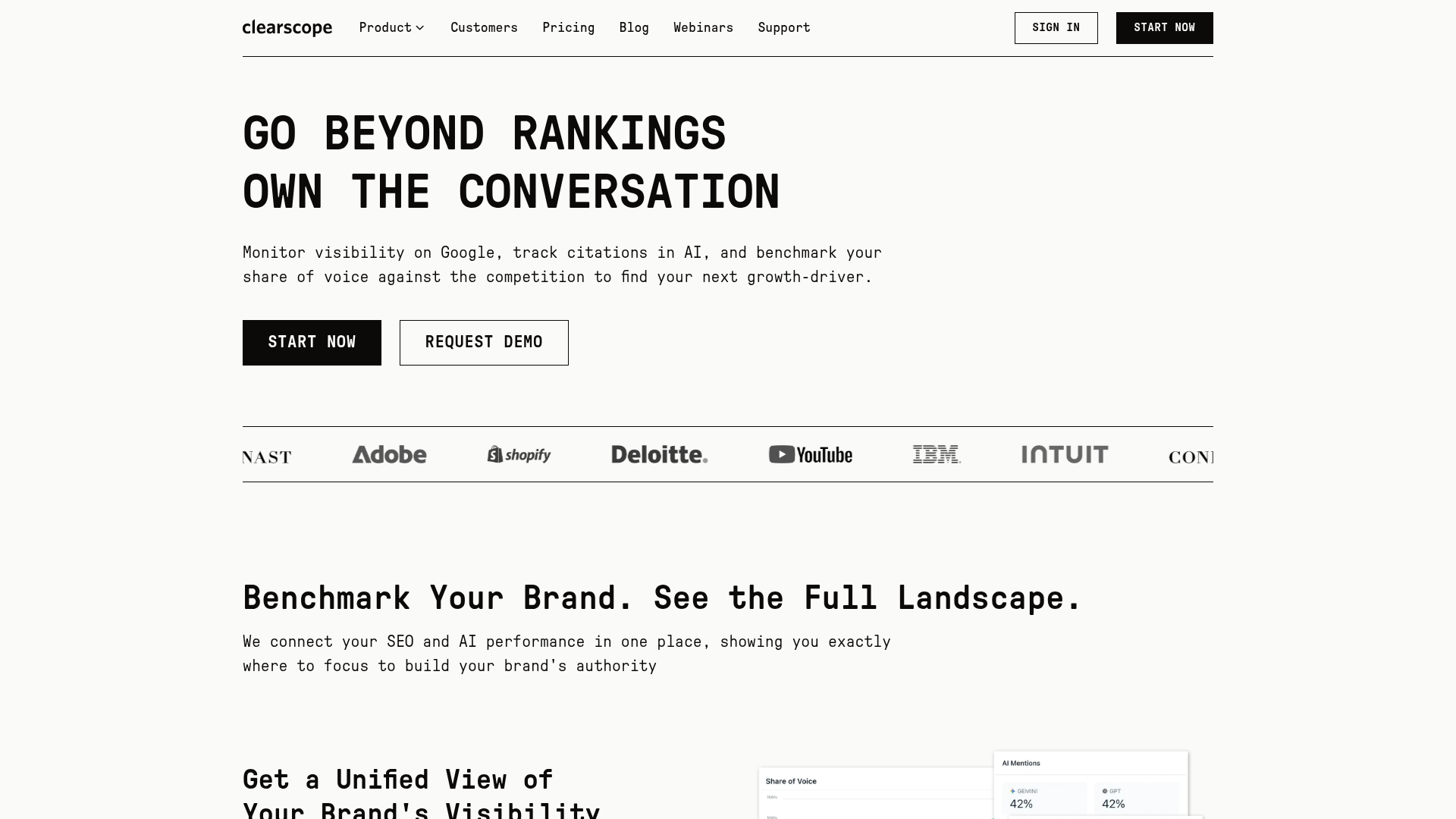
- Expand monitors your brand's visibility across three AI engines: ChatGPT, Gemini, and Perplexity. It tracks how often your brand appears in AI-generated answers for your tracked topics.
- Your team gets a baseline view of AI visibility performance, helping you identify where your brand is cited and where it's absent.
- Expand provides a focused monitoring view for teams that need AI visibility data without a full execution platform.
- Optimize (content grading)
- Optimize grades your content against NLP-driven benchmarks, scoring each page from A+ to F based on keyword coverage, readability, and topic relevance.
- Your team gets clear, repeatable quality signals that writers and editors can use to improve individual pages before publishing.
- The grading system provides a consistent quality bar that helps your team maintain content standards across multiple writers.
- Discover (topic research)
- Discover surfaces topic clusters and keyword opportunities based on search volume, competition, and content gaps in your existing coverage.
- Your team identifies new content opportunities and builds editorial calendars grounded in search demand data.
- The research tools help your team plan content strategy, though execution still requires separate writing and publishing workflows.
- Write (AI drafting)
- Write generates first drafts using AI based on your selected topic and target keywords, producing content that starts closer to your Optimize score targets.
- Your team accelerates the drafting phase for individual articles, though each draft still requires manual editing and brand voice review.
- The AI writing feature works on a per-article basis, making it practical for smaller content programs.
- Protect (content monitoring)
- Protect monitors your published pages for ranking changes, content decay, and competitive shifts, alerting your team when pages need attention.
- Your team catches declining pages before they fall out of ranking positions, reducing the risk of losing established traffic.
- The monitoring system provides early warning signals, though taking action on those signals requires separate tools and processes.
The feature split comes down to what happens after your team spots an opportunity. AirOps gives you the automation and publishing tools to act on insights inside the same platform. Clearscope gives you strong diagnostic signals but expects your team to handle execution through the rest of your marketing stack.
Product architecture overview: AirOps vs Clearscope
AirOps is built as an operating system for content operations, connecting data collection and prioritization to execution and measurement. Clearscope is built as a diagnostic and monitoring tool, designed to sit alongside your existing production stack and provide quality signals at the page level.
Data collection and portability
Both platforms collect data about how content performs, but they build different pictures with it.
- Data Sources and Integrations: AirOps connects to GSC, GA4, CMS platforms, and AI search engines to build a unified page-level view through Page360. Clearscope relies on its own NLP analysis and monitors three AI engines (ChatGPT, Gemini, and Perplexity) but doesn't pull first-party analytics data from your Google accounts. Your team fills that gap with manual exports or separate dashboards.
- Data Accuracy and Freshness: AirOps combines first-party performance data with AI citation signals, giving your team a view grounded in actual clicks, sessions, and engagement alongside AI visibility metrics. Clearscope's content grades update when you re-run a report, and its AI visibility data refreshes based on your tracked topic cadence. The distinction matters when your team needs to make fast decisions: first-party data tells you what's happening now, while periodic rescans tell you what was happening at the last check.
- Data Portability: AirOps data flows into external tools through MCP, API connections, and CMS integrations, making it accessible in Claude, project management platforms, and publishing systems. Clearscope data lives primarily inside its own interface, with Google Docs and WordPress integrations for content editing but limited options for routing data into other operational tools.
AirOps treats data as the fuel for automated execution. Clearscope treats data as a diagnostic signal your team acts on manually.
Prioritization of opportunities
Both platforms help your team decide which pages deserve attention, but they prioritize through different lenses.
- Decision Engines and Scoring: AirOps categorizes opportunities into action types like creation and refresh, then assigns impact scores based on combined signals from organic search and AI visibility. Clearscope scores individual pages from A+ to F based on NLP keyword coverage, giving your team a quality benchmark but leaving the prioritization of which pages to fix first to your own judgment.
- AI-powered Recommendations: AirOps surfaces specific, actionable recommendations tied to execution: which pages to refresh and what content to create. Clearscope's recommendations center on content improvements within individual pages, suggesting terms to add or topics to cover for a higher grade.
- Integration of Signals: AirOps combines AI citations, brand mentions, organic traffic, and engagement data into a single prioritization view. Clearscope keeps its AI visibility data (Expand) and content grading data (Optimize) as separate modules, so your team cross-references between them to build the full picture.
AirOps prioritizes based on combined business signals and tells your team what to do next. Clearscope prioritizes based on content quality scores.
Workflow building and automation
This is where the two platforms diverge most sharply.
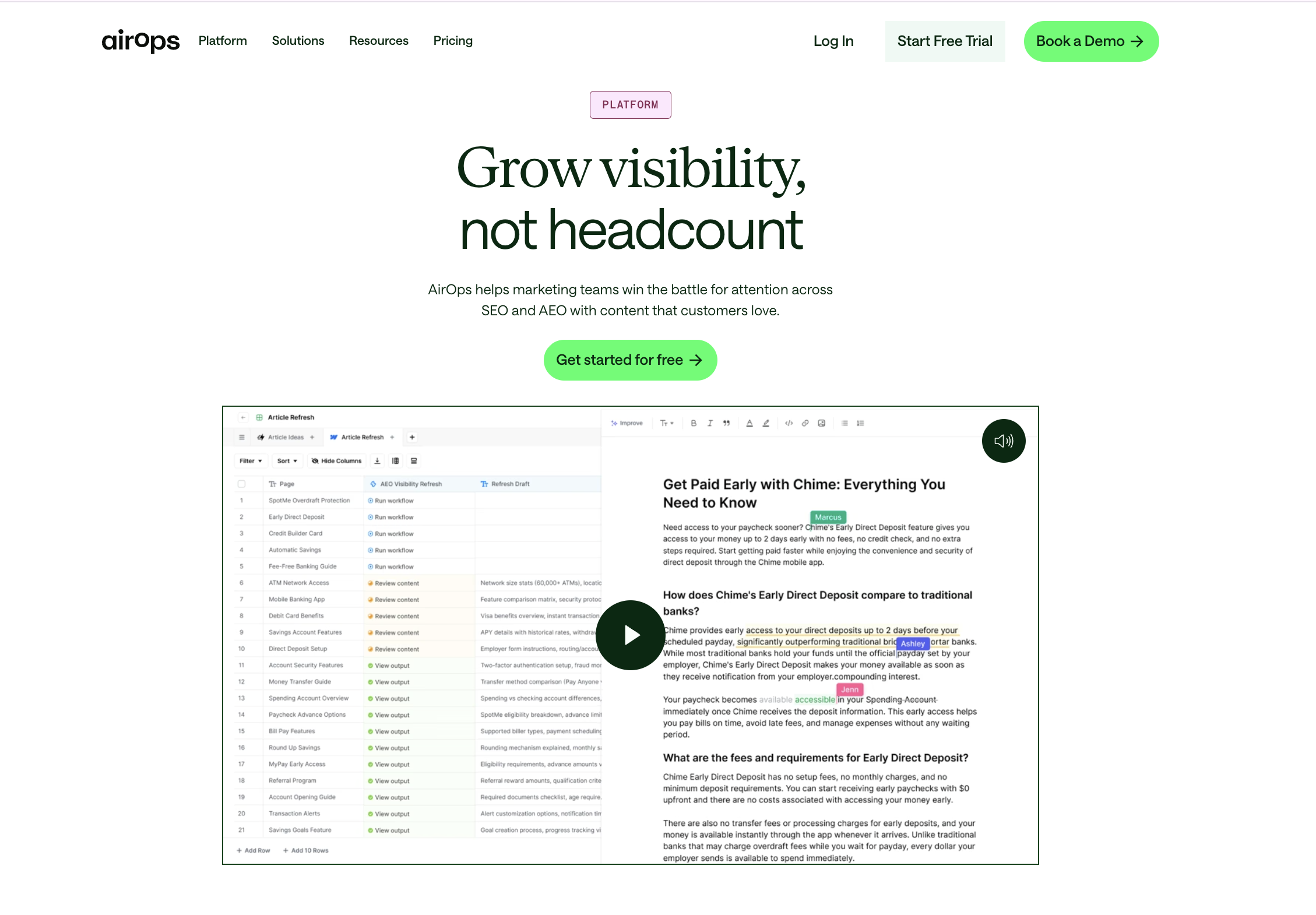
- Workflow/Playbook Builder Capabilities and Flexibility: AirOps provides a visual Playbook builder where your team designs custom multi-step pipelines for different content types, audiences, and processes. Clearscope doesn't include a workflow builder; its workflow is a fixed sequence of topic research, content drafting, optimization scoring, and manual publishing.
- Workflow Automation Features: AirOps automates the full production chain from analysis through brief generation, draft creation, brand voice review, editorial routing, and CMS publishing. Clearscope automates content grading when you paste or connect a document, but every step before and after grading runs manually through your team's existing tools.
- Workflow Conditional Logic and Triggers: AirOps workflows support branching logic, conditional steps, and triggers based on performance thresholds or schedule cadences. Clearscope doesn't offer conditional logic or automated triggers; the platform responds when your team initiates an action.
- Ease of Building vs. Complexity of What Can Be Built: AirOps requires initial setup time to configure workflows, Brand Kits, and integrations, but once configured, those systems handle execution at scale. Clearscope is simpler to start using because its fixed workflow requires no configuration, though that simplicity limits what your team can automate as content programs grow.
AirOps is built for teams that want to encode their processes into automated systems. Clearscope is built for teams that want a quality check within an existing manual workflow.
Governance and brand control
Scaling content production without brand governance creates a different kind of problem: more content, but inconsistent voice and quality.
- Brand Voice and Governance Features: AirOps enforces tone, persona, and editorial standards through Brand Kits, which apply as constraints across every workflow and agent output. Clearscope doesn't include brand governance features; content voice consistency depends on your team's editorial review process and separate style guides.
- Knowledge Bases and Brand Kits: AirOps lets your team upload proprietary knowledge, configure product line positioning, define audience personas, and set writing rules that workflows reference automatically. Clearscope doesn't offer Knowledge Bases or structured brand context; its AI drafting pulls from general web knowledge rather than your company's specific information.
- Customization vs. Templates: AirOps allows deep customization across brands, content types, and regions, making it practical for enterprise teams managing multiple product lines or markets. Clearscope provides a consistent but fixed experience: the same grading methodology and writing interface applies to all content, which is simpler but less flexible for complex brand architectures.
AirOps governs content at the system level, making brand consistency a platform constraint rather than a manual review step. Clearscope leaves governance to your team's editorial process.

Integrations and ecosystem
AirOps connects to the systems content teams use for production, analytics, and publishing. Clearscope connects to the tools your team uses for individual content editing.
AirOps integrations
- CMS platforms (WordPress, Webflow, Contentful, Shopify, Ghost, Sanity, ContentStack): Your team publishes refreshed and new content directly from AirOps workflows without copying between tools or managing separate publishing steps.
- Analytics (GSC, GA4): Page360 pulls first-party performance data into the same view as AI citation signals, giving your team a full picture of how each page performs across both channels.
- MCP (Claude, AI assistants): AirOps data and tools are accessible inside Claude and other AI assistants through 35+ MCP tools, letting your team work with brand data wherever they already operate.
Clearscope integrations
- Google Docs: Your team uses the Clearscope sidebar inside Google Docs to check content grades while writing, keeping the optimization feedback visible during editing.
- WordPress: The WordPress integration connects Clearscope reports to published pages, allowing your team to track content grades for live articles.
AirOps treats integrations as production infrastructure, connecting data, execution, and publishing into a single operational flow. Clearscope treats integrations as editing conveniences, keeping the writing experience connected to its grading system.
Platform depth and scalability
Enterprise content teams need platforms that handle growth in content volume, team size, and operational complexity.
- Architectural Breadth and Depth: AirOps supports the full content operations lifecycle from AI visibility monitoring through prioritization, workflow automation, brand governance, bulk operations, CMS publishing, and measurement. Clearscope supports content research, quality grading, AI visibility monitoring, and content protection; the remaining operational steps live in other tools.
- Scalability Across Teams and Content Volume: AirOps includes unlimited seats on Pro plans and handles bulk operations across 1,000+ pages at once through Grids, making it practical when your team of five to twenty people works across a large content library. Clearscope includes unlimited users on all plans and processes pages individually, so scaling to hundreds of pages means running hundreds of separate optimization reports.
- Long-Term Extensibility and Future-Proofing: AirOps monitors five AI engines (ChatGPT, Gemini, Perplexity, Google AI Mode, and Google AI Overviews) and connects to new data sources through its MCP infrastructure. Clearscope monitors three AI engines (ChatGPT, Gemini, and Perplexity) and adds new modules like Localize and Linking as the platform evolves.
AirOps is built to serve as the operating system for content teams that need depth, scale, and extensibility. AirOps research shows that pages not refreshed within three months are more than three times as likely to lose AI citations. Clearscope is built to serve as a reliable quality and monitoring tool within a broader stack of specialized tools.
AirOps vs Clearscope: out-of-the-box services and solutions
Both platforms offer entry-level value quickly, but the shape of that value differs. AirOps gets your team producing content through pre-built workflows within the first week. Clearscope gets your team grading and improving individual articles on day one.
Clearscope gets you grading content faster because there's less to configure. AirOps takes more setup time upfront, but once your workflows and Brand Kits are configured, your team operates at a velocity that manual processes can't match.
AirOps vs Clearscope: Support, resources, and community
AirOps invests in hands-on implementation support and a growing Content Engineering community. Clearscope invests in a clean self-service experience with dedicated account management on higher tiers.
Execution and training
- Implementation Support and Training: AirOps provides dedicated onboarding with implementation support, workflow configuration assistance, and training for enterprise accounts. Clearscope provides dedicated account managers on Business plans and above, with self-serve onboarding resources for Essentials users.
- Managed Services vs. Self-Service Approaches: AirOps offers managed services for enterprise teams that want hands-on help configuring workflows, Brand Kits, and content operations. Clearscope follows a primarily self-service model with account management support on higher tiers; your team configures and operates the platform independently.
Ease of use and onboarding
- Onboarding Process: AirOps onboarding involves configuring Brand Kits, connecting integrations, and building initial workflows, typically guided by the AirOps team for enterprise accounts. Clearscope onboarding is lightweight: connect your Google Docs account, run your first Optimize report, and you're producing usable output within minutes.
- Ease of Use: Clearscope's interface is intentionally simple: run a report, write content, check your grade. AirOps has a broader surface area because it covers more of the content operations lifecycle, though Copilot and pre-built Playbooks reduce the learning curve.
Support and resources
- Resources: AirOps offers an academy, documentation, webinars, and the Content Engineering Certification for teams building AI-driven content operations. Clearscope provides a help center, blog, and educational content focused on content optimization best practices.
- Community: AirOps invests in the Content Engineering community through its certification program, the Champions program, and the AirOps Builders Slack community. Clearscope doesn't operate a dedicated customer community forum.
- Customer Support: AirOps provides Slack-based support, dedicated customer success managers, and enterprise support tiers. Clearscope provides email-based support with dedicated account managers on Business and Enterprise plans.
AirOps vs Clearscope: pricing and value comparison
The two platforms use different pricing structures that reflect their different scopes. AirOps prices on tasks and capabilities. Clearscope prices on tracked topics and page limits.
Total cost of ownership extends beyond the subscription price. Clearscope's monthly fee is straightforward, but your team still needs separate tools for workflow automation, CMS publishing, brand governance, and cross-channel analytics. AirOps consolidates those capabilities into a single platform investment, potentially reducing the number of tools in your stack and the coordination cost between them.
Real-world: when to use each platform
Both platforms serve content teams, but they fit different operating models and team structures.
AirOps
Workflow fit: AirOps fits your team when you manage ongoing content programs across hundreds or thousands of pages and need to move from insight to published content without manual handoffs between tools. It's built for refresh cycles, new page creation, offsite mention building, and AI visibility optimization that runs continuously rather than in one-off campaigns.
Industry fit: AirOps serves enterprise companies with $50M or more in revenue across SaaS, fintech, e-commerce, and education, rated 4.7 out of 5 on G2. It's strongest when your team has five or more content producers who need shared workflows, brand governance, and visibility tracking across both traditional search and AI search.
Clearscope
Workflow fit: Clearscope fits your team when you produce content on a per-article basis and want reliable content quality scoring for each piece before publishing. It works well as a writing companion inside Google Docs, giving editors real-time NLP feedback during the drafting process.
Industry fit: Clearscope serves content teams across many industries, with strong adoption among media companies, SaaS brands, and agencies that need consistent content quality scoring. It's strongest when individual contributors write and optimize articles independently without needing automated production pipelines.
AirOps vs Clearscope: strengths and limitations
AirOps
Strengths:
- Full-loop execution: AirOps connects visibility data to automated production in a single platform, so your team doesn't lose momentum between discovering an opportunity and shipping the fix. Chime saw 3x AI citations in 4 weeks and 89% time reduction per refresh.
- AI search depth: AirOps monitors five AI engines including Google AI Mode and Google AI Overviews, covering the platforms where your buyers are increasingly making decisions. Carta reached 7x AI citations and grew content velocity from 5 to 20 pieces per quarter.
- Scale without headcount: Grids and Workflows let your team execute at a volume that would otherwise require hiring, making it practical to maintain large content libraries with lean teams. Webflow achieved 5x refresh velocity and 40% traffic uplift.
Limitations:
- Setup investment: AirOps requires upfront time to configure Brand Kits, workflows, and integrations before your team sees the full value of the platform.
- Learning curve: The platform's breadth means new team members need time to learn workflow building, Grid operations, and the governance system.
- Best at scale: Your team may find the platform's automation capabilities more than you need when managing fewer than 50 pages.
Clearscope
Strengths:
- Immediate usability: Clearscope's interface is clean and focused, letting writers start grading content within minutes of signing up without configuration or training.
- Consistent quality benchmark: The A+ to F grading system gives your team a shared language for content quality that's easy for writers, editors, and stakeholders to understand.
- Proven customer base: Clearscope serves well-known brands including Intuit, Adobe, Shopify, and Conde Nast, demonstrating its value for content quality optimization.
Limitations:
- No execution automation: Clearscope surfaces quality signals and monitoring data, but every action step from briefing to publishing requires separate tools and manual coordination.
- Limited AI engine coverage: Clearscope tracks three AI engines (ChatGPT, Gemini, and Perplexity) and doesn't cover Google AI Mode or Google AI Overviews, which are increasingly important for enterprise visibility.
- Page-by-page scaling: The platform processes content individually, so your team managing hundreds of pages faces repetitive manual effort that compounds as content libraries grow.
Bottom line
AirOps is the platform for enterprise content teams that need to connect AI visibility data to published content with brand governance built in and every action tied to a measurable outcome. Clearscope is the tool for teams that need reliable content quality grades and AI visibility monitoring within a broader stack of production tools.
Choose AirOps if:
- You manage hundreds of pages and need to execute content refreshes, new page creation, and offsite mention building within the same platform.
- Your team needs brand governance, workflow automation, and CMS publishing built into the same system where you track AI visibility.
- You're accountable for AI search visibility across five engines and need a platform that connects every content action to a measurable outcome.
Choose Clearscope if:
- Your team produces content on a per-article basis and wants a reliable NLP grading system to maintain consistent quality across writers.
- You need a focused monitoring tool for AI visibility across ChatGPT, Gemini, and Perplexity without needing production automation.
- Your content stack is already established and you want a quality check that plugs into Google Docs and WordPress without replacing existing workflows.
Why your team chooses AirOps
Clearscope tells you how individual pages score and whether your brand appears in three AI engines. It does that well, and your team will find it reliable when you need a focused grading tool. The tradeoff is everything that happens between the score and the published improvement: you still coordinate briefing, writing, and publishing across separate tools.
AirOps closes that gap. Your team moves from AI visibility insight to published content inside a single platform, with brand governance enforced at every step and performance data flowing back to inform the next cycle. Docebo saw +25% sessions from AI discovery, 50% cost reduction, and 2x velocity after adopting AirOps. That's the difference between a monitoring tool and an operating system for content.
Book a call to see how AirOps connects your AI visibility data to published content your team can measure.
Frequently Asked Questions
FAQs
Does AirOps replace Clearscope?
AirOps covers a broader scope than Clearscope, including AI visibility monitoring, workflow automation, brand governance, bulk operations, and CMS publishing. Your team can handle content quality needs through Brand Kits and Workflow-based quality checks. Many teams that switch find they no longer need a separate grading tool because AirOps governs quality at the system level.
Which platform tracks more AI search engines?
AirOps monitors five AI engines: ChatGPT, Gemini, Perplexity, Google AI Mode, and Google AI Overviews. Clearscope monitors three: ChatGPT, Gemini, and Perplexity. Google AI Mode and Google AI Overviews are increasingly important for enterprise visibility because they're integrated directly into the search experience your buyers already use.
Can Clearscope automate content production?
Clearscope doesn't include workflow automation, CMS publishing, or bulk operations. It generates AI drafts one at a time through its Write module and grades content through Optimize reports. Every step from briefing through publishing runs manually through your team's existing tools. AirOps automates the full production chain from analysis through published content.
How does pricing compare for growing teams?
Both platforms include unlimited users, so team size doesn't directly affect pricing. Clearscope's entry point is $129/mo for the Essentials plan with 20 tracked topics and 50 pages. AirOps offers a free Solo plan to start with 20K tasks. The key pricing difference is what's included: Clearscope charges for grading and monitoring capabilities, while AirOps includes insight, execution, governance, and measurement in a single platform investment.
Do both platforms have query fan-out visibility?
Yes. Both AirOps and Clearscope surface the sub-queries (fan-outs) that AI engines run behind each prompt. AirOps calls them Query Fan-outs, and Clearscope calls them AI Source Queries. The difference is what happens next: AirOps connects those fan-out insights to automated workflows, so your team can optimize content for the specific sub-queries driving citations. Clearscope surfaces the data for your team to act on manually.
What kind of team gets the most value from AirOps vs Clearscope?
AirOps delivers the most value for enterprise content teams managing large content libraries who need to move from insight to published content quickly and consistently. Clearscope delivers the most value when your team produces content on a per-article basis and wants a reliable quality grading system without needing production-level automation. The deciding factor is whether your bottleneck is understanding content quality or executing improvements at scale.
Does AirOps work better with AI search engines than Clearscope?
AirOps tracks more AI search engines than Clearscope, monitoring five (ChatGPT, Gemini, Perplexity, Google AI Mode, and Google AI Overviews) against Clearscope's three. It also connects that visibility data to automated refresh and publishing, so your team acts on AI search gaps instead of only tracking them.
How does AirOps compare to Clearscope for content optimization?
AirOps optimizes content across the full production chain, connecting AI search insight to briefs, drafts, brand governance, and CMS publishing in one system. Clearscope optimizes individual pages with NLP letter-grade scoring, then leaves briefing, writing, and publishing to your other tools. The practical difference is whether you optimize one page at a time or run content optimization at scale.
Which platform is best for content quality scoring, AirOps or Clearscope?
AirOps enforces content quality through Brand Kit governance and Workflow-based Content Review, applying your standards across every page and writer automatically. Clearscope scores individual pages from A+ to F against NLP benchmarks, which suits teams that want a per-article quality grade. Choose AirOps when you need quality enforced across production at scale, and Clearscope when you want a standalone grading tool.
Get the latest on AI content & marketing
