- AI visibility hinges on citations and mentions, not on SERP rankings alone
- Direct answers in clear Q&A formats make your content easier for AI systems to extract
- Consistent brand descriptions across channels help models recognize and categorize you correctly
- Original data and research give AI engines a reason to cite your brand as the source
- Accessible, crawlable pages determine whether AI platforms can use your content at all
- Ongoing tracking and updates protect visibility as citations shift over time
Your brand can rank #1 on Google and still disappear when someone asks ChatGPT for a recommendation.
AI answer engines now generate responses directly from web content. The brands they mention gain visibility without users ever clicking a link.
This guide explains the repeatable actions that help you show up more often in AI answers.
You will learn how to structure content for AI extraction, build the authority signals AI systems trust, confirm crawlers can access your pages, and measure whether your work produces results.
Partners like AirOps aggregate AI search signals — citations, mentions, prompt coverage — for content investment prioritization.
Why brand visibility in AI search matters now
Millions of people now use ChatGPT, Perplexity, and Google Gemini as their first stop for information. McKinsey & Co research shows 44% of users prefer AI answers over traditional search results. Brand visibility in AI search is how often, and how favorably, AI answer engines cite or mention your brand when someone asks a category question.
When someone asks an AI assistant a question, the system pulls from web content to craft a response. The brands mentioned inside that answer gain attention and credibility even if no one clicks through.
Traditional SEO focused on ranking pages. AI Search visibility focuses on getting cited or mentioned when AI systems answer questions. You can hold the top Google result and still stay invisible in AI answers if your content does not support citations.
To improve visibility, brands need to become authoritative, consistently described entities that appear across high-quality, publicly accessible sources.
AI brand visibility depends on whether AI systems can find, trust, and extract your content when answering user questions.
Brands that appear in both citations and mentions earn compounding visibility over time.
Only 16% of brands systematically track AI search performance today, leaving a wide gap for early movers.
Citations vs. mentions in AI answers
Not every appearance in an AI answer works the same way. Understanding the difference between citations and mentions helps you set the right goals.
What is an AI citation?
A citation is a linked reference to a source that the AI used to generate its answer. In tools like Perplexity, citations appear as footnotes or inline links that users can click to verify information.
Citations drive referral traffic and prove your page supplied the answer.
What is an AI brand mention?
An AI brand mention happens when the AI names your company inside the answer text without necessarily linking to your site.
For example, if a user asks, "What is the best project management tool?" and the AI responds, "Asana works well for team collaboration," that counts as a mention.
Why both citations and mentions drive visibility
Citations send direct traffic and validate your authority
Brand mentions increase brand recall and shape buying decisions
Both signals influence how often your brand appears in future answers
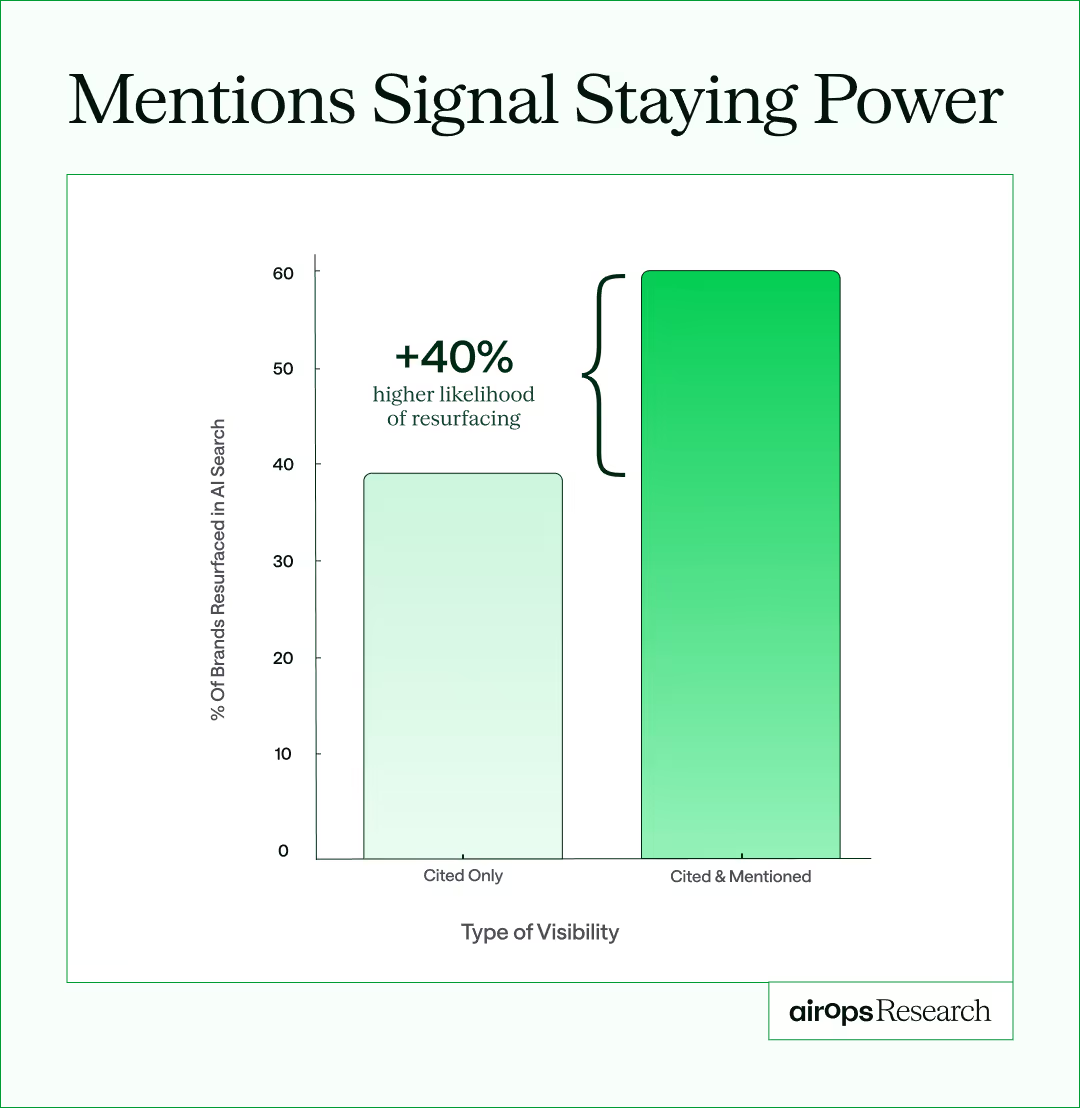
Brands that earn both citations and mentions are 40% more likely to stay visible across multiple AI responses than brands that rely on citations alone.
Jeremy Moser, CEO at uSERP, summarizes the dynamic clearly:
"What other people say about you and your brand and your solution is the single best way to drive increased share of voice right now." — Jeremy Moser
What research reveals about AI brand visibility
Several patterns emerge from studying how AI systems select sources for their answers. Understanding these patterns is the first step toward improving your LLM brand visibility and brand discoverability across ChatGPT, Perplexity, and Gemini.
Citation drift and volatility patterns
AI systems frequently rotate which sources they cite. You may appear for a query today and disappear tomorrow, even if the question stays identical.
This pattern, called citation drift, means visibility changes constantly. A single snapshot never tells the full story.
AirOps research shows only 30% of brands stay visible from one AI answer to the next, and just 20% remain visible across five consecutive runs. Visibility in AI Search is inherently unstable.
You need ongoing monitoring rather than one-time checks.
The first-occurrence effect
Brands that already appear frequently across authoritative sources tend to surface more often in AI answers.
Established brands benefit because AI training data contains more references to them.
Newer brands need presence across multiple trusted sites instead of one channel.
Traditional rankings still help, but they do not guarantee success
AI systems rely on many of the same signals as traditional search engines, but they weigh them differently.
Research from Seer Interactive found clear correlations between search performance and AI mentions:
Google rankings: 0.65 correlation
Bing rankings: 0.56 correlation
Domain authority: 0.25 correlation
Backlinks: 0.10 correlation
The takeaway is simple: strong search visibility improves your odds of appearing in AI answers, but it doesn't secure placement on its own. AI systems also prioritize how clearly your content answers questions and how consistently your brand appears across trusted sources.
How to structure content for AI citations
Formatting matters as much as authority. AI search optimization starts with small structural changes that make your pages far easier for AI systems to extract and cite.
1. Use clear question-and-answer formats
Write headers as explicit questions and follow them with direct answers.
Instead of:
Our approach to customer support
Use:
How does [Brand] handle customer support?
Then answer immediately in the first sentence.
AI systems parse Q&A formats easily and often extract them directly.
2. Front-load key information in each section
Put the most important fact in the first one or two sentences of each section.
AI models frequently pull from opening statements when building answers.
Write like a journalist using the inverted pyramid. Lead with the conclusion, then add supporting details.
3. Write concise, self-contained paragraphs
Each paragraph should express one idea that makes sense on its own.
Avoid paragraphs that require earlier context to understand. AI systems favor content they can extract cleanly.
4. Add structured data and schema markup
Schema markup helps crawlers understand page meaning.
Use:
FAQ schema
HowTo schema
Organization schema
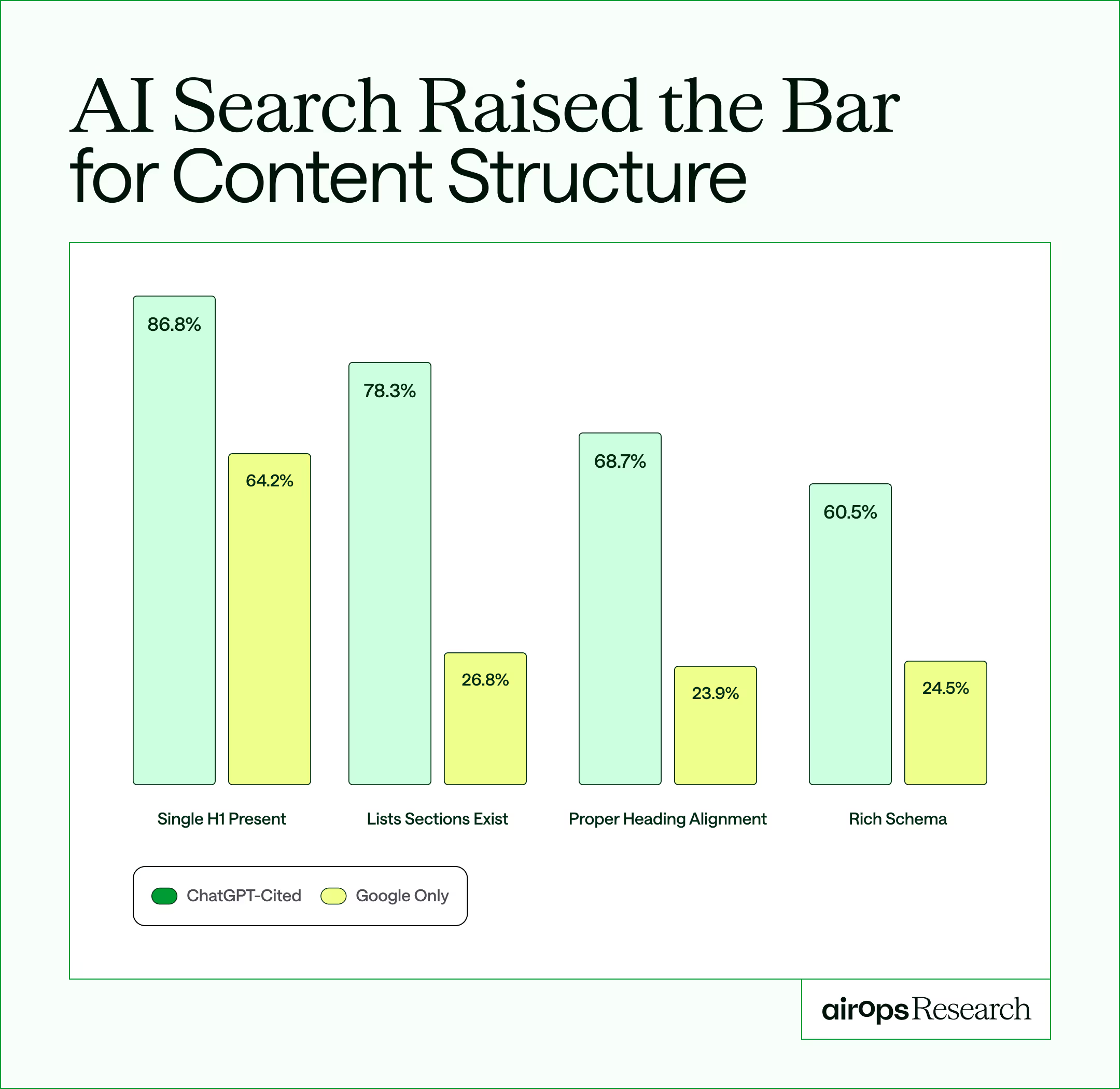
AirOps research found pages with clear headings and schema earn 2.8× more AI citations than poorly structured pages. Structured markup helps AI systems understand and select your content.
5. Create dedicated pages for long-tail queries
Dedicated pages that answer specific niche questions often outperform broad guides.
A focused page on "How do B2B SaaS companies reduce churn in the first 90 days?" will beat a generic "Customer retention guide" for that exact query.
6. Add TL;DR summaries and outcome-driven subheadings
A short TL;DR summary at the top of a page gives AI answer engines a clean, extractable answer to lift. Subheadings that state a clear outcome improve LLM visibility because they map directly to the questions people ask.
Open key pages with a two or three sentence TL;DR that answers the core question first.
Write subheadings as clear outcomes or questions, not vague labels, so answer engine optimization (AEO) has strong signals to match.
Keep each TL;DR self-contained so ChatGPT, Perplexity, and Gemini can quote it without extra context.
How to build authority for LLM visibility
Trust and credibility signals influence whether AI systems select your content over competitors.
Keep brand messaging consistent
AI models learn brand associations from multiple sources, so improving brand verifiability for LLMs means describing your brand the same way everywhere.
Use the same terminology, positioning, and descriptions across:
Your website
Social profiles
Directories
Press releases
If your LinkedIn describes you as a marketing automation platform while your website calls you a customer engagement tool, AI systems struggle to categorize you.
Show expert authorship
Add author bios with credentials and link to author LinkedIn profiles. Publishing under recognized expert names signals E-E-A-T (Experience, Expertise, Authoritativeness, Trustworthiness) to AI systems.
.png)
AI answers frequently pull from content attributed to identifiable subject matter experts.
Publish original research and data
Unique data, surveys, and studies give AI systems a reason to cite your brand as the primary source. Generic content gets passed over for original insights that cannot be found elsewhere.
This means less fluff, more depth, and authoritative opinions backed by real expertise.
Earn high-quality backlinks
Mentions and links from authoritative publications signal trustworthiness to AI training data. Pursue PR coverage and industry publication features to build this authority. AirOps research on the influence of offsite signals in AI search found that domain authority from offsite trust signals directly correlates with citation likelihood, making third-party validation one of the strongest drivers of LLM search visibility.
How off-site mentions drive AI brand visibility
Fixing brand invisibility in LLMs often starts with off-site presence, since weak external signals are a primary cause of low visibility in LLM search results. AI systems evaluate brand authority by scanning what others say about you across the web, not just what you publish on your own site.
AirOps data shows that external, third-party mentions are the dominant signal LLMs use to evaluate brand authority and relevance. In a recent AirOps webinar, Alex Halliday shared that 85% of B2B SaaS top-of-funnel AI visibility comes from unowned domains.
Eli Schwartz, SEO Advisor and Consultant, reinforced this shift in an AirOps session: "You don't necessarily need a backlink with an href anymore. You need a mention."
Pitch industry publications and analysts for brand mentions, not just backlinks.
Publish original research that others cite as a primary source.
Earn product reviews on third-party comparison sites and directories.
Contribute expert commentary to high-authority publications in your space.
Track where competitors get mentioned and target those same publications.
Why community engagement boosts LLM brand mentions
Active participation on community platforms creates compounding brand visibility in AI answers. Answer engines look for consensus across LinkedIn, Reddit, and YouTube when deciding which brands to recommend.
Aja Frost, Head of Enterprise SEO at HubSpot, explained in an AirOps webinar that these three platforms consistently appear in AI-generated answers due to their depth of user-generated content and data partnerships with AI providers. HubSpot found that active platform presence triggers a compounding effect: more brand activity leads to more third-party mentions, which feeds back into AI visibility.
Real results back this up. Zola saw a 35% brand mention lift and up to 60% improvement on single high-priority prompts through targeted off-site campaigns. Synthesia achieved 15% brand mention growth on focused topics compared to unfocused efforts.
Prioritize LinkedIn, Reddit, and YouTube for off-site brand presence.
Encourage employees and leadership to post regularly on LinkedIn.
Participate authentically in Reddit communities relevant to your space.
Create YouTube content that directly answers common industry questions.
Monitor how community mentions shift brand sentiment in AI answers over time.
How can enterprise brands improve visibility in AI search?
Enterprise brands improve visibility in AI search by describing their products consistently everywhere and tracking AI mentions down to the product level. Scale is the real challenge, because more pages, markets, and product lines create more chances for AI systems to find conflicting information.
Large brands see the fastest AI search visibility gains when they focus on a few high-value plays:
Track AI and LLM answer mentions at the product or SKU level, not just the brand level, so you can see which lines win answers and which get skipped.
Keep entity descriptions, positioning, and pricing consistent across every owned domain, since LLMs learn your category from whichever source is clearest.
Prioritize a small set of strategic topic clusters, because focused effort produces larger AI brand visibility gains than thin coverage spread across every prompt.
Standardize your AI visibility metrics across product lines so regional teams measure progress the same way.
Enterprise teams also need governance. When dozens of contributors publish content, a shared source of truth for how the brand is described keeps AI answers accurate and helps AI brand visibility compound over time.
How to make your content accessible to AI crawlers
Many sites accidentally block AI crawlers, which breaks LLM indexing for brands and makes their content invisible to answer engines.
Review robots.txt settings
Common AI crawler user agents include:
GPTBot (OpenAI)
ClaudeBot (Anthropic)
PerplexityBot
Google-Extended
Audit your robots.txt file to confirm you allow or intentionally block specific bots. Some brands block AI crawlers without realizing the visibility trade-off.
Prefer static HTML over JavaScript
Many AI crawlers struggle with JavaScript-heavy pages.
Serve critical content as static HTML or use server-side rendering so crawlers see your text immediately.
If your key information loads only after JavaScript runs, AI systems may never index it.
Platform-specific tactics for ChatGPT, Perplexity, and Gemini
Each AI platform pulls answers from different sources and presents citations in different ways. Small adjustments to your content and tracking approach can improve visibility across all three.
Use these differences to guide priorities:
ChatGPT:Strengthen Bing visibility and focus on pages with clear, direct answers to improve ChatGPT brand visibility. Structure content with concise, self-contained paragraphs that the model can extract directly.
Perplexity: Emphasize structured content with obvious, extractable statements that support visible citations.
Google Gemini: Maintain strong traditional SEO fundamentals alongside AI-friendly formatting.
Align content creation and measurement with the platforms that matter most to your audience.
How to measure brand visibility in AI search
Tracking whether your brand appears in AI answers requires new monitoring approaches, especially since only 16% of brands systematically track AI search performance today.
Manual tracking
Run regular test queries across ChatGPT, Perplexity, and Gemini for your target keywords. Document results in a spreadsheet to track changes over time.
Key metrics to track include:
Citation frequency: How often your brand is cited for priority queries
Mention context: Whether mentions are positive, neutral, or negative
Query coverage: Which queries trigger your brand vs. competitors
Automated tracking
Manual checks help, but they do not scale. AI visibility changes constantly, and tracking it across multiple platforms quickly becomes impossible in spreadsheets.
AirOps provides AI visibility monitoring that shows exactly how your brand appears across answer engines. Instead of guessing, you see:
Which queries mention you
Where competitors win
How visibility shifts week to week
Which pages drive the most citations
Where content gaps limit coverage

AirOps connects insights directly to action. From a single dashboard, teams can spot declining visibility, identify refresh opportunities, and trigger structured workflows to improve content immediately. Building a brand visibility dashboard for AI search starts with an AI visibility tracker that monitors citation rates, mention frequency, and competitor share of voice across ChatGPT, Perplexity, and Gemini. AirOps serves as that tracker, combining all three data points in a single view so your team can measure progress weekly rather than guessing.
Key takeaways
AI Search reshapes discovery by prioritizing cited and trusted sources over simple rankings.
Strong SEO foundations combined with structured, extractable content drive consistent visibility.
Track meaningful signals, update content regularly, and manage AI visibility as an ongoing system.
Make AI visibility a system, not a one-time effort
AI answers change constantly. That volatility feels risky, but it also creates opportunity.
Brands that track results and adapt regularly earn more citations and mentions over time. Teams that treat AI Search as a single project drift out of answers as models refresh and sources rotate. AirOps research found that 40% of brands that lose AI visibility can resurface through strategic citation and mention campaigns, and that these signals compound over time, creating a visibility flywheel that rewards consistent effort.
The most reliable path forward is simple: publish structured, authoritative content, confirm crawlers can access it, and measure what actually moves the needle. Then repeat the cycle.
AirOps brings those pieces together. AirOps shows where your brand appears across AI answers, highlights gaps against competitors, and helps you create content designed for extraction and trust. Instead of guessing, you get a clear feedback loop that connects insight to action.
AirOps is the partner for this shift: the platform, the media mix, and the team together, not just software to log into.
Book a demo to see how AirOps helps your team turn AI visibility into measurable, repeatable growth.
Frequently Asked Questions
Can small businesses compete with enterprise brands in AI search results?
Yes, smaller brands can outperform larger competitors on specific niche queries by creating highly focused, expert-driven content that directly answers long-tail questions, since AI systems prioritize relevance and answer quality over brand size or domain authority alone.
Does paid advertising affect whether AI assistants mention your brand?
Paid advertising has no direct influence on AI answer generation, as these systems pull from organic web content and training data rather than ad placements, though strong brand awareness campaigns may indirectly increase the volume of third-party mentions that AI models learn from.
Should you create separate content strategies for AI search and traditional SEO?
A unified content strategy works best since AI systems and traditional search engines share many ranking signals, but you should layer AI-specific formatting like Q&A structures and concise extractable statements on top of your existing SEO foundation rather than treating them as separate efforts.
How do you measure brand visibility in AI search?
Track three core metrics across ChatGPT, Perplexity, and Gemini: citation rate (how often your pages are linked as sources), mention rate (how often your brand name appears in answers), and share of voice (your visibility compared to competitors for the same prompts). Use an AI visibility tracker like AirOps Insights to automate this across platforms and measure trends weekly rather than relying on manual spot checks.
Are there industries where AI search visibility matters more than others?
B2B software, professional services, healthcare, and financial services see particularly high AI search impact because users in these sectors frequently ask complex comparison and recommendation questions that AI assistants are well-suited to answer with cited sources.
How do I optimize my content for ChatGPT brand visibility?
Structure each page around clear questions with direct answers in the first sentence, since ChatGPT pulls from concise, extractable statements. Strengthen your Bing presence too, because ChatGPT pulls from the Bing index when browsing. Keep your brand description consistent across your site and third-party pages so the model categorizes you correctly.
How do I audit brand visibility on LLMs?
Run your priority prompts across ChatGPT, Perplexity, and Gemini, then record where your brand is cited, where it is mentioned, and where competitors win instead. Because AI answers rotate sources, repeat the audit on a regular schedule rather than once. AirOps Insights automates this audit across engines, tracking citation rate, mention rate, and share of voice in one view.
How do I see how my brand shows up in LLM search results?
Query the LLMs your buyers use with real questions, then capture whether each answer cites your pages, names your brand, or points to a competitor. Manual checks work for a handful of prompts, but visibility shifts week to week and quickly outgrows a spreadsheet. AirOps Insights shows exactly how your brand appears across answer engines and how that position changes over time.
How do I increase brand mentions in AI search?
Build third-party mentions across the sources LLMs trust, since external validation drives most brand discovery in AI answers. Pitch industry publications, publish original research others cite, and stay active on LinkedIn, Reddit, and YouTube. Track which mentions move your visibility so you can double down on what works.
What features should I look for in a platform that tracks and improves brand visibility in AI answers?
Look for a platform that measures citation rate, mention rate, and share of voice across ChatGPT, Perplexity, and Gemini, then connects those insights to action. AirOps pairs visibility tracking with content workflows and offsite mention building, so you close gaps instead of only spotting them. Prioritize tools that tie every action back to a measurable visibility outcome.
How long does it take to see improvements in AI brand mentions?
Most brands see early movement within a few weeks, but durable gains take two to three months of consistent effort. AI answers rotate sources constantly, so visibility builds as citations and mentions accumulate across trusted pages. Track progress weekly and expect compounding results rather than an overnight jump.
How can I analyze my competitors' visibility in LLMs?
Run your priority prompts across ChatGPT, Perplexity, and Gemini and record which competitors get cited or mentioned instead of you. Track their share of voice over time so you can see which topics they own and where you have room to win. AirOps Insights benchmarks your brand against competitors across answer engines in one view.
Get the latest on AI content & marketing
