- Citations overtook rankings as the real visibility driver, with AI models pulling from brands they trust rather than the ones sitting at the top of the SERP.
- AI summaries became the primary search experience, pushing traditional organic results below the fold.
- Agents like Comet and Arc/Dia emerged as the new browsers, surfacing key facts before users ever hit a website.
- Hybrid AI workflows became the high-performing norm, pairing AI scale with human judgment.
- Content engineering and LLM-friendly structure turned into the new moat, reinforced by community authority and measurable AI visibility.
For years, search was simple: type a keyword, get a list of links, and pick one. Then the whole setup shifted at once. Google rewired the SERP, answer engines started replying before you finished typing, and “ranking” suddenly felt quaint.
And the brands that recognized the shift early — like Webflow, Carta, and Docebo — didn’t wait around for the dust to settle. They doubled down on structured content, built real authority across communities and invested in AEO as a core strategy. Those moves gave them a head start while everyone else was still trying to figure out what changed.
Below is a breakdown of what changed in 2025, and the playbook for anyone who wants to actually win in 2026.
1. Visibility Moves from Rankings to Citations & Mentions
What Changed
Answer Engine Optimization actually became real this year. AI systems started pulling in sources directly, which means your visibility now hinges on whether models cite you when they construct an answer.
AirOps CEO Alex Halliday highlighted that structured, information-gain content earned far more citations. Brands with a broad footprint across third-party sites like media, communities and expert networks were most likely to appear in AI answers.
AirOps research also showed something surprising: for top-of-funnel commercial queries, 85% of brand mentions came from third-party sources and not the brands themselves. In one case study of Chime, citations increased 3× after adopting AEO-specific workflows.
- Trusted third-party sources and mentions mattered more than backlink count
- PR, SEO and brand teams aligned around earning citations and improving reputation signals
- Models surfaced citations more prominently inside answers, making offsite presence a direct driver of visibility
What It Means
To appear inside AI answers, your brand needs to show up across the trusted sources that models rely on beyond your website. The strongest AEO performers pair structured content with broad credibility in communities, media and expert networks. AirOps research on how citations and mentions impact visibility in AI search found that 40% of cited pages resurface in subsequent AI answers, showing how citation momentum compounds over time. This compounding effect is one of the defining AEO trends reshaping search strategy.
2. AI Overviews and AI Mode Rewrite the SERP
What Changed
Google pushed AI to the center of the search experience. With more locations of AI Overviews and expansion of AI Mode, overviews became the primary view for many informational queries.
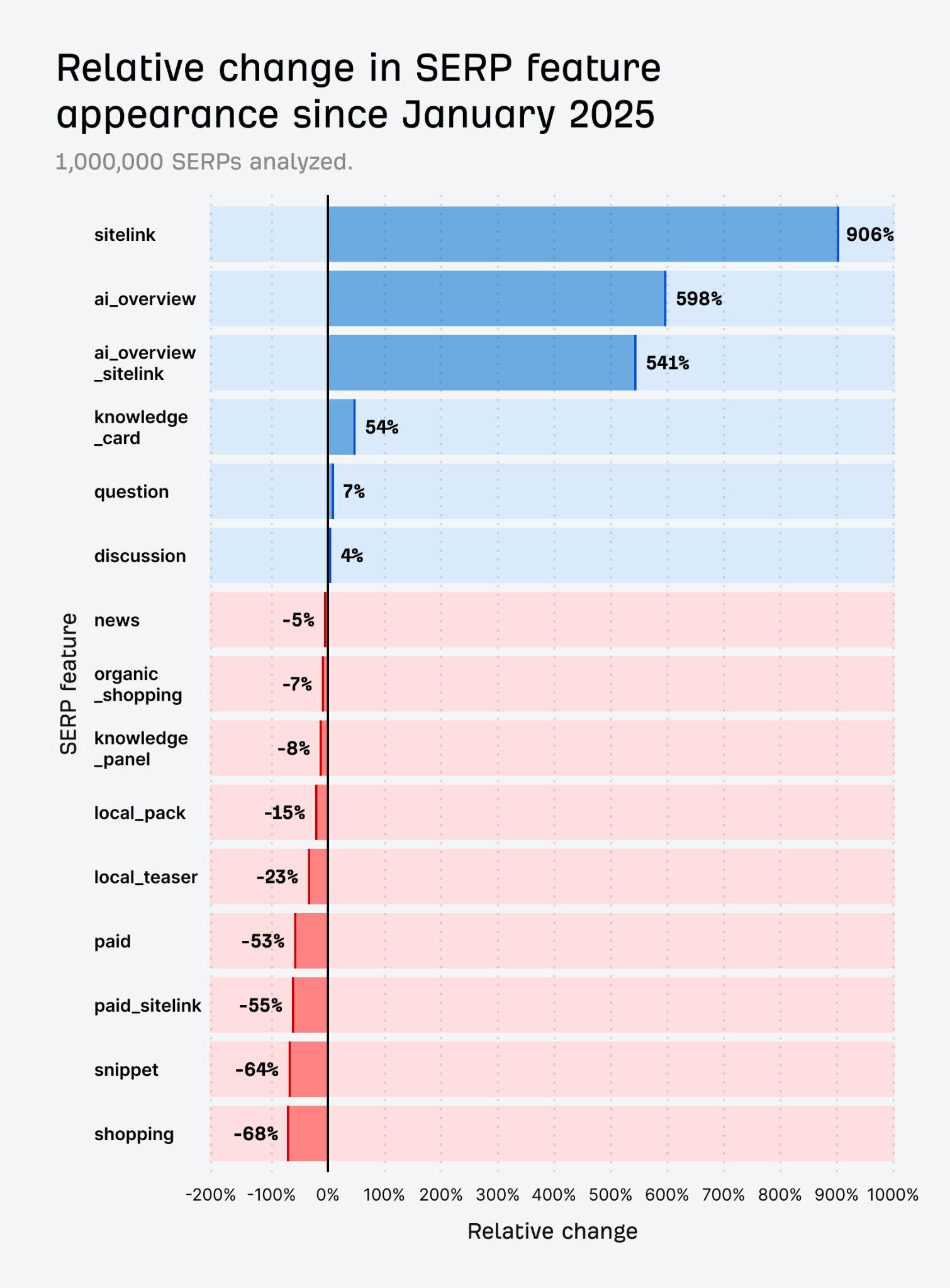
Source: Ahrefs
Most searches now end in an AI-generated summary rather than a traditional results page, and while organic links still matter, they sit lower in the hierarchy.
- Zero-click search became the norm as more queries ended inside AI summaries, and the average prompt length grew to 60 words compared to 3.5 words for traditional searches
- AI Mode encouraged conversational exploration instead of navigation
- Google tested visual prompts in AI Mode, letting users upload images for Lens + Gemini answers
What It Means
Rankings still matter, but appearing inside the AI summary matters more. The brands gaining ground are creating clear, structured, factual, machine-readable content that models trust and pull from.
3. A New Wave of AI Browsers
.png)
Perplexity's Comet
What Changed
A new wave of browsers arrived in 2025. Tools such as Atlas, Comet, Arc/Dia and Opera Neon function like task agents rather than traditional browsers.
Momentum accelerated when Atlassian acquired Arc, which was a clear sign that agent-led browsing is becoming a core part of the ecosystem rather than a niche experiment.
- Browsers started generating answers before users finished typing
- Content began being judged for agent readability, not just design
- Key facts and instructions were lifted into side panels, reducing the need for page views
- Agents increasingly shaped what users saw first, long before any direct navigation
What It Means
Content teams now have two audiences at the same time: people and agents. A human might eventually read your page, but an agent reads it first and decides what gets highlighted, summarized or ignored.
4. Hybrid AI Workflows Become the Standard
What Changed
Content teams learned that fully automated AI content misses the mark, but traditional workflows are too slow. The best performers landed in the middle, keeping humans in the loop.
They let AI handle the structure, research and synthesis, while humans focused on accuracy, clarity and story. This hybrid model became the default for high-performing content teams.
- AI cut down the time needed for research, outlining and first drafts
- Human editors protected correctness, brand voice and strategic framing
- Teams developed templates, repeatable workflows and content systems that improved speed and quality.
What It Means
Great content now comes from the balance of speed and judgment. AI gets you to a strong starting point, but humans shape the final result. The teams that win are the ones that treat AI as a collaborator, not a replacement. Effective AI content optimization starts with this hybrid model, where automated workflows handle scale and humans protect accuracy.
5. Content Engineering Becomes The New Foundation
What Changed
Content engineering shifted from a side-topic in SEO circles to a core capability inside modern teams. Leaders began treating content as a system rather than a collection of one-off assets. That shift introduced templates, pipelines, automation and structured workflows that improved both speed and consistency.

Lucy Hoyle from Carta at the AirOps NYC hackathon.
Real-world examples made the impact clear. Hundreds of content marketers and SEO specialists became certified content engineers. For instance, Radyant created repeatable frameworks that improved localized pages, and LegalZoom built systems that increased production speed and reduced errors for Reddit while others like Lucy Hoyle from Carta were promoted.
“AirOps is more customizable, scalable, personalized and human than any tool we’ve used in the past. Now, we can add more creativity to our content,” Lucy told us in the Carta case study.
- Automated workflows supported metadata, linking and content refresh cycles.
- Content engineers improved collaboration between SEO, data and editorial functions.
- Systems thinking allowed teams to scale output without sacrificing quality.
- Content Engineering made it possible to scale answer engine optimization across multiple product lines by templating structured formats, automating metadata and linking, and reusing research workflows across verticals.
What It Means
Modern search is now about infrastructure as much as keywords. The teams that build structured, repeatable, reliable content systems will outperform the ones still relying on ad hoc production.
6. LLM-Friendly Structure & Freshness Determines Visibility
What Changed
LLMs work best when information is structured, not buried in long blocks of prose. Clear headings, lists, tables, FAQs and consistent formatting made content far more likely to be cited in AI search. Google’s core updates in March, June and August also put more weight on quality, recency and real expertise. Fresh, experience-based content (E-E-A-T) outperformed older material and low-value AI-written pages, which pushed teams to tighten their structures and make their best insights easier for both humans and models to retrieve.
AirOps research showed that structured content increased citation frequency across all models. Real visibility comes from how content is organized, not from new file formats. The same research found a 2.8x citation lift from pages with proper heading hierarchy, FAQ formatting and schema. For teams investing in AI search optimization, structure is the highest-leverage change.
- Unstructured content struggled to surface in AI answers.
- Schema and markup improved model comprehension.
- FAQ sections performed well across AI systems.
- Content with clear hierarchy was reused most often.
What It Means
Content must be built for retrieval. LLMs need clean sections, clear answers and predictable structures.
7. Community Authority Becomes a Ranking Signal
What Changed
LLMs leaned heavily on community platforms like Reddit, StackExchange and LinkedIn to understand real user experiences.
Reddit became a top training and citation source, and AirOps research found that roughly 48% percent of AI answers are influenced by UGC and community platforms. Community platforms shaped how models interpreted categories, which products to compare and which brands to trust.
- Reddit consistently ranked as a top citation source.
- LinkedIn expert posts were cited more often than expected.
- Question-and-answer formats aligned well with LLM retrieval.
- Brands invested in UGC ecosystems to improve visibility.

What It Means
Community authority now shapes search visibility. If your brand is not part of trusted conversations, LLMs have fewer reasons to cite you. Being present in these spaces improves trust for both people and models.
8. AI Visibility Becomes the New KPI That Matters
What Changed
Traditional rankings stopped telling the full story, so teams shifted toward metrics that reflect how AI systems cite, summarize and recommend brands. As AI search opened new visibility pathways, reporting had to evolve. LLMs.txt raised questions about crawler governance, but limited adoption showed the need for clearer, enforceable rules on how AI systems access and reuse publisher content — and pushed teams to focus more on what models actually pull in.
.png)
AI visibility tightened fast. Instead of ranking many results, AI agents choose a few sources for a single answer. That shifted reporting to topic-level inclusion: defining key queries, mapping model behavior, and tracking how often you’re cited. Visibility is now zero-sum.
Several new metrics gained traction. According to G2 CMO Sydney Sloan, 51% of buyers now use and trust AI tools for purchase research, which makes AI search visibility a direct revenue signal. Teams that align content strategy with AI visibility goals track citation frequency, sentiment and brand presence across ChatGPT, Gemini, Perplexity and Google AI.
- Citation frequency across GPT, Gemini, Claude and Perplexity.
- Sentiment within model-generated answers.
- Structured content performance and chunk-level extraction.
- Dark traffic attributable to AI-driven discovery.
What It Means
SEO reporting needs a new lens and a broader view of visibility. Rankings still matter, but the real signal is whether AI systems actually use your content. Modern dashboards need to track brand presence across multiple AI ecosystems to reflect how people discover information today.
9. Filtering Out The Hype To Find the Signal
What Changed
2025 produced more AEO hype cycle moments than breakthroughs, so the real work was separating signal from noise. The AEO vs SEO debate intensified, but the trends with staying power were the ones that improved clarity, trust and structure. AI Overviews, AEO, Content Engineering, UGC authority and structured content became the true drivers of visibility.
.png)
Source: nytimes.com
Legal and economic pressure also began reshaping how AI models access publisher data. Cloudflare’s AI bot blocking, new licensing deals and Microsoft’s Publisher Content Marketplace all pointed toward a world where data pipelines are paid, controlled and no longer based on wide-open crawling.
Honorable mentions:
- llms.txt has yet to gain real adoption, though the debate signaled rising pressure for clearer rules on AI crawler access and reuse
- Undifferentiated AI slop proved unreliable
- DeepSeek hype cycles created noise but ChatGPT, Perplexity, Claude, and Google remain in charge
- “SEO is dead” narratives
What It Means
Search didn’t vanish, but it evolved. Visibility now depends on reputation, structure and authority across trusted platforms. The teams that focused on durable capabilities this year ended up with the biggest advantage. Those same foundations will matter even more in 2026.
Why First-Party Data Earns More AI Citations Than Backlinks
What did predict citations was first-party data: business benchmarks, case studies and customer outcomes. LLMs cite the original source of a statistic, so including proprietary data gives your page a citation advantage that third-party stats cannot.
Scalable AEO strategies for improving AI visibility start with this shift:
- Replace third-party statistics with your own benchmarks. If you cite someone else’s number, the LLM will credit them, not you.
- Structure pages with 20+ external links, descriptive titles, block quotes and TL;DR sections. These formatting signals are positively associated with higher citation rates.
- Mine query fanouts for FAQ content. The sub-questions AI engines generate from a single prompt are strong candidates for FAQ sections that earn citations.
- Track citation performance per page, not just per domain. A single well-structured page can outperform an entire backlink strategy.
How to Build an AEO Roadmap for 2026
Integrating AEO into an existing SEO strategy requires a phased approach. You do not need to overhaul your content operation overnight. Start with measurement, then expand.
A 12-month AEO roadmap breaks into three phases:
- Months 1-3: Measure and baseline. Track citation frequency, brand mentions and AI search visibility across ChatGPT, Gemini, Perplexity and Google AI. Identify which pages already earn citations and which prompts your brand appears in.
- Months 4-8: Optimize and structure. Refresh your highest-traffic pages with LLM-friendly formatting: clear heading hierarchy, FAQ sections, schema markup and first-party data. Build Content Engineering workflows that automate metadata, linking and structured output across product lines.
- Months 9-12: Scale and compound. Expand structured content across your full site. Invest in offsite signals: community presence, media coverage and third-party citations. Monitor citation momentum and adjust based on which topics and formats earn the highest citation rates.
Running an AEO strategy requires different skills than traditional SEO. As G2 CMO Sydney Sloan noted, the complexity demands dedicated internal ownership rather than outsourced execution.
Looking Ahead
The edge won’t come from chasing features or trying to outrun every update. It will come from content that models can understand and people can actually use, work that is readable, reliable and grounded, easy for a model to parse and easy for a person to follow. Structure, systems, earned authority and measurement that reflects how AI actually works will matter far more than anything in the old SEO dashboard era.
This is the direction AirOps is focused on. Our platform helps teams build the content engineering foundations they need, automate structured workflows, strengthen AEO readiness and understand how AI systems surface their brand. If you want to modernize your content operations and get ready for what comes next, start with our guide on how a content engineering platform can transform your team.
AirOps is the partner for this shift, bringing the platform, the media mix, and a hands-on team together rather than software to log into, and tying the work across owned content, third-party sources, and AI ad placements back to pipeline and revenue.
Next Steps:
- Review our new research report: The State of AI Search in 2026
- Get your complete guide for AI search
- Book your demo to see AirOps in action.
What mattered more than rankings in search during 2025?
In 2025, citations and mentions inside AI-generated answers mattered more than traditional SERP rankings. Visibility increasingly depended on whether AI systems trusted and cited your brand when constructing responses, not just where your page ranked.
Why did AI Overviews and AI Mode change how users interact with search?
AI Overviews shifted search from navigation to resolution by answering questions directly before users clicked through to websites. As a result, many searches ended without clicks, making inclusion inside AI summaries more valuable than organic link placement.
How should teams adapt their content strategy for AI search in 2026?
Teams need to focus on structured, LLM-readable content paired with real authority across communities, media, and third-party platforms. Winning visibility now requires content systems, freshness, and credibility signals that AI models can easily interpret and reuse.
How do I integrate AEO into an existing SEO strategy?
Start by adding citation tracking to your existing SEO dashboard. Then restructure your highest-traffic pages with clear headings, FAQ sections and first-party data so AI models can extract answers directly. AEO and SEO are complementary: strong organic rankings give AI models a reason to crawl your page, and structured content gives them a reason to cite it.
What is the difference between AEO and traditional SEO?
Traditional SEO optimizes for rankings on a search results page. AEO optimizes for citations and mentions inside AI-generated answers. SEO drives clicks through link placement. AEO drives visibility through structured, authoritative content that AI models trust enough to cite directly. Both matter, but the balance shifted toward AEO in 2025 as AI summaries became the primary search experience.
Frequently Asked Questions
What mattered more than rankings in search during 2025?
In 2025, citations and mentions inside AI-generated answers mattered more than traditional SERP rankings. Visibility increasingly depended on whether AI systems trusted and cited your brand when constructing responses, not just where your page ranked.
Why did AI Overviews and AI Mode change how users interact with search?
AI Overviews shifted search from navigation to resolution by answering questions directly before users clicked through to websites. As a result, many searches ended without clicks, making inclusion inside AI summaries more valuable than organic link placement.
How should teams adapt their content strategy for AI-driven search in 2026?
Teams need to focus on structured, LLM-readable content paired with real authority across communities, media, and third-party platforms. Winning visibility now requires content systems, freshness, and credibility signals that AI models can easily interpret and reuse.
Get the latest on AI content & marketing
