Best AI Brand Visibility Tracking Tools in 2026
Your brand is being described, recommended, or ignored inside ChatGPT, Perplexity, Gemini, Claude, Copilot, and AI Overviews right now. Track AI visibility, fix inaccuracies, and outrank competitors where buyers actually search.

Webflow 5xed content refresh velocity and increased visibility across Google and ChatGPT

Webflow 5xed content refresh velocity and increased visibility across Google and ChatGPT
Webflow 5xed content refresh velocity and increased visibility across Google and ChatGPT

Chime went from being recommended in 24 to 68 priority questions


George Bonaci VP of Growth, Ramp

Nicole Baer, CMO, Carta


50% cut in production costs, thanks to the elimination of external agencies and manual tasks.

Marcio Arnecke, CMO, Apollo















What Are AI Brand Visibility Tracking Tools?
AI brand visibility tracking tools monitor how your brand appears in AI-generated responses across platforms like ChatGPT, Perplexity, Gemini, Claude, Copilot, and Google AI Overviews. As tools for tracking LLM brand visibility, they monitor brand mentions, citation sources, sentiment, accuracy, and share of voice in LLM outputs. They help SEO, brand, and demand gen teams pinpoint where they're visible, where competitors are winning, and what to optimize next.
This matters more than most teams realize. Over half of B2B software buyers now start their research with AI chatbots before visiting a vendor's website (G2, 2026). If your brand doesn't show up in those answers, or worse, if AI hallucinates your pricing or positioning, you're losing pipeline you can't even see. AI search is reshaping the buyer journey, and the brands that track it first will own the advantage.
Traditional SEO tools measure keyword positions on Google's blue links. They can't tell you whether ChatGPT recommends your product, whether Perplexity cites your content, or whether Gemini describes your features accurately. AI brand visibility software sits at the intersection of LLM SEO tools, AEO analysis, and competitive intelligence, closing a gap that rank trackers were never designed to fill. If you're still relying solely on a traditional brand visibility tool, you're optimizing for a surface that represents a shrinking share of how buyers discover brands.
AI Brand Visibility Tools Compared: Feature-by-Feature
See how the leading AI brand visibility tracking tools stack up across the features that matter most. We evaluated the best LLM visibility software and AI brand visibility checking tools to help you make a confident decision without spending weeks on demos.
TL;DR: Most tools stop at monitoring. AirOps helps you track AI search visibility, diagnose why competitors are winning, and take action through repeatable optimization workflows.

Who Needs an AI Brand Visibility Tracking Tool? Use Cases by Role
SEO & Content Teams: Stop Optimizing Blind - See Where AI Engines Actually Cite Your Content
Track which pages earn citations in ChatGPT, Perplexity, and Google AI Overviews. AI brand visibility trackers show you exactly which prompts return your pages and which return competitor content. Identify prompt-level gaps where competitors appear and you don't, then use AirOps' content recommendations to close them. If you're investing in content engineering or SEO content automation, AI tools for tracking brand visibility over time tell you whether that work is actually landing in the places buyers search first.
Brand & Demand Gen Leaders: Protect Your Brand Narrative Before AI Rewrites It for You
AI brand visibility monitoring tools track how AI engines describe your product, pricing, and positioning across every major platform. Catch hallucinations and inaccurate brand descriptions before they reach your buyers and derail sales conversations. Understanding AI visibility metrics and benchmarks for your industry is the first step toward controlling the narrative instead of reacting to it.
Agencies & Consultants: Add AI Visibility Reporting to Every Client Engagement
Benchmark client brands against competitors across all major AI search engines. AI visibility tracking tools for agencies deliver multi-brand dashboards, white-label reporting, and scalable prompt libraries from a single platform. Deliver search engine share of voice reports, citation audits, and GEO recommendations that justify retainers and prove measurable impact. Tools for tracking brand visibility in AI search platforms give agencies the cross-engine data they need to prove campaign impact. If you're exploring answer engine optimization tools for enterprise SEO teams, AirOps gives you the multi-brand, multi-region infrastructure agencies need.
RevOps & Growth Teams: Understand the Invisible Pipeline AI Search Is Building or Blocking
Buyers are forming opinions inside AI answers before they ever visit your site. Use an AI visibility tracker for brand presence to determine whether answer engines are sending qualified traffic or sending buyers to competitors, and quantify the revenue impact of AI visibility gaps. When over half of B2B buyers start with AI chatbots before visiting a vendor, this isn't an SEO project. It's a pipeline intelligence priority.
Track, Analyze & Optimize AI Visibility in 3 Steps
Other platforms hand you a dashboard and wish you luck. AirOps connects monitoring directly to optimization, so you move from insight to action without switching tools or guessing what to fix.
Connect Your Brand & Competitors
Enter your brand name, domain, and up to 10 competitors. AirOps automatically maps your category landscape and begins monitoring across ChatGPT, Perplexity, Gemini, Claude, Copilot, and Google AI Overviews. Setup takes under 30 minutes, requires zero engineering support, and starts populating your dashboard with real data immediately.
Monitor Prompts, Citations & Sentiment Across AI Engines
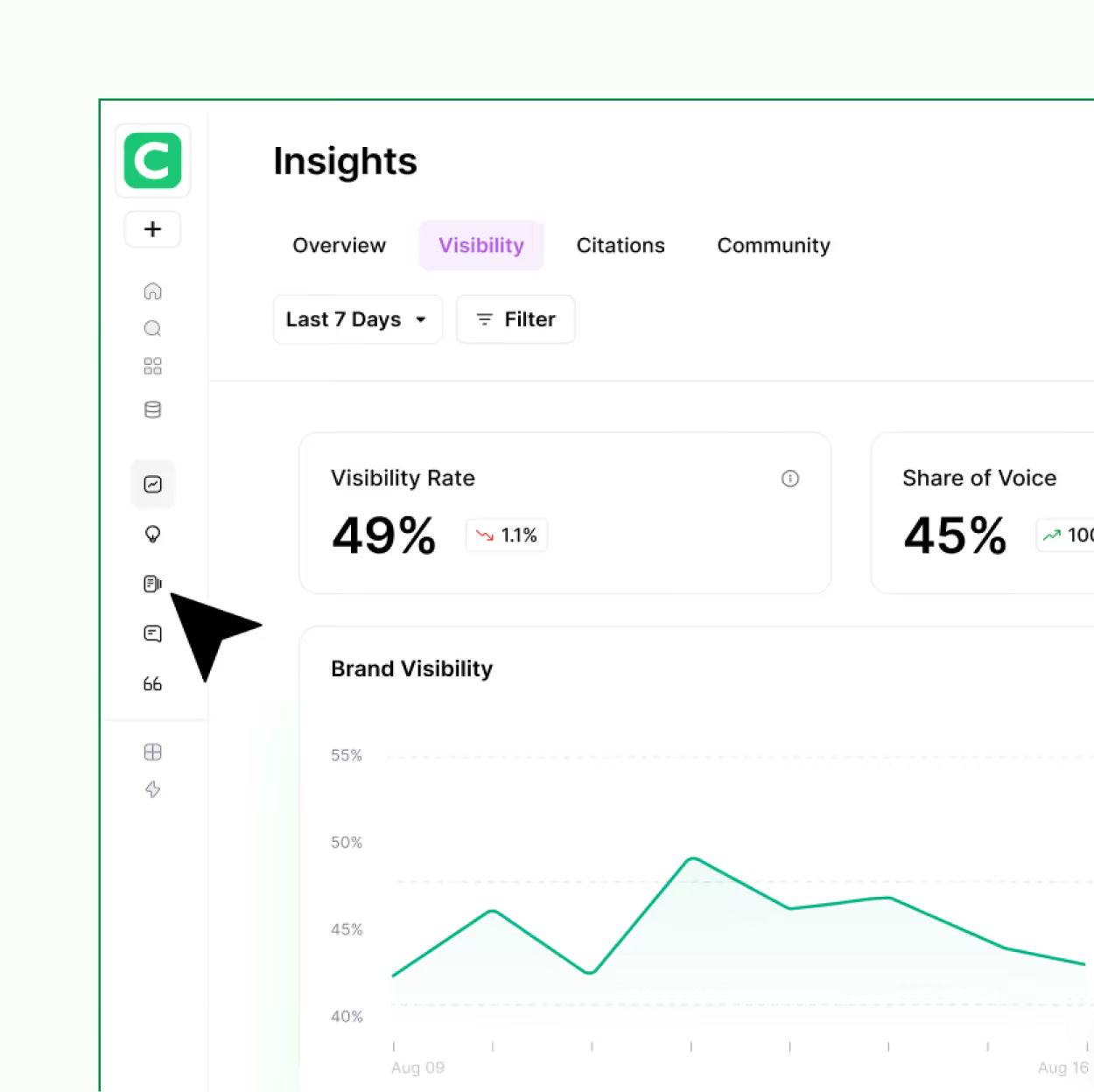
Your dashboard surfaces which buyer prompts mention your brand, which of your pages earn LLM citations, how each AI engine describes your product, and where competitors hold a larger share of voice. Because every AI engine uses different models and training data, your visibility can vary dramatically across them. AirOps normalizes that complexity into a single view so you're not juggling six separate workflows. These AI brand visibility insights help teams prioritize which content to create, refresh, or restructure for better citation coverage.
Get Actionable Recommendations to Improve Visibility
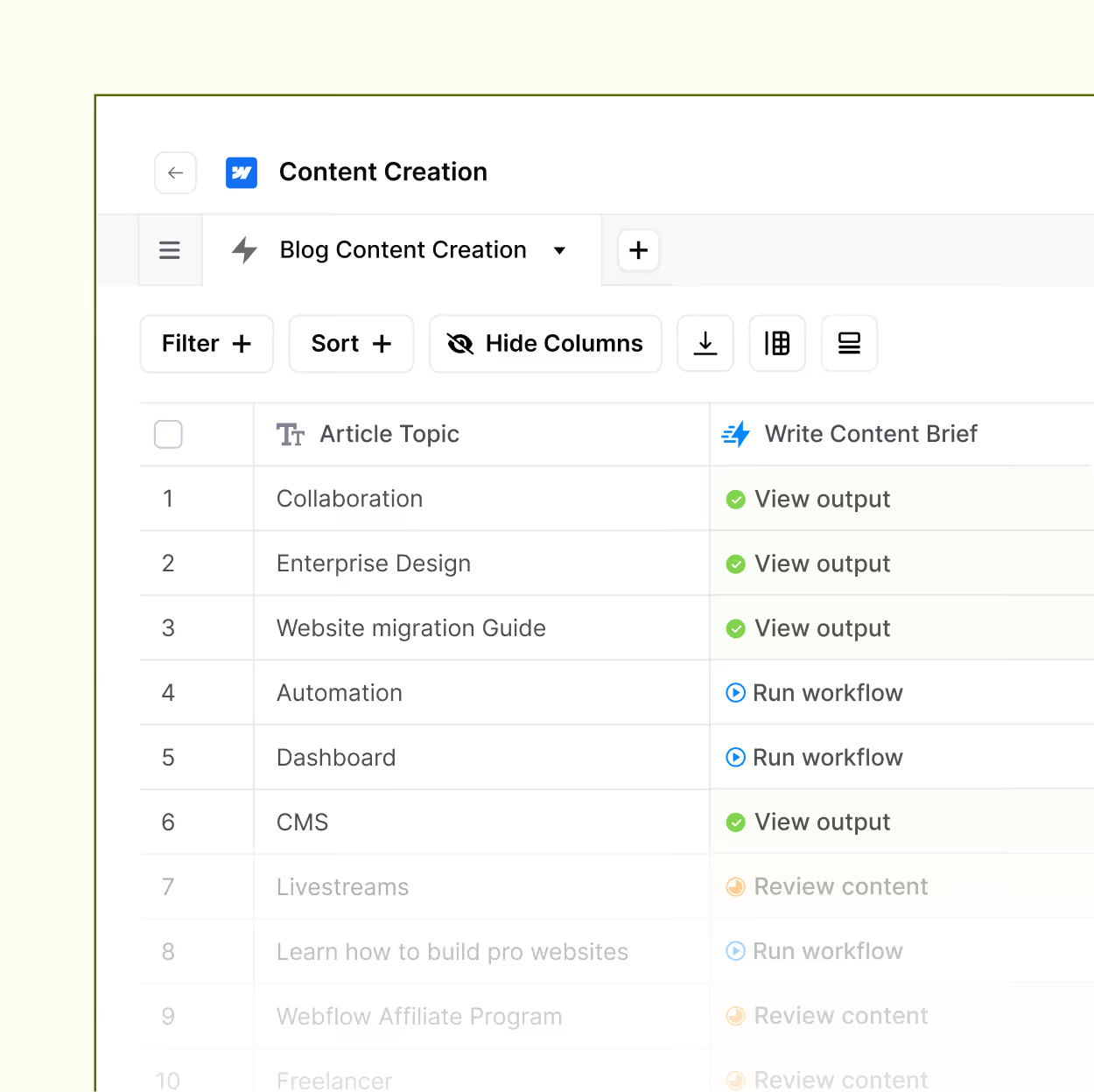
This is where most tools stop and AirOps keeps going. As an AI brand visibility optimization tool, AirOps generates specific content, schema, and GEO recommendations based on your visibility gaps designed to help you optimize content for answer engines. Every recommendation is tied to a measurable gap, so your team always knows what to prioritize and why.
Frequently Asked Questions
What are the tools or features that set AirOps apart?
What's the difference between AI visibility tracking and traditional SEO rank tracking?
Traditional SEO rank trackers monitor your keyword positions on Google's organic results. AI brand visibility tracking tools monitor how your brand appears inside AI-generated answers on platforms like ChatGPT, Perplexity, Gemini, and Google AI Overviews. They track prompt-level mentions, citation sources, sentiment, accuracy, and competitor share of voice - metrics that simply don't exist in traditional SEO tools. As AI search optimization tracking becomes essential for measuring key metrics over time, teams need both traditional and AI-focused tools to get a complete picture of how buyers discover their brand.
How do AI brand visibility tracking tools monitor citations in LLMs?
LLM citation tracking works by systematically querying AI engines with category-relevant prompts and analyzing which brands, pages, and sources are referenced in the responses. The best platforms for analyzing citation data for LLMO strategies track citation frequency, source URLs, and whether your content is being attributed correctly. This helps teams understand not just whether they're mentioned, but whether AI engines are linking back to their content as an authoritative source. LLM link citation tracking is especially valuable for content teams that need to prove ROI on organic investments.
Can AI visibility tools detect when ChatGPT or other AI engines hallucinate about my brand?
Yes. Advanced AI brand visibility tracking tools include hallucination and accuracy detection that flags when an AI engine states incorrect information about your brand, such as wrong pricing, fabricated features, or outdated positioning. This is critical because AI-generated misinformation can reach buyers before your sales team does, undermining trust and pipeline quality. It's worth noting that ChatGPT doesn't give the same answers to everyone - responses vary by prompt phrasing, location, and context - which makes continuous monitoring across tools like those that monitor visibility in Perplexity and other engines essential rather than optional.
What AI search engines should a visibility tracking tool cover?
At minimum, look for coverage across ChatGPT, Perplexity, Google AI Overviews (including AI Mode), Gemini, Claude, and Microsoft Copilot. These are the six platforms where B2B and B2C buyers most frequently encounter AI-generated brand recommendations from an AI powered answer engine. Some tools also track emerging vertical AI search platforms. Multi-engine coverage is essential because each platform uses different models, training data, and citation behaviors. Your brand might dominate in Perplexity responses but be completely absent from Gemini, and you won't know without purpose-built answer engine optimization tools tracking all of them.
Are there AI visibility tools designed specifically for agencies or enterprise SEO teams?
Yes. Some platforms like AirOps are built to support both agency and enterprise workflows, with features like multi-brand monitoring, competitor benchmarking at scale, white-label reporting, and role-based access. When evaluating tools, agencies should prioritize platforms that support region-based prompts, client-level reporting, and scalable prompt libraries. If you're comparing Profound alternatives with region-based prompts and reporting, evaluating tools like Peec AI, or searching for the best Scrunch AI competitor, the key differentiator is whether the platform connects monitoring data to actionable optimization recommendations or leaves that work to you.
How quickly can I set up an AI brand visibility tracking tool and start getting insights?
Most modern AI visibility platforms, including the best AEO checking tools on the market, can be set up in under 30 minutes. You'll typically enter your brand name, domain, key competitors, and a set of category-relevant prompts. The tool then begins monitoring AI engines and populating your dashboard with mention data, citation sources, sentiment scores, and competitive benchmarks. Look for platforms that provide a free audit or trial so you can evaluate visibility data before committing to a paid plan. The best AEO trackers will show you meaningful insights on day one, not after a weeks-long onboarding process.
What data can you get from an AI brand visibility tracker?
An AI brand visibility tracker surfaces brand mention frequency, citation sources, sentiment polarity, share of voice relative to competitors, prompt-level appearance data, and accuracy scoring for how AI engines describe your product. Advanced platforms also show which of your pages earn citations, which competitor pages outrank you in AI responses, and how your visibility shifts over time across ChatGPT, Perplexity, Gemini, Claude, Copilot, and Google AI Overviews.
What is the best platform to track brand visibility across ChatGPT, Copilot, and Perplexity?
AirOps monitors brand visibility across ChatGPT, Microsoft Copilot, Perplexity, Gemini, Claude, and Google AI Overviews from a single dashboard. It tracks prompt-level mentions, citation sources, competitor share of voice, and sentiment across all engines simultaneously. Unlike point solutions that cover one or two platforms, AirOps normalizes cross-engine data so teams can compare performance and identify gaps without switching between tools.
What are the best AI visibility analytics tools for tracking brand mentions?
The best AI visibility analytics tools track brand mentions at the prompt level across all major AI search engines, not just aggregate domain counts. Look for platforms that combine mention tracking with citation source analysis, sentiment scoring, and competitive benchmarking. AirOps stands out by connecting mention data directly to content optimization workflows, so teams can act on visibility gaps rather than just report on them.
How do AI visibility tracking tools for enterprise brands differ from SMB solutions?
Enterprise AI visibility tracking tools support multi-brand portfolios, role-based access controls, API-first integrations with existing martech stacks, automated reporting cadences, and regional or language-specific monitoring. SMB solutions typically offer single-brand tracking with manual exports. Enterprise platforms also provide dedicated onboarding, SLA-backed support, and the prompt volume needed to track visibility across hundreds or thousands of category-relevant queries.
What AI visibility platforms work best for developer tool companies tracking mentions in Microsoft Copilot?
Developer tool companies need platforms that monitor Microsoft Copilot alongside ChatGPT, Perplexity, and Gemini, since developer buyers research across multiple AI assistants. AirOps tracks Copilot-specific citations and mentions at the prompt level, showing which technical queries surface your documentation, API references, or product pages. This visibility lets DevTool teams optimize their technical content for the AI assistants their buyers actually use during evaluation.