- AEO readiness analysis tools test whether AI answer engines like ChatGPT, Perplexity, Gemini, and Google AI Overviews can extract, understand, and cite your content for the prompts buyers actually ask.
- The category splits into two camps: tools built to monitor AI visibility and report gaps, and tools built to close those gaps with governed, published content.
- AirOps is the strongest fit for enterprise teams ready to move from readiness insight to scaled content execution in one system, with citation tracking, prioritization, on-brand drafting, and CMS publishing connected end to end.
- AthenaHQ suits teams that want prescriptive recommendations tied to cited sources, and BrightEdge fits teams extending an established enterprise SEO program into AI search.
- When you evaluate these tools, weigh multi-engine coverage, real-intent prompt data, a unified AI plus SEO view, and whether the platform ships fixes or only reports findings.
AI answer engines handle billions of queries each month, yet most brands still can't answer one simple question: Will an AI engine cite our content when someone asks for a recommendation?
Traditional SEO metrics like rankings, backlinks, and domain authority do not predict whether ChatGPT or Perplexity will mention you when a buyer asks, “What is the best project management tool for remote teams?” That disconnect is what creates the AI citation gap.
This guide explains what AEO readiness tools actually do, how to evaluate them, and which platforms help you move from “we see the problem” to “we shipped the fix.”
AEO readiness analysis tools at a glance
Here is a quick comparison of the leading AEO readiness analysis tools. Use it to see where each tool fits, where it excels, and where it falls short. These AEO checking tools each approach citation readiness differently, so the right fit depends on your team's workflow.
How we evaluated these tools
We evaluated each AEO readiness analysis tool against criteria that matter most for teams managing large content portfolios:
Core AEO depth: Multi-engine tracking, citation analysis, content scoring, and readiness diagnostics, including whether the platform functions as a full AEO software suite or a focused AEO checking tool
Scale: Portfolio-wide assessment, bulk operations, and automated prioritization across hundreds of pages
SEO integration: Support for Google Search Console and GA4 signals alongside AI search signals
Flexibility: Brand governance, custom evaluation criteria, and support for different content types, plus data compliance readiness for regulated teams
Team usability: Pricing transparency, onboarding effort, and alignment with day-to-day content operations
Insight-to-action connectivity: Whether the platform helps you ship fixes or only reports findings, and whether it can refresh content for re-citation
What is an AEO readiness analysis tool?
An AEO readiness tool evaluates whether AI answer engines can extract, understand, and cite your content for the prompts that matter in your category. Strong platforms deliver page-level citation diagnostics, scoring per-page AI citation readiness so teams know which URLs to fix first.
Answer Engine Optimization (AEO) focuses on structuring content so platforms like ChatGPT, Perplexity, Gemini, Google AI Mode, and Google AI Overviews can pull direct answers and cite credible sources. Readiness analysis is the diagnostic step inside AEO. It shows you what blocks citations and what to change.
Some tools act as an AEO grader, scoring each page against citation-readiness benchmarks. Others detect poor AEO formatting across your site, flagging structural issues that stop AI engines from extracting usable answers. This AEO analysis software also shows which passages earn citations and which get ignored, the core of citation analysis in AEO.
Unlike visibility monitoring tools that only report outcomes after the fact, readiness tools help you diagnose issues before you publish or when you need to prioritize updates across an existing library.
What makes a great AEO readiness analysis tool?
It checks more than one AI engine. Different engines cite content differently. A strong platform evaluates performance across multiple models so you’re not guessing based on one system’s behavior.
It connects AI search signals with traditional SEO signals. Citations, Google Search Console data, and engagement metrics all matter when prioritizing updates. A unified view helps teams focus on the right pages first.
It outputs fixes, not just charts. Dashboards show the gap. Teams need specific guidance writers and editors can apply, along with a clear path to publishing updates.
It audits at the portfolio level. Page-by-page checks do not scale once you manage hundreds or thousands of URLs. Bulk analysis and automated prioritization keep progress moving.
It supports brand governance and human review. AI can draft changes. People still need to validate accuracy, voice, and claims. The best tools make review easy to run at scale.
It diagnoses structural issues, not just topical gaps. The strongest AI visibility tools check whether your content is formatted for retrieval. Research on structuring content for LLMs shows well-structured pages earn 2.8x more citations than unstructured equivalents. Heading hierarchy, passage-level formatting, and FAQ structure all influence citation eligibility.
How AEO tools differ from GEO and SEO tools
AEO tools, generative engine optimization tools, and traditional SEO tools measure different things. SEO tools track rankings, keywords, and backlinks. AEO and GEO tools track whether AI engines cite and mention you in their answers.
SEO tools: rankings, keywords, and backlinks on the classic search results page.
Answer engine optimization tools: citations and mentions inside AI answers from ChatGPT, Perplexity, and Google AI.
Generative engine optimization tools: the same AI-answer focus, often with content formatting guidance built in.
Readiness analysis sits inside the AEO and GEO category. It diagnoses why AI engines skip your pages, then points to the structural and content fixes that make you citable.
How to choose the right AEO tool
Not every AEO tool solves the same problem. Some focus on citation tracking, others on content optimization, and a few try to cover both. The right choice depends on where your team stands today and where you want to go.
The strongest AI visibility tools do both. They pair citation tracking with an AEO analysis tool that scores each page, so you can see the gap and fix it in one place.
Before you commit, map your priorities against these decision factors.
Citation visibility vs. content optimization. Some tools only show whether AI models mention your brand. Others go deeper with AI citation gap analysis, revealing exactly which pages lose citations and why. Decide whether you need a monitoring dashboard, an optimization engine, or both.
LLM coverage across providers. AI answers vary by model. A tool that only checks one LLM gives you a partial picture. Look for platforms that track citations across ChatGPT, Gemini, Perplexity, and AI Overviews so you can spot provider-specific gaps.
Content structure and formatting signals. AI models parse your pages differently than humans do. As Steve Toth shared in a recent AirOps webinar on AEO tactics, running pages through Google Vertex API reveals how LLMs actually chunk your content. The best tools surface AEO formatting problems that block citation eligibility before you publish.
Integration with your existing workflow. A tool that lives outside your content workflow creates friction. Prioritize options that connect to your CMS, your analytics stack, and your publishing process. Isolated insights rarely turn into action.
Continuous tracking vs. one-time audits. AI search results shift weekly. A tool that runs a single scan gives you a snapshot, not a strategy. Choose platforms that monitor citation changes over time so your team can respond before visibility drops.
Start by listing the questions your team asks most often about AI visibility. Then match those questions to the tool that answers them with real data, not surface-level scores.
How to measure AI visibility and AEO readiness
AEO readiness comes down to a few measurable signals, not a single score. Track these metrics across ChatGPT, Perplexity, and Google AI to see where you stand and what to fix first.
Citation rate: the share of AI answers that cite your page for a tracked prompt.
Mention rate: how often AI engines name your brand, even without a link.
Share of voice: your citations and mentions measured against competitors in the same answers.
Sentiment: whether AI engines describe your brand positively, neutrally, or negatively.
Coverage gaps: the prompts where competitors get cited and you do not.
Strong AI visibility tools combine these signals with Google Search Console and engagement data at the URL level. That lets AEO audit tools rank pages by opportunity, so your team fixes the URLs losing the most ground first.
9 best AEO readiness analysis tools (reviewed & compared)
The best AEO tools combine readiness diagnostics with execution capabilities. These AEO platforms span enterprise-grade suites to focused point solutions, each evaluated against the criteria above: core AEO depth, scale, SEO integration, flexibility, team usability, and insight-to-action connectivity. The strongest tools to scan articles for AEO readiness also handle auditing website AEO readiness at scale, not one page at a time.
1. AirOps
Best for: Teams that want to move from readiness insight to published content in one system
Most tools stop at reporting. They show you where content fails to earn citations, then hand the work back to your team to manage across docs, tickets, and CMS updates.
AirOps connects readiness diagnostics directly to governed execution. AirOps is the partner brands bring in for this shift: the platform, the media mix, and the team together, not just software to log into.
Teams assess visibility across major AI answer engines, prioritize high-impact pages, then update and publish content from the same system. This consolidates AI search optimization tools into one workflow, replacing separate platforms for tracking citations, mentions, and content updates. Brand Kits protect voice and constraints, and human review steps catch issues before anything ships.
What AirOps automates in AEO readiness analysis
Visibility assessment and scoring
Tracks core readiness metrics like mention rate, share of voice, citation rate, sentiment, and average position across major AI engines
Combines AI citation data with Google Search Console and GA4 engagement data at the URL level for prioritization
Monitors prompt sets over time so teams can see where AI engines cite competitors instead of them
Opportunity discovery and prioritization
Surfaces prioritized actions such as creation gaps, refresh priorities, outreach targets, and community opportunities
Categorizes cited URLs by page type and domain type so you can see what AI engines trust in your category
Supports filter-based targeting, such as pages losing clicks while gaining citations, so content teams prioritize refresh based on citation loss
Content execution and publishing
Runs bulk content operations across many pages, with scheduled execution and CMS publishing
Pulls AI search answers, citations, and mentions directly into content production steps
Routes updates through human review with diff views before publishing
Centralizes voice and product context rules through Brand Kits

When AirOps fits
AirOps works best for teams that:
Manage 100+ pages and need to assess and fix readiness at scale without adding headcount
Want a unified view of AI citations plus traditional SEO and engagement signals
Plan to run ongoing refresh programs triggered by citation shifts
Want to publish updates from the same system that surfaced the issue
Need consistent governance across multiple brands, regions, or clients
When AirOps doesn’t fit
AirOps may not fit if you:
Manage fewer than 50 pages and prefer manual optimization
Need pre-publication simulation above all else
Only want single-engine tracking and do not plan to expand
Prefer simple point-and-click tools without configuration
Primarily need technical SEO fixes rather than content-level improvements
Pricing
AirOps pricing is scoped with our team to your funnel and opportunity, with engagement levels that grow as your program does:
Solo: An entry engagement with tracked prompts and pages, ChatGPT insights, monthly reports, and task limits
Pro: Adds multi-engine coverage, weekly reports, higher task limits, research integrations, and unlimited seats
Enterprise: Custom limits, multi-region tracking, advanced collaboration features, and dedicated support
2. Contently
Best for: Enterprise marketing teams that want AEO scoring inside content production systems
Key features:
Scores drafts against 30 answer-engine signals
Auto-schema injection for FAQ, HowTo, Product, and Organization markup
Share of voice dashboard across major AI engines
Refresh triggers to address AI recency bias
Large freelance network for human rewrites
Pros
Unified planning-to-analytics motion reduces tool sprawl
Combines automated scoring with an editorial network
Strong compliance posture for regulated industries
Alerts when AI citations drop below custom thresholds
Cons
No publicly available pricing
Vendor-published performance claims lack independent validation
Enterprise positioning can block mid-market evaluation
Tool rankings published by the vendor can create perception bias
Pricing: Not publicly disclosed.
Who it fits: Large regulated orgs that want scoring and production support inside a single vendor relationship.
3. Profound
Best for: Enterprise organizations managing global brand presence across many AI answer engines
Key features:
Monitoring across 10+ AI answer engines with front-end capture
Gap analysis for missing high-value prompts
Pre-publication content assessment
Recommendations for answer-ready formats
URL structure analysis with semantic slug guidance
Pros
Broad engine coverage
Strong user review presence (per vendor-published sources)
Captures responses through a user-like experience rather than only APIs
Structured enterprise onboarding
Cons
Pricing details require sales engagement
Enterprise focus can limit accessibility
Public documentation on feature gating remains limited
Pricing: Enterprise tier; quote required.
Who it fits: Global brands that need broad engine coverage and dedicated support.
Learn more about Profound alternatives here.
4. Goodie AI

Best for: Growth marketers and content teams starting AI visibility tracking
Key features:
Visibility tracking across multiple AI engines
Guidance hub for semantic content and schema
Topic Explorer to identify weak coverage
AEO content writing tools
Agentic Outreach for citation opportunities
Pros
Clear “monitor → diagnose → action → measure” loop
Multi-region and multi-language support
Lightweight setup
Browser extension for quick checks
Cons
Requires separate tools for traditional SEO and technical audits
Quote-based pricing can add friction
Content recommendations can feel basic for advanced teams
Attribution often requires external analytics
Pricing: Quote-based; third-party estimates vary.
Who it fits: Teams that want an accessible entry point to AI visibility and basic readiness guidance.
5. BrightEdge
Best for: Enterprise SEO teams extending existing SEO programs into AI search
Key features:
AI Catalyst tracking across major AI surfaces
Automated suggestions for content updates
Assisted title and meta recommendations
Competitive analysis and share of voice tooling
Pros
Unified system for traditional SEO and AI search metrics
Mature enterprise platform with global support
Built for large teams with established processes
Cons
Enterprise-only pricing
Public documentation emphasizes traditional SEO more than AEO readiness detail
No self-serve evaluation path
Pricing: Custom enterprise pricing.
Who it fits: Orgs already invested in BrightEdge that want to add AI search visibility without switching platforms.
6. SemAI AEO Audit & Improvement
Best for: B2B SEO teams that want deep diagnostic scoring
Key features:
Real-time scoring across multiple AEO dimensions
Gap detection for missing readiness elements
Step-by-step implementation guidance
Query clustering and intent classification
Follow-up query generation aligned to conversational search patterns
Pros
Granular readiness diagnostics
Optimization feedback during creation
Free tier for initial evaluation
Managed services option for teams that want execution support
Cons
Focus on B2B SaaS can limit broader fit
Limited independent reviews
Pricing details can feel unclear without deeper evaluation
Pricing: Tiered plans with credit-based usage; enterprise via sales.
Who it fits: B2B teams that want scoring depth and structured remediation guidance.
7. AIclicks
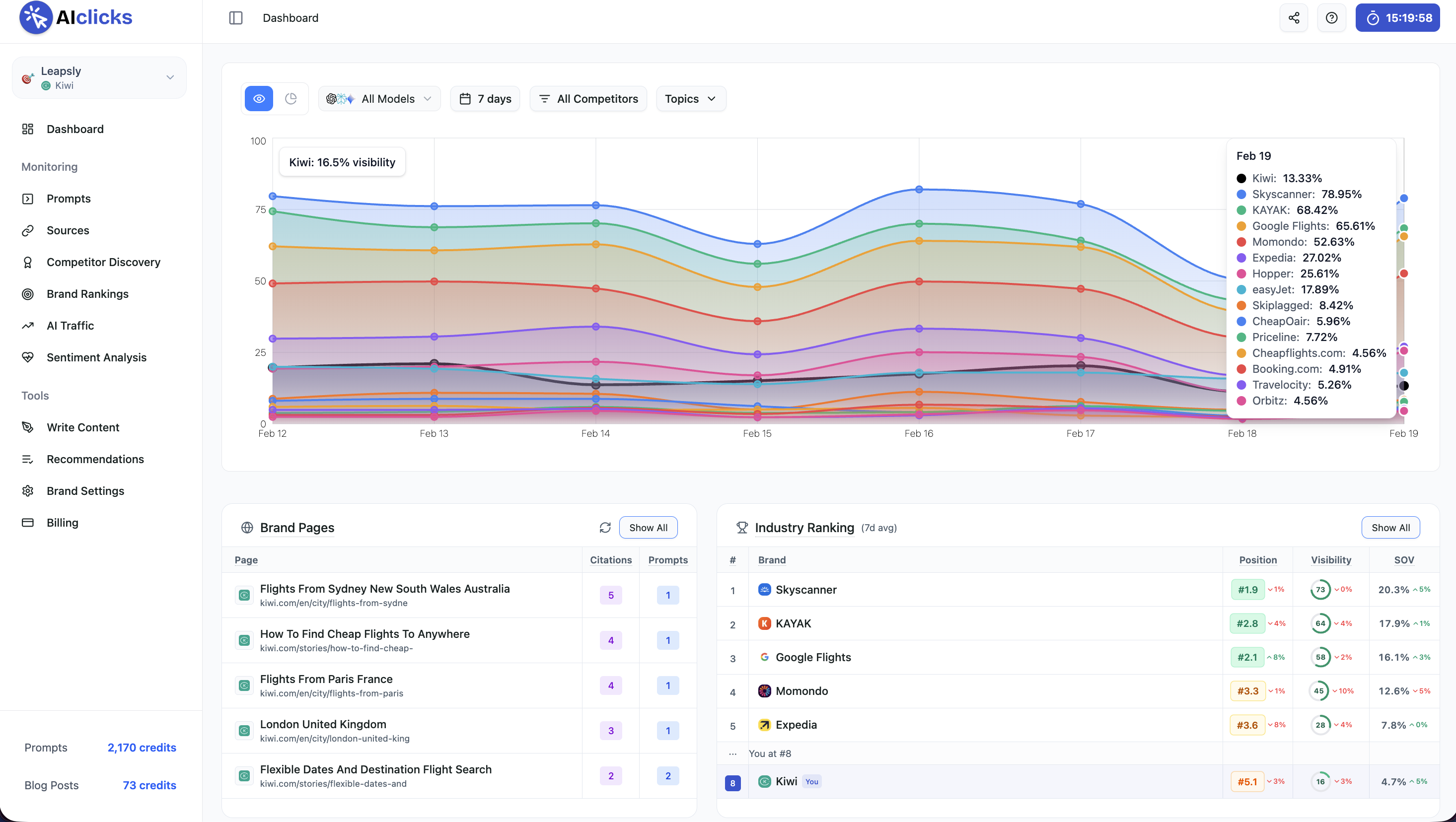
Best for: SMBs and agencies that want affordable AI visibility tracking
Key features:
AEO monitoring across six major LLMs
Citation Intelligence explaining which sources engines trust
Prompt discovery
Recommendation engine
Region and language testing
Pros
Accessible starting price
Broad LLM coverage for the cost
Prompt-level analytics designed for marketers
Trial and refund policy lowers adoption risk
Cons
Newer platform with limited validation
Limited depth in traditional SEO analysis
Limited third-party reviews
Vendor claims can be hard to validate
Pricing: Starts at $39/month (promo Starter); $79/month standard; enterprise pricing varies.
Who it fits: Small teams and agencies that want prompt-level monitoring with lightweight readiness guidance.
8. Scrunch
Best for: Enterprise brands and agencies focused on how AI systems consume and represent content
Key features:
Agent Experience Platform (AXP) for AI-readable site versions
Readiness flags for technical barriers
Knowledge Hub for outdated information detection
Journey mapping for AI perception across the funnel
Persona and funnel-stage visibility tracking
Pros
Distinct “AI-first audience” approach
Strong enterprise posture (security, governance)
Agency plans for multi-client management
Cons
No built-in content creation
Entry tiers limit engine coverage and retention windows
Higher tiers can increase cost quickly
Product maturity varies by feature set
Pricing: Starts at $100/month (ChatGPT only); higher tiers expand engine coverage and limits.
Who it fits: Teams that want AI consumption and representation insights, especially across personas and journeys.
Learn more about how Scrunch compares to AirOps here.
9. AthenaHQ
Best for: Scale-ups and SaaS companies that want to validate AI representation before publishing
Key features:
Pre-publication simulations for major models
Citation tracking and brand description monitoring
Action Center for sprint planning
Multi-model tracking
Support for multimodal improvements
Pros
Strong pre-publication simulation concept
Built for teams that want to reduce surprise after publishing
Enterprise features like SSO and onboarding support
Cons
Credit-based pricing can complicate budgeting
Limited public documentation for some advanced capabilities
Smaller customer base than legacy enterprise suites
Pricing: Self-serve from $295/month with credits; enterprise pricing varies.
Who it fits: Teams that want to test AI answers before pushing major changes live.
Learn more about how AthenaHQ compares to AirOps here.
Close the citation gap with a system, not another report
AEO readiness analysis only creates value when it leads to shipped updates. The teams earning more citations treat readiness as an ongoing operating motion, not a quarterly audit. They connect diagnostics directly to execution so citation gaps turn into prioritized refreshes, approved updates, and published improvements without adding headcount.
AI citations now shape which brands buyers discover and trust. The right approach helps you identify blockers, focus on high-impact pages, and move from insight to publication in one motion.
Track citation trends, not snapshots. According to a recent AirOps webinar on AEO insights from HubSpot, 50% of cited pages change every month. Build weekly or monthly tracking into your workflow. Prioritize refresh based on citation loss so the pages slipping first get fixed first.
Close gaps before they compound. Research on citations and AI visibility shows 40% of brands that lose visibility can resurface by addressing citation gaps. The window narrows the longer gaps stay open.
Connect diagnostics to execution. Readiness analysis creates value only when it drives published updates. Route findings directly into content workflows so fixes ship in days, not quarters. AEO gap analysis tools software turns those findings into a prioritized refresh queue.
AirOps connects multi-engine visibility tracking, page-level prioritization, and governed content updates in one platform. Teams can identify citation gaps, route updates through review, and publish improvements without juggling separate systems. Behind the platform, the AirOps team builds and runs the strategy alongside yours, and ties the work back to pipeline and revenue growth.
Book a demo to see how AirOps helps teams turn AEO readiness insights into published updates at scale.
Why one-time AEO audits fall short
A single AEO audit tells you where you stand right now. It does not tell you where you will stand next week. AI citation landscapes shift faster than traditional search rankings, and static reports cannot keep up.
The data makes this clear. According to Aja Frost’s research shared in a webinar on AEO insights from HubSpot, 50% of cited pages change every single month. Nearly 6 in 10 cited pages show up once and do not appear again the next month.
Continuous monitoring with AEO analytics software for AI citation tracking catches what one-time audits miss.
Citation decay between audits. Pages that earn citations today can lose them within weeks. Research on stale content and AI visibility shows unrefreshed pages experience up to 3x citation loss. Without ongoing tracking, you will not see the decline until your next audit.
New competitor entries. Competitors publish and optimize constantly. A new page from a rival can displace your cited content between quarterly reviews. Continuous tracking alerts your team the moment a competitor takes a citation you held.
LLM model updates and re-ranking. AI providers update their models regularly. Each update can reshuffle which pages get cited for the same query. Only ongoing monitoring reveals whether a visibility drop comes from your content or from a model change.
Content freshness signals. LLMs favor recently updated content for many query types. A page that performed well six months ago may lose citations simply because it has not been refreshed. Continuous systems flag aging content before it falls out of citation results.
The teams winning in AI search treat AEO as an ongoing discipline, not a quarterly checkbox. Build a monitoring rhythm that matches the pace of change in the AI models you want to appear in. A good rhythm helps you diagnose why you dropped out of Perplexity citations before the drop spreads.
Frequently Asked Questions
FAQs
What is the best AEO readiness analysis tool for SEO teams?
The best AEO readiness analysis tool depends on whether you need monitoring, diagnostics, or execution. AirOps fits teams that want to connect readiness findings directly to governed content updates at scale, while Profound fits enterprise teams that prioritize broad multi-engine monitoring. SemAI fits B2B teams that want granular scoring, and AIclicks fits teams that need a low-cost starting point.
When should you use an AEO readiness analysis tool?
Use AEO readiness analysis when you manage a large content library, see competitors appearing in AI answers, or need to validate high-value pages before publishing. It is especially useful when you want to prioritize refreshes based on citation gaps rather than guess which pages to update. Teams that build AI visibility into ongoing workflows see the strongest results.
Are free AEO readiness tools worth it?
Free tiers can help you validate the use case and spot obvious citation gaps without committing budget. Most free plans cap engine coverage, tracked prompts/pages, and exports, so you will hit limits once you move from sampling to portfolio-wide work. If you need multi-engine analysis and ongoing iteration, paid tiers usually make sense.
How do AEO readiness analysis tools work?
AEO readiness tools test how AI engines respond to your target prompts, measure mentions and citations, and analyze which sources AI engines trust. They diagnose gaps in content structure, entities, and evidence that make content difficult for AI systems to extract or cite, then recommend updates that improve citation likelihood. The strongest platforms connect those recommendations to production so teams can ship fixes without rebuilding the process elsewhere.
Can AI automate content readiness assessment?
AI can automate monitoring, scoring, and prioritization, which removes a lot of manual analysis work. Teams still need human review to confirm accuracy, protect brand voice, and validate claims before publishing. You get the best results when automation drafts and routes changes, and editors approve what ships.
Do I need AEO readiness tools if I already use Ahrefs or Semrush?
Yes, because Ahrefs and Semrush focus on rankings, backlinks, and technical SEO, not whether AI engines cite you. They cannot show how your brand appears inside AI answers or what changes increase citation likelihood across ChatGPT, Perplexity, or Google AI surfaces. AEO readiness tools answer a different question: not “does this rank?” but “will AI cite this?”
How do I detect poor AEO formatting across my site?
Run your pages through an AEO readiness tool that scores formatting at the page level. It flags weak heading hierarchy, dense passages, and missing FAQ structure that block AI engines from extracting answers. Fix those structural gaps first, then re-check citation eligibility.
What tools can scan articles for AEO readiness?
AirOps, Profound, and SemAI all scan articles for AEO readiness, each with a different focus. AirOps pairs page-level readiness scoring with governed content updates, so you scan and fix in one system. Profound covers the most AI engines, and SemAI offers granular per-metric scoring.
Which AEO gap analysis tool shows missing citations, missing brand mentions, and where competitors win in AI answers?
AirOps surfaces missing citations, missing brand mentions, and the pages where competitors win AI answers, then routes fixes into governed content updates. Profound and Goodie AI also flag competitive gaps across multiple engines. Choose the tool that connects gap analysis directly to publishing, not just reporting.
Which AEO tools provide the most insightful citation analysis and reports?
AirOps combines AI citation data with Google Search Console and GA4 metrics at the URL level, giving teams the deepest citation analysis and reports. Profound reports across 10+ engines, and AIclicks offers Citation Intelligence at a low starting price. The most insightful reports connect citation trends to the specific pages you act on.
What is a good citation rate for AEO?
A good AEO citation rate climbs over time and beats your topic's competitive average, not a fixed number. Citation rate measures the share of AI answers that cite your page for a tracked prompt. Benchmark it against competitors in your category, and watch the weekly trend instead of any single snapshot.
How does citation analysis work in AEO?
Citation analysis in AEO tracks which of your pages and passages AI engines cite, then maps the gaps where competitors get cited instead. AEO analysis tools test your target prompts across ChatGPT, Perplexity, and Google AI, record every citation and mention, and score which URLs to fix first. That turns raw AI answers into a prioritized list of pages to refresh.
Get the latest on AI content & marketing
