- AI summaries are driving 46.7% fewer clicks, forcing marketing leaders to move beyond rank tracking into Answer Engine Optimization (AEO) and Generative Engine Optimization (GEO).
- AthenaHQ is strong for GEO analytics, but many teams want more predictable pricing and built-in workflows to fix visibility drops, not just monitor them.
- This guide compares 9 leading AthenaHQ alternatives, including enterprise suites like Semrush and Conductor, AI visibility trackers like Profound and Peec.ai, and execution-focused platforms like AirOps.
- AirOps stands out by connecting AI visibility data directly to action, combining Page360 analytics with automated content refresh and creation workflows.
- AI search requires more than dashboards. It requires an engine that can diagnose, prioritize, and ship improvements at AI speed.
Users clicking 46.7% less when AI summaries appear. This shift forces marketing leaders to find tools that do more than track rankings—they need to monitor and influence Generative Engine Optimization (GEO) or Answer Engine Optimization (AEO).
AthenaHQ has built a strong reputation for GEO analytics, but many leaders are now looking for other options. You might find the credit-based pricing model unpredictable, or perhaps you feel limited by a dashboard that shows you what is happening but lacks the workflows to fix it. You are not alone in needing a platform that bridges the gap between seeing a problem and solving it.
This guide covers 9 top alternatives to AthenaHQ. We include everything from enterprise SEO suites to specialized AI trackers and content engineering platforms. You will find the right tool for your specific budget, operational maturity, and need for execution.
These AthenaHQ competitors range from enterprise SEO suites to LLM visibility tools built for the AI search era.
What Is AthenaHQ?
AthenaHQ is a GEO and AEO tool that tracks your brand's visibility across AI search engines like ChatGPT, Perplexity, and Gemini.
It's built for analytics. The platform monitors LLM citations using proprietary metrics (ACE and QVEM), includes an Action Center for content tweaks, and offers enterprise features like RBAC and SSO. That makes it popular with enterprise teams and agencies. Like most LLM visibility tools, it reports where AI engines cite you, but it stops at analytics rather than fixing the gaps it finds.
Why Look for AthenaHQ Alternatives?
Cost predictability creates budget friction. AthenaHQ uses a credit-based pricing model where one credit equals one AI response. Teams often burn through credits faster than expected, especially when monitoring multiple regions or engines, which makes forecasting monthly spend difficult.
The gap between insight and action slows progress. While AthenaHQ provides excellent analytics, it focuses primarily on measurement. Leaders often need platforms that go beyond flagging a visibility drop to providing the automation and workflows required to fix it immediately, such as programmatic content refreshes. That gap matters because AI visibility is volatile. Only 30% of brands stay visible from one AI answer to the next, so AI search monitoring tools need to track trends continuously, not in one-off snapshots.
High entry barriers limit lean teams. The pricing structure and enterprise focus can be prohibitive for startups and mid-market teams. Organizations that need a low-risk "baseline monitoring" solution often find the entry costs too high to justify before proving ROI. Lower-cost AI visibility tools now close much of that gap, so lean teams can start tracking AI search mentions without an enterprise contract.
Integration needs go beyond basic connections. Modern content teams need deep integration into their existing stacks. You might require visual workflow builders that allow you to design custom logic for how AI interacts with your data, rather than just standard CMS connections. AI search changed how results look, not what buyers need. The best alternatives strengthen your SEO and AEO work rather than replace it, a point from a recent AirOps webinar.
What to look for in an AthenaHQ alternative
The best AthenaHQ alternatives track more than citations. The best AEO software also benchmarks your brand against competitors across LLMs, so you spot gaps before they widen. Weigh these capabilities before you pick an AEO platform:
- Share of voice across answer engines, so you see how often AI cites you versus competitors.
- Google AI Overviews tracking alongside ChatGPT, Perplexity, and Gemini coverage.
- Region-based prompts and reporting for teams tracking AI visibility across markets.
- Sentiment monitoring that shows how AI search describes your brand, not only whether it mentions you.
- The number of LLMs tracked, since coverage varies widely between tools.
- Brand visibility tracking that ties AI mentions back to the pages and prompts driving them.
- Both mention and citation tracking, since brands that earn a citation and a mention are 40% more likely to resurface in AI answers than brands earning citations alone.
- Automated reporting and scheduled exports, so the AEO tools you pick push visibility data into the dashboards your team already uses.
The Best AthenaHQ Alternatives in 2026
1. AirOps: Best for LLM Visibility & AI Content Workflows
Overview
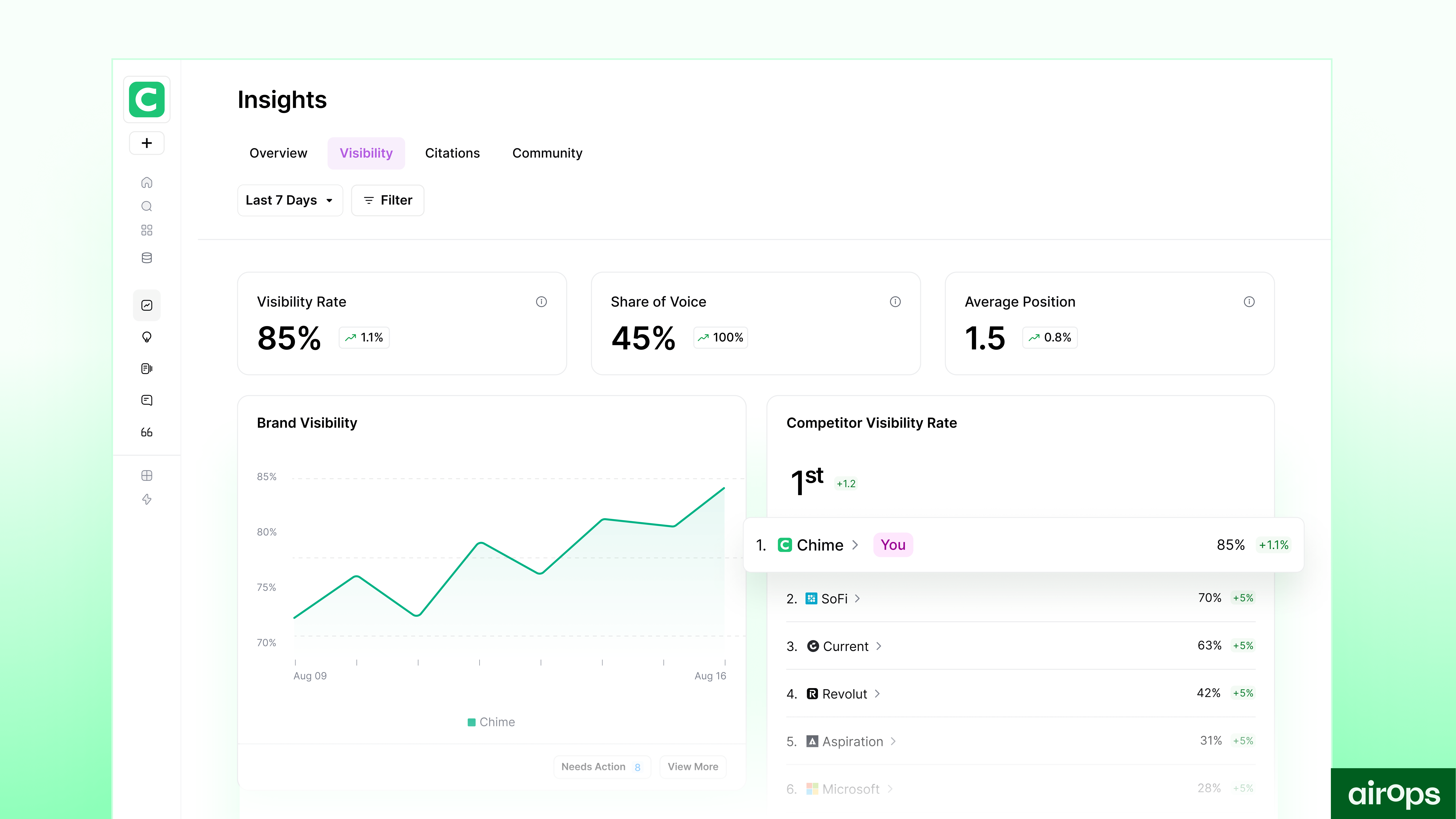
AirOps is an end-to-end, enterprise-grade content engineering platform for AI search. It bridges the critical gap between deep analytics and execution at any volume. While many tools stop at telling you where you are losing visibility, AirOps connects those insights directly to the workflows needed to fix them. We built it for teams that need to measure performance and then take precise, automated action to improve it.
Key Features
- Page360: A unified performance layer that combines SEO metrics from Google Search Console (GSC), AI search signals, and web analytics from Google Analytics 4 (GA4) into a single view to diagnose content health.
- Opportunities Engine: An AI prioritization system that surfaces high-impact actions, such as "Creation Opportunities" (gaps where competitors are cited) and "Refresh Opportunities."
- Action Layer (Grid & Workflows): A visual workflow builder and spreadsheet-like interface that allows you to run complex, multi-step AI workflows at scale.
- Brand Kits & Knowledge Bases: Centralized governance ensures all AI-generated content adheres to strict brand voice and factual accuracy.
- Multiple AI Models: Access to over 20 models from OpenAI, Anthropic, Google, and Groq with direct cost control.
- AirOps Anywhere: Brand Kit context and AEO integrations available in Claude through the AirOps Claude connector.
Best For
SEO and Content Directors who want to move beyond passive monitoring and build an "always-on" engine for refreshing content and capturing new AI search demand. It pairs AI visibility tracking with answer engine optimization workflows that ship on a schedule.
Pros
- Connects visibility data directly to automated execution workflows.
- Unified view of SEO and AI metrics simplifies prioritization.
- Bulk operations allow you to update thousands of pages at once.
- Flexible pricing model allows for easy entry and scaling.
Cons
- Requires setup of workflows to unlock full execution value.
- Includes more comprehensive features than simple rank trackers.
Pricing
- Insights: Free tier available.
- Solo: Starts free.
- Pro: Starts free.
- Enterprise: Custom pricing with dedicated support.
2. Profound: Best for Enterprise AEO & Server-Side Tracking
Overview
Profound focuses strictly on LLM visibility through consumer-side capturing and server-side tracking. You see what users actually see, not sanitized API output. Learn more about Profound and other helpful LLM visibility tools.
Key Features
- Agent Analytics: Server-side tracking captures AI crawler behavior (e.g., OAI-SearchBot) that client-side tools miss.
- Consumer-First Data: Captures AI responses from the actual front-end experience.
- Compliance: SOC 2 Type II and HIPAA certified for regulated industries.
- Multi-Engine Monitoring: Tracks 10+ AI engines including ChatGPT and Perplexity.
Best For
Enterprise organizations in regulated industries (healthcare, finance) that need strict compliance and deep bot visibility.
Pros
- High-fidelity data reflects real user experience.
- Strong security and compliance certifications.
- Server-side tracking reveals hidden crawler activity.
Cons
- Higher barrier to entry for smaller teams.
- Monitoring-focused, not built for content workflows.
Pricing
- Starter: $99/month.
- Growth: $399/month.
- Enterprise: Custom pricing.
3. Scrunch: Best for AI Visibility & Agent Experience Optimization
Overview
Scrunch combines monitoring with a delivery layer that serves optimized content directly to AI agents, maximizing retrieval by giving bots exactly what they need. Find out more about how Scrunch and AirOps stack up to Athena.
Key Features
- Agent Experience Platform (AXP): Intercepts AI traffic and serves stripped-down, AI-optimized versions of your site.
- Comprehensive Monitoring: Tracks 8 platforms including Google AI Mode and Copilot.
- Influence Score: Prioritizes citation sources by frequency and prompt volume.
- Traffic Analysis: Measures AI agent and human referral traffic.
Best For
Technical SEO teams optimizing site architecture for AI crawlers.
Pros
- Unique delivery layer for AI agents.
- Broad platform coverage.
- Strong technical SEO focus.
Cons
- Requires technical implementation.
- 90-day historical data limit.
Pricing
- Explorer: $100/month.
- Growth: $500/month.
- Enterprise: Custom pricing.
4. Conductor: Best for Unified Enterprise SEO & AEO Intelligence
Overview
Conductor is a premium enterprise SEO platform that has integrated Answer Engine Optimization (AEO) intelligence. It provides a single "command center" for both traditional and AI search. This allows large teams to consolidate their stack and view all search performance data in one place.
Key Features
- Unified Data Engine: Connects AI visibility, rank tracking, and technical health in one platform.
- API-First Data Collection: Uses official APIs for data collection to ensure stability and compliance.
- Security: ISO 42001 certification for AI systems ensures enterprise-grade security.
- Content Guidance: AI-driven optimization recommendations based on search data.

Best For
Large enterprises already using Conductor for SEO who want to consolidate their stack and require high-touch support.
Pros
- Seamless integration of SEO and AEO data.
- High security standards and certifications.
- Excellent customer support and educational resources.
Cons
- High cost makes it inaccessible for smaller teams.
- The platform tracks ranks weekly by default, not daily.
Pricing
- Custom: Value-based pricing (generally premium/high-cost).
5. Peec.ai: Best for Authentic UI-Based Visibility Tracking
Overview
Peec.ai is a specialized analytics platform that uses User Interface (UI) scraping and browser automation. It replicates the exact user experience of AI search to provide "authentic" data. This approach captures visual elements like source sidebars that API-based tools might miss. Compare Peec and AirOps for LLM visibility to see which one fits your needs.
Key Features
- Authentic Data: Captures "chats" via browser automation to see exactly what a user sees.
- Unlimited Seats & Countries: Pricing model allows for unlimited team members and geographic tracking.
- Source Analysis: Distinguishes between "Citations" (text references) and "Sources" (background processing).
- Sentiment Analysis: Scores brand perception in AI responses.
Best For
Agencies and international marketing teams that need cost-effective, granular visibility tracking across multiple regions without per-seat costs.
Pros
- Captures the true visual experience of AI search.
- Generous limits on seats and countries.
- Fast setup and intuitive interface.
Cons
- No built-in content generation workflows.
- Data collection is daily, not real-time.
Pricing
- Starter: €89/month.
- Pro: €199/month.
- Enterprise: Custom pricing.
6. Rankshift: Best for Flexible, Credit-Based AI Monitoring
Overview
Rankshift is an analytics-focused platform built for the "zero-click era." It offers flexible, credit-based monitoring of AI visibility. The platform emphasizes capturing data directly from the user interface to ensure accuracy in reporting share of voice and sentiment.
Key Features
- UI-Captured Data: Captures responses directly from the user interface rather than APIs.
- Unlimited Users & Projects: Removes friction for agency collaboration and multi-brand management.
- Looker Studio Integration: Strong native connectors allow you to pipe data into custom BI dashboards.
- Crawler Analytics: Tracks AI model crawler behavior on your site.
Best For
Agencies and data-driven marketers who want raw visibility data to pipe into custom BI dashboards and need flexibility in allocation.
Pros
- Flexible credit model suits varying needs.
- Strong reporting integrations for agencies.
- Unlimited users and projects reduce friction.
Cons
- No content creation or optimization features.
- Credit consumption can be hard to predict.
Pricing
- Starter: ~€69/month.
- Professional: ~€159/month.
- Business: ~€359/month.
7. Writesonic: Best for Unified SEO & AI Content Creation
Overview
Originally an AI writing tool, Writesonic has evolved into a GEO platform. It combines visibility tracking with a robust content creation suite. This allows teams to monitor their AI presence and immediately generate optimized content to address any gaps.
Key Features
- Unified Workflow: Combines AI visibility tracking with an "Instant Article Writer" and SEO editor.
- Real-Time Scraping: Monitors real consumer web interfaces for data accuracy.
- AI Traffic Analytics: Server-side analytics track how AI crawlers discover your content.
- SEO AI Agent: Automates research, strategy, and content creation tasks.

Best For
Content marketing teams that want a single tool to both monitor their AI presence and immediately generate content.
Pros
- Seamless transition from tracking to writing.
- Server-side analytics provide unique insights.
- Affordable entry point for smaller teams.
Cons
- Workflow logic is less flexible than enterprise tools.
- Some advanced features are still in development.
Pricing
- Lite: $49/month.
- Standard: $99/month.
- Professional: $249/month (includes GEO tracking).
8. Frase: Best for Agentic SEO & Content Optimization
Overview
Frase is an "Agentic SEO" platform that consolidates research, writing, and optimization. It focuses on dual optimization, helping you rank on Google. The platform uses autonomous agents to handle repetitive tasks.
Key Features
- Frase Agent: Autonomous execution of research and brief generation tasks.
- Dual Scoring: Provides separate scores for traditional SEO and GEO (AI visibility).
- AI Search Tracking: Tracks 8 AI platforms with daily updates.
- Programmatic SEO: Generates pages from data using templates.
Best For
Freelancers, SMBs, and lean content teams looking for an affordable, all-in-one solution to research, write, and track.
Pros
- Very affordable pricing for the feature set.
- Unified workflow for SEO and GEO.
- Agentic capabilities save time on research.
Cons
- Support can be variable.
- AI writing quality may require human editing.
Pricing
- Starter: $39/month (billed annually).
- Professional: $103/month (billed annually).
- Scale: $239/month (billed annually).
9. Semrush: Best for Comprehensive Digital Marketing & Data Scale
Overview
Semrush is a massive digital marketing platform. It has added a dedicated "AI Visibility Toolkit" in its SEMRush One offering. This provides a unified view of traditional SEO, PPC, and AI search visibility backed by a massive data repository.
Key Features
- Data Scale: Massive databases for keywords (27B+) and backlinks (43T+).
- Semrush One: Bundles traditional SEO tools with AI visibility tracking.
- Content Toolkit: Integrated workflows for research, writing, and optimization.
- Market Intelligence: Deep competitive analysis and traffic estimation.
Best For
Marketing leaders who want a single, proven vendor for everything from PPC and Social to SEO and AI visibility.
Pros
- Unmatched breadth of data and features.
- Consolidates multiple marketing tools.
- Strong educational resources and community.
Cons
- Pricing can become expensive with add-ons.
- Steep learning curve due to feature density.
Pricing
- Semrush One Starter: $199/month.
- Pro+: $299/month.
- Advanced: $549/month.
10. Qwairy
Overview
Qwairy is a Generative Engine Optimization (GEO) platform that helps brands monitor and grow their visibility across AI search engines like ChatGPT, Perplexity, Gemini, Copilot, and Grok.
Qwairy is built around actionability, translating visibility data into concrete recommendations so marketing and SEO teams know exactly what to do next to get cited more by AI models. Qwairy also offers a native MCP (Model Context Protocol) integration, allowing teams to connect their GEO data directly into AI workflows and tools like Claude.
Key Features
- AI Visibility Monitoring: Tracks brand mentions, citations, and sentiment across 10+ AI engines (ChatGPT, Perplexity, Gemini, Claude, Grok, Copilot, DeepSeek, Google AI Mode, and more) using both API and UI-based data collection.
- Content Opportunities with Dual Gap Scoring: Pinpoints exactly which content to create to gain AI citations, using Brand Gap and Source Gap scoring to show where competitors are referenced instead of you.
- Backlink Opportunities with Marketplace Comparison: Identifies high-value backlink prospects from actual AI citations, and uniquely compares prices across 32+ backlink marketplaces so you can act on them at the best cost.
- GEO Strategy Chat: A unique conversational interface that lets you ask direct questions about your GEO strategy and get instant, data-driven recommendations, a capability no other platform currently offers.
- Native MCP Integration:" Connect Qwairy's GEO data directly into AI tools like Claude, enabling teams to query their visibility data, surface opportunities, and get strategic recommendations without ever leaving their AI workflow.
Best For
SEO professionals, marketing teams, and SEO agencies that don't just want to know where they stand in AI search, but want a clear, prioritized action plan to improve it.
Pros
- Uniquely action-oriented: moves beyond dashboards to deliver specific content to create, links to build, and strategy recommendations to implement
- Native MCP integration lets teams plug GEO data directly into their AI tools and workflows
- Covers 10+ AI engines with both API and UI-based data collection for maximum accuracy
- Unlimited team members on all plans, with fast 2-minute setup and a free trial (no credit card required)
Cons
- Relatively new platform with a growing review base on G2 (5/5 from early reviewers, but still accumulating volume)
- The depth of actionable features can feel like a lot for teams who only need basic monitoring
Pricing
- Starter: from €49/month - 57$ (billed annually). Up to 1 websites, 1,000 credits/month
- Growth: from €157/month - 182$ (billed annually). Up to 5 websites, 4,000 credits/month
- Business: from €374/month - 432$ (billed annually). Up to 20 websites, 10,000 credits/month
- Enterprise: Starting from €990/month -1090$. Custom integrations, white-label, dedicated support
- All plans include unlimited team members and access to all AI engines. Free trial available with 100 credits, no credit card required.
11. Airefs: Best for teams that want to start cheap and scale
Overview
Airefs is the only AEO tool in this list with a $24/mo entry point and a managed execution tier on the same platform. Teams can start tracking AI citations themselves, then hand off all execution to the Airefs team when they're ready to scale — without switching tools.
Key Features
- Low-cost entry: Lite plan at $24/mo includes prompt tracking on ChatGPT, source-level citation data, and competitor monitoring. No enterprise commitment required to get real data.
- Done-for-you tier: At $249/mo+, the Airefs team runs your AI search strategy for you — monthly strategy calls, AEO-optimized content creation and upload, and third-party placement outreach.
Pros
- Cheapest way into AEO tracking: $24/mo with a 7-day free trial on the Pro plan. 4.9/5 on G2. Most competitors start at $95–$295/mo for equivalent functionality.
- Article creation, comment drafting and backlink/brand mention opportunities included in the cheapest plan.
- Team execution included if you want it: The done-for-you tier is rare in this category. Most tools stop at surfacing opportunities — Airefs can act on them for you.
Cons
- Prompt tracking defaults to ChatGPT and Google AI Overviews. Other LLMs are available on request but not enabled by default.
- No historical data before signup. You can't backfill benchmarks or compare against performance before your account was created.
Pricing
- Plans range from $24/mo (Lite) to $83/mo (Expert).
- Done-for-you starts at $249/mo and includes content creation and community engagement managed by the Airefs team.
- All plans billed yearly; 7-day free trial on Pro.
How to Choose the Right AthenaHQ Alternative
The right tool depends on your team's specific constraints and goals. AirOps is the logical choice for teams that need to act on data, not just watch it. Weigh pricing, AI visibility tracking, and the AEO ROI each tool can prove before you commit. The strongest GEO tools and answer engine optimization tools pair tracking with execution, so you can turn AI visibility data into published content.
- Choose AirOps if you need to bridge the gap between insight and execution. If your team struggles to implement changes quickly, AirOps provides the workflows to fix visibility gaps immediately. It fits startups and enterprise teams that want actions, not just tracking.
- Choose Profound if you are in a highly regulated industry like healthcare or finance and need strict compliance and server-side tracking.
- Choose Peec.ai if you need cost-effective monitoring for multiple international regions without per-seat costs.
- Choose Semrush if you want a single, massive platform that covers everything from PPC to social media alongside SEO.
How to switch from AthenaHQ to an alternative
Moving off AthenaHQ is straightforward when you plan the switch in stages. Start by exporting your prompt list and historical benchmarks so you keep a record of past visibility.
Then map your must-have features to the new tool before you cancel the old one. Run both platforms in parallel for a few weeks to confirm the data lines up.
- Export your tracked prompts, competitors, and any saved reports from AthenaHQ.
- List the engines you need, such as ChatGPT, Perplexity, Gemini, and Google AI Overviews.
- Rebuild your prompt set in the new platform and tag prompts by topic and region.
- Run both AI search monitoring tools side by side for two to four weeks to validate the numbers.
- Confirm the new tool connects to your content workflow so you can act on gaps, not only watch them.
Do you need a GEO agency or a GEO tool?
Most teams need a GEO tool first, not an agency. A tool gives you direct visibility into how AI engines cite your brand, and it costs far less than retained services.
Generative engine optimization (GEO) services and agencies make sense when you lack the team to act on the data. Many buyers searching for GEO services really want a platform that pairs tracking with execution.
- Pick a tool if you have a content team and want to own the work in house.
- Pick a GEO agency if you need strategy and hands-on execution you cannot staff yet.
- Pick a platform like AirOps if you want both tracking and content execution in one place.
Final Thoughts: Choosing the Best AthenaHQ Alternative
The AI search market is exploding from $15.2B to $41.6B by 2033. You've got real LLM visibility tools and AEO alternatives now that fix AthenaHQ's pricing, execution, and workflow gaps.
Need pure monitoring? Profound and Peec.ai deliver. Want enterprise scale with traditional SEO? Semrush and Conductor work.
But if you know that seeing the problem isn't enough, AirOps is your answer. It's the only platform that connects insights (Page360) directly to action—so you can fix issues and ship content at AI speed.
Want to see it in action? Book a strategy session and we'll show you how it fits your team.
Frequently asked questions
What's an alternative tool to AthenaHQ?
AirOps is the strongest AthenaHQ alternative for teams that want to act on AI visibility data, not only track it. Profound, Peec.ai, and Semrush also work well, depending on your budget and whether you need pure monitoring or execution.
What other LLM visibility tools are like AthenaHQ?
AirOps, Profound, Peec.ai, and Rankshift all track LLM visibility across ChatGPT, Perplexity, and Gemini. AirOps stands apart by connecting that visibility data to the content workflows that fix the gaps it surfaces.
Are there cheaper AthenaHQ alternatives under $100 per month?
AirOps offers a free tier to start, and Frase ($39 per month), Writesonic ($49 per month), and Profound ($99 per month) are cheaper AthenaHQ alternatives under $100 per month. These lower-cost options trade some enterprise features for predictable pricing that suits startups and lean teams.
What are the best Semrush alternatives for GEO and AEO?
AirOps, Profound, and Conductor are the best Semrush alternatives for GEO and AEO. AirOps adds content execution workflows, while Profound focuses on server-side tracking and Conductor unifies SEO and AEO data for large enterprises.
Is Profound or AthenaHQ better for an SMB?
For a small or medium-sized business (SMB), AirOps is the strongest starting point, since it offers a free tier and connects AI visibility to action. Between the two, Profound suits SMBs that want affordable, compliance-grade monitoring, while AthenaHQ fits teams that want deep GEO analytics and can absorb credit-based pricing.
How is AthenaHQ different from tools like Profound?
AirOps pairs AI visibility tracking with the content workflows that improve it, which sets it apart from both. AthenaHQ focuses on GEO analytics with proprietary metrics, while Profound emphasizes server-side bot tracking and consumer-side data capture.
What are the best AthenaHQ alternatives for agencies?
AirOps, Peec.ai, and Rankshift are the best AthenaHQ alternatives for agencies. AirOps supports multi-client workflows and bulk content execution, while Peec.ai and Rankshift offer unlimited seats and flexible, credit-based monitoring for managing many brands.
When does AthenaHQ still make sense?
AthenaHQ still makes sense for enterprise analytics teams that want deep GEO metrics and can absorb credit-based pricing. If you need to act on visibility gaps, not only measure them, an execution platform like AirOps is the stronger fit.
How does AirOps compare to Clearscope and Frase for AI-powered SEO?
AirOps goes further than Clearscope and Frase by connecting AI visibility tracking to automated content workflows at scale. Clearscope focuses on content grading and Frase on agentic research and writing, while AirOps runs the refreshes and net-new pages that close AI search gaps.
Do you still need a GEO tool if you already use Semrush?
Yes, if AI search visibility is a priority. Semrush adds broad AI visibility tracking, but dedicated GEO tools and AI visibility tools give you deeper prompt-level data and, in the case of AirOps, the workflows to act on it.
AirOps for AthenaHQ alternatives
AirOps is the AthenaHQ alternative built for teams that need to act on AI visibility, not only track it. Page360 connects your AI search citations to Google Search Console and GA4 data, and Quill runs the content refreshes and net-new pages that close the gaps. AirOps brings this together as a partner, not just software to log into: the platform, the media mix, and the team that builds and runs the strategy alongside your team and ties it back to pipeline and revenue.
See how AirOps turns AI search insight into action. Book a strategy session.
Get the latest on AI content & marketing
