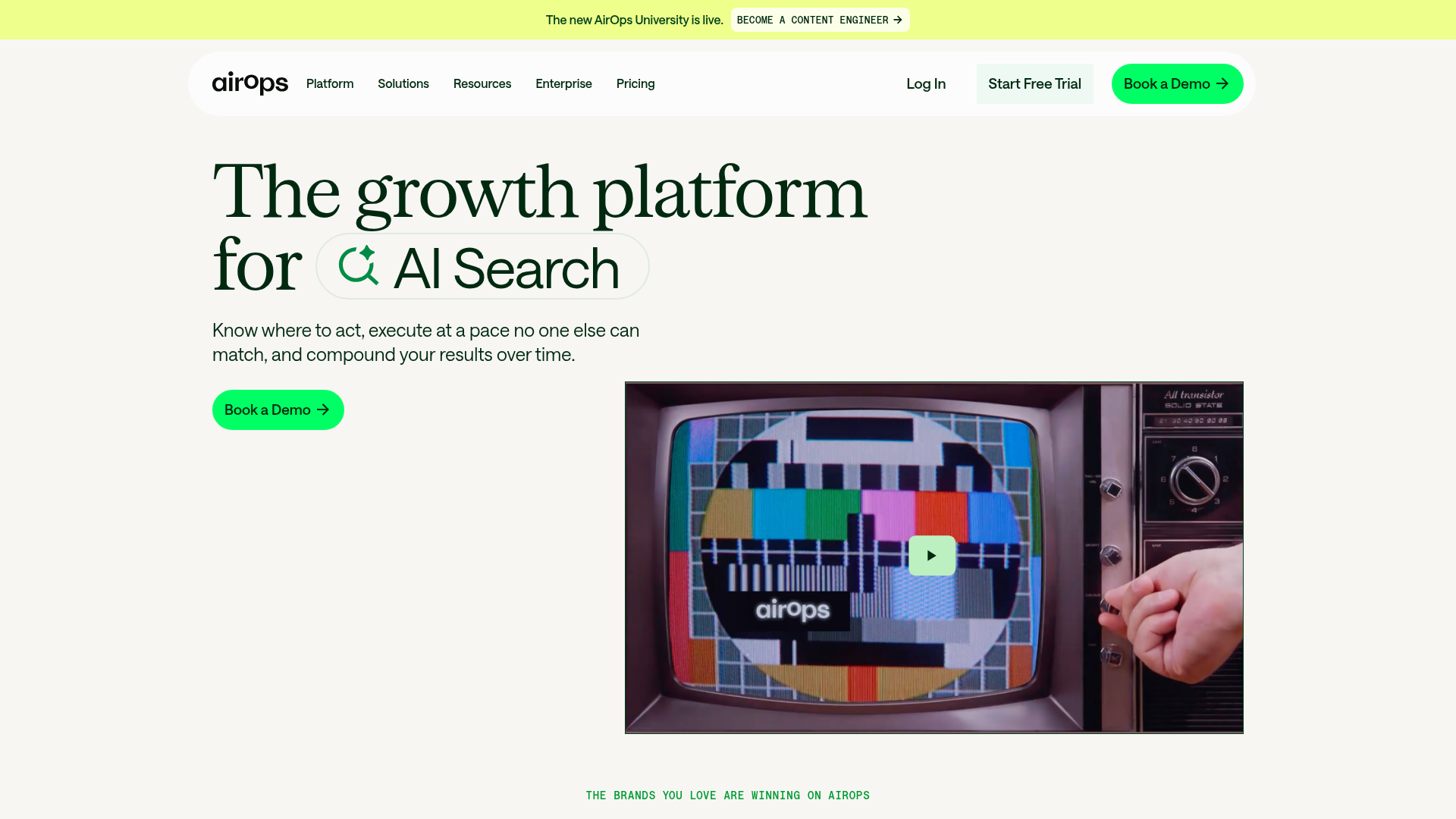
- AirOps is the growth platform for AI search, connecting Answer Engine Optimization (AEO) visibility insights to content execution and measurement in a unified workflow.
- MarketMuse is a content intelligence platform built around patented topic modeling, designed to help teams plan and prioritize traditional search engine optimization (SEO) content.
- Teams that need to monitor AI search visibility, execute content at scale, and measure performance will find AirOps covers the full workflow. Teams focused on SEO topic research and content briefs will find MarketMuse a capable planning tool.
- AirOps operates as a complete content operating system covering the full workflow from visibility monitoring through execution to performance tracking. MarketMuse plugs into the planning stage and relies on other tools for everything that follows.
AI search is reshaping how buyers discover brands. More than half of product research now starts in AI-powered answer engines like ChatGPT and Gemini rather than a traditional search engine results page (SERP). For enterprise content teams, this shift creates a new bottleneck: planning content for one channel while the fastest-growing discovery channel goes unmonitored.
AirOps and MarketMuse both serve content teams, but they solve different parts of the problem. AirOps connects AI search visibility to execution and measurement. MarketMuse helps you plan what to write based on topic modeling and SEO signals.
This article breaks down features, architecture, pricing, and real-world fit so you can decide which platform matches your team in 2026.
AirOps vs MarketMuse at a glance
Among AI content optimization tools, AirOps delivers faster time-to-value because your team can start tracking AI search visibility quickly, then scale into execution workflows. MarketMuse requires a sales conversation to get started and additional tools to act on the briefs it creates.
AirOps vs MarketMuse: platform overview
AirOps is the growth partner for AI search, built to connect insight, action, and measurement in a single system. It serves enterprise content teams that need to understand how their brand appears across AI answer engines, improve that visibility, and track what moves. AirOps is purpose-built for content directors who run large teams and need a governed, scalable system.
MarketMuse is a content intelligence platform that uses patented topic modeling to help teams plan and prioritize SEO content. It's designed for content strategists who need to identify topical gaps and generate detailed briefs. MarketMuse fits teams that operate in traditional search and want data-driven guidance on what to write next. Following its acquisition by Siteimprove in October 2024, its roadmap is part of a broader digital experience suite.
Core features: how AirOps and MarketMuse stack up
AirOps features
- Quill
- Quill runs Playbooks across content creation, refresh, and AI search optimization, operating on the insights AirOps surfaces. Your team sets the strategy. Quill runs the execution.
- Your content team stops spending hours on manual updates and instead reviews and ships at a pace that matches how fast AI search results change.
- MarketMuse has no autonomous agent; every brief it produces requires manual execution in a separate tool.
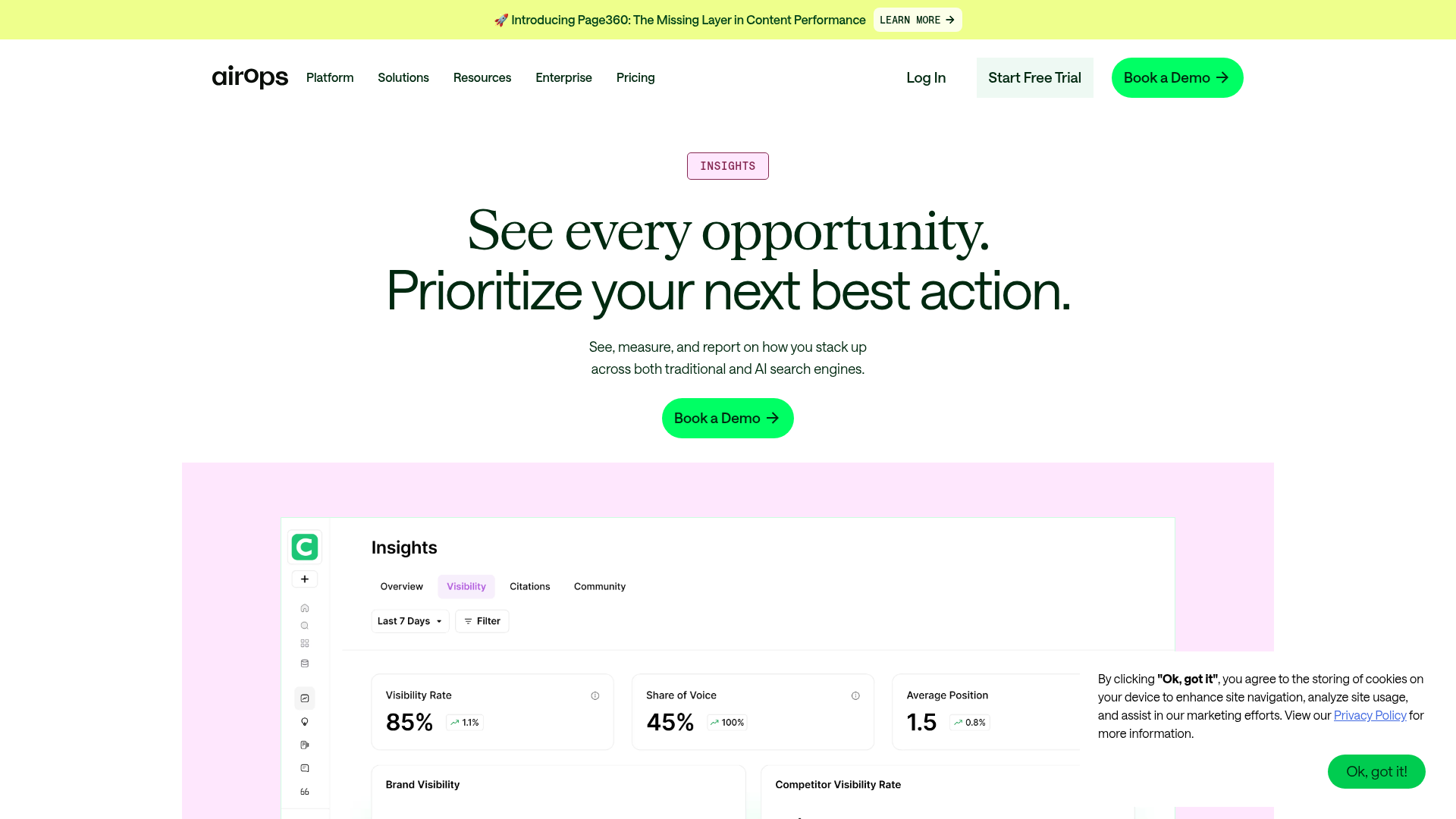
- Page360 unified view
- Page360 connects GSC, GA4, and AI citation data into a single page-level view.
- Your team prioritizes based on complete data instead of switching between dashboards.
- MarketMuse scores content against its topic model but doesn't integrate GSC, GA4, or AI search signals.
- Prompt Discovery from four intent sources
- Prompt Discovery surfaces the questions buyers ask AI search engines before they reach your site, pulling from four distinct intent sources.
- You uncover the exact prompts driving AI-powered discovery so your content targets the queries that matter.
- MarketMuse focuses on traditional keyword research and doesn't track what questions buyers ask AI answer engines.
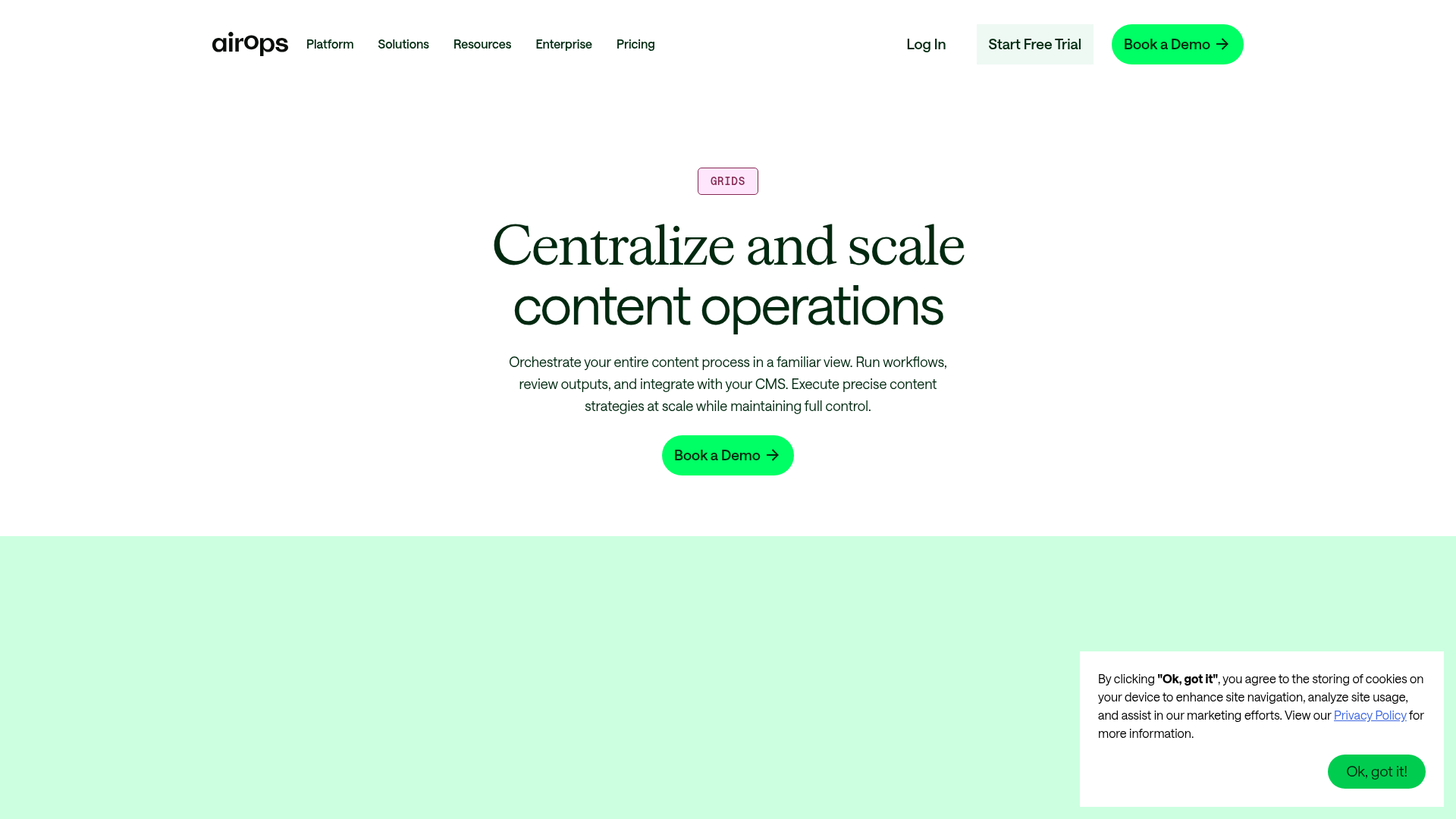
- Grids for bulk operations
- Grids run bulk content operations across hundreds of pages in a spreadsheet-like interface with built-in workflow execution.
- Your team handles at scale what used to require page-by-page work, cutting production time from weeks to hours.
- MarketMuse caps output at 20 briefs per month on its highest tier with no bulk operations interface.
- Brand Kits
- Brand Kits store your brand voice, writing rules, audience profiles, and terminology as persistent governance that every workflow respects.
- Your entire team produces brand-consistent content without manual style guide checks because governance is built into the system.
- MarketMuse offers per-brief tone settings but has no persistent brand governance, knowledge base, or reusable brand context.
- AirOps MCP with 35+ tools
- AirOps MCP exposes 35+ tools through the Model Context Protocol (MCP), letting AI assistants like Claude read your AEO data and trigger workflows directly.
- Your team extends AirOps into the AI tools they already use without engineering support.
- MarketMuse has no MCP support and no external AI connectivity beyond its own editor.
- Offsite
- Offsite manages third-party publisher placements and grows your brand's AI citation share by building consensus signals across the sources large language models (LLMs) reference.
- Most brand discovery in AI search happens through third-party sources. Offsite closes that gap.
- MarketMuse focuses exclusively on your own content and has no offsite visibility, outreach, or citation-building capabilities.
- Query Fan-outs
- Query Fan-outs reveal the sub-queries AI engines run behind each prompt, showing the internal search chains that determine which sources get cited.
- You optimize content for the signals that drive AI citations rather than guessing which keywords matter in an LLM's retrieval process.
- MarketMuse analyzes traditional SERPs but has no visibility into how AI engines decompose queries internally.
- Closed-loop execution
- Closed-loop execution maps every content action to a visibility signal so you can attribute AI search performance changes to specific campaigns.
- You prove content return on investment (ROI) to leadership with data that ties execution to outcomes.
- MarketMuse measures content quality against its topic model but doesn't track downstream AI search performance or connect publishing to visibility changes.
MarketMuse features
- Patented topic modeling
- MarketMuse uses US Patent 10,409,875 to map semantic relationships between concepts, identifying content gaps and topical coverage opportunities.
- Content strategists get data-backed guidance on which topics to cover, reducing guesswork in editorial planning.
- AirOps approaches content planning through AI search demand signals (Prompt Discovery, citation data) rather than a static topic model based on traditional SERP analysis.
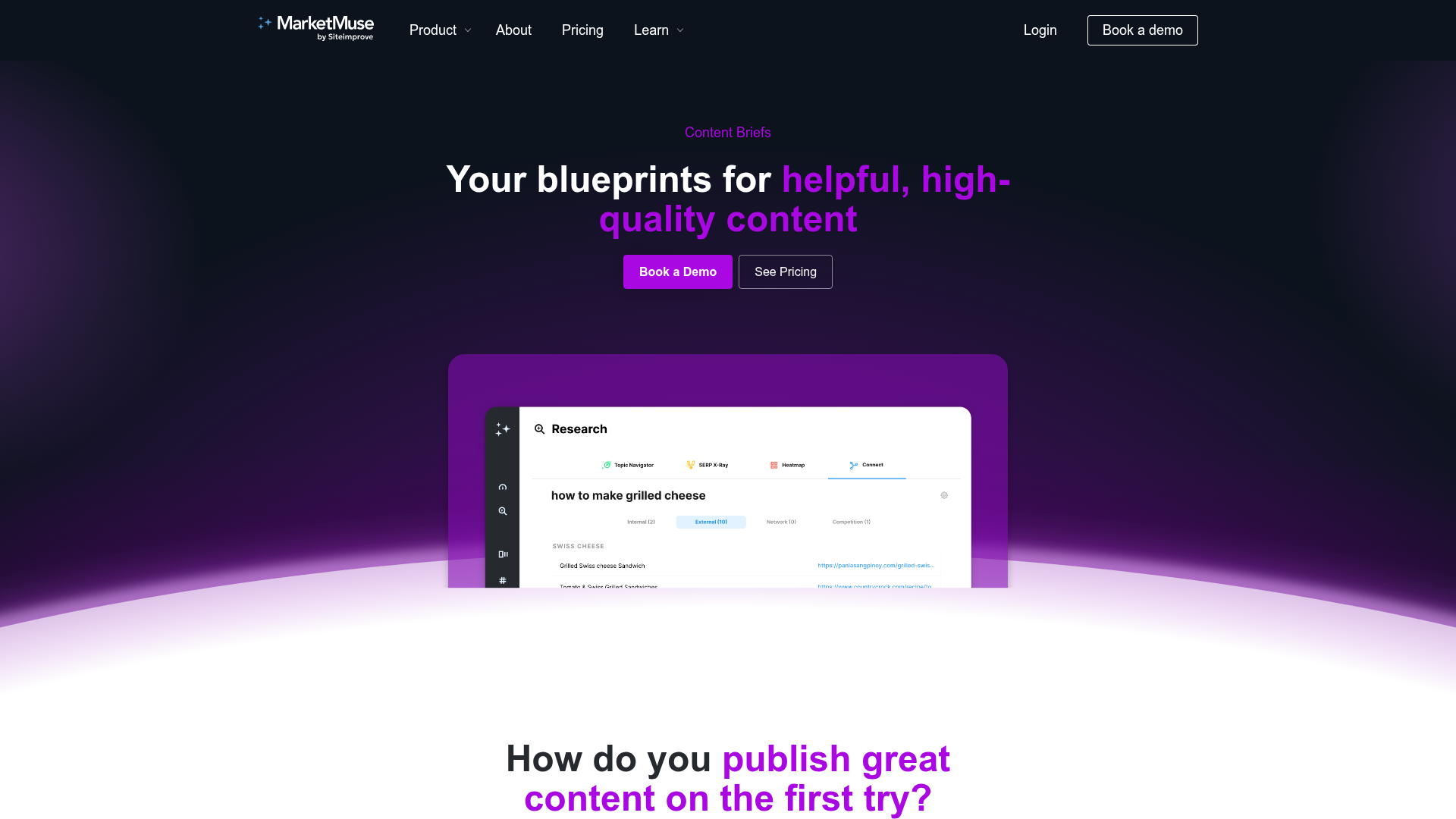
- Content Briefs (9 types)
- MarketMuse generates nine brief formats (Article, Comparison, FAQ, Guide, How-to, Listicle, Local, News/Event, Product Review) pre-populated with topic recommendations.
- Writers receive structured guidance before drafting, which speeds up the briefing process and standardizes expectations.
- AirOps handles briefing as one step in a full workflow. Quill generates briefs and drafts, then publishes. MarketMuse treats briefing as the primary deliverable.
- Content Inventory
- Content Inventory audits your entire site, scoring each page against MarketMuse's topic model and flagging pages that need updates or consolidation.
- Content directors get a site-wide view of content health without manual spreadsheet audits.
- AirOps surfaces similar prioritization through Page360 and Insights but adds AI search visibility metrics and GSC/GA4 data that MarketMuse doesn't include.
- Personalized Difficulty metrics
- Personalized Difficulty scores how hard it would be for your specific site to rank for a given topic, factoring in existing authority.
- You avoid wasting resources on topics where you're unlikely to compete and focus on high-opportunity areas instead.
- AirOps focuses on AI search citation likelihood rather than traditional ranking difficulty.
- SERP analysis tools
- SERP X-Ray and SERP Heatmap tools visualize how competitors cover topics on the traditional results page, revealing content gaps you can target.
- SEO teams get a visual map of competitive content strategy that makes it easier to brief writers.
- AirOps tracks competitor visibility across AI answer engines beyond traditional SERPs, giving you competitive intelligence in the growing channel.
What feature differences mean in practice: AirOps covers the full content lifecycle from AI search insight through governed execution to measurement. MarketMuse specializes in planning and briefing. Teams that rely on MarketMuse still need additional tools to draft, publish, and measure content. Teams on AirOps consolidate those steps where each action feeds data back into the next decision.
The content refresh comparison between AirOps and MarketMuse is the clearest example. AirOps ships the updates and tracks the results, and MarketMuse stops at pointing to what needs work.

Product architecture overview: AirOps vs MarketMuse
Data system
The data each platform collects determines what decisions your team can make.
Data sources and integrations: AirOps pulls data from five AI search engines daily, plus GSC, GA4, and content management system (CMS) platforms through 30+ integrations. MarketMuse collects traditional SERP data and runs it through its proprietary topic model. It exports to Google Docs and WordPress but doesn't connect to AI search engines, GSC, or GA4.
Data accuracy and freshness: AirOps updates AI search visibility data daily. MarketMuse refreshes its topic model periodically, but because it doesn't track AI search, there's no freshness metric for the channel where buyer behavior is shifting fastest.
Data portability: AirOps supports data export through Grids, API, and MCP tools that push data into other systems. MarketMuse exports briefs to Google Docs or Word with a limited API.
Prioritization of opportunities
Knowing what to work on next is where good data becomes valuable.
Decision engines and scoring: AirOps scores opportunities by combining AI citation rates, mention rates, and traditional search performance into a unified prioritization view. MarketMuse scores content against its topic model using Content Score and Personalized Difficulty. AirOps factors in AI search signals that MarketMuse doesn't capture.
AI-powered recommendations: AirOps generates actionable recommendations tied to AI search visibility: refresh this page to improve citation rate, create content targeting this prompt cluster, build offsite mentions for this topic. MarketMuse recommends topics to cover based on competitive SERP analysis.
Integration of signals: AirOps combines AI citations and brand mentions into a single decision surface alongside organic traffic data. MarketMuse integrates its own topic scores with SERP data but doesn't pull in traffic or AI search signals.
Workflow building and automation
The gap between knowing what to do and doing it is where most content teams lose time. AirOps supports AI workflow automation that most competitors do not. Quill runs multi-step Playbooks autonomously across content creation, refresh, and publishing, and MarketMuse stops at research and briefs.
Workflow builder capabilities and flexibility: AirOps provides a visual workflow builder where you design custom processes for different content types and teams. Quill executes these workflows autonomously while respecting Brand Kit governance. MarketMuse follows a fixed linear flow from research to brief to optimization with no way to customize the process.
Workflow automation features: AirOps automates the full content lifecycle from analysis through drafting, quality assurance, and publishing via repeatable workflows that run with minimal manual input. MarketMuse automates topic research and brief generation but stops before drafting, publishing, or performance tracking.
Workflow conditional logic and triggers: AirOps workflows support conditional logic and triggers based on performance thresholds that adapt to data inputs. MarketMuse has no conditional logic or automated triggers.
Ease of building vs. complexity of what can be built: AirOps balances flexibility with usability. Grids feel like a spreadsheet, and Quill handles complexity behind the scenes. MarketMuse is simple because its workflow is fixed, but that simplicity caps what you can build.
Governance, context, and brand control
When content volume scales, consistency breaks without governance.
Brand voice and governance features: AirOps enforces tone, terminology, and editorial rules through Brand Kits that apply automatically to every workflow. MarketMuse lets you set tone preferences per brief, but there's no persistent governance system that carries rules across projects.
Knowledge bases and Brand Kits: AirOps supports reusable Knowledge Bases and Brand Kits where you upload company context and writing rules that every workflow references. MarketMuse has no knowledge base feature.
Customization vs. templates: AirOps lets you customize governance for different brands and teams across regions within the same platform. MarketMuse relies on its nine fixed brief templates with limited customization beyond topic inputs.
Integrations and ecosystem
Platforms that connect to your existing stack reduce context switching. Each platform takes a different approach to ecosystem depth.
AirOps integrations
- AI search engines: Daily tracking across ChatGPT, Gemini, Perplexity, Google AI Mode, and Google AI Overviews.
- Analytics: GSC, GA4 native connections for unified performance data.
- CMS platforms: WordPress, Webflow, Shopify, and Contentful for direct publishing.
- AI tools: MCP protocol with 35+ tools connecting to Claude and other AI assistants.
- Project management: Asana, Jira, and Monday.com for workflow coordination.
- Communication: Slack and email notifications for team approvals and alerts.
MarketMuse integrations
- Content export: Google Docs and Microsoft Word for brief delivery.
- CMS: WordPress plugin for content optimization within the editor.
- API: REST API for custom data pulls (availability varies by tier).
- Chrome extension: Browser-based SERP analysis overlay.
AirOps treats integrations as a core capability, connecting to the tools your team already uses. MarketMuse's ecosystem is narrower, focused on content export rather than operational connectivity. An AirOps vs MarketMuse integrations comparison is stark: AirOps connects to 30+ tools across AI search, analytics, and CMS platforms. MarketMuse integrations cover four channels.
Platform depth and scalability
A platform's architecture determines whether it grows with your team or becomes a bottleneck.
Architectural breadth and depth: AirOps supports workflows across AI search monitoring, content creation, publishing, offsite citation building, and performance measurement. MarketMuse goes deep on content planning and topic analysis but doesn't extend into execution or AI search tracking.
Scalability across teams and content volume: AirOps offers unlimited seats on Pro and Enterprise with no content volume cap. MarketMuse caps its highest tier at five users and 20 briefs per month.
Long-term extensibility and future-proofing: AirOps adds new AI search engines as they emerge and extends capabilities through MCP and API access. MarketMuse's roadmap is now controlled by Siteimprove, with no new AI search features announced since the acquisition.
Out-of-the-box services and solutions: AirOps vs MarketMuse
AirOps ships pre-built Playbooks and workflow templates that cover common content operations from day one. MarketMuse provides brief templates and a content inventory scan, but everything after the brief is on your team.
AirOps delivers value faster because Insights gives you real AI search data immediately. MarketMuse requires a sales conversation and a full site inventory scan before your team can start making decisions.
Support, resources and community: AirOps vs MarketMuse
AirOps invests in hands-on enablement and community building. MarketMuse provides self-service resources and standard support channels.
Execution and training
Implementation support and training: AirOps offers dedicated onboarding, custom agent builds on Enterprise, and the Content Engineering Certification program. MarketMuse provides onboarding calls and training documentation on paid tiers.
Managed services vs. self-service approaches: AirOps Enterprise includes a dedicated account manager with custom agent builds. MarketMuse operates primarily as a self-service tool with guided onboarding.
Ease of use and onboarding
Onboarding process: AirOps connects to your analytics and content management system (CMS) during setup, then provides pre-built Playbooks so your team starts running workflows quickly. MarketMuse's setup involves a site inventory crawl that can take several days before users access research and briefing tools.
Ease of use: AirOps uses familiar interfaces. Grids look like spreadsheets, and Quill handles complexity autonomously. Content teams don't need technical backgrounds. MarketMuse is straightforward for topic research and brief generation.
Support and resources
Resources: AirOps provides documentation, webinars, AirOps Academy, and the Content Engineering Certification. MarketMuse offers a help center, blog, and a resource library focused on SEO strategy.
Community: AirOps runs an active Content Engineering community where practitioners share workflows. MarketMuse has a user community through its blog but no dedicated practitioner forum.
Customer support: AirOps provides in-app chat, Slack Connect on Pro and Enterprise, and dedicated customer success managers (CSMs) on Enterprise. MarketMuse offers email support and chat on paid plans.
AirOps vs MarketMuse: pricing and value comparison
AirOps offers real AI search visibility data. MarketMuse moved to a "contact for pricing" model after the Siteimprove acquisition. For anyone comparing MarketMuse pricing, AirOps uses sales-led pricing while MarketMuse lists no public rates.
Total cost of ownership is the real differentiator. MarketMuse's price covers planning and briefing, but your team still needs separate tools for execution, publishing, AI search tracking, and brand governance. AirOps consolidates those costs into one platform.
Real-world: when to use each platform
Choosing between these platforms comes down to what your team needs to accomplish daily. Comparing AirOps and MarketMuse for content refresh makes the split clear: AirOps refreshes pages at scale while MarketMuse only flags which pages need updates.
AirOps
Workflow fit: AirOps fits teams that need to close the gap between knowing what to do and doing it. Content directors who manage creation, refresh, publishing, and performance reporting benefit from having those steps connected. Quill handles execution while your team focuses on strategy.
Industry fit: SaaS, fintech, e-commerce, and enterprise B2B organizations that compete for AI search visibility. Teams at Webflow and Carta use AirOps because their buyers research through AI answer engines before visiting a website.
MarketMuse
Workflow fit: MarketMuse fits teams whose primary bottleneck is deciding what to write. Content strategists who need deep topic analysis and structured briefs before handing off to writers will find its planning capabilities valuable.
Industry fit: Content-heavy publishers and SEO agencies focused on traditional organic search where topic authority and keyword coverage are the primary ranking signals.

AirOps vs MarketMuse: strengths and limitations
AirOps strengths
- Closed-loop architecture: AirOps connects AI search visibility to execution and measurement so every action feeds data back into the next decision.
- AI search visibility: Daily tracking across five AI answer engines gives your team visibility into the discovery channel growing fastest. AirOps research found brands earning both a citation and a mention are 40% more likely to resurface across AI answers than brands earning citations alone. AirOps tracks both.
- Governed scalability: Brand Kits, Knowledge Bases, and unlimited seats on Pro mean your team scales production without sacrificing brand consistency.
AirOps limitations
- Learning curve for advanced workflows: Teams building custom multi-step workflows need onboarding time, though Quill's pre-built Playbooks reduce the ramp.
- Custom pricing on paid tiers: Solo, Pro, and Enterprise require a sales conversation, which can slow procurement for self-service buyers.
- Newer platform: AirOps has a shorter track record than MarketMuse (founded 2013), though its rapid feature development and growing enterprise customer base offset this.
MarketMuse strengths
- Patented topic modeling: MarketMuse's proprietary technology provides differentiated topic analysis that goes deeper than standard keyword research tools.
- Structured briefing workflow: Nine brief types with pre-populated recommendations give writers clear direction before drafting.
- Personalized metrics: Personalized Difficulty and Topic Authority scores are calibrated to your site, showing where you can realistically compete.
MarketMuse limitations
- No AI search visibility: MarketMuse doesn't track how your brand appears in ChatGPT, Gemini, or Perplexity. The fastest-growing discovery channel goes unmonitored.
- Stops at planning: The platform produces briefs but doesn't draft, publish, or measure content. Your team needs additional tools to complete the workflow.
- Scalability ceiling: Five users and 20 briefs per month on the highest tier creates a hard cap for enterprise teams.
Which has better AEO capabilities, AirOps or MarketMuse?
AirOps has stronger AEO capabilities than MarketMuse. AirOps tracks answer engine optimization (AEO) signals across five AI engines daily, and MarketMuse tracks none.
- Citation tracking: AirOps monitors how often ChatGPT, Gemini, Perplexity, Google AI Mode, and Google AI Overviews cite your pages. MarketMuse offers no AI citation tracking.
- Structured, citation-ready content: AirOps research found sequential heading structures boost citation odds by 2.8x, and Quill builds that structure into every refresh.
- Prompt-level insight: Prompt Discovery surfaces the AI search questions buyers ask, so your content targets the prompts that drive citations.
- Offsite citation building: AirOps grows your citation share across the third-party sources large language models (LLMs) reference, and MarketMuse works only on your own site.
MarketMuse leads on traditional SEO topic modeling. For AEO capabilities, AirOps is the more complete choice.
Bottom line: AirOps vs MarketMuse
AirOps is the stronger choice for enterprise content teams that need the full loop of insight, action, and measurement in a single system. MarketMuse is a capable planning tool for teams whose primary focus is traditional SEO topic research and briefing. Teams weighing MarketMuse alternatives should match the tool to the job. AirOps fits AI search visibility and execution, and MarketMuse fits traditional SEO topic planning.
AirOps is the right fit when:
- Your team needs to track and improve brand visibility across AI answer engines like ChatGPT and Perplexity.
- You want to connect content planning to governed execution and performance measurement without stitching together multiple tools.
- You're scaling content operations across a large team and need unlimited seats with Brand Kits and automation that compounds results over time.
MarketMuse is the right fit when:
- Your team's primary need is deep topic modeling and SEO content planning for traditional organic search.
- You already have execution, publishing, and measurement tools in place and want a specialist research tool to feed your existing stack.
- Your team is small (five or fewer users) and produces fewer than 20 pieces of content per month.
Why teams choose AirOps
AirOps helps you decide, execute, govern, and measure what your content moves: from AI search visibility through to performance data. MarketMuse helps you decide what to write. For enterprise content teams navigating the shift to AI search, that difference matters. On content refresh, the AirOps vs MarketMuse decision comes down to execution: AirOps refreshes and measures every page, and MarketMuse stops at the recommendation.
AirOps is the partner brands bring in for this shift: the platform, the media mix, and the team together, not just software to log into. Our team builds and runs the strategy alongside yours, and ties the work back to pipeline and revenue growth.
The results show up in the data. Chime saw a 3x increase in AI citations within four weeks of deploying AirOps, along with a 70% increase in content refresh velocity. Webflow grew AI-attributed signups from 2% to 10% with zero headcount growth. Carta achieved a 7x increase in AI citations and a 75% citation rate on new pages.
These teams run a complete Content Engineering operation where every insight connects to an action and every action connects to a measurable outcome. Docebo cut production costs by 50% by consolidating disconnected tools into AirOps. Explore the AirOps platform to see how it connects AI search visibility to content execution at scale.
Book a call to see how AirOps connects AI search visibility to content execution.
Frequently Asked Questions
FAQs
Does MarketMuse track AI search visibility?
No. MarketMuse focuses on traditional SEO metrics like topic authority and content scores. It doesn't track how your brand appears in AI answer engines. AirOps tracks five AI platforms daily and connects that visibility data to execution workflows.
Which platform is better for content refresh at scale?
AirOps is built for content refresh at scale. Grids run bulk operations across hundreds of pages, Quill executes refresh workflows autonomously, and Page360 shows which pages need attention. MarketMuse's Content Inventory identifies pages that need updates, but your team handles every refresh manually in a separate tool.
Can MarketMuse publish content directly to a CMS?
No. MarketMuse exports to Google Docs or Word. It has a WordPress plugin for in-editor optimization but no direct publishing workflow. AirOps publishes directly to WordPress, Webflow, Shopify, and other CMS platforms through native integrations.
What integrations does AirOps support vs MarketMuse?
AirOps offers 30+ integrations spanning AI search engines, analytics (GSC, GA4), CMS platforms (WordPress, Webflow, Shopify, Contentful), project management tools, and AI assistants through MCP. MarketMuse integrates with Google Docs, WordPress (plugin), and a limited REST API.
How does AirOps compare to MarketMuse for enterprise teams?
AirOps is built for enterprise scale with unlimited seats on Pro, unlimited Brand Kits on Enterprise, single sign-on (SSO), and role-based access control (RBAC). MarketMuse caps its highest tier at five users and 20 briefs per month. Enterprise content directors managing large teams typically need the scalability AirOps provides.
Can AirOps and MarketMuse be used together?
Some teams use MarketMuse for topic research and AirOps for execution and measurement. AirOps covers content planning through Prompt Discovery and AI search demand signals, so most teams find they can consolidate rather than run both.
What happened to MarketMuse pricing after the Siteimprove acquisition?
MarketMuse moved to a "contact for pricing" model after Siteimprove acquired the company in October 2024. Third-party sources cite historical pricing in the $99-$499/month range. AirOps offers a free Insights tier at $0/month so you can evaluate before committing.
AirOps for content refresh at scale
AirOps runs content refresh as one connected workflow that finds the pages that slipped and ships the updates. It then measures what each refresh moved, so you can prove the impact to leadership.
Get the latest on AI content & marketing
