ChatGPT is a powerful AI engine. AirOps builds the system that turns prompts into ranking pages.
- Track AI citations alongside organic search performance in one live dashboard per URL, combining data from 6 AI engines with Google Search Console (GSC) and Google Analytics 4 (GA4)
- Publish directly to 7+ CMS platforms with native field mapping, plus connect Semrush, Ahrefs, Moz, and 30+ integrations out of the box
- Scale content operations through Grids and Workflows powered by Quill, AirOps' AI agent captain, using 20+ AI models with bring-your-own API keys. The AirOps team sets the strategy with you. Quill runs the execution.

Webflow 5xed content refresh velocity and increased visibility across Google and ChatGPT

Webflow 5xed content refresh velocity and increased visibility across Google and ChatGPT
Webflow 5xed content refresh velocity and increased visibility across Google and ChatGPT

Chime went from being recommended in 24 to 68 priority questions


George Bonaci VP of Growth, Ramp

Nicole Baer, CMO, Carta


50% cut in production costs, thanks to the elimination of external agencies and manual tasks.

Marcio Arnecke, CMO, Apollo















Why Customers Choose AirOps to Go Beyond Visibility
Watching trends while traffic slips away is not a winning strategy. Only AirOps gives you the system to produce quality content that earns citations.
and agents alike
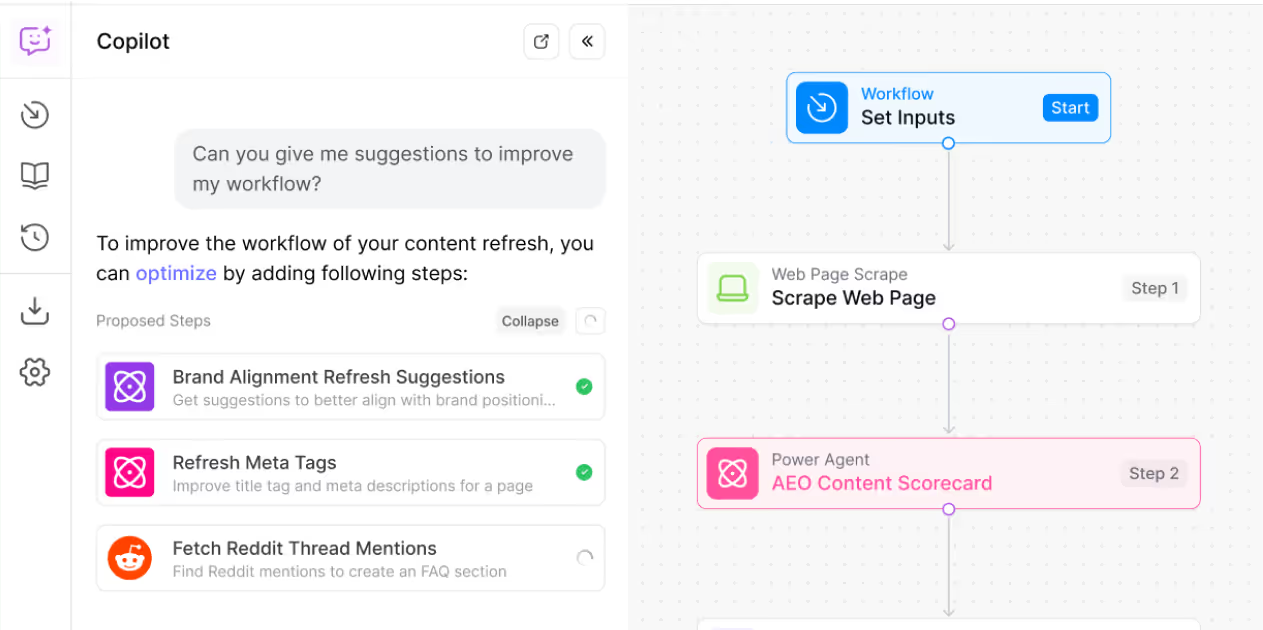
Get prime placement in AI Search by improving the structure, clarity, and quality of your content.
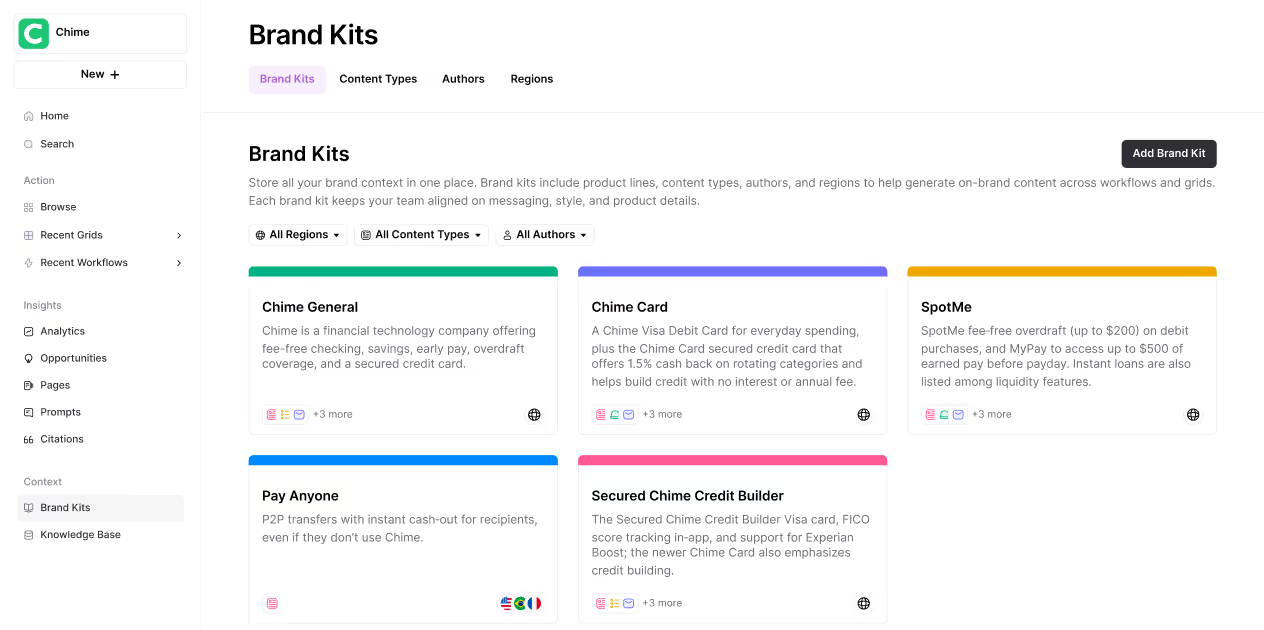
Brand Kits
Create content that sounds like your brand by weaving in your brand voice, personas, and expertise.
Our experts help brands like Carta and Rippling build workflows and train their teams to move faster with confidence.

What sets AirOps apart from ChatGPT
AirOps is built for content teams that need to close the loop between visibility data and published content, pairing the platform with a team of experts that sets and executes the AI search strategy across owned content and external content, with strategy, intelligence, and measurement for AI ads, community, and social and influencer. ChatGPT is a general-purpose AI assistant that generates text one conversation at a time, with no visibility tracking or CMS publishing and no workflow orchestration to measure what content actions drive results. AirOps unifies Answer Engine Optimization (AEO) tracking across 6 AI engines (including ChatGPT itself), GSC, and GA4 in Page360, then connects that data to multi-step content workflows that publish directly to your CMS. Every improvement your team ships feeds back into the system, so performance compounds over time.

What our customers are saying
“AirOps is unlike any other AI tool we’ve seen. We’ve been able to drop our agency and focus on the highest value initiatives in weeks”

Nick Fairbain
VP Growth Marketing, Chime
“Our brand visibility score hit a high of 28% after we refreshed content. We saw a 56% increase in subscriptions in 30 days that corresponds to content engineered for agents."

George Bonaci
VP of Growth and Demand, Ramp
“With AirOps, we grew AI-attributed signups from 2% to over 10% in under a year with zero headcount growth. Just sharper workflows and faster loops.”

Josh Grant
VP of Growth, Webflow
AirOps vs. ChatGPT
Which platform is right for your team?
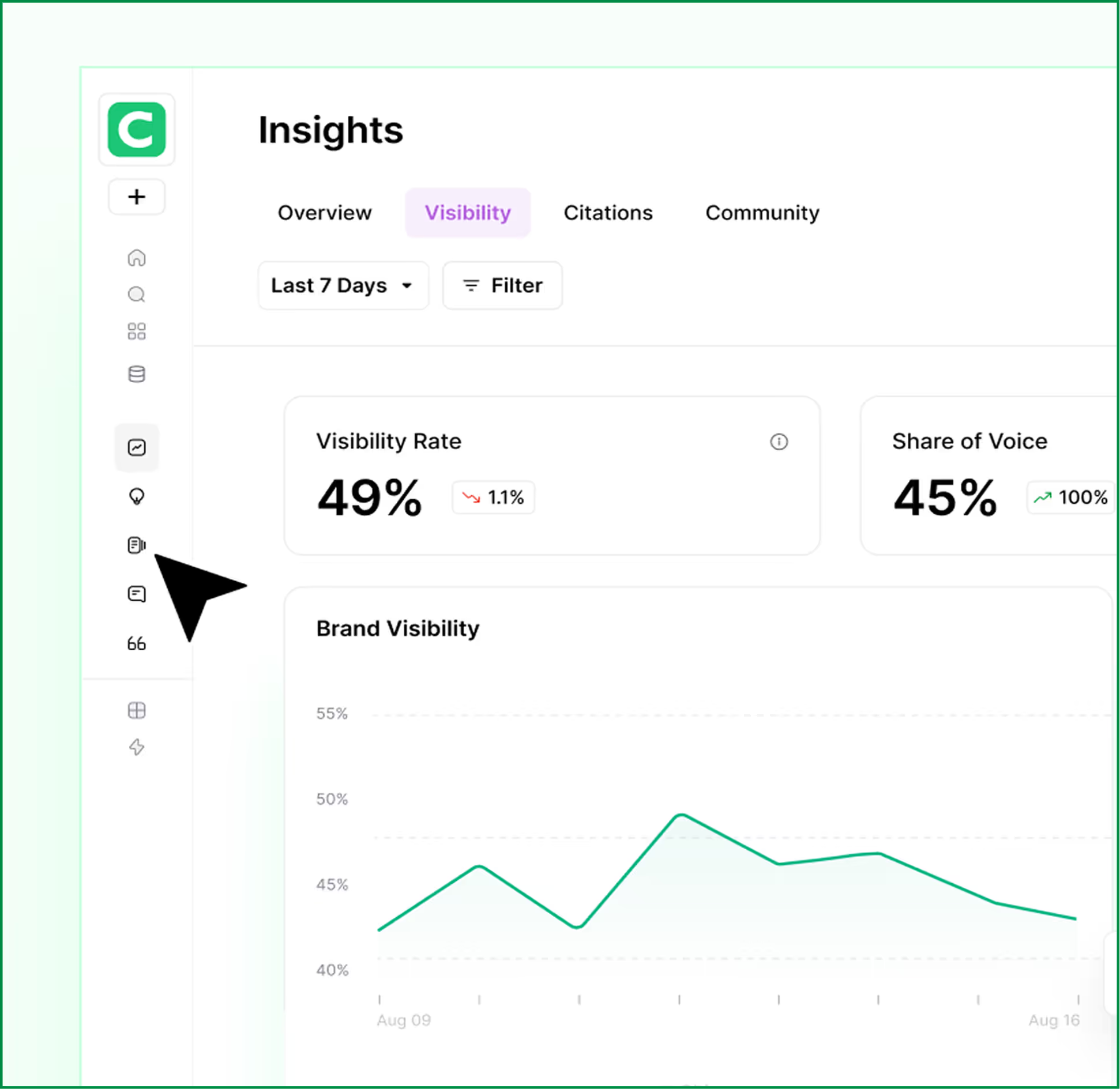
Track visibility across AI search
AirOps gives you the complete picture of AI visibility and organic search performance in one view per URL. Page360 combines AI citation data across 6 engines with GSC performance metrics and GA4 engagement data into a single prioritized dashboard that also tracks content freshness. ChatGPT is one of the AI engines AirOps monitors, but it has no capability to track how your brand appears in AI search results or connect that data to SEO performance.
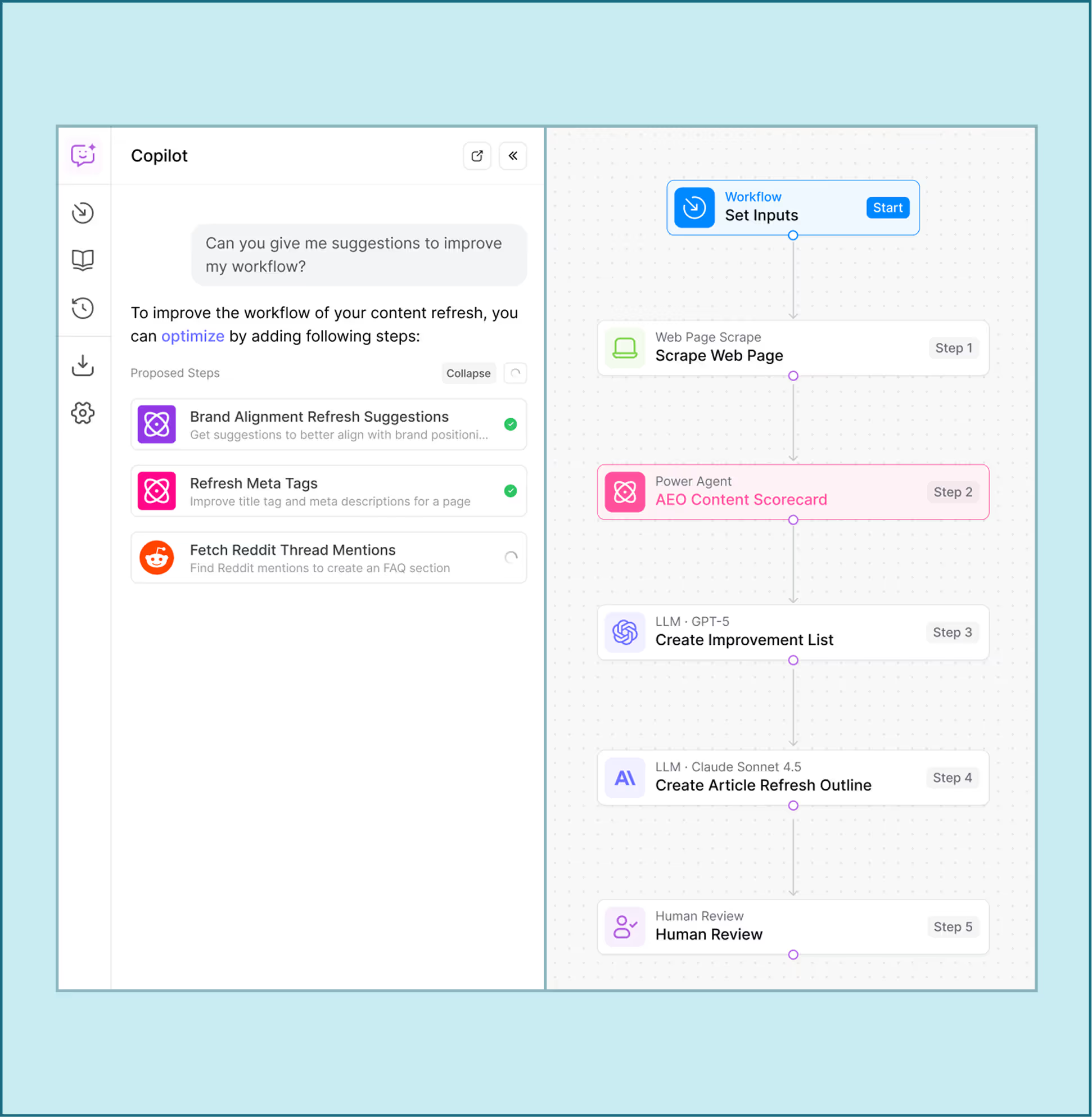
Content creation, refresh and publishing workflows
AirOps surfaces content gaps from live market data, then executes fixes through multi-step Workflows and Grids for bulk operations, with Campaigns automating entire execution pipelines from gap identification through publishing. ChatGPT generates content one conversation at a time with no multi-step builder or CMS publishing and no bulk execution engine for running operations across thousands of pages. The AirOps team sets the strategy with you. Quill runs the execution.
Native integrations
AirOps connects your entire content stack from day one with 30+ native integrations spanning 7+ CMS platforms, SEO tools like Semrush and Ahrefs, GSC, GA4, and project management tools like Asana and ClickUp. ChatGPT connects to 60+ workplace apps (Google Drive, Slack, Salesforce) for data retrieval, but has zero CMS publishing integrations and no connections to SEO tools or analytics platforms that content teams rely on.
SEVERAL CMS platforms
(Webflow, Contentful,
WordPress, Ghost,
and more)
Email and live chat support
AirOps pairs hands-on support with Solutions Architects who work alongside your team from strategy through execution to build workflows and operationalize AI search strategy. ChatGPT offers a Help Center and community forums, with enterprise support reserved for Enterprise-tier customers at approximately $50-60 per user per month. AirOps includes live cohort trainings and a Content Engineering Certification alongside a fully managed external content service.

How Chime Increased AI Search Citations 3x with AirOps
Frequently Asked Questions
Which is better: AirOps or ChatGPT?
AirOps is better for teams that need to track AI search visibility and execute content operations at scale while measuring the impact of every piece they publish. ChatGPT is better suited for individual knowledge work, ad-hoc writing and research. ChatGPT generates strong text in a single conversation, but it has no visibility tracking or CMS publishing and no workflow builder for running content operations across hundreds of pages. AirOps closes that gap with a team of experts and a platform that connect insight to action to measurement.
What features does AirOps offer that ChatGPT does not?
AirOps offers several capabilities ChatGPT lacks:
Quill, AirOps' AI agent captain, for running Playbooks across content creation and refresh at scale
Page360 unified view for combining AI citations with GSC clicks and GA4 engagement per URL, including content freshness tracking
Prompt Discovery from four intent sources: third-party panel data, SERP People Also Ask, search intent data, plus voice-of-customer conversations
Grids for bulk operations across thousands of content items with version history and real-time collaboration
Brand Kits for centralized brand governance with versioning and approval workflows in an AI-readable structure
AirOps Model Context Protocol (MCP) with 38+ tools, available in the Claude App Store
External content for earning placements in the third-party sources AI already trusts, with full attribution
Copilot for conversational AI assistance inside AirOps workflows
Query Fan-outs revealing the sub-queries AI engines run behind each tracked prompt
Closed-loop execution connecting every content action to visibility outcomes so performance compounds over time
Can ChatGPT create and publish content at scale?
ChatGPT can generate text and code within a single conversation. It supports Canvas for longer documents and Projects for organizing related conversations. But it has no multi-step workflow builder and no bulk operations engine. CMS integrations are nonexistent. Every piece of content requires manual copy-paste into your publishing system.
AirOps automates the full loop from identifying content gaps to creating on-brand content to publishing directly to your CMS. Workflows handle conditional branching and human review checkpoints with code execution steps built in. Grids let you run operations across hundreds of pages simultaneously. ChatGPT shows you what needs fixing. AirOps builds the system that fixes it at scale.
How do AirOps workflows differ from ChatGPT's automation?
ChatGPT offers Scheduled Tasks for recurring prompts and Custom GPTs for reusable instructions, but these operate within single conversations. There is no visual workflow builder or conditional branching, and no way to chain multiple steps together with human review checkpoints or bulk execution. Every task runs in isolation.
AirOps Workflows use a visual no-code builder with conditional branching (if/then logic) and human-in-the-loop review checkpoints, plus code execution steps and direct CMS publishing. Grids enable bulk execution across hundreds of rows simultaneously. Campaigns automate execution pipelines from gap identification through publishing. The platform connects to 30+ integrations and publishes directly to 7+ CMS platforms. Every workflow runs with Brand Kit context baked in.
How does AirOps track AI search visibility compared to ChatGPT?
AirOps tracks AI visibility across 6 AI engines: ChatGPT, Claude, Perplexity, Gemini, Google AI Mode, and Google AI Overviews. ChatGPT is one of the engines AirOps monitors. It is an AI search platform, not a visibility tracking tool, so it has no capability to measure how your brand appears in its own results or any other AI engine.
AirOps Page360 unifies AI citation data with actual GSC clicks and GA4 engagement metrics in a single view per URL that also tracks content freshness. Prompt Discovery surfaces the questions buyers ask across AI search and traditional search, plus direct customer conversations. Query Fan-outs reveal the sub-queries AI engines run behind each prompt. A page losing AI citations but gaining SEO traffic signals a different action than a page declining in both channels simultaneously. That level of context requires unified data, which ChatGPT does not provide.
Can AirOps replace both ChatGPT and my content creation tools?
Partially. AirOps replaces the execution gaps in your content stack: workflow orchestration and bulk content operations with CMS publishing, plus brand governance alongside team collaboration. It handles the end-to-end process from identifying what to create or refresh through publishing and measuring results.
ChatGPT maintains advantages for ad-hoc knowledge work alongside code generation and image creation, plus voice interaction for tasks outside content operations. With 400 million users and GPT-5.5 models, it remains the most capable general-purpose AI assistant available.
Many teams use both together. AirOps Workflows include native large language model (LLM) steps that can call OpenAI models directly. You get ChatGPT's generation capabilities inside AirOps' governed workflow environment, with Brand Kit context and human review plus direct CMS publishing.
What's the pricing difference between AirOps and ChatGPT?
ChatGPT offers individual plans from Free to Pro (starting at $100/month for 5x usage, $200/month for 20x). The Go plan at $8/month and Plus at $20/month sit in between. Business pricing runs $20-25 per user per month. Enterprise is custom, typically $50-60 per user per month for 150+ seats. Per-user pricing adds up quickly for content teams.
AirOps scopes each partnership to your funnel and opportunity and meets your team where it is, whether you are just starting with AI search or running an advanced program.
The total cost comparison goes beyond subscription fees. ChatGPT charges for AI generation but requires separate subscriptions for SEO tools, CMS publishing, workflow automation, and analytics. AirOps combines visibility tracking, content workflows, and a team of experts in one partnership, consolidating what would otherwise be multiple tool subscriptions.
How hard is ChatGPT to operationalize day to day for content teams?
ChatGPT handles individual tasks well, but operationalizing it for a content team requires workarounds. Bulk operations need manual repetition or API development. Custom GPT instructions are per-GPT, not centralized brand governance. Shared Projects support collaboration, but there is no production workflow or CMS publishing and no analytics integration to track which content actions moved visibility metrics.
AirOps is built for daily content operations. Grids give your team a production workspace for managing hundreds of content items. Workflows automate multi-step processes with human review at the right checkpoints. Page360 shows which pages need attention first. Brand Kit ensures every piece of content stays on-brand without manual policing. Your entire team operates in one environment. ChatGPT gives you a capable assistant. AirOps gives you the partner for content at scale.
Can I use both AirOps and ChatGPT together?
Yes. Many AirOps customers use ChatGPT for ad-hoc research, brainstorming, and one-off writing tasks while using AirOps as their content operations partner. AirOps Workflows include native LLM steps that call OpenAI models (the same models powering ChatGPT) directly inside governed pipelines with Brand Kit context and human review plus direct CMS publishing.
AirOps also tracks ChatGPT as one of 6 AI engines in its visibility dashboard, so you can see how your content performs in ChatGPT's search results while using ChatGPT as a daily productivity tool. The two platforms serve complementary roles: ChatGPT for individual AI assistance, AirOps for content operations at scale.
Does AirOps use ChatGPT's models?
AirOps is model-agnostic and supports 20+ AI models, including OpenAI's GPT-5.5 family (the same models powering ChatGPT), Anthropic's Claude and Google's Gemini, along with Perplexity and others. You can select models per workflow step based on the task requirements, and bring-your-own-API-key support gives you direct control over model costs.
AirOps also monitors ChatGPT as one of 6 AI engines in its AEO tracking system. So ChatGPT's models power content creation inside AirOps workflows, while ChatGPT the platform is simultaneously tracked for brand visibility. That dual relationship, using the technology while monitoring the platform, is unique to AirOps.
How is AirOps different from just using ChatGPT?
AirOps runs the full loop that ChatGPT alone cannot: it surfaces how your brand shows up across AI engines, acts on those gaps with governed content workflows, and measures what each change moves. ChatGPT generates strong text in a single conversation, but it has no visibility tracking, no CMS publishing, and no way to run content operations across hundreds of pages. AirOps turns those prompts into ranking, citation-ready pages and ties every content action back to your SEO and AI visibility metrics.