- AI Overviews select content based on structure, authority, and direct answerability. Traditional rankings help but don't guarantee citations
- Content built for extraction outperforms content built for ranking alone. Lead every section with a clear, direct answer
- Measurement across multiple AI providers is essential. Track citation rate, mention rate, and share of voice
- AEO builds on SEO fundamentals but adds a higher bar for extractability and cross-platform tracking
- AirOps connects AI visibility tracking to content execution, showing which prompts drive citations on each platform
AI Overviews now appear in nearly half of Google searches, and over 60% of searches now end without a click. Your content either gets cited or it gets skipped. The difference comes down to structure, authority, and measurement.
Most optimization guides stop at structure. This one covers all three, including the cross-platform measurement that separates AEO (Answer Engine Optimization) from traditional SEO.
AirOps tracks citations across every major AI provider, connecting visibility data to content action. This guide breaks down what makes content citable and how to track your progress. AirOps pairs that tracking with a team that builds and runs the strategy alongside yours, tying AI search work to pipeline and revenue.
1. Understand What AI Overviews Look For
AI Overviews don't pull from a single source. They parse content into chunks, then assemble answers from multiple pages. Understanding how AI answer engines choose which websites to cite explains why some pages get cited and others don't.
Organic rankings matter. According to AI SEO statistics for 2026, roughly 76% of cited pages rank in the top 10. But rankings aren't the full picture. About 46% of cited URLs rank outside the top 50. Well-structured, authoritative niche content can earn citations even without page-one rankings. Effective AI search optimization focuses on making every section directly answerable, not on chasing traditional ranking signals alone. Teams that learn how to optimize content for AEO treat each heading as a retrieval target for AI engines.
Google AI Overviews, ChatGPT, Perplexity, Gemini, and Claude each weight different signals. Research on what sources AI answer engines cite shows Google leans heavily on existing organic rankings. Perplexity favors niche, specific sources. ChatGPT pulls from a broader set but rewards recent, structured content.
Across all providers, three filters determine whether your content gets selected:
Direct answerability. Does the page answer the question in a clear, extractable format?
Structural clarity. Can the AI parse the page into discrete, meaningful chunks?
Source authority. Does the page come from a trusted, credible source?
AirOps Insights reveals which content gets selected and why, tracking citations across all major AI providers in a single dashboard.

2. Structure Every Section for Chunk-Level Extraction
Structure is the single biggest lever you control. AI systems extract content in chunks. If your page isn't organized for chunk-level extraction, it gets passed over.
Lead every section with a direct answer to the question implied by its heading. The first 40 to 60 words after each heading are the most valuable real estate on your page. AI systems pull from these opening statements more than any other part of the content. Think of each section as a standalone answer that could be extracted on its own.
You should be thinking about chunk-level relevance... making sure that each section of the page answers a specific question clearly. - Ethan Smith
Use question-based H2 and H3 headings that match how people search. "How does schema markup affect AI Overviews?" outperforms "Schema Markup Considerations" because it mirrors the queries AI systems receive.
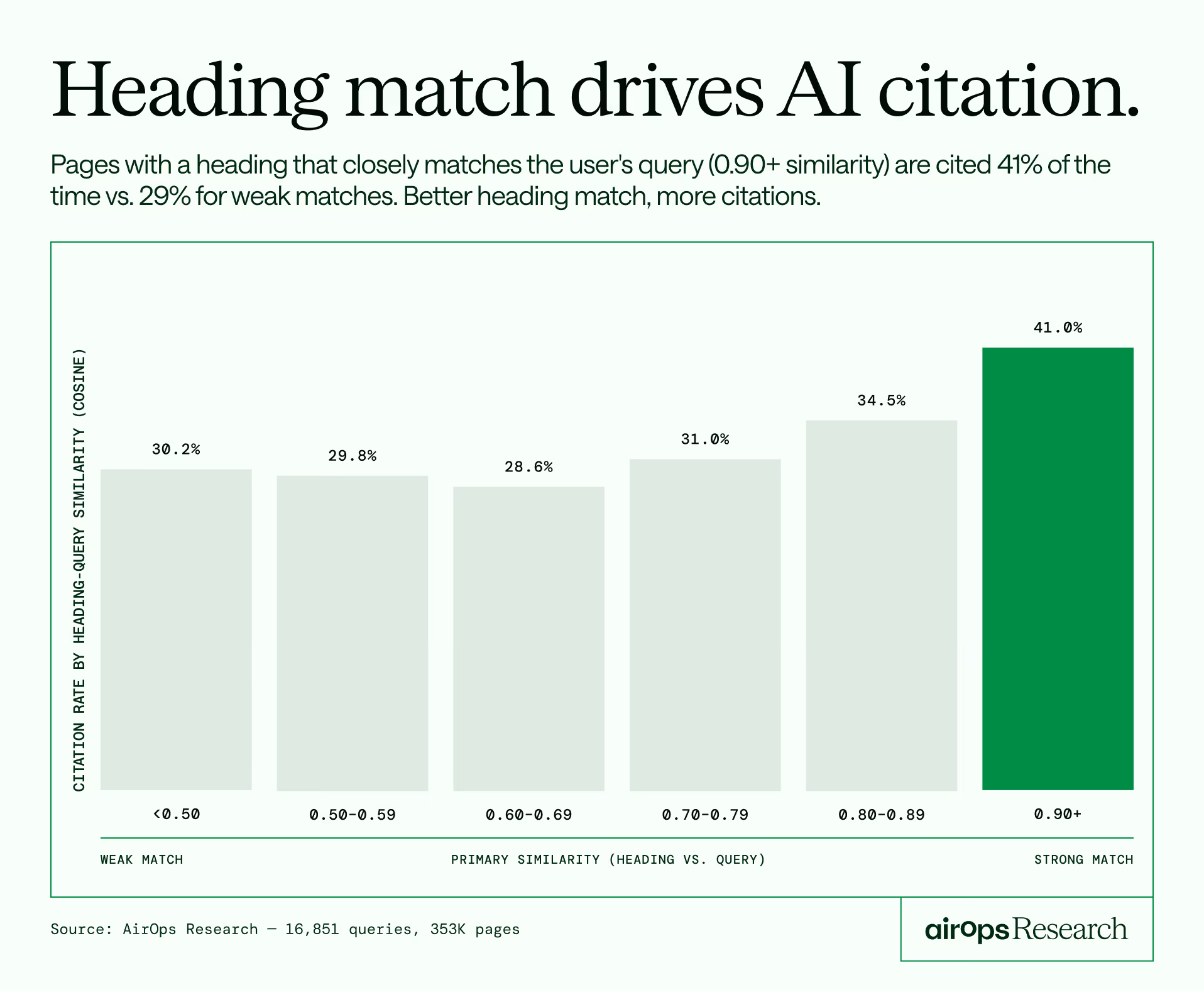
That alignment matters more than most teams realize. AirOps research found that pages with headings closely matching the user's query were cited 41% of the time, compared to 29% for weak heading matches.
The takeaway: AI systems don't just evaluate the quality of a section. They evaluate whether the section clearly signals relevance before extraction even begins.
The Fan-Out Effect: What Happens Between a Query and a Citation
Format for extraction:
Bullet lists for criteria, features, and definitions
Numbered steps for processes and workflows
Comparison tables for product or strategy evaluations
Short paragraphs of two to four sentences with one idea per paragraph
Avoid burying key information behind JavaScript, accordions, or "read more" buttons. AI crawlers often can't access content hidden behind interaction triggers.
Use semantic HTML with proper heading hierarchy. H2 sections containing H3 subsections signal clear content structure to both crawlers and AI parsers. A page with a flat heading structure forces AI systems to guess where one topic ends and another begins. Proper nesting removes that ambiguity.
Test your own pages by asking: can each section stand alone as a complete answer? If yes, your structure is extraction-ready. This is the foundation of content formatted for AI extraction. To measure extractability, check whether each H2 answers a single question in its opening sentence and whether the section can stand alone without surrounding context. AEO optimization depends on this structure more than any other factor.
Research on structuring content for LLMs found that pages with optimized heading structures see a 2.8x citation lift compared to unstructured equivalents.
How Query Fan-Out Affects Your AI Citations
When a user asks an AI engine a question, the engine does not search for that exact query. It generates a set of sub-queries, each targeting a different facet of the original question. This process is called query fan-out, and it determines which pages get retrieved and cited.
Understanding how AI citations work starts with understanding fan-out. A single user question like "best CRM for small businesses" might generate sub-queries about pricing, integrations, ease of setup, and customer support. Each sub-query retrieves its own set of candidate pages. Your content earns a citation when it matches one of those sub-queries directly.
This has practical consequences for how you structure pages:
Use H2 and H3 headings that match the sub-queries your audience triggers. AirOps research on the fan-out effect shows that heading-query alignment is the strongest predictor of citation selection.
Add FAQ sections that address the sub-questions AI engines generate. In a recent webinar, Aja Frost noted that FAQ sections correlate with higher citations, and adding FAQ schema on top compounds the lift.
Write each section so it can be retrieved independently. AI engines do not read your page top to bottom. They pull the section that best matches each sub-query.
The long tail of fan-out queries is where most citation opportunities live. Almost everything in AI search is in the long tail, which means highly specific pages targeting distinct use cases outperform broad overview content.
3. Build Authority That AI Systems Trust
Structure gets your content parsed. Authority gets it selected. E-E-A-T for AEO (Experience, Expertise, Authoritativeness, Trustworthiness) is Google's trust framework, and AI systems use similar signals to decide which sources to cite.
First-hand experience is the strongest differentiator. Original research, proprietary data, and case studies with specific results give AI systems information they can't regenerate on their own. A page citing "Webflow saw 5x more citations in weeks, not months" carries more weight than a page summarizing generic best practices.
Non-commodity content gets prioritized. If an AI can produce the same answer without citing any source, your content doesn't add value to its response.
The bar: does your page contain information, data, or perspective that the AI model doesn't already have?
Expert bylines with real credentials, named customer results, and original benchmarks all clear this bar. Generic best-practice summaries don't.
First-party data drives AI visibility optimization more effectively than generic industry statistics.
In a recent session, Aja Frost of HubSpot explained that including third-party stats gives the citation credit to the original source, not your brand. LLMs reference the data owner. Business-specific benchmarks, case studies, and customer outcomes are what you want an AI engine repeating to a potential customer.
Authority signals that increase your citation likelihood:
Original research and proprietary data that AI models cannot regenerate
Named customer results with specific metrics (revenue, time saved, conversion lift)
Expert bylines with real credentials and verifiable experience
First-party benchmarks that LLMs cannot attribute to anyone else
Schema markup for AEO provides machine-readable authority signals. Article, FAQPage, and HowTo schema help AI systems understand your content's purpose and structure.
These aren't ranking factors on their own, but they reduce ambiguity for AI parsers. Google's guidance on AI-generated content reinforces that quality and trustworthiness remain the primary evaluation criteria.
Quality backlinks from relevant, authoritative domains reinforce trust. A citation from an industry publication carries more weight than dozens of low-authority links. Focus your link-building efforts on topically relevant sites rather than chasing volume.
4. Invest in Off-Site Brand Visibility
Off-site signals matter more than most teams realize. Brand mentions on Reddit, YouTube, industry forums, and third-party publications all influence AI visibility. AI systems train on and index these sources.
When your brand appears consistently across them, AI models treat you as a more authoritative source. Investing in brand visibility in AI search is a long-term play that compounds over time. Building off-site mentions is one of the most effective ways to optimize for AI search beyond your own site. Research on how citations and mentions impact AI visibility found that 40% of brands that lost AI visibility were able to resurface by improving citation and mention signals.
AI visibility is fundamentally a brand game. The brands that get mentioned are the ones that show up everywhere. - Eli Schwartz
AirOps tracks both citations (links back to your content) and mentions (your brand name referenced without a link). Both are signals of authority that AI systems recognize.
5. Optimize Across All AI Providers
Most AI search optimization advice focuses on Google. That's a blind spot. Five major AI providers now serve answers to your audience: Google AI Overviews, ChatGPT, Perplexity, Gemini, and Claude. Each cites content differently.
Google AI Overviews heavily favors pages already ranking in organic results. Your existing SEO investments pay dividends here. Strong traditional rankings give you a clear head start on Google's AI citations.
Perplexity cites niche, specific sources with clear answers. Pages that go deep on a narrow topic often outperform broad overview content.
ChatGPT Web Search pulls from a broader set of sources. It favors recent, well-structured content. Publication date and content freshness carry more weight here than on other platforms. Research shows fewer than 1% of ChatGPT citations are consistent across repeated queries, which makes ongoing measurement critical.
Gemini and Claude show distinct citation patterns too. Gemini draws from Google's index but applies different selection criteria. Claude favors authoritative, well-sourced content with clear attribution. The core principles of AI overview optimization overlap across providers, but knowing the differences helps you prioritize. Writing AEO-optimized content means leading with direct answers, structuring for extraction, and including the authority signals each provider values.
The good news: optimizing for one platform improves visibility across all of them. The fundamentals overlap. Clear structure, strong authority, and direct answers work everywhere. A strong set of answer engine optimization strategies serves you across every provider. You don't need five separate strategies. You need one strong strategy with platform-specific visibility data to refine it.
The key differentiator is knowing which platforms cite you and for which prompts. Without that data, you're optimizing blind. AirOps Insights tracks citations across all five providers in a single dashboard, showing exactly which prompts drive visibility on each platform.
6. Keep Your Content Fresh
AI engines reward freshness. Review your high-priority pages every 90 days. Update statistics, add recent examples, and refresh outdated references. A page with 2024 data loses citation share to a page with 2026 data, even if the older page ranks higher. Treat freshness as an ongoing content operation.
Pages that want to appear in AI search results need data from the current year, not last year. Research on stale content and AI visibility found that unrefreshed pages experience up to a 3x loss in AI citations over time.
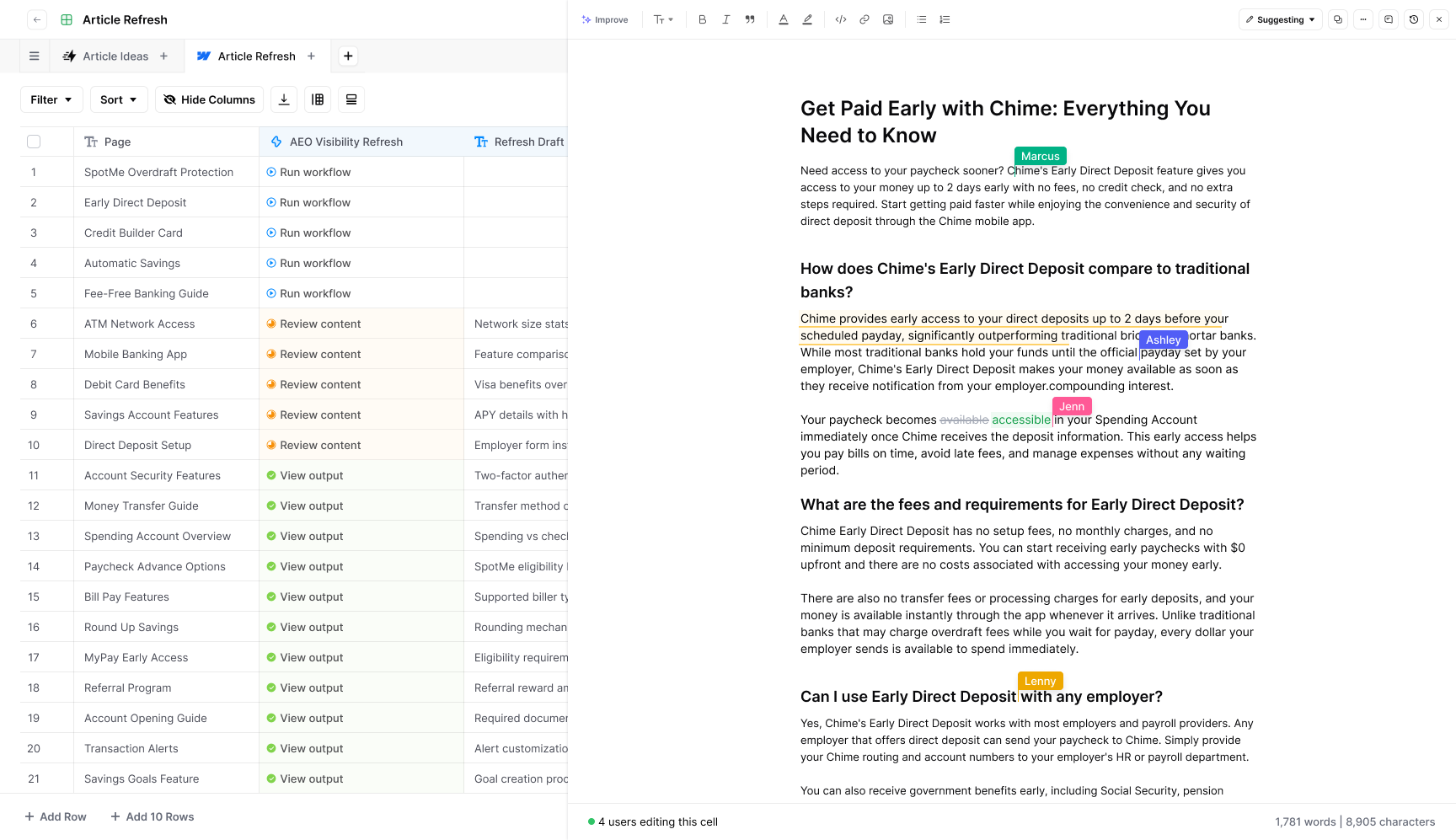
Webflow used this approach and saw 5x more citations in weeks, not months. The combination of targeted content updates and cross-platform tracking made the difference. They identified which prompts mattered, updated the right pages, and tracked citation changes in real time.
Common AI Search Optimization Mistakes
Knowing what to do is half the picture. Knowing what to avoid saves months of wasted effort. These are the mistakes that cost teams AI visibility:
Publishing AI-generated content without editing or expert input. Mike King of iPullRank calls this the "Mount AI" pattern: AI-generated pages perform well for one to two months, then drop substantially as user interaction signals accumulate. AI engines demote content that fails to engage readers over time.
Treating AI Overviews like featured snippets. AI Overviews assemble answers from multiple sources. Optimizing for a single snippet position misses the multi-source retrieval model.
Relying on backlinks as the primary authority signal. HubSpot's data shows that a page with just one backlink earned 85 AI citations. Content structure and specificity outweigh link authority for AI retrieval.
Using third-party statistics without original data. LLMs attribute data to the original source. If you cite someone else's benchmark, the AI credits them, not you.
Measuring snapshots instead of trends. Half of cited pages change every single month. Checking whether you appeared once tells you nothing. Track citation rate and mention rate directionally over time.
Every one of these mistakes is fixable. The teams pulling ahead are the ones running structured content refreshes on a regular cadence, not one-time optimization passes.
7. Measure Citations Across Every Platform
Measurement is the biggest gap in AEO today. Most teams don't know which pages AI cites or which prompts trigger those citations. Without measurement, you can't tell whether a content refresh improved your citation rate or had no effect. Without prompt intelligence, you don't know which questions your buyers are asking across AI search.
Track three core AI search metrics:
Citation rate: The percentage of AI answers that link back to your content for a given prompt.
Mention rate: The percentage of AI answers that reference your brand by name, with or without a link.
Share of voice: Your brand's share of total AI mentions and citations compared to competitors.
You need to track citations and mentions separately. A citation means the AI linked to you. A mention means it talked about you. Both matter, but they're different signals. - Alex Halliday
Connect AI visibility data to traditional metrics. AirOps Page360 provides a unified view of citations alongside Google Search Console clicks and GA4 traffic. Prompt Discovery surfaces the exact questions buyers ask across AI search, so you know which content to create or refresh. Content Publish Tracking correlates page updates to citation changes.
Use the AEO audit checklist to systematically evaluate your content portfolio. To know if your content is visible in AI search, check your citation rate and mention rate across providers weekly.
A rising trend means your content is gaining traction. A flat or declining trend signals that competitors are outpacing you or your content needs a refresh.
AI Visibility Requires Continuous Optimization
AI citations don't come from rankings alone. They come from content AI systems can parse, trust, and confidently surface in answers.
The teams gaining visibility across AI search continuously improve structure, authority, freshness, and off-site presence based on real citation data.
AirOps helps teams track mentions and citations across every major AI provider, identify visibility gaps, and turn insights into content action faster. Book a demo today to see how.
FAQs
How Does Google Choose Content for AI Overviews?
Google selects content based on three primary factors: direct answerability, structural clarity, and source authority. Pages ranking in the top 10 have a clear advantage, but well-structured niche content with strong E-E-A-T signals can earn citations even from lower ranking positions.
Do I Need To Rank on Page One To Appear in AI Overviews?
No. About 46% of cited URLs rank outside the top 50. Strong organic rankings increase your chances significantly, but well-structured content with clear authority signals can compensate for lower positions. Focus on making your content the best answer available, regardless of where it ranks.
How Is AEO Different From Traditional SEO?
AEO differs from traditional SEO in that it raises the bar for content extractability and cross-platform measurement. SEO focuses on ranking in search results. AEO focuses on being cited in AI-generated answers. When teams learn how to optimize content for AEO, the focus shifts from ranking positions to citation rates. AEO requires content formatted for AI extraction, measured across multiple providers, and structured so AI engines can retrieve and cite specific sections independently.
How Do I Track My AI Overview Performance?
Track citation rate, mention rate, and share of voice across all AI providers. Connect these metrics to Google Search Console and GA4 data for a complete picture of how AI visibility impacts your traffic and conversions. AirOps Insights provides this cross-platform tracking in a single dashboard.
Better structure, stronger proof points, and cross-platform visibility data are what earn citations today. AirOps connects AI visibility tracking to content execution, so every update you make is informed by real citation data across every provider that matters. When you're ready to act on that data, AirOps brings the platform, the media mix, and the team together to build the evidence that earns an agent's trust.
Frequently Asked Questions
FAQs
How does Google choose content for AI Overviews?
Google selects content based on three primary factors: direct answerability, structural clarity, and source authority. Pages ranking in the top 10 have a clear advantage, but well-structured niche content with strong E-E-A-T signals can earn citations even from lower ranking positions.
Do I need to rank on page one to appear in AI Overviews?
No. About 46% of cited URLs rank outside the top 50. Strong organic rankings increase your chances significantly, but well-structured content with clear authority signals can compensate for lower positions. Focus on making your content the best answer available, regardless of where it ranks.
How is AEO different from traditional SEO?
AEO differs from traditional SEO in that it raises the bar for content extractability and cross-platform measurement. SEO focuses on ranking in search results. AEO focuses on being cited in AI-generated answers. The tactics overlap significantly, but AEO requires content formatted for AI extraction and measurement across multiple providers, not search engines alone.
How do I track my AI Overview performance?
Track citation rate, mention rate, and share of voice across all AI providers. Connect these metrics to Google Search Console and GA4 data for a complete picture of how AI visibility impacts your traffic and conversions. AirOps Insights provides this cross-platform tracking in a single dashboard.
Better structure, stronger proof points, and cross-platform visibility data are what earn citations today. AirOps connects AI visibility tracking to content execution, so every update you make is informed by real citation data across every provider that matters.
Get the latest on AI content & marketing
