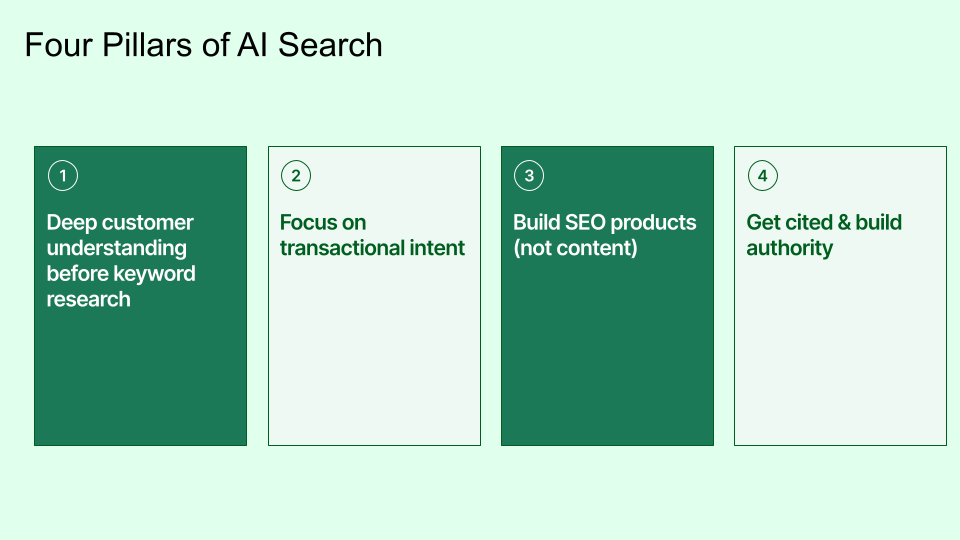
AI search changed how results look, but it didn't change what buyers need. In this AirOps webinar, Josh Spilker sat down with Eli Schwartz to break down the four pillars that still drive visibility and pipeline: customer understanding, funnel selection, asset creation, and brand visibility.
The discussion focused on what content teams should stop overvaluing, what they should build next, and how to think about AI search without chasing short-term tricks. For directors of content and SEOs, the big message was simple: win the buyer journey, not the algorithm.
Top 5 Takeaways
1. AI Search Changes the Interface, Not the Fundamentals
User intent, utility, and clear positioning still matter more than short-term tactics. The core job of search hasn't changed—teams still need to understand what buyers want and help them find it.
2. Not Every Company Should Overinvest in SEO
If customers don't use search to solve the problem, SEO may be a weak growth lever. Before you commit resources, validate that search actually influences buying decisions in your category.
3. Mid- and Bottom-Funnel Content Matter More Now
- Comparison, pricing, use-case, and adoption-stage assets are more durable than generic top-of-funnel pages.
- LLMs now answer broad discovery questions, which means decision-stage content holds more value.
- Focus on content that helps buyers evaluate, compare, and commit.
4. Build Assets Around Real Jobs-to-Be-Done and Conversion Paths
Content should solve a specific user need and move someone toward a measurable next step. Every asset needs a clear purpose and a path to action, whether that's a demo request, pricing view, or product comparison.
5. AI Visibility Is Increasingly a Brand Game
- Mentions, reviews, PR, and off-site citations now matter as much as on-site optimization.
- AI systems pull from brands that people already mention, review, and recognize across the web.
- Strong on-site content still matters, but off-site proof carries more weight in how AI chooses what to include.
Best Practices and Key Learnings
The discussion kept coming back to one idea: teams win when they understand buyers better and build content that helps them act. These best practices show where to focus now, what to cut back on, and how to turn AI search insights into real business outcomes.
AI Search is a New Interface, Not a New Discipline
LLMs, AI Overviews, and AI Mode changed how search results appear, but they didn't change the core job of search. Teams still need to understand intent, publish useful assets, and help internal stakeholders ship the work.
- Audit your current SEO program for durable strengths like intent mapping, clear positioning, and practical utility.
- Cut tactics that depend on one model behavior or one temporary search feature.
- Align SEO, content, product, and brand teams around the same user problem before you publish anything.
Validate Search Demand and Pick the Right Funnel Stage
Before you spend heavily on SEO, confirm that buyers actually use search to solve this problem. Then choose the part of the funnel where search still influences decisions instead of dumping effort into broad awareness content.
- Map the buyer journey from first pain point to evaluation, adoption, and conversion.
- Reduce SEO spend when search plays a minor role and other channels move pipeline faster.
- Put more focus on pages that support comparison, fit checks, pricing review, and adoption questions.
Shift Content Toward Evaluation and Adoption
LLMs now answer more broad discovery questions before users click, which cuts into the value of generic top-of-funnel pages. Content teams should spend more time on assets that help buyers compare options, validate fit, and keep moving.
- Build comparison pages, pricing pages, use-case pages, and competitor pages that answer real buying questions.
- Keep educational content on-site when it supports the journey after the click, not because you expect it to rank on its own.
- Refresh high-intent pages often so buyers and search engines can find current product details.
"Anything around top of funnel is going to belong to the LLMs." — Eli Schwartz
Use Customer Research to Find Better Content Angles
Customer research still gives teams their strongest edge. Open-ended interviews, sales calls, and support trends reveal the triggers, objections, and language that keyword tools often miss.
- Interview ten recent customers and ask why they chose you, what they compared, and what almost stopped them.
- Review sales calls, support tickets, onboarding questions, and reviews to spot repeated friction points.
- Turn those patterns into page ideas, messaging updates, and sharper use-case content.
"Just talk to 10 customers, you'll get great ideas." — Eli Schwartz
.png)
Build Assets with a Clear Conversion Path
Useful SEO assets do more than attract visits. They help a buyer complete a job-to-be-done and move to a next step that the business can measure.
- Define the user task each asset needs to support before you write a brief.
- Add a clear next action, such as a product comparison, signup, pricing view, or demo request.
- Judge performance by conversion, activation, qualified visits, or influenced pipeline instead of traffic alone.
Prioritize SEO Work with THRICE
Roadmaps fall apart when teams treat every idea as equally urgent. Eli's THRICE framework helps teams score work by Time, Headcount, Reach, Impact, Confidence, and Effort so they can make sharper tradeoffs.
- Score quick wins and large projects in the same system so everyone can see the cost of each decision.
- Use THRICE before you ask for engineering or design support, not after you already picked the project.
- Drop ideas that look exciting but launch too slowly or fail the expected return.
Build Brand Visibility Beyond Your Site
AI answers pull from brands that people already mention, review, cite, and recognize across the web. Strong on-site content still matters, but off-site proof now carries much more weight in how AI systems choose what to include.
- Invest in digital PR, review platforms, category sites, forums, and trusted mentions where buyers already spend time.
- Make your positioning, products, pricing, and use cases easy to understand on your own site.
- Study which sources appear in relevant prompts, then build real presence on those sources.
"You don't necessarily need a backlink with an href anymore. you need a mention." — Eli Schwartz
Measure What AI Can Influence, Not Just What It Can attribute
AI products still make measurement messy, so teams need a broader scorecard. Prompt checks, branded search demand, direct traffic, and sales feedback often tell a clearer story than referral data alone.
- Create a recurring prompt set around your category, competitors, and core use cases.
- Track whether your brand appears, how often it appears, and which sources the model cites.
- Compare prompt trends with changes in branded search, direct traffic, demo requests, and sales conversations.
Putting These AI Search Insights into Practice
AI search pushes more discovery into AI interfaces, which means generic awareness content loses value faster. Teams that understand buyer intent and publish decision-stage assets will keep winning because buyers still need proof, pricing, comparisons, and clear next steps.
Here's where to start:
- Audit your content by funnel stage. Identify which assets support evaluation and adoption versus broad awareness.
- Interview customers. Ask why they chose you, what they compared, and what almost stopped them.
- Score new ideas with THRICE. Prioritize projects that balance impact with effort and time to launch.
- Invest in off-site brand mentions. Build presence on review sites, forums, and category platforms alongside on-site assets that support conversion.
The work takes time, but the path forward is clear.
Win AI Search with Strong Brands and Useful Content
Eli's framework gives content and SEO teams a grounded way to respond to AI search without getting distracted by hacks. Focus on real buyer needs, high-intent content, and stronger brand signals to build a program that drives both visibility and pipeline.
How AirOps Helps Teams Turn AI Search into Pipeline
AirOps helps teams find the prompts that matter, build high-intent content faster, and strengthen off-site visibility that influences AI answers. AirOps is the partner for this shift: the platform, the media mix, and the team together, not just software to log into, building and running the strategy alongside your team and tying it back to pipeline and revenue growth. If you want to turn these ideas into a repeatable system for SEO, content, and brand, book a call.
Get the latest on AI content & marketing
