- Jasper supports brand and campaign content, but it doesn't provide native SEO data or AI search visibility signals.
- Content teams are shifting toward systems that connect research, briefing, writing, and optimization into one continuous process.
- AI search has changed how content gets discovered, with citations, mentions, and share of model shaping visibility alongside rankings.
- AirOps differs from Jasper Ai by connecting AI search visibility data to content execution workflows within one governed platform.
- Platforms that unify performance data with execution help teams prioritize updates, improve existing content, and scale output more effectively.
- The right alternative depends on your primary objective, whether that is content production, SEO performance, or AI search visibility.
Jasper helped bring AI writing into the mainstream. But for SEO and content leaders, the challenge has shifted.
Generating text is no longer the hard part. Building systems that earn visibility in Google and AI search is where teams struggle.
Teams are re-evaluating Jasper for practical reasons: rising per-seat costs, fragmented SEO tooling, and no native visibility into AI search performance. A drafting tool alone doesn’t support a modern content program.
This guide covers 11 Jasper.ai alternatives across different use cases, from full content engineering platforms to specialized SEO tools. You’ll see what each tool does well, where it falls short, and how to choose the right fit for your team. These are the best AI writing tools and AI content creation platforms for teams that care about SEO and AI search visibility, not just output volume.
What is Jasper.ai?
Jasper.ai is an AI writing platform built for enterprise marketing teams. It focuses on brand consistency, using features like Jasper IQ to apply voice and style guidelines across campaigns.
The platform includes tools like:
- Jasper Canvas for collaboration
- Jasper Grid for bulk generation
- Multi-model support across providers like OpenAI and Anthropic
Jasper works best for:
- Product marketing teams
- PR and brand teams
- Campaign-driven content
Where it struggles:
- SEO data requires external tools
- No native AI search visibility tracking
- Limited connection between insights and execution
It works well for content creation, though it doesn’t support the full needs of performance-driven teams
Why look for Jasper.ai alternatives?
Teams outgrow Jasper when their focus shifts from general marketing copy to performance-driven content operations. The best Jasper AI alternatives close the gaps that hold teams back: SEO data, AI search visibility, and content quality.
- Pricing becomes difficult to scale: Jasper uses a per-seat model that starts around $59 per user. Costs increase quickly as teams grow. Many teams also add Surfer SEO for optimization, which raises total spend.
- SEO workflows stay fragmented: Because Jasper relies on integrations for SEO data, teams move between tools for research, briefing, and optimization instead of working in one place.
- AEO visibility is missing: AI Overviews now appear in a large share of searches, and tools like ChatGPT and Perplexity influence discovery. Jasper doesn’t track citations, mentions, or share of model.
- Output often needs heavy editing: Many users report repetitive or generic outputs. Teams spend time rewriting instead of starting from strong, data-backed drafts.
- Scaling requires systems: Large content programs depend on repeatable processes that connect research, writing, and updates, which goes beyond what prompt-based workflows can support.
How we picked these Jasper alternatives
We evaluated each tool on how well it supports a modern content program, not just how fast it drafts. Every alternative here earns its place on four criteria.
- SEO and AEO depth: native keyword research, content scoring, and AI search visibility tracking, not bolt-on integrations.
- Content quality: data-grounded drafts that need less rewriting, so teams ship faster.
- Scale and workflow: repeatable systems for research, drafting, and content refresh across many pages.
- Pricing and value: transparent plans that stay predictable as your team grows.
Structure matters as much as the tool. AirOps research across 12,000+ pages found that sequential heading structures boost AI citation odds by 2.8x, so the right alternative should help you publish clear, extractable content that AI engines cite.
The best Jasper.ai alternatives in 2026
Jasper's main competitors span content engineering platforms, SEO writing tools, and AI visibility trackers. The strongest Jasper AI alternatives below include AirOps, Frase, Surfer SEO, Writesonic, and Semrush, each built for a different team and workflow.
1. AirOps
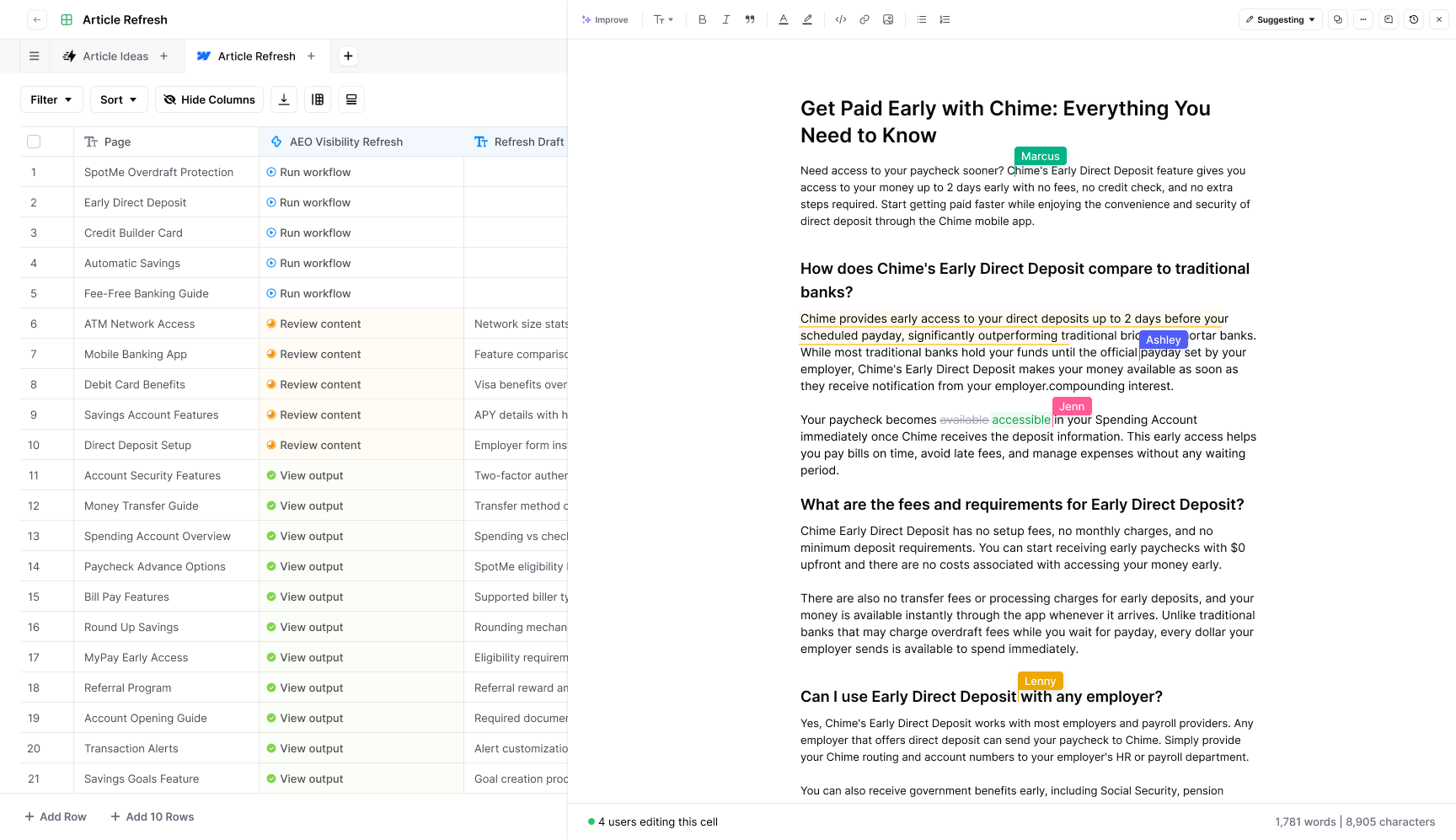
AirOps is a content engineering platform built for AI search. It helps teams move beyond text generation and build data-backed content systems at scale. The platform combines SEO data, AI search visibility, and content operations into one system, so teams can act on insights without switching tools.
Key features
- Page360: Combines SEO data from Google Search Console (GSC), web analytics from Google Analytics 4 (GA4), and AI search signals (citations and mentions) in a single view so teams can prioritize actions immediately.
- Grid & Workflows: Runs complex, multi-step AI workflows covering research, drafting, review, and publishing at scale across thousands of pages using a collaborative, spreadsheet-style interface.
- Deep Research: Uses agentic workflows to perform live SERP analysis and information retrieval, grounding content in real data to reduce hallucinations.
- Content Refresh: Identifies decaying content and automatically runs workflows to refresh it, boosting visibility in both Google and AI engines.
- Quill: AirOps' AI agent captain runs content refresh, creation, and AI search optimization Playbooks, then reports results against your SEO and AI visibility goals. It connects to Claude through the AirOps connector, so teams can query performance data and launch work without leaving their AI tools.
Best for
SEO and Content Directors who need to operationalize their strategy, manage content at scale, and maintain visibility as AI search continues to reshape discovery.
Pros
- Converts insights directly into automated action.
- True bulk execution for large content libraries.
- Transparent model access and cost control.
- Deep integrations across CMS, data, and SEO tools.
Cons
- More capable than basic monitoring tools, so there's a wider surface area to set up.
- Requires upfront workflow design to unlock full value.
Pricing

2. Frase
Frase consolidates research, briefing, and writing into a single interface. It replaces the fragmented stack of separate research and writing tools by using the Frase AI Agent to handle the heavy lifting of content production.
Key features
- Frase Agent: An AI copilot that handles research, strategy, and writing autonomously.
- Dual Optimization: Provides real-time scoring for both traditional SEO and Generative Engine Optimization (GEO).
- AI Search Tracking: Tracks brand visibility and competitor share of voice across 8 AI platforms.
- Content Opportunities: Identifies quick wins and content gaps using GSC data.
Best for
Content teams and agencies looking for a cost-effective, SEO-focused alternative to the Jasper + Surfer combination.
Pros
- Unified workflow for research, writing, and optimization.
- Dual scoring for Google and AI engines.
- Cost-effective compared to enterprise suites.
Cons
- Packaging inconsistencies around which features are available at which tier.
- Support responsiveness can vary.
- AI writing output may require significant editing for tone.
Pricing
- Starter: $39/mo (billed annually).
- Professional: $103/mo (billed annually).
- Scale: $239/mo (billed annually).
Learn more about Frase alternatives.
3. SurferSEO
Surfer is the market standard for content optimization and on-page SEO scoring. It focuses on putting SEO content processes into action, from research and briefing through writing and auditing, so content performs in both search engines and AI platforms.
Key features
- Content Editor: Provides real-time feedback on 500+ ranking factors and NLP-ready keywords.
- Surfer AI: Generates ready-to-rank articles using GPT-4 with built-in optimization.
- AI Tracker: Monitors brand mentions and visibility scores in Google AI Overviews and ChatGPT.
- Topical Map: Clusters keywords to help build topical authority.
Best for
Teams whose primary KPI is ranking individual pages in Google and who need structured guidelines for writers.
Pros
- Data-driven guidelines based on real-time SERP analysis.
- Strong integration with Google Search Console.
- Intuitive "Content Score" makes optimization feel tangible.
Cons
- Pricing friction from credit limits and add-ons.
- Limited deep technical SEO capabilities.
- API access is gated behind higher-tier plans.
Pricing
- Discovery: $49/mo (billed annually).
- Standard: $99/mo (billed annually).
- Pro: $182/mo (billed annually).
See how AirOps and SurferSEO stack up.
4. Writesonic

Writesonic has evolved from a simple copy tool into a GEO platform, combining AI writing with visibility tracking. It helps businesses track and grow brand visibility across traditional search engines and AI platforms like ChatGPT and Perplexity.
Key features
- AI Visibility Tracking: Monitors performance across ChatGPT, Gemini, and Perplexity with real-time visibility scores.
- Article Writer 6.0: Generates fact-checked, SEO-optimized content with internal linking.
- Chatsonic: A multimodal AI assistant with real-time Google Search integration.
- AI Traffic Analytics: Server-side analytics to track AI crawler traffic.
Best for
Teams that need a budget-friendly hybrid of drafting tools and AI visibility tracking.
Pros
- Unified workflow for GEO and SEO.
- Monitors real consumer web interfaces alongside API-based data.
- Easy-to-use interface for quick content generation.
Cons
- Workflow logic capabilities are limited compared to dedicated automation platforms.
- Some features, including "Publish" in agents, are still in development.
- Credits don't roll over.
Pricing
- Lite: $49/mo.
- Standard: $99/mo.
- Professional: $249/mo.
Learn more about Writesonic alternatives.
5. Search Atlas
Search Atlas is an agency-focused platform that emphasizes automation over recommendations. It's an all-in-one tool designed to replace multiple products, using AI agents to deploy fixes and improvements directly to websites.
Key features
- OTTO SEO: An autonomous agent that identifies and executes optimizations like meta tags and schema via pixel injection.
- Content Genius: A semantic SEO suite that researches, drafts, and optimizes content based on live SERP data.
- LLM Visibility: Tracks brand mentions and sentiment across major AI models.
- GBP Galactic: Automates local SEO management for Google Business Profiles.
Best for
Agencies and multi-brand enterprises looking to automate technical and content execution.
Pros
- Execution-first architecture deploys fixes directly.
- Consolidates SEO, content, and PR tools.
- Strong agency features including white-labeling.
Cons
- Relies on a pixel for execution, which creates a dependency.
- Support responsiveness can be inconsistent.
- Measurement tools don't always reflect pixel-based changes immediately.
Pricing
- Starter: $99/mo.
- Growth: $199/mo.
- Pro: $399/mo.
6. Semrush
Semrush is a comprehensive digital marketing suite that has expanded into AI and content marketing. Its modular "Semrush One" package unifies traditional SEO with AI search visibility, covering everything from rank tracking to market intelligence.
Key features
- Semrush One: Bundles traditional SEO tools with AI visibility tracking.
- AI Visibility Toolkit: Tracks share of voice and brand mentions in large language models (LLMs).
- Content Toolkit: Manages the content lifecycle from ideation to optimization.
- Semrush Copilot: An AI assistant that delivers personalized recommendations and alerts.
Best for
Marketing leaders who want a single source of truth for all digital channels, including SEO, pay-per-click (PPC), and social.
Pros
- Massive data scale for keywords and backlinks.
- Unified view of SEO and AI visibility.
- Extensive feature breadth covering all marketing channels.
Cons
- Modular pricing compounds quickly.
- Steep learning curve given the feature density.
- Traffic data comes from modeled estimates rather than direct analytics,
Pricing
- Pro: $139.95/mo.
- Guru: $249.95/mo.
- Business: $499.95/mo.
See how AirOps and Semrush stack up.
7. Clearscope
Clearscope is a premium content optimization platform known for high-fidelity grading and ease of use. It focuses on discoverability across both Google and AI chatbots, providing data-driven insights to write, optimize, and protect content visibility.
Key features
- Content Reports: Provides real-time grading on topic coverage and readability.
- Content Inventory: Monitors page performance and flags content decay.
- AI Visibility Tracking: Tracks AI mentions and citations across models like ChatGPT and Gemini.
- Internal Linking: Analyzes SERPs to surface dynamic link opportunities.
Best for
Quality-focused content teams that prioritize depth and relevance over volume.
Pros
- Unified monitoring for SEO and AI mentions.
- Strong native integrations with Google Docs and WordPress.
- Intuitive interface that simplifies complex data.
Cons
- Credit-based model with no rollover.
- High entry price point.
- Limited automation capabilities compared to workflow platforms.
Pricing
- Essentials: $129/mo.
- Business: $399/mo.
- Enterprise: Custom pricing.
Learn more about Clearscope alternatives.
8. MarketMuse
MarketMuse is a strategy-first platform that uses AI to analyze domain authority and content inventory. It functions as a Content Command Center, helping teams prioritize content based on their specific site's authority and competitive landscape.
Key features
- Inventory: Analyzes published pages to provide personalized difficulty scores.
- Topic Navigator: Generates topic models and identifies content gaps.
- Content Briefs: Creates AI-generated blueprints for writers.
- Competitive Analysis: Visualizes content gaps against top SERP results.
Best for
Content strategists planning complex topic clusters who rely on data to prioritize what to create and what to skip.
Pros
- Unique topic modeling technology.
- Personalized prioritization based on site authority.
- Visual identification of competitive gaps.
Cons
- Limited public API documentation.
- Pricing can be a barrier for smaller teams.
- Steep learning curve given the depth of data.
Pricing
- Optimize: $99/mo.
- Research: $249/mo.
- Strategy: $499/mo.
Learn more about Marketmuse alternatives.
9. Conductor
Conductor is an enterprise SEO and AEO platform built for large-scale organic marketing teams. It unifies workflows from insight to action, connecting AI visibility, search performance, and technical monitoring into a single data engine.
Key features
- Conductor Intelligence: Tracks AI search performance alongside traditional rankings.
- AI Writing Assistant: Generates content drafts grounded in real-time data.
- Technical Monitoring: Provides 24/7 website monitoring with intelligent prioritization.
- AI Topic Map: Visualizes content clusters and opportunities.
Best for
Large enterprises that require strict security (ISO/SOC2), governance, and integration with enterprise analytics stacks.
Pros
- Unified enterprise platform that eliminates data silos.
- High security and compliance standards.
- API-first approach to data collection ensures integrity.
Cons
- Rank tracking defaults to weekly (daily requires configuration).
- High cost puts it out of reach for most SMBs.
- UI carries a learning curve.
Pricing
- Custom: Enterprise pricing models.
10. seoClarity
seoClarity is an enterprise platform offering unlimited scale in data and crawling. It targets large organizations with a focus on faster SEO results without data limits, unifying data, insights, and execution in one system.
Key features
- Clarity ArcAI: Monitors and optimizes visibility in AI search engines.
- ClarityAutomate: Enables no-code SEO implementations and split testing.
- Content Fusion: AI-driven content marketing workflow.
- Rank Intelligence: Daily and hourly rank tracking across global engines.
Best for
Enterprise brands with massive sites, such as e-commerce and travel, that need unlimited crawl budgets and real-time data.
Pros
- Unrestricted scale for crawls and keywords.
- Execution capabilities that bypass engineering bottlenecks.
- Strong AI search readiness with ArcAI.
Cons
- UI/UX can be complex and overwhelming.
- High cost barrier for entry.
- Some performance lag reported in certain modules.
Pricing
- Essentials: ~$750/mo.
- Core Packages: Start ~$2,500/mo.
Learn more about seoClarity alternatives.
11. Profound
Profound is a specialized analytics platform dedicated purely to AEO and AI visibility. It helps brands understand and control their presence in AI-generated answers by capturing data directly from consumer-facing interfaces.
Key features
- Answer Engine Insights: Tracks visibility across 10+ AI engines.
- Agent Analytics: Tracks AI crawler behavior server-side.
- Prompt Volumes: Quantifies user demand in AI search.
- Workflows: Automates content audits and brief generation based on AEO data.
Best for
Brands specifically focused on measuring and reporting their Share of Model across the AI landscape.
Pros
- Comprehensive coverage across 10+ AI engines.
- Technical observability into AI crawlers.
- Data integrity via front-end capture.
Cons
- Export usability could be improved.
- Setup effort required to build out prompt lists.
- Niche focus means pairing with other SEO tools is necessary.
Pricing
- Starter: $99/mo.
- Growth: $399/mo.
- Enterprise: Custom pricing.
See how AirOps and Profound stack up.
Jasper.ai alternatives compared
This comparison of the best Jasper alternatives shows pricing, best-fit use case, and standout strengths at a glance.
How to choose the right Jasper.ai alternative
Pick the platform that fits your team's needs and where you're going.
- Choose AirOps for scalable content operations. If you’re building repeatable systems for programmatic SEO or bulk content refreshes, you need the control its Grid and workflows provide.
- Choose SurferSEO or Clearscope for pure SEO scoring. If you need content grading inside Google Docs without complex automation, both tools work well.
- Choose Frase or Writesonic when budget matters most. Both balance writing and basic SEO features for smaller teams.
- Choose Conductor or seoClarity for enterprise governance. These platforms support large sites with strict compliance and scale requirements.
- Choose AirOps, Profound, or Search Atlas for AI search visibility. They track citations and mentions across platforms like ChatGPT and Perplexity, which Jasper does not.
Are there free Jasper alternatives?
Yes. Several tools on this list offer a free plan or trial, so you can test a Jasper alternative before you commit budget.
- AirOps: a free tier lets you try workflows and content operations before you scale up.
- Writesonic: a free plan covers basic AI writing and quick content generation.
- MarketMuse: a free plan supports limited content and topic research.
- Frase and Search Atlas: low-cost trials give teams a way to test the workflow first.
A free Jasper AI alternative works for testing. A growing content program usually needs a paid plan for scale, SEO data, and AI search tracking.
Build for visibility across search and AI
Jasper still works for brand and campaign content. But SEO and content teams today need more than a writing tool.
They need systems that connect data directly to execution, support both Google and AI search, and scale across large, evolving content programs.
That shift is what separates teams that produce content from teams that consistently earn visibility.
Partners like AirOps help close that gap by combining performance data, AI search signals, and execution into one system. Instead of drafting in isolation, teams can prioritize what matters, act on it quickly, and improve results over time. AirOps is the partner brands bring in for this shift, combining the platform, the media mix, and a hands-on team that builds and runs the strategy alongside yours, then ties it back to pipeline and revenue.
Book a demo to see how AirOps helps teams turn content into measurable visibility across search and AI.
Frequently Asked Questions
Can AirOps replace Jasper.ai?
Yes, for most performance marketing use cases. AirOps replaces Jasper’s writing capabilities with data-grounded agents and adds stronger SEO and AEO insights. Teams that rely on Jasper for brand voice in non-SEO use cases like email may still use both, but AirOps handles most growth-focused work.
Do I still need Surfer SEO if I use these alternatives?
No. AirOps, Frase, and Search Atlas all have native content scoring and research built in, so teams can consolidate spend. Jasper requires a separate Surfer subscription to access those features at all.
Which tool is best for tracking visibility in ChatGPT and Perplexity?
AirOps (via Insights and Page360), Profound, and Search Atlas lead in tracking Share of Model and citations. Traditional rank trackers and Jasper generally miss these signals entirely.
Are these tools difficult to learn compared to Jasper?
Jasper's simple UI makes it easy to start, but limiting for advanced work. AirOps and Search Atlas offer more capability and a slightly steeper learning curve, but both provide templates and pre-built workflows to help teams get value quickly.
How do these tools handle data privacy compared to Jasper?
Enterprise-ready alternatives, including AirOps, Conductor, and seoClarity offer SOC2 compliance and don't train models on customer data, matching or exceeding Jasper's security standards.
Are these Jasper alternatives better for quality than Jasper or Copy.ai?
For marketing teams that need quality, not just volume, data-grounded tools like AirOps produce drafts that need less editing than Jasper or Copy.ai. AirOps grounds content in live SERP and AI search data, so drafts start closer to publish-ready.
Is Jasper still worth it in 2026?
Jasper still works for brand and campaign copy. For SEO and AI search performance, most teams get more value from an alternative that connects content data to execution and tracks citations across AI engines.
Get the latest on AI content & marketing
