- AirOps is the execution platform for AI search: it closes the loop from visibility insights to published content to measured outcomes, all governed by your brand standards.
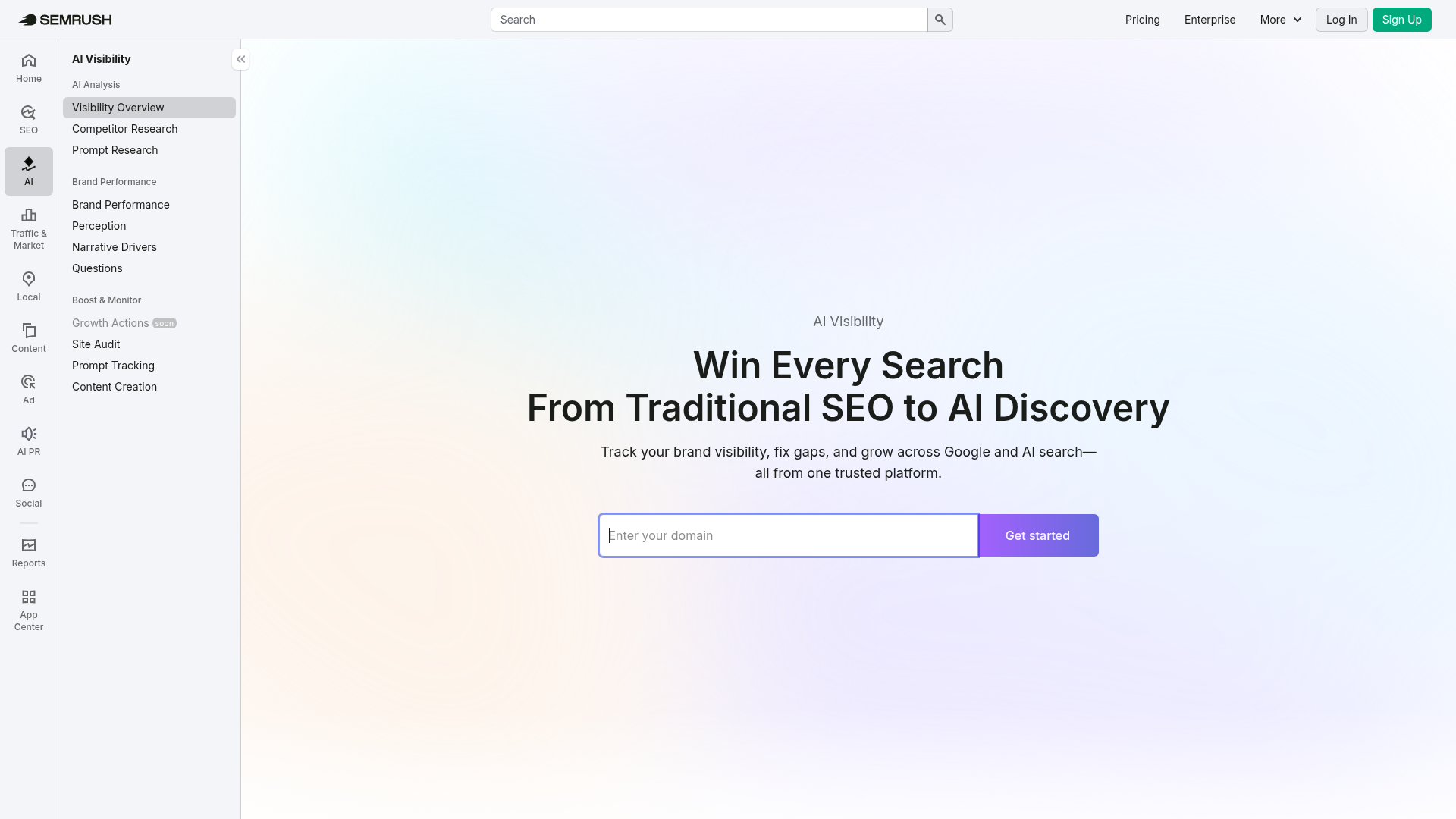
- Semrush, now an Adobe company, is the intelligence platform: it delivers keyword research and competitive data, plus AI visibility monitoring across a massive dataset of 28 billion keywords and 261 million-plus large language model (LLM) prompts.
- Content Directors running mature operations that need to ship governed content at scale will get more from AirOps. Teams that primarily need research data and rank tracking, or pay-per-click (PPC) campaign management, will get more from Semrush.
- Many teams run both: Semrush as a research and monitoring input, AirOps as the system that turns those signals into published pages and tracks what they produce.
Your team has more content data than ever. The bottleneck is execution: turning the signals you already have into published pages that show up where your buyers are looking.
AirOps and Semrush approach that problem from opposite ends. One gives you the intelligence; the other gives you the infrastructure to act on it.
This article breaks down both platforms across features, architecture, pricing, and real-world fit so you can decide which belongs in your stack, or whether you need both.
AirOps vs Semrush at a glance
AirOps gives you the system to act on AI search signals and measure what happens next. Semrush gives you the data to inform that action. The decision comes down to whether your bottleneck is intelligence or execution.
AirOps vs Semrush: platform overview
AirOps is the growth platform for AI search, built to take enterprise marketing teams from LLM visibility insight to published content to measured AEO outcomes in a single system. It serves SEO, content, and growth teams that already know where they need to show up but lack the operational infrastructure to get there at scale. The platform is purpose-built for Content Engineering: the emerging discipline of systems-oriented marketers who design repeatable content operations rather than writing individual pieces.
Semrush is a digital marketing intelligence platform, now operating as a wholly owned Adobe subsidiary following its April 2026 acquisition. It serves marketers who need keyword research and competitive analysis alongside rank tracking and AI visibility monitoring across a dataset of 28 billion keywords, 43 trillion backlinks, and 808 million domains. The acquisition brings Adobe's creative and data ecosystem closer to Semrush's search intelligence, though the combined platform doesn't yet add workflow execution or brand governance to the stack.
Core features: how AirOps and Semrush stack up
Feature sets reveal how each platform thinks about the content problem. AirOps treats visibility data as the starting point for an execution system. Semrush treats it as the product.
AirOps features
- Quill
- Quill is the autonomous agent that runs Playbooks across content creation, refresh, brand monitoring, and Answer Engine Optimization (AEO). Your team sets the strategy. Quill runs the execution.
- Your team reclaims hours previously spent on manual content production and can redirect that time toward strategy and editorial judgment.
- Semrush's ContentShake AI generates individual drafts but doesn't execute multi-step workflows or operate autonomously across your content library.
- Page360 unified view
- Page360 combines AI visibility data with Google Search Console (GSC) and Google Analytics 4 (GA4) metrics into a single page-level view so you can see how each piece of content performs across traditional search and AI search simultaneously.
- You stop toggling between tabs and dashboards to correlate performance data, which means faster decisions about what to refresh, what to create, and what to deprioritize.
- Semrush provides SEO metrics and a separate AI visibility toolkit, but the data lives in different reports with no unified page-level view that ties AI citations back to organic traffic.
- Prompt Discovery from four intent sources
- Prompt Discovery surfaces the exact questions buyers ask AI engines before reaching your site, pulling from four distinct intent sources to map how your brand appears in AI-driven conversations.
- You get a direct line into buyer intent that traditional keyword research misses: the prompts your audience types into ChatGPT, Gemini, and Perplexity when they're evaluating solutions.
- Semrush tracks AI visibility across LLM prompts at scale but doesn't surface four separate intent source types or connect prompt data directly to an execution workflow.
- Grids for bulk operations
- Grids let you run bulk content operations across hundreds of pages in a spreadsheet-like interface, with AI-powered columns that execute tasks row by row.
- You can refresh an entire content library or generate metadata at scale without building custom scripts or waiting on engineering resources.
- Semrush offers bulk keyword analysis and position tracking, but there's no equivalent to a programmable grid that executes content operations across your pages.
- Brand Kits
- Brand Kits encode your brand voice, writing rules, terminology, audience profiles, and regional guidelines into a governance system that every AI output must follow.
- You maintain brand consistency at scale without manually reviewing every piece: the system enforces your standards before content reaches human review.
- Semrush's SEO Writing Assistant checks tone and readability against basic parameters, but it doesn't offer a structured brand governance system with scoped rules per audience, region, or content type.
- AirOps MCP with 35+ tools
- AirOps MCP (Model Context Protocol) exposes 35-plus read-and-write tools that let external AI agents interact with your AirOps workspace: creating content, updating Brand Kits, querying analytics, and publishing through connected content management systems (CMSs).
- Your existing AI tools and automations plug directly into your content operations infrastructure, which means you're not locked into a single interface or workflow.
- Semrush offers an MCP server, but it's read-only: you can pull data out, but you can't write back or trigger actions from external agents.
- Offsite
- Offsite manages third-party publisher placements to grow your brand's AI citation share through the mentions and references that LLMs use to validate what your own site says about you.
- You build the off-domain consensus that AI engines look for when deciding whether to cite your brand, which is the piece most content teams miss entirely.
- Semrush tracks backlinks and mentions but doesn't provide tools to actively manage offsite AI visibility or coordinate publisher placements for citation growth.
- Query Fan-outs
- Query Fan-outs reveal the sub-queries AI engines run behind each user prompt, showing you the hidden search behavior that determines which brands get cited in AI answers.
- You can optimize for the actual queries driving AI citations, not the surface-level prompts your competitors are targeting.
- Semrush monitors AI visibility at the prompt level but doesn't expose the sub-query architecture that AI engines use internally.
- Closed-loop execution
- Closed-loop execution connects every piece of content back to the visibility signal that triggered it and tracks the outcome it produces, creating a compounding cycle where every insight drives action and every action produces a measurable outcome.
- You can prove content ROI to your executive team by pointing to the specific gap you identified, the page you shipped to close it, and the metric it moved.
- Semrush provides data to identify opportunities and metrics to track rankings, but the connection between signal and shipped content requires manual tracking or external tools.
Semrush features
- Keyword research and database
- Semrush's keyword database covers 28 billion keywords with volume, difficulty, intent classification, and Search Engine Results Page (SERP) feature data across 140-plus countries.
- You get the deepest keyword dataset available for planning traditional SEO campaigns and identifying content gaps.
- AirOps focuses on AI search prompts and the questions buyers ask AI engines rather than building a standalone keyword research database.
- Competitive intelligence
- Semrush tracks competitor traffic, keyword rankings, backlink profiles, and paid ad strategies across 808 million domains.
- You can reverse-engineer competitor strategies at a level of detail that informs both SEO and PPC (pay-per-click) decisions.
- AirOps tracks competitive share of voice in AI search specifically but doesn't offer the breadth of traditional competitive intelligence across domains, ads, and backlinks.
- AI visibility toolkit
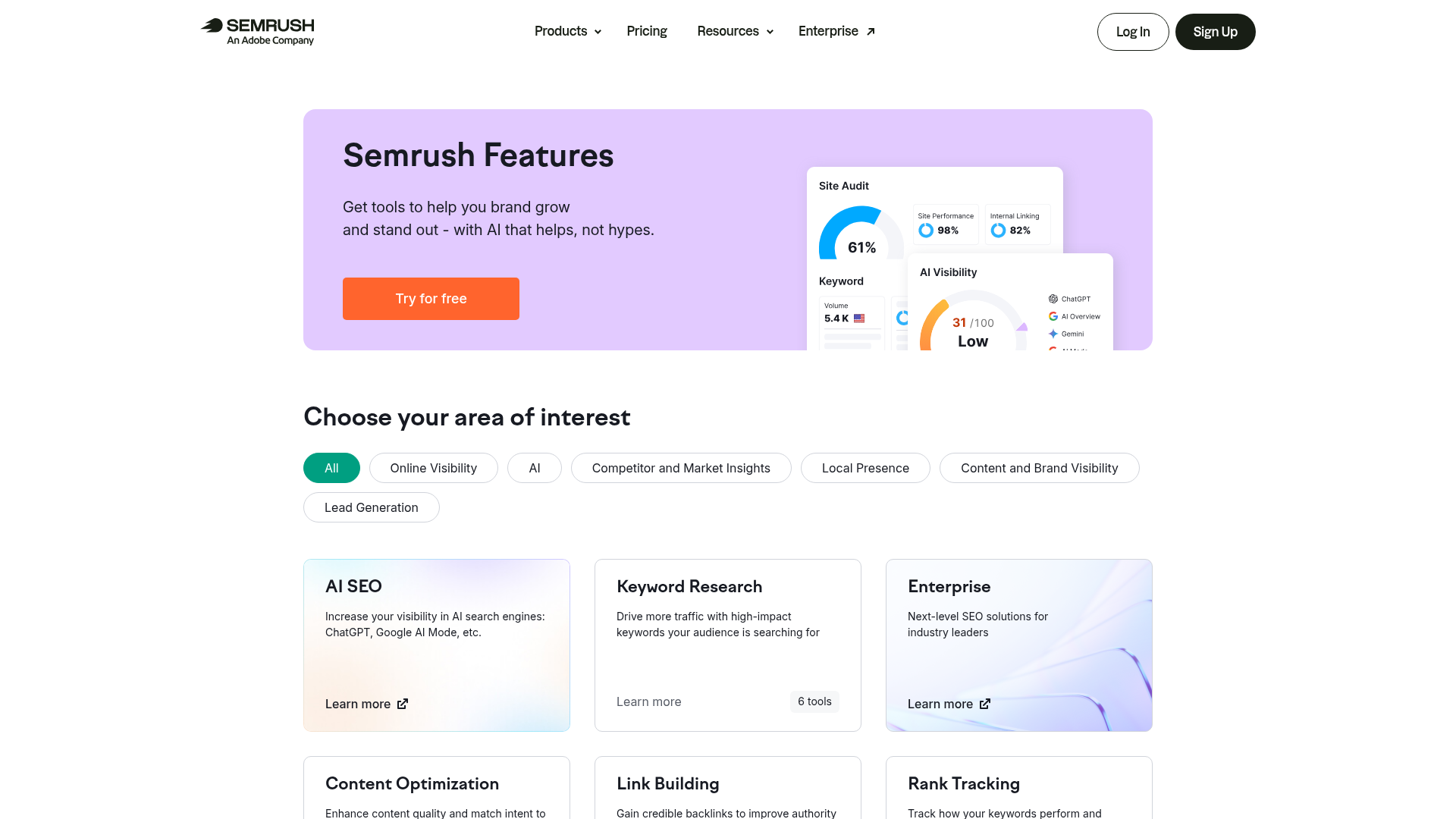
- Semrush One combines traditional SEO data with AI search visibility, tracking how brands appear across AI engines on 261 million-plus LLM prompts.
- You get a high-level read on your brand's AI search presence alongside your organic performance.
- AirOps provides deeper AI visibility analytics with direct connections to content execution; Semrush surfaces the data but doesn't offer a path from insight to action within the same platform.
- ContentShake AI
- ContentShake AI generates SEO-optimized draft articles using Semrush's keyword data and competitive insights.
- You can produce first drafts faster for straightforward SEO content.
- AirOps doesn't offer a standalone content generator; instead, Quill and Workflows handle content production as part of governed, multi-step operations.
- Site audit and technical SEO
- Semrush crawls your site to identify technical SEO issues: broken links, crawl errors, page speed problems, and structured data gaps.
- You keep your site technically healthy, which is foundational to both traditional SEO and AI search visibility.
- AirOps focuses on content operations and AI visibility rather than technical site auditing.

What feature differences mean in practice
The feature split maps to two different operational needs. Semrush arms you with the data to plan your SEO strategy and monitor where you stand. AirOps gives you the system to act on that strategy at scale, govern every output, and measure what each piece of content produces. Teams that have the data but can't ship fast enough need AirOps; teams that need the data in the first place need Semrush.
Product architecture overview: AirOps vs Semrush
AirOps is built as a content operations platform where data flows directly into execution workflows and back into measurement. Semrush is built as a data intelligence platform where analysis and monitoring are the primary outputs. The architectural difference shapes everything from how you onboard to how you scale.
Data layer
Both platforms ingest search performance data, but they store and process it for fundamentally different purposes. AirOps connects data to action; Semrush connects data to analysis.
- Data sources and integrations: AirOps pulls AI visibility data from its own monitoring engine and combines it with GSC, GA4, and CMS data through native integrations with eight content management systems. Semrush aggregates data from its proprietary crawler, clickstream providers, and third-party data partnerships to build the industry's largest keyword and domain database. The difference: AirOps integrates data for execution, while Semrush integrates it for research.
- Data accuracy and freshness: AirOps refreshes AI visibility data continuously and syncs page-level performance metrics from GSC and GA4 in near real-time, giving you current data when you need to decide what to publish or refresh next. Semrush updates keyword rankings, backlink data, and AI visibility reports on daily to weekly cycles depending on your plan tier. Both platforms deliver reliable data; the freshness difference matters most when you're making time-sensitive publishing decisions.
- Data portability: AirOps exposes 35-plus MCP tools for both reading and writing data, and Grids let you export and manipulate data in spreadsheet format. Semrush offers API access on higher tiers and a read-only MCP server for pulling data into external systems. AirOps treats data portability as bidirectional; Semrush treats it as an output channel.
AirOps builds a data architecture that feeds execution. Semrush builds one that feeds analysis. The choice depends on whether your team's constraint is understanding the landscape or acting on it.
Prioritization of opportunities
Knowing what to work on next separates productive content teams from busy ones. Both platforms surface opportunities, but they do it with different end goals.
- Decision engines and scoring: AirOps scores content opportunities based on the gap between current AI visibility and potential impact, factoring in citation rate, mention rate, competitive positioning, and page-level performance data from GSC and GA4. Semrush scores keywords by volume, difficulty, and competitive density, with newer AI visibility metrics added to higher tiers. AirOps prioritizes based on where action will move the needle; Semrush prioritizes based on where opportunity exists in the data.
- AI-powered recommendations: AirOps connects recommendations directly to executable workflows: a suggested content refresh flows into a Quill Playbook that drafts the content, routes it through human review, then publishes to your CMS. Semrush's Copilot surfaces SEO recommendations but leaves execution to you or to third-party tools. AirOps connects recommendations to executable workflows, which means insights become shipped content rather than backlog items.
- Integration of signals: AirOps merges AI visibility signals with traditional search signals and content performance data into a single prioritization view through Page360. Semrush's signals live across separate toolkits: the SEO toolkit, the AI visibility toolkit, and the advertising toolkit each have their own prioritization logic. Consolidated signals lead to faster, more confident decisions.
AirOps builds prioritization that leads to action. Semrush builds prioritization that leads to planning. Both are valuable at different stages of maturity.
Workflow building and automation
Execution speed depends on how well your tools turn decisions into shipped content. This is where the platforms diverge most sharply.
- Workflow builder capabilities and flexibility: AirOps includes a visual workflow builder where you design multi-step content operations with branching logic, human review gates, API calls, and direct CMS publishing. Semrush doesn't include a native workflow builder. Content operations beyond keyword research and draft generation require external orchestration through tools like Zapier, Make, or custom scripts.
- Workflow automation features: AirOps automates content creation, refresh, publishing, and monitoring through Quill Playbooks that run end-to-end with configurable human checkpoints. Semrush automates reporting and rank tracking but doesn't offer automated content production or publishing workflows. Automation at the execution level is the operational gap that separates the platforms.
- Workflow conditional logic and triggers: AirOps workflows support conditional branching based on data inputs, content scores, brand compliance checks, and human review outcomes. Semrush's automation is limited to scheduled reports and alert triggers based on ranking changes or site audit findings. Conditional logic at the content operations level is exclusive to AirOps.
- Ease of building vs. complexity of what can be built: AirOps requires more upfront configuration to design workflows that match your team's process, but the payoff is operations that run repeatedly without manual intervention. Semrush is faster to start using for research and monitoring because there's less to configure, but the ceiling on what you can automate is lower. The tradeoff is setup time versus operational ceiling.
AirOps treats workflow automation as the core product. Semrush treats it as outside scope. That's not a criticism; it reflects different platform philosophies about where the value sits in the content lifecycle.

Governance, context, and brand control
AI-powered content production at scale creates a governance problem that most platforms ignore. How you maintain brand consistency across hundreds of outputs determines whether AI helps or hurts your brand.
- Brand voice and governance features: AirOps Brand Kits encode your writing rules, terminology, audience guidelines, regional adaptations, and brand voice into a structured system that AI outputs must follow before reaching human review. Semrush's SEO Writing Assistant checks tone and readability against basic parameters like target keyword density and reading level. Brand governance at the system level versus content-level readability checks is a meaningful operational difference for teams producing at volume.
- Knowledge bases and Brand Kits: AirOps lets you build Knowledge Bases that ground AI outputs in your company's specific data, case studies, product documentation, and approved messaging. Semrush provides keyword data and competitive intel as context for its ContentShake AI tool, but there's no equivalent to a structured knowledge base that ensures AI outputs reflect your specific brand facts.
- Customization vs. templates: AirOps lets you define content types with custom template outlines, header conventions, call-to-action (CTA) rules, and scoped writing rules per audience or region. Semrush offers content templates based on top-ranking competitors for a given keyword. AirOps customization reflects your brand; Semrush templates reflect the market.
Brand governance is a hard requirement for enterprise content teams. AirOps builds it into the execution system. Semrush leaves it to your team's editorial process.

Integrations and ecosystem
Platforms earn their place in your stack by connecting to it. Both AirOps and Semrush integrate with common marketing tools, but the depth and direction of those integrations differ.
AirOps integrations
- CMS publishing (Webflow, WordPress, Contentful, Sanity, ContentStack, Ghost, Strapi, Shopify): direct publishing from workflows, which means content goes from "approved" to "live" without manual CMS work.
- SEO tools (Semrush, Ahrefs, Moz, DataForSEO): pulls research data into AirOps as an input for content operations.
- Project management (Asana, ClickUp, Monday, Airtable, Notion, Slack): connects content workflows to your team's existing project tracking.
- MCP with 35-plus read/write tools: lets external AI agents interact with your full AirOps workspace bidirectionally.
Semrush integrations
- Google (Search Console, Analytics, Ads, My Business): core data connections for SEO and PPC analysis.
- Social platforms (Facebook, Instagram, Twitter, LinkedIn): scheduling and analytics for social campaigns.
- WordPress: direct publishing for ContentShake AI drafts (WordPress only).
- Trello, Zapier, Surfer: workflow and task management connections for extending Semrush into broader toolchains.
AirOps integrates into your stack as the execution hub that connects data sources to publishing destinations. Semrush integrates as a data source that feeds into other tools. The distinction: AirOps is where content operations happen; Semrush is where research data comes from.
Platform depth and scalability
As your content operation grows, the platform needs to grow with it. Scale means more pages, more team members, more workflows, and more complexity.
- Architectural breadth and depth: AirOps covers the full content operations lifecycle in a single platform, with each component built to feed the next. Semrush covers research, monitoring, and reporting in deep detail but stops short of execution infrastructure. Breadth and depth serve different needs: AirOps spans the full workflow at the expense of standalone research depth; Semrush goes deep on data at the expense of operational breadth.
- Scalability across teams and content volume: AirOps Pro includes unlimited seats, which means your content team grows without per-seat cost increases. Semrush charges $45/month for each additional user, which adds up quickly for teams of five or more. Per-seat pricing becomes a meaningful constraint when you're trying to give every content producer access to the platform.
- Long-term extensibility and future-proofing: AirOps is built for the AI search era with native support for AEO, LLM prompt monitoring, and autonomous content agents. Semrush is adding AI visibility capabilities on top of a platform originally designed for traditional SEO. Adobe's acquisition provides resources for product expansion, but the foundational architecture favors data analysis over content operations. Teams building for AI search as a primary channel will find AirOps's architecture more aligned with where the market is heading.
AirOps scales as an operations platform: more workflows, more pages, more team members without linear cost increases. Semrush scales as a data platform: more keywords, more domains, more competitive intelligence. Choose based on which scaling axis matters to your team.
AirOps vs Semrush: out-of-the-box services and solutions
AirOps delivers more immediate execution value for teams that need to ship content. Semrush delivers more immediate research value for teams that need to plan campaigns.
Semrush gets you to your first insight faster. AirOps gets you to your first shipped, governed piece of content faster. The time-to-value question depends on whether "value" means data or published output.
AirOps vs Semrush: support, resources, and community
AirOps invests in implementation and operational enablement. Semrush invests in self-serve education and a broad learning ecosystem. The difference tracks with each platform's complexity: execution infrastructure needs more hands-on onboarding than a research tool.
Execution and training
- Implementation support and training: AirOps provides dedicated implementation support, including workflow design, Brand Kit configuration, CMS integration setup, and team training. Enterprise accounts get a dedicated Customer Success Manager (CSM) and ongoing operational guidance. Semrush offers Semrush Academy with certifications in SEO, content marketing, and PPC, plus extensive documentation. Implementation is mostly self-serve with account management available on higher tiers.
- Managed services vs. self-service approaches: AirOps offers managed services for teams that want AirOps experts to configure and optimize their content operations. Semrush is designed as a self-service platform with optional professional services for enterprise accounts. Teams that want to operate rather than configure prefer AirOps's managed approach; teams that prefer hands-on control prefer Semrush's self-serve model.
Ease of use and onboarding
- Onboarding process: AirOps onboarding typically runs four to six weeks for enterprise teams, covering workflow design, integration setup, Brand Kit configuration, and team training. Semrush onboarding is faster: most teams are pulling reports within a day, with a learning curve concentrated around advanced features like custom reporting and API access.
- Ease of use: AirOps has a steeper initial learning curve that reflects the depth of what you can build; once configured, daily operations are straightforward. Semrush is approachable from day one for research and monitoring tasks, with complexity increasing as you add toolkits and integrations.
Support and resources
- Resources: AirOps publishes product documentation, Content Engineering guides, playbook templates, and customer case studies. Semrush offers one of the most extensive SEO knowledge libraries in the industry, including Semrush Academy, a research blog, and regular webinars.
- Community: AirOps hosts the Content Engineering community, including the Content Engineering Certification program for systems-oriented marketers. Semrush runs an active community forum and hosts events worldwide.
- Customer support: AirOps offers in-app chat, email, Slack Connect for enterprise accounts, dedicated CSMs, and priority support for Enterprise tier customers. Semrush provides email and chat support, with phone support on higher tiers and dedicated account management for Enterprise.
AirOps vs Semrush: pricing and value comparison
AirOps starts free and scales based on platform usage. Semrush starts at $139/month and scales by feature tier plus per-seat add-ons. The pricing structures reflect different value models: AirOps prices for operational output; Semrush prices for data access.
Total cost of ownership tilts in AirOps's favor for larger teams. Semrush's $45/month per additional user adds up: a ten-person team on Pro+ pays $299 plus $405 in extra seats, totaling $704/month before add-ons. AirOps Pro includes unlimited seats at a custom rate, which means your fifth content producer costs the same as your first. Factor in the cost of the third-party workflow tools you'd need alongside Semrush to match AirOps's execution capabilities, and the gap widens further.
Real-world: when to use each platform
The right choice depends on where your team sits in its content operations maturity and what your primary bottleneck is today.
AirOps
- Workflow fit: AirOps fits teams that have outgrown the manual loop of researching keywords and writing individual pieces without an execution system and need a system that automates content operations from signal to published page. It's built for Content Directors managing five-plus producers who need governed output at scale, and for GEO (Generative Engine Optimization) and AEO-focused teams building for AI search as a primary acquisition channel.
- Industry fit: Enterprise SaaS, fintech, e-commerce, and any vertical where brand governance and AI search visibility are board-level priorities. Teams in regulated industries benefit especially from Brand Kit governance and compliance-check workflows.
Semrush
- Workflow fit: Semrush fits teams that need deep keyword research and competitive analysis alongside rank tracking as their primary workflow. It's ideal for SEO practitioners running traditional search campaigns, agencies managing multiple client accounts, plus PPC teams that need competitive ad intelligence alongside their organic strategy.
- Industry fit: Agencies, publishers, e-commerce brands focused on traditional SEO, and marketing teams running paid search alongside organic. Teams that primarily need data to inform strategy rather than infrastructure to execute it will get the most from Semrush.
AirOps vs Semrush: strengths and limitations
AirOps
Strengths
- Closed-loop execution: AirOps connects AI visibility insight to content production to measured outcome in a single system, which means you can prove what your content operation produces without stitching together external tools.
- Brand governance at scale: Brand Kits enforce your writing rules and terminology alongside voice guidelines across every AI output, which solves the quality control problem that scales linearly with content volume on other platforms.
- Unlimited seats on Pro: your entire team operates inside the same system without per-seat cost escalation, which removes the "who gets a license?" bottleneck that limits adoption on per-user platforms.
Limitations
- Steeper onboarding: AirOps requires more upfront configuration than a research tool because you're building an execution system, not just logging in to pull reports. Most enterprise implementations take four to six weeks.
- Traditional keyword depth: AirOps focuses on AI search prompts and content operations rather than building a standalone keyword research database, so teams that rely heavily on traditional keyword discovery will still need a dedicated research tool.
- Newer platform: AirOps has a shorter track record than Semrush, which may matter to procurement teams that weight vendor maturity heavily, though G2 reviewers rate it 4.6/5 for customer satisfaction.
Semrush
Strengths
- Deepest keyword database: 28 billion keywords and 43 trillion backlinks across 808 million domains make Semrush the most data-rich research platform for traditional SEO and competitive intelligence.
- Adobe ecosystem: the acquisition brings Semrush into Adobe's creative and analytics ecosystem, which could create value for teams already invested in Adobe's stack.
- Fast time-to-insight: Semrush is productive on day one. You can pull competitive reports and run site audits, then start tracking rankings within minutes of creating an account.
Limitations
- No native workflow execution: Semrush doesn't include a workflow builder or content publishing automation. There are no autonomous agents. Going from "identified opportunity" to "published page" requires external tools or manual work.
- Per-seat pricing: $45/month for each additional user creates a cost ceiling that discourages full-team adoption, which fragments access to data across your content operation.
- Basic brand governance: Semrush's tone and readability checks don't approach the structured brand governance that enterprise content teams need to maintain quality at volume.
Bottom line
AirOps and Semrush solve different problems in the content lifecycle. AirOps is the execution platform: it takes your team from visibility signal to governed, published content with measurement built in. Semrush is the intelligence platform: it gives you the deepest dataset available for planning search strategy and monitoring where you stand.
Choose AirOps if:
- Your bottleneck is shipping governed content at scale, not discovering what to write about.
- You need a system that connects AI visibility insights to content production to measured outcomes, and you need to prove content ROI to your executive team.
- You're building for AI search as a primary channel and need both on-site content operations and offsite citation growth in a single platform.
Choose Semrush if:
- Your primary need is keyword research and competitive intelligence alongside rank tracking across the industry's largest search dataset.
- You're running an agency or managing multiple client accounts that need standardized SEO reporting and site audits.
- You need PPC competitive intelligence alongside your organic strategy and want both in one interface.
Why teams choose AirOps
The comparison comes down to what's missing from your stack. Semrush tells you where to look. AirOps gives you the system to act on what you find and govern the output, then prove what it produced. Choosing Semrush alone means you still need to solve for execution and brand governance. Content ROI measurement remains a separate problem too.
The results from teams running AirOps back this up. Webflow achieved 5x content refresh velocity and 40% organic traffic uplift within days of launching their AirOps-powered workflows. Carta saw a 7x increase in AI search citations and 300% content velocity growth while maintaining brand voice through a major rebrand. Chime cut per-refresh time by 89% and tripled AI citations in four weeks across a 700-post blog library. Parallel grew share of voice from 2% to 20% in six months as a single-marketer team competing against full departments.
Teams running AirOps on a single connected system produce results like these consistently, rather than chasing outcomes across disconnected tools.
Book a call to see how AirOps turns AI search signals into published content your team controls.
Frequently Asked Questions
FAQs
Can I use AirOps and Semrush together?
Yes, and many teams do. AirOps natively integrates with Semrush, pulling keyword data and competitive intelligence into your content workflows. Semrush serves as the research input; AirOps serves as the execution and governance system. The combination gives you Semrush's dataset plus AirOps's operational infrastructure.
What is AEO and how does it differ from SEO?
Answer Engine Optimization (AEO) focuses on how your brand appears in AI-generated answers from platforms like ChatGPT, Gemini, and Perplexity. SEO focuses on ranking in traditional search results. AirOps covers both with connected analytics and execution tools. Semrush has added AI visibility monitoring but remains primarily an SEO platform.
Does the Adobe acquisition change what Semrush offers?
Adobe completed its acquisition of Semrush in April 2026. The acquisition validates Semrush as an enterprise data platform and opens integration potential with Adobe's Creative Cloud and Experience Cloud. It doesn't add workflow execution, brand governance, or closed-loop content publishing to Semrush's capabilities today.
Which platform is better for small teams?
AirOps offers a free Solo tier that gives a single marketer access to prompts, tasks, and the core platform. Semrush's entry point is $139/month. For lean teams that need to ship content, AirOps's free tier plus execution tools deliver more operational value. For lean teams that need keyword research above all else, Semrush's data depth justifies the cost.
How does AirOps handle brand governance for AI-powered content?
Brand Kits in AirOps encode your writing rules, voice guidelines, terminology, audience profiles, and regional adaptations into a structured governance system. Every AI output passes through this governance system before it reaches human review. You define the rules once; the platform enforces them at scale across every workflow and content type.
What integrations does each platform support?
AirOps integrates with eight CMS platforms (including Webflow, WordPress, Contentful, and Shopify), SEO tools (including Semrush itself), project management tools (Asana, ClickUp, Notion, Slack), and exposes 35-plus MCP tools for bidirectional AI agent access. Semrush integrates with Google's suite (Search Console, Analytics, Ads), social platforms, WordPress for CMS publishing, and a read-only MCP server.
How long does it take to get started with each platform?
Semrush is productive within minutes for research and monitoring tasks. AirOps enterprise implementations typically take four to six weeks, covering workflow design, Brand Kit setup, CMS integrations, and team training. The longer onboarding reflects the difference between logging into a research tool and configuring a content operations system. Teams running AirOps's free Solo tier can start building workflows immediately.
Get the latest on AI content & marketing
