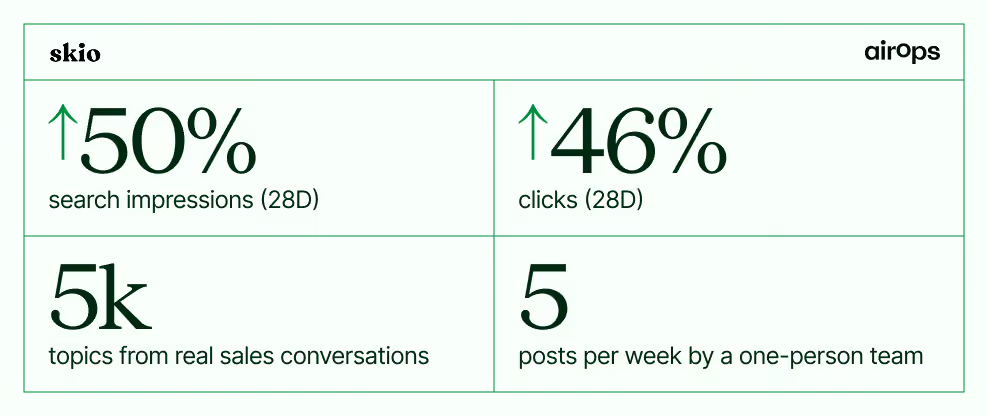
- 50% increase in search impressions and 46.1% increase in clicks in the first 28 days
- ~5,000 content concepts generated from real demo and discovery call questions
- Content doubles as a sales asset: BDRs use it in outbound to engage new target accounts and multi-thread open opportunities
- Built from zero (no blog, no content infrastructure) by a one-person marketing team
Meet Skio: a challenger brand where outbound drives the business
Skio (a Recharge company) sells subscription management to Shopify brands in a competitive market. There are four or five platforms a serious brand would consider, and Skio competes on product quality rather than sheer size.
Its buyers are mid-market and up, brands that already run subscription programs and are looking for something better: more flexibility in their portal, stronger payment recovery, a platform that can keep pace with how they're growing.
Almost all of Skio's business comes through outbound and referrals.
- A BDR reaches a prospect on LinkedIn
- An agency recommends Skio to a client
- Word travels
Very little traffic comes through the website, and almost none through the Shopify App Store.
When Allen Finn, Skio's Director of Marketing, joined as the company's one-person marketing team 10 months ago, the website was a homepage, a demo form, and an about page. No blog. No content. No organic traffic to speak of. His job was to figure out what content could actually do for a business where inbound wasn't the growth engine.
The problem with the obvious organic playbook
The default move for a SaaS company investing in content is some version of programmatic SEO: spin up a glossary, publish hundreds of "what is" pages, chase broad top-of-funnel keywords. At least one company in every vertical is doing it right now.
"A glossary is not a good fit for Skio," Allen said. "If you are trying to define dunning, you probably shouldn't be using Skio."
The logic is simple. Skio's buyers aren't Googling introductory terms. They already run subscription programs. They're researching specific operational problems: payment recovery for seasonal businesses, migrating from a competitor without disrupting active subscribers, custom portal builds for high-SKU catalogs.
Broad content attracts the wrong audience and does nothing to position Skio as the answer for those buyers.
Allen had spent 12 years in content marketing, including stints at WordStream and Triple Whale, but he had to rethink what content meant for a business like this. The question wasn't how to generate traffic. It was how to create content specific enough to be useful to qualified buyers, and useful enough that the sales team would actually want to share it.
The signal was already in the sales calls
The answer was already sitting in Skio's call recordings. Every demo and discovery call contains the exact questions buyers are asking and the specific pain points driving them to evaluate a new platform. Allen just needed a way to extract that signal and turn it into content at scale.
He found the tooling through AirOps Cohort, a hands-on training program where marketers learn how to think like Content Engineers in live sessions. Allen came in with the use case already mapped out: analyze sales call transcripts, extract prospect problems, match them to keywords, research competitor content for those keywords, and create something better.
"By the end of Cohort I had a working pipeline," he said. "AirOps made it possible to go from a raw transcript to a publish-ready post without needing a whole content team."
By the end, he had a working prototype. He tried building the entire pipeline as a single AirOps workflow but found it was too many steps for one chain to handle cleanly. So he broke it into stages, with AirOps handling the content generation and optimization. That modular approach gave him the highest value at the lowest cost, a practical entry point for a team of one.
How 5,000 content concepts get made
Every demo and discovery call gets scraped for three things: the specific questions the prospect asked, the pain points they cited, and the responses from Skio's team. All of that feeds into a database automatically.
Each new entry gets matched against existing content concepts. The system is deliberately broad in how it looks for relationships. "I want it matching broadly, where one concept looks related to 12 other posts," Allen said. The goal is to enrich an existing concept rather than create a new one, keeping the library tight instead of letting it sprawl. If there's no match, a new concept gets created.
Once a concept exists, a second workflow kicks in. It pulls keyword data to find terms that map back to the questions and pain points, identifies secondary keywords, and groups everything into content clusters: a pillar page with 8 to 12 supporting posts. That library now holds roughly 5,000 content concepts.
The system then generates an outline that includes a competitive SERP analysis: what's currently ranking for the primary keyword, whether competitors are on page one, what gaps exist in the best-performing pages. That analysis shapes the structure of Skio's version.
AirOps drafts from Skio's Knowledge Base and Brand Kit. The first pass is information-heavy and deliberately clinical: section structure, H-tags, where to place tables for LLM consumption versus traditional search. It identifies internal linking opportunities in both directions, flagging existing pages that should link to the new post and pages the new post should link to.
.avif)
Allen reviews a batch of these every Friday for the following week. Once he approves the structure, the system rewrites it in brand voice and publishes. A custom script generates a branded header image for each post using Skio's mascot (a purple space cat with 18 category-specific variants) and the post title in brand typeface.
"The key to scale is building end-to-end automation: the call scraping, the keyword research, the competitive analysis, the drafting," Allen said. "This program is possible because AirOps is a single, highly connected system."
Content that serves two audiences at once
The system publishes at a rate of 5 posts per week. Early results from Search Console: impressions are up 50% and clicks to the website are up 46.1% compared to the previous 28-day period.
But the more interesting outcome is happening off the website. Skio's BDRs have started pulling from the content library in their outbound outreach.
"They love it because it gives them something to send that isn't a product update," Allen said. The posts address the exact pain points prospects raise on calls, which means a BDR can send a piece of content that directly speaks to what a prospect cares about. Some reps share the posts themselves. Others pull insights from them and fold the information into their own messaging.
"It makes you look like a useful person," Allen said. "Even if reps aren't sharing an actual post, they're pulling the insights out and working them into their own outreach."
For Allen, the sales enablement result is the one he cares about most. Traffic and impressions are nice, but Skio doesn't depend on inbound for pipeline. What matters is whether the content makes outbound more effective.
"The thing I care about most is hearing from a BDR that they used a post and a prospect found it valuable," Allen said. "The content covers such specific pain-points that BDRs use it to reengage a stale prospect. Or while one person from an account was being demoed, they could multi-thread with other people on the team and send them content that directly addresses their pain point."
Results
- 50% increase in search impressions and 46% increase in clicks in the first 28 days
- ~5,000 content concepts generated from real sales conversations
- 5 posts published per week, built and managed by a one-person marketing team
- BDRs actively using content in outbound to re-engage prospects and multi-thread accounts
What's next: end-to-end automation and content freshness
The biggest remaining bottleneck is publishing. Skio's website runs on Framer, and programmatic publishing there is, in Allen's words, "a massive pain in the ass." An AirOps Framer integration is in development, which could close that gap and let the pipeline run end to end without a manual handoff.
After that, the focus shifts to keeping the library alive. Five thousand content concepts is a strong foundation, but search rankings decay and buyer questions evolve. Allen plans to build systems for ongoing freshness: monitoring which posts are losing position, updating content as new call data comes in, and strengthening internal linking as the library grows.
"Once we've had this running a bit longer, I'll probably use AirOps more for the analysis, the freshness work, and internal linking," Allen said.
"AirOps is what makes the math work for a team of one," Allen said. "I'm not managing a content ops team. I'm reviewing output on Fridays."
Five thousand content concepts. One person. A pipeline that starts with a sales call and ends with a published post that both ranks and sells. And it's just getting started.
Get the latest on AI content & marketing
