
- LegalZoom's content team was buried in mechanical work: briefing, refreshing, and maintaining thousands of legal articles by hand, with no capacity for the expert content that actually differentiates them
- Using AirOps, they automated the mechanical layer, cutting article refresh time by 90% and compressing a month of content briefing into a single day
- They can track AI visibility and take action in one platform, moving away from Profound to consolidate analytics and execution in AirOps
- Other departments took notice: a $250K, six-month redaction project was replaced by an afternoon of in-house work, bringing total savings to $600K+ across three departments
Meet LegalZoom: Leaning into AI in an industry where expertise and trust are non-negotiable
LegalZoom has spent 25 years helping families and small businesses navigate legal complexity, from LLC formation to estate planning.
As AI reshapes how people discover and access legal services, the company has been deliberate about where the technology fits: while AI can help with scale and discoverability, human experts always need to supervise. In an industry where bad advice carries real consequences, that oversight isn't optional.
That philosophy only works if someone builds the systems to deploy AI. At LegalZoom, that started with Connor Beaulieu, a Senior SEO Manager who turned to AirOps to modernize the company's content operations. The results caught attention across the organization. Within months, teams in Legal and Central Operations were bringing their own problems to the table.
AirOps is the partner you bring in for the shift to AI search: the platform, the media mix, and the team together, not just software to log into.
Rebuilding content operations for 90% efficiency gains
LegalZoom's content team was producing 80 to 100 articles a month, but nearly all of those hours went toward mechanical work that didn't require human judgment. Connor was spending 80% of his time writing content briefs. He and leadership both wanted him on higher-value work, but the briefing volume made that impossible.
Using AirOps, he codified the process that had been living in his head into a system that handles the full briefing pipeline:
- Analyzing search results and running competitor analysis
- Surfacing subtopics that haven't been addressed
- Checking against a Knowledge Base loaded with Connor's best briefs and LegalZoom's top-performing articles
The output: briefs he estimates match 95% of human quality, sometimes better, in a fraction of the time.
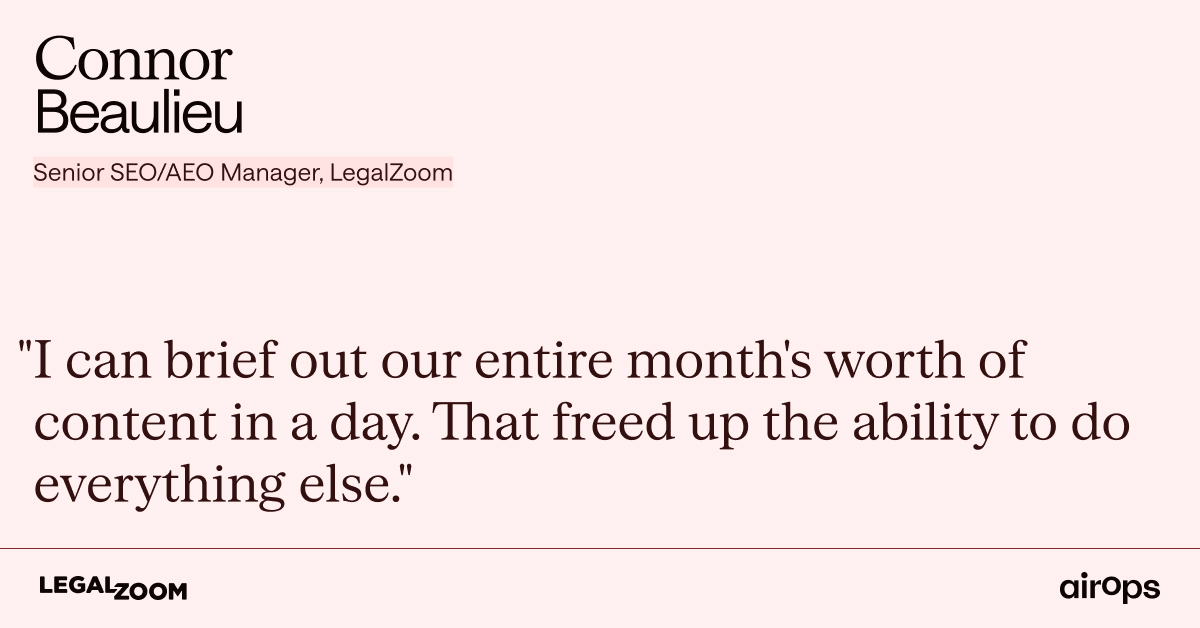
"I could brief out our entire month's worth of content in a day," Connor said. "That freed up the ability to do everything else."
Article production saw the same gains. Previously, a single 2,500-word article required roughly 10 hours across writers and editors. With thousands of articles to maintain and many underperforming, the backlog was growing.
The team built an automated refresh system that triggers when articles show performance decay through Google Search Console data. The automation handles the mechanical parts: pulling current search data, analyzing competitor updates, restructuring the article, and producing a draft that follows LegalZoom's editorial standards. Expert editors and legal reviewers take it from there.
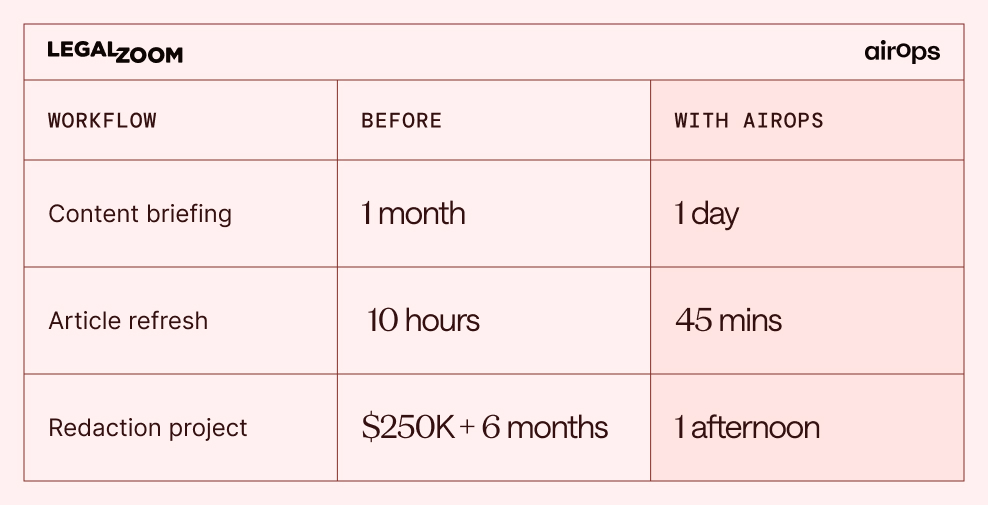
Execution time dropped from 10 hours to about 45 minutes.
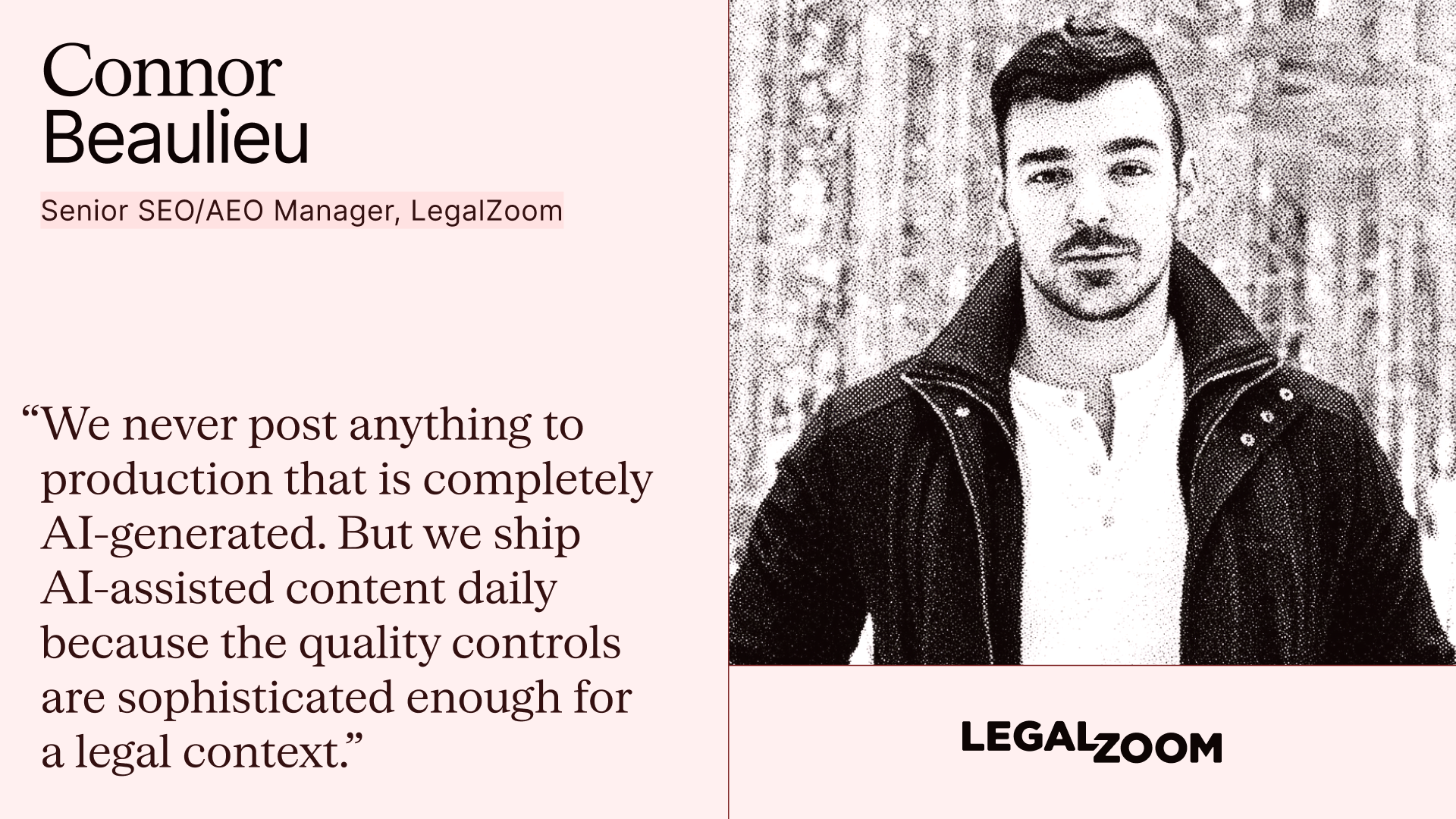
"We never post anything to production that is completely AI-generated," Connor said. "But we ship AI-assisted content daily because the quality controls are sophisticated enough for a legal context."
More time for information gain and audience research
The freed-up hours went toward work the team had never had capacity for: sourcing expert legal opinions, adding nuance that only a practicing attorney would know, and running proprietary research studies. That depth matters to readers and to the AI platforms they use to search for information. Pages with expert-sourced content regularly earn more AI citations than generic alternatives.
The team also built a Reddit research system that monitors the subreddits most relevant to LegalZoom's audience, tracking popular posts and comments over a rolling 90-day window. The results surfaced needs that a keyword spreadsheet never would.
Instead of "how do I form an LLC," communities were asking things like "How do I deal with the loneliness of being an entrepreneur?" and "How do I find community when I'm starting a business?" LegalZoom sharpened their strategy by building content that answers those real questions.
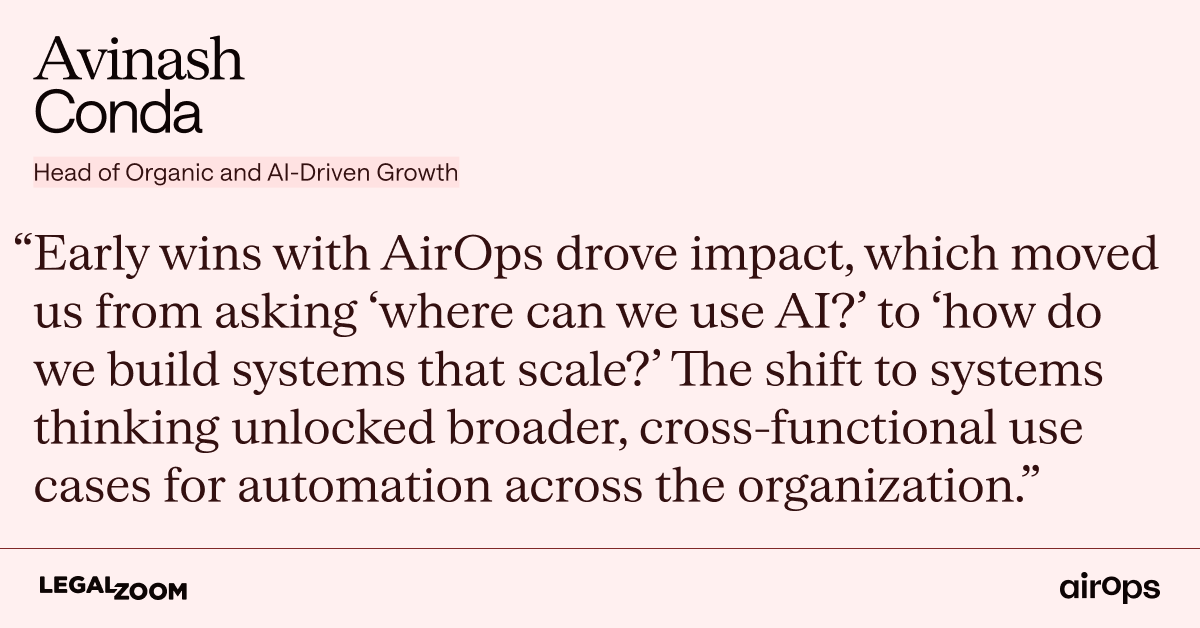
“What’s been most powerful isn’t just the efficiency gains from AirOps, it’s the mindset toward systems thinking that it enabled,” said Avinash Conda, Head of Organic and AI-Driven Growth.
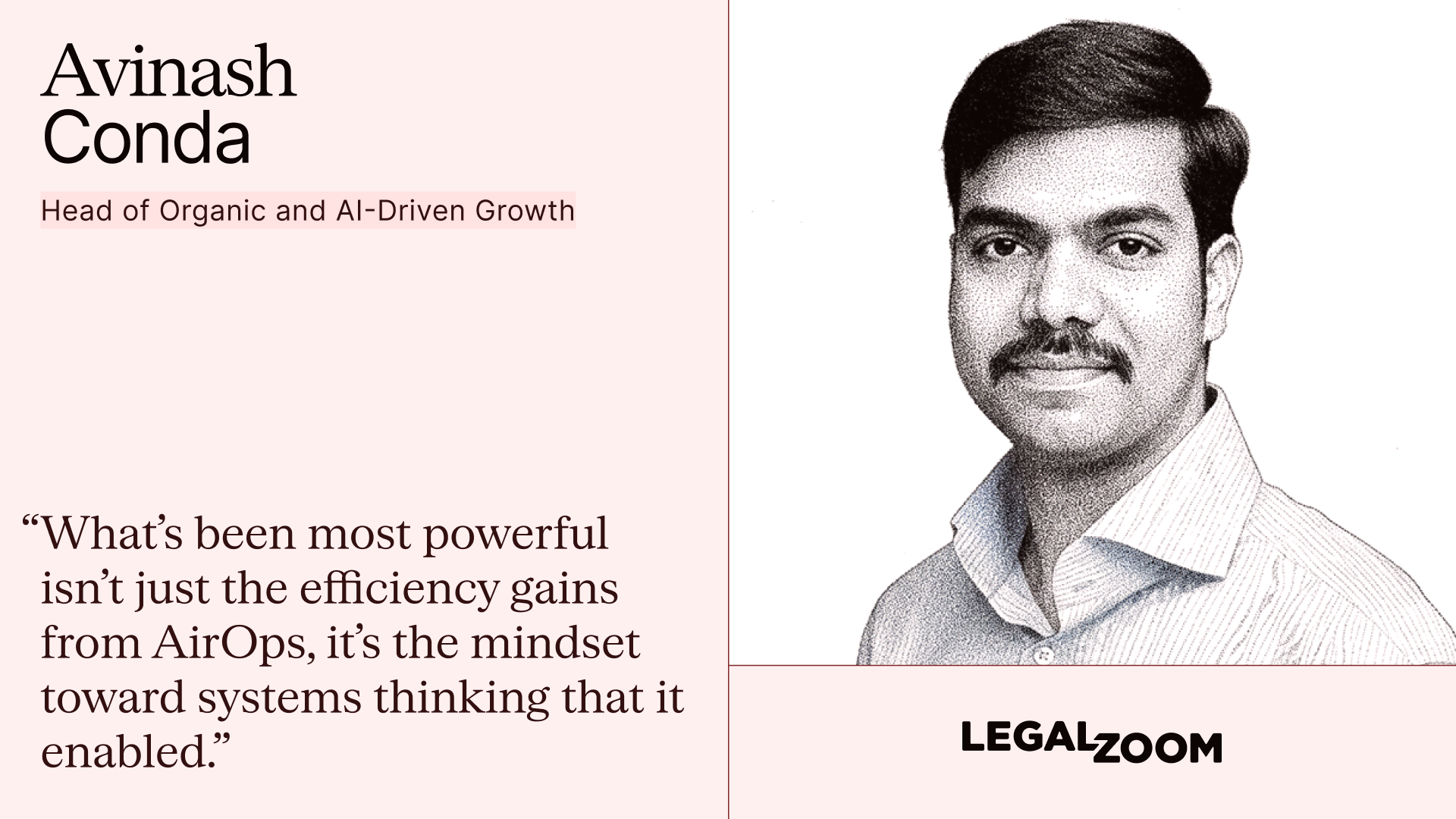
“Early wins with AirOps drove impact, which moved us from asking ‘where can we use AI?’ to ‘how do we build systems that scale?’ The shift to systems thinking unlocked broader, cross-functional use cases for automation across the organization.”
Fresher content, better visibility, and higher conversions
Content freshness is a ranking signal in traditional search, and the stakes are even higher in AI. AirOps research found that pages going more than a quarter without refreshing are 3x more likely to lose AI citations. For commercial queries, 83% of citations come from pages updated within the past 12 months. LegalZoom's automated refresh process keeps high-value content current at a pace that would be impossible manually.
But freshness alone doesn't explain the results. The content the team produces now, backed by review by licensed attorneys, original research, and real community insights, converts at a 5x higher rate than the surface-level content they were grinding through before. That shift pushed the team to move their KPI from traffic volume to revenue per session.
The same dynamic is playing out in AI search. Click-through rates are down 80% in the legal space, but LLM referral traffic converts at 5x the rate of traditional organic. Fewer sessions, higher value per session.
The AEO data backs this up. LegalZoom holds an 18.55% AI search citation share in "Finding Legal Help & Attorney Services," their highest-value topic, outpacing YouTube, Reddit, and traditional legal publishers like Wolters Kluwer. Across all 12 tracked topic categories and 1,238 monitored questions, they maintain a 2.49% overall citation share, strongest in the categories closest to their core business.
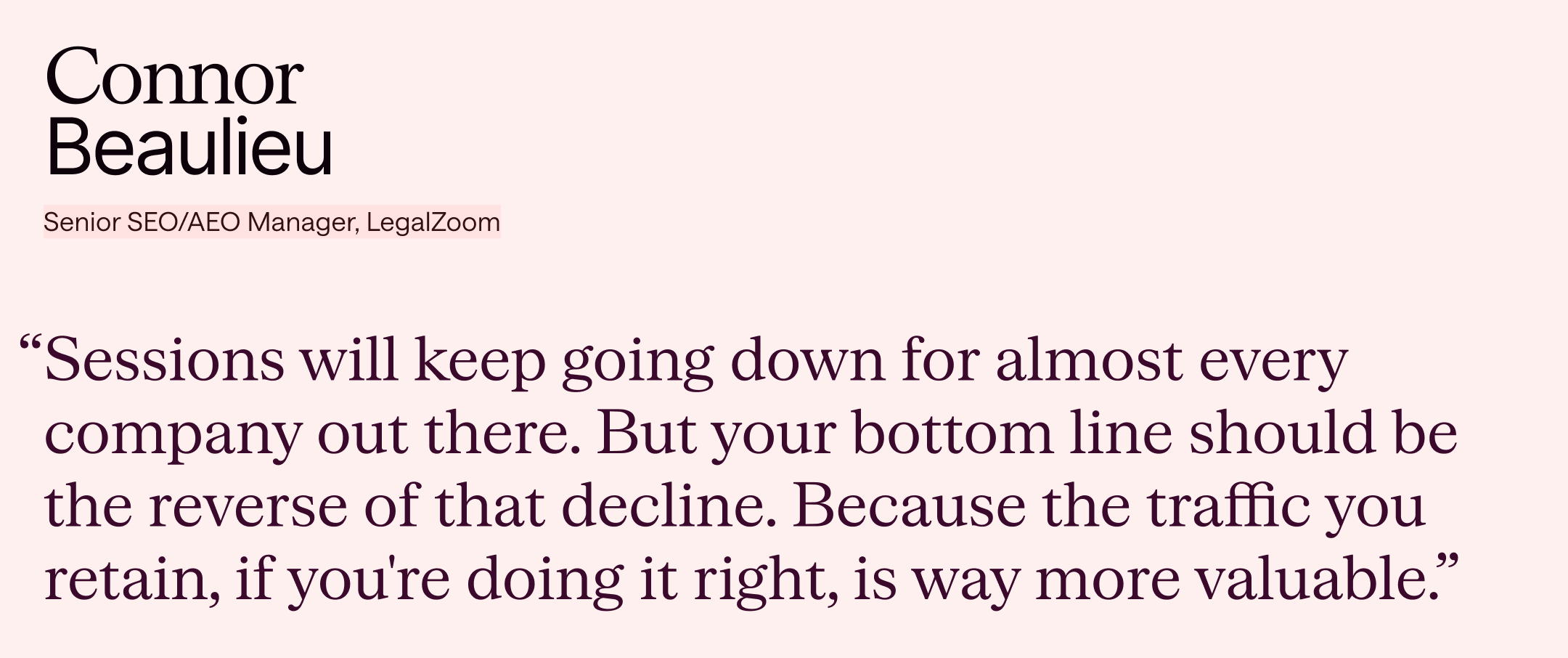
"Sessions will keep going down for almost every company out there," Connor said. "But your bottom line should be the reverse of that decline because the traffic you retain, if you're doing it right, is way more valuable."
The full value of the Content Engineering skillset: solving a $250K Ops problem in one afternoon
LegalZoom adopted AirOps to fix content operations. But as the team built knowledge bases, validation steps, and human review gates, they realized the same infrastructure could solve expensive problems well beyond marketing.
The first test came from Central Operations. The team had an internal knowledge base called Knowledge Bridge: roughly 2,000 articles that customer success agents use to answer questions. They wanted to use those articles to train customer-facing AI chatbots , but the articles mixed proprietary information with public-facing material. An agency quoted roughly $250K and six months for the manual redaction work.
A director from Operations who'd heard about the marketing team's automation work reached out to ask if it could help.
"I said, 'Yeah, that'll take an afternoon and two pots of coffee,'" Connor said.
He built a redaction tool with proprietary information guidelines loaded into the Knowledge Base and processed URLs concurrently on a grid. After human review of 100 articles, the team got the green light to process the remaining 1,900. The output fed back into an AirOps Knowledge Base and connected via API to power customer-facing AI. Total saving: $250K and months of reclaimed time.
The project was a cross-functional effort. The original idea came from Central Ops, Legal handled the QA and compliance review, and Marketing provided the automation expertise. In an industry where deploying AI to customer-facing materials requires more than speed, the knowledge bases, validation steps, and review gates the team had already built for content gave LegalZoom the confidence to move ahead on a project that potentially touches every customer interaction.
Results
LegalZoom's results fall in two cagetories:
- Efficiency and cost-savings:
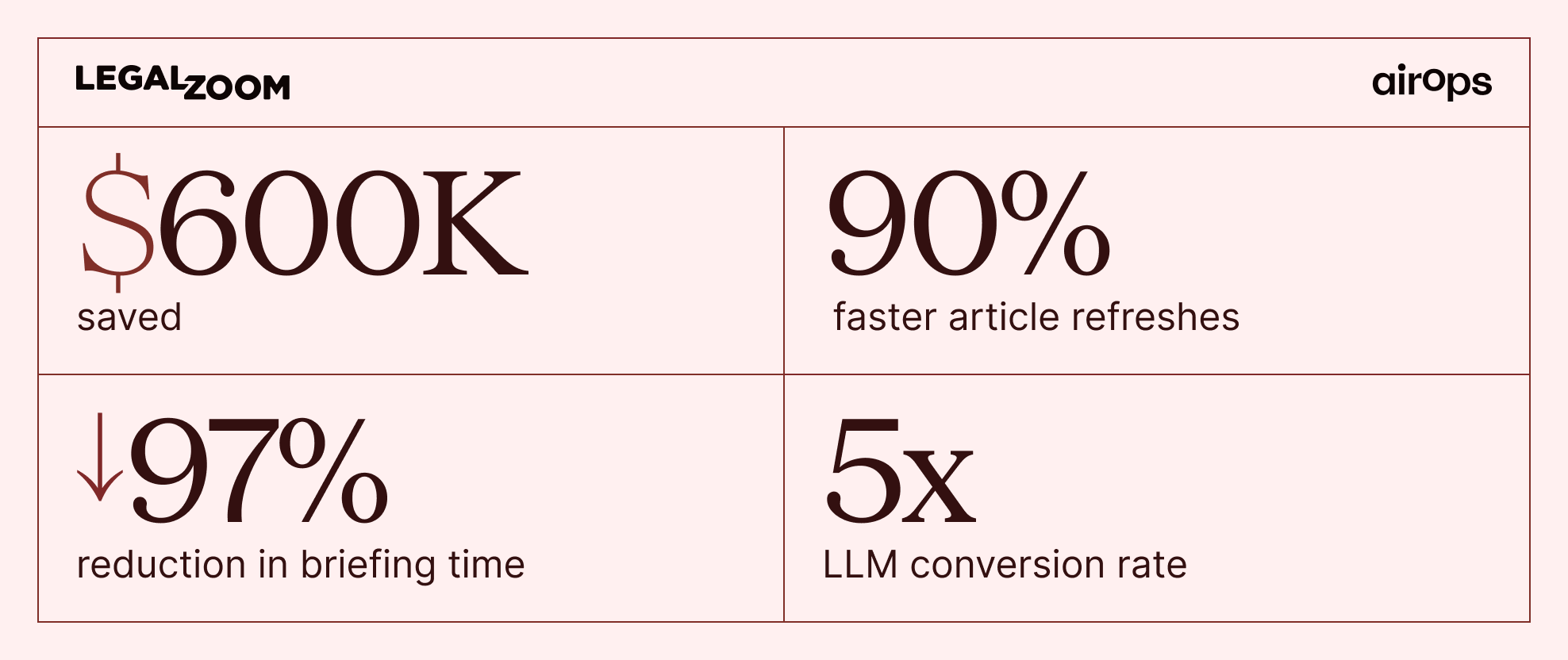
- $600K+ saved across Marketing ($329K in content refresh), Legal, and Central Operations ($250K redaction project)
- 90% reduction in article refresh time, from 10 hours to 45 minutes per article
- 97% reduction in content briefing time, from one month to one day
- Six-month, $250K agency redaction timeline replaced by a single afternoon of in-house work
- Three departments (Marketing, Legal, Central Operations) now run automation on the same platform
- Ability to measure and win AI Search
- 18.55% AI search citation share in "Finding Legal Help," their highest-value topic, competing with YouTube, Reddit, and Wolters Kluwer
- 1,938 questions tracked across 12 topic categories, giving full visibility in AI search performance
- 5x conversion rate on LLM referral traffic vs. traditional organic, validating the shift from traffic volume to revenue per session
What's next: measuring and shaping how AI talks about LegalZoom
The team consolidated their measurement stack by migrating AI visibility tracking from Bluefish and Profound to AirOps, putting monitoring and execution under one roof.
"I'm so sick of bloated tech stacks," Connor said. "If I can have my monitoring and my execution under the same umbrella, I'm gonna do it." And with AirOps, he now does.
The capability they're building toward: sentiment and product accuracy analysis at the citation level. The goal is identifying the most influential URLs shaping how AI platforms talk about LegalZoom, then stack-ranking them by influence, sentiment, and accuracy. A highly influential page that's also inaccurate becomes the top priority. They're also building proactive pricing monitoring, so every time LegalZoom updates pricing, automated outreach fires to sites carrying outdated information.
Get the latest on AI content & marketing
