- SurferSEO supports single-page optimization, but large libraries require systems that manage hundreds of URLs at once
- AI Search visibility depends on citations inside answers, not just keyword rankings on the SERP
- Credit-based tools slow production when teams need to refresh or publish at scale
- Monitoring tools surface AI visibility gaps, but teams still need built-in execution to close them
- AirOps connects SEO data, AI Search citations, and bulk publishing in one scalable system
SurferSEO helped popularize content scoring. SEO in 2026 looks different.
Green scores don't win AI Search. Citations inside AI Overviews, ChatGPT, and Perplexity shape brand discovery alongside traditional rankings.
AirOps differs from Surfer SEO by connecting AI search visibility data to content execution workflows within one governed platform.
SurferSEO still works for single-page optimization. Teams managing larger libraries often hit limits with credit-based pricing, limited AI Search tracking, and manual execution.
This article reviews nine SurferSEO alternatives based on what modern content teams need today: monitoring, governance, enterprise SEO, or full-scale content engineering.
What is SurferSEO?
SurferSEO focuses on on-page SEO and SERP optimization. Its “Content Score” analyzes top-ranking pages and recommends keyword usage, structure, and density.
It works well for:
Individual SEO specialists
Freelance writers
Agencies optimizing single URLs
Core features include:
Content Editor
Keyword Research
SERP Analyzer
Surfer AI article generation
Surfer improves individual pages. Teams managing hundreds or thousands of URLs run into friction when they work document by document.
Why teams look for SurferSEO alternatives
Most teams don’t leave Surfer because it breaks. They leave because their scope expands.
Growth teams feel this first, because their content libraries expand faster than single-page tools can support. The strongest SurferSEO competitors in 2026 pair on-page optimization with AI Search visibility and bulk execution.
1. Credit-based pricing slows scale
Surfer splits credits across writing, audits, and LLM optimization. High-volume teams run into limits quickly. Production pauses when credits run out mid-sprint.
2. Limited AI Search visibility tracking
The Surfer AI tracker does not show how large language models cite your brand.
If you don’t track ChatGPT, Perplexity, or Google AI Overviews, you miss a meaningful share of brand exposure.
Teams comparing competitors to the Surfer AI tracker usually want citation visibility built into the platform, not a separate monitoring add-on. The strongest alternatives to Surfer for answer engine optimization (AEO) track how ChatGPT, Perplexity, and Google AI Overviews cite your brand.
3. No bulk execution
Refreshing 500 articles requires manual edits.
Modern content teams rely on bulk actions, structured systems, and direct CMS publishing to move quickly.
4. Insights without execution
Scores highlight what needs improvement. They do not apply the update.
Teams managing large libraries need:
Programmatic refreshes
Structured content updates
Offsite citation tracking
Automated publishing
Monitoring without action creates backlog. AI content optimization tools that only score pages leave the execution gap open.
What to look for in a SurferSEO alternative
The best SurferSEO alternative connects visibility insights to action at scale. Look for AI content optimization tools that track both Google rankings and AI Search citations, then let you act on what you find.
Many SurferSEO competitors focus on per-article scoring. Scoring shows what needs work, but it does not fix the problem.
Teams managing hundreds of pages need bulk execution, not one-by-one edits.
Selection criteria:
AI Search visibility and AEO tracking: The tool should monitor how your brand appears in ChatGPT, Perplexity, and Google AI Overviews. Answer engine optimization (AEO) tracks citations inside AI answers, not just organic rankings.
Rank tracking and analytics integration: Look for native connections to Google Search Console and GA4. Rank tracking paired with traffic data shows which pages drive results and which need attention.
Bulk execution and refresh automation: Refreshing 200 pages one at a time stalls production. The tool should support bulk updates across your library through templates, workflows, or grid-based operations.
Pricing scalability: Credit-based models can slow teams mid-sprint. Evaluate whether the pricing structure supports high-volume output without surprise caps or overages.
Integrations and CMS publishing: Direct CMS connections cut manual steps. The tool should publish to your site, pull analytics, and sync with your existing stack without export workarounds.
The best SurferSEO alternatives in 2026
The following platforms offer distinct advantages depending on whether you need deep analytics, enterprise governance, or end-to-end content execution.
1. AirOps: best for AI Search and content engineering
AirOps is a content engineering platform built for teams managing content at scale. It focuses on turning AI Search visibility insights into structured execution across your entire content library.
Instead of optimizing one page at a time, AirOps helps teams understand how content performs across Google and AI Search engines and then prioritize and refresh pages in bulk. The platform connects SEO data, AI citations, governance rules, and publishing into one connected system. AirOps also helps structure content for large language models (LLMs) so answer engines can extract and cite it.
Go deeper and compare AirOps with Surfer.
AirOps brings together:
SEO performance data
AI Search citations
Structured execution systems
Native CMS publishing
Teams can identify visibility gaps, generate structured refreshes, and publish updates without switching tools.
Key features
Page360: Combines Google Search Console (GSC), Google Analytics 4 (GA4), and AI Search citations to show which pages drive visibility and which need updates
Grid: Run bulk updates across hundreds of URLs instead of editing one document at a time
Offsite tracking: Monitor third-party citations that influence AI answers
Brand kits: Enforce tone, structure, and factual accuracy at scale
For a deeper walkthrough of how bulk refresh and AI Search prioritization works in practice, see the product overview:
Best for
Directors of Content and SEO leaders who need to:
Win in Google and AI Search
Refresh large content libraries efficiently
Maintain brand governance while scaling output
Pros
Connects AI Search insights directly to execution
Supports bulk updates and structured refresh systems
Tracks offsite citations influencing AI answers
Keeps humans in the loop for review and approval
Cons
Requires teams to adopt a systems-based approach
More capability than needed for solo bloggers
Pricing
Pricing plans are scoped to your brand's funnel and opportunity. AirOps works as a partner, bringing the platform, the media mix, and the team together from strategy through execution, not just software to log into.
2. Clearscope: best for structured content scoring
Clearscope focuses on content grading and keyword relevance. It provides structured optimization guidance in a clean, editorial-friendly interface.
The platform analyzes top-ranking pages for a given query and surfaces recommended terms, headings, and related topics to strengthen individual articles.
Key features
Content grading: Assigns a letter grade based on keyword coverage, semantic relevance, and competitive benchmarks
Keyword relevance scoring: Surfaces primary and secondary terms based on NLP analysis of top-ranking content
Google Docs integration: Allows writers to optimize directly inside Docs without switching tools
Competitor content analysis: Shows how competing pages structure content and distribute terms
Best for
Editorial teams optimizing blog posts one at a time.
Pros
Clean interface that writers adopt quickly
Clear optimization signals grounded in SERP data
Strong integration into existing editorial workflows
Cons
No AI Search visibility tracking
No bulk execution or programmatic refresh capabilities
Pricing
Essentials: $170/month
Enterprise: Custom
3. Profound: best for AI visibility monitoring
Profound tracks how brands appear inside AI answers across multiple engines. It focuses on visibility monitoring, compliance, and AI answer observability.
The platform emphasizes understanding how models retrieve and present brand information rather than changing on-site content.
Key features
Server-side agent tracking: Monitors AI crawler behavior and bot interactions on your site
Front-end answer capture: Records the actual responses users see inside AI interfaces
Multi-engine monitoring: Tracks brand visibility across a broad range of AI systems
Compliance visibility controls: Supports regulated industries that need oversight into how AI systems represent their brand
Best for
Enterprise brands that need deep AI visibility, observability, and compliance oversight.
Pros
Captures real user-facing AI responses
Designed for enterprise security and governance requirements
Strong visibility reporting across engines
Cons
Monitoring-focused with no built-in content execution
Requires a separate workflow to act on findings
Pricing
Starter: $99/month
Growth: $399/month
Enterprise: Custom
Learn more about AirOps vs Profound.
4. AthenaHQ: best for GEO analytics
AthenaHQ centers its approach on Generative Engine Optimization. It blends AI Search analytics with limited drafting and refresh capabilities.
The platform introduces proprietary metrics designed to estimate citation value and demand in a zero-click search environment.
Key features
Action Center: Surfaces visibility gaps and supports draft updates within the platform
Proprietary citation metrics: Estimates citation influence and query demand inside AI answers
Shopify integration: Connects AI Search visibility to ecommerce performance
Revenue attribution modeling: Links AI citations to downstream ecommerce impact
Best for
Ecommerce brands measuring AI Search visibility and revenue attribution.
Pros
Quantifies zero-click demand
Strong ecommerce integrations
Clear GEO-focused methodology
Cons
Credit consumption can increase with multi-engine tracking
API documentation remains limited compared to traditional SEO platforms
Learn more about AirOps vs Athena.
5. Peec.ai: best for pure AI Search monitoring
Peec.ai specializes in AI Search visibility tracking. It uses UI scraping to replicate real chat interfaces and capture authentic user-facing answers.
The platform focuses exclusively on monitoring and reporting rather than content execution.
Key features
Front-end scraping: Captures AI responses as users see them in chat interfaces
Source vs citation breakdown: Differentiates between mentions and direct citations
Unlimited seats: Supports distributed teams without per-user pricing
Regional tracking: Monitors AI visibility across countries and languages

Best for
Agencies and global teams that need accurate AI visibility monitoring across regions.
Pros
Cost-effective for distributed teams
Realistic answer capture
Fast implementation
Cons
No execution layer
Data refreshes occur daily rather than in real time
Learn more about AirOps vs Peec.ai.
6. Conductor: best for enterprise SEO suite
Conductor is an established enterprise SEO platform that includes AI Search visibility tracking within its broader search suite.
It combines technical SEO, content insights, and reporting for large organizations managing complex websites.
Key features
Enterprise SEO platform: Technical auditing, keyword tracking, and competitive benchmarking
AI Search visibility integration: Tracks AI Overviews and evolving SERP features
Content performance dashboards: Connects rankings to engagement and conversion metrics
Professional services support: Offers strategic guidance for enterprise implementations
Best for
Large organizations consolidating vendors under one enterprise SEO platform.
Pros
Mature enterprise infrastructure
Strong reporting and executive dashboards
Professional services available
Cons
Expensive relative to mid-market tools
Long-term contracts common
Slower deployment for smaller teams
7. Brightedge: best for enterprise search analytics
Brightedge provides large-scale search data infrastructure for enterprise brands. It focuses on deep analytics, forecasting, and market-level visibility tracking.
The platform supports technical SEO initiatives alongside AI Search analysis.
Key features
Enterprise data repository: Aggregates search performance across large sites
SERP feature tracking: Monitors traditional rankings and AI-driven result formats
Automation recommendations: Suggests optimizations across large content libraries
Market-level analysis: Provides competitive visibility benchmarking
Best for
Enterprise SEO Directors managing massive sites across markets.
Pros
Robust data coverage
Built for enterprise scale
Automation reduces manual reporting
Cons
Complex interface
Enterprise pricing structure
Focused more on analysis than content systems
8. seoClarity: best for technical SEO at scale
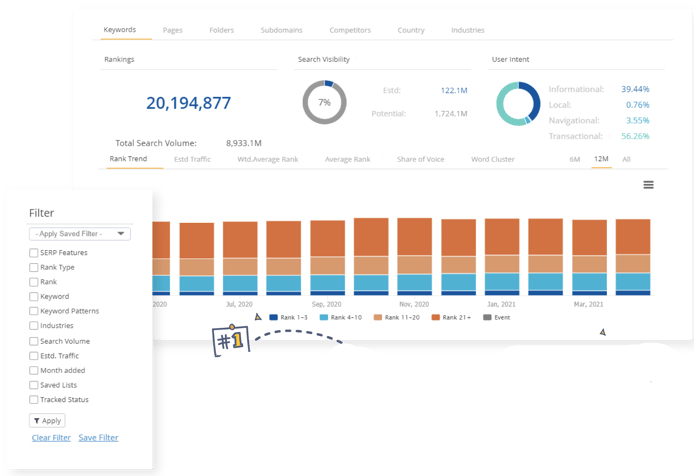
seoClarity emphasizes keyword tracking, technical optimization, and automation for large organizations.
It centers on search data infrastructure and operational scale rather than editorial workflows.
Key features
Extensive keyword tracking: Large-scale rank tracking across markets
Technical SEO auditing: Site diagnostics, crawl insights, and issue prioritization
Workflow automation: Supports implementation of SEO fixes across large sites
AI-assisted recommendations: Suggests optimization opportunities based on search data
Best for
Retailers and enterprise SEO teams focused on technical depth and infrastructure.
Pros
Deep keyword coverage
Strong technical SEO capabilities
Built for large site environments
Cons
Less focused on structured content systems
Enterprise pricing model
9. Ahrefs: best for backlink and competitive analysis
Ahrefs remains one of the strongest platforms for backlink analysis and competitive keyword research.
While it does not focus on AI Search visibility, many teams use it to strengthen domain authority and identify link-building gaps.
Key features
Backlink database: Large index of referring domains and link profiles
Competitor gap analysis: Identifies ranking and backlink opportunities
Keyword explorer: Tracks keyword difficulty, search volume, and SERP composition
Content gap tools: Highlights topics competitors rank for that you do not
Best for
Teams prioritizing link building and competitive research.
Pros
Industry-leading backlink database
Strong competitive insights
Reliable keyword tracking
Cons
No AI Search citation tracking
No native content execution layer
SurferSEO alternatives compared (quick overview)
Each tool below solves a different layer of the problem. Some focus on scoring, others on monitoring, and a few connect monitoring to execution.
Use this table to narrow your options before diving deeper into a demo.
How to choose the right SurferSEO alternative
Choose based on what limits you today.
Choose AirOps if your bottleneck is execution across large content libraries.
Choose Profound or Peec.ai if your primary gap is AI visibility monitoring.
Choose Conductor or Brightedge if you want to consolidate enterprise SEO vendors.
Choose Clearscope if you only need structured content grading.
Choose AthenaHQ if you focus on ecommerce AI revenue modeling.
Identify the constraint first. The right tool usually becomes obvious. Revisit your shortlist often because the best SurferSEO alternatives in 2026 keep adding AI Search features.
Build systems that scale
SurferSEO still works for optimizing individual pages. Content leaders in 2026 manage systems, not documents.
AI Search favors brands that can:
Track citations across engines
Refresh content in bulk
Maintain brand governance
Connect performance data to execution
Monitoring alone does not increase visibility. Scoring alone does not scale impact.
High-performing teams combine clear performance data with structured execution. They build repeatable systems that earn citations and compound authority over time.
Book a demo to see how AirOps helps content teams turn AI Search insights into scalable execution.
Frequently Asked Questions
Frequently Asked Questions: SurferSEO alternatives
Can AirOps replace SurferSEO?
Yes. AirOps includes content optimization, keyword research, and AI-assisted drafting. It also adds bulk execution and AI Search citation tracking. Teams that manage large libraries typically use it in place of SurferSEO.
Why is AI Search visibility different from traditional SEO?
Traditional SEO ranks links. AI Search synthesizes answers from multiple sources. Many AI citations do not overlap with top organic rankings. Teams must track citations inside answers, not just keyword positions.
Is SurferSEO expensive at scale?
It can be expensive. Credit-based pricing often becomes restrictive during high-output months, especially for teams refreshing large content libraries.
Do I need a separate tool for ChatGPT tracking?
Legacy SEO tools do not track ChatGPT visibility. Platforms like AirOps, Profound, and AthenaHQ include AI Search monitoring alongside traditional SEO metrics.
What are the alternatives to Surfer AI tracker for growth teams?
Growth teams usually weigh AirOps, Profound, and Peec.ai as alternatives to the Surfer AI tracker. AirOps connects AI Search visibility to bulk content execution in one system, so teams can act on gaps immediately. Profound and Peec.ai focus on monitoring, while AirOps adds the execution to close those gaps at scale.
Can Surfer help prioritize competitive AI visibility gaps?
Surfer does not prioritize competitive AI visibility gaps, because it focuses on on-page SEO scoring rather than AI Search citations. AirOps surfaces where competitors earn citations across AI engines and turns those gaps into prioritized refreshes. That connects competitive insight directly to the pages you update next.
Is there a free SurferSEO alternative?
Yes. AirOps offers a free Solo plan at $0 that gives you access to the platform. This is a genuine free SurferSEO alternative for individuals or small teams exploring AI Search visibility and content execution.
What is the cheapest SurferSEO alternative?
AirOps is the cheapest SurferSEO alternative with a functional free tier and paid plans that scale with usage. Surfer's lowest paid tier starts around $59 per month, and other tools like Clearscope start at $170 per month.
Which SurferSEO alternative is best for agencies?
AirOps is a strong SurferSEO alternative for agencies because it supports unlimited seats, bulk execution across client sites, and Brand Kits for voice governance. Agencies managing dozens of clients can run Grid templates that refresh content at scale.
Can I use AirOps to replace both Surfer and Frase?
AirOps covers AI Search tracking, bulk refresh, and direct CMS publishing, which replaces most Surfer and Frase workflows. AirOps does not replicate Surfer's per-article Content Score, so some teams keep Surfer for granular on-page scoring during the transition. Frase does not track AI Search citations or support bulk execution, so AirOps fills those gaps directly.
How do I switch from Surfer to AirOps?
Start by importing your pages into AirOps Grids. Connect your CMS, Google Search Console, and GA4. Set up a Brand Kit to lock in your voice and writing rules, then run Grid templates for refresh and optimization. Many teams keep Surfer active for per-article scoring while they build out their AirOps workflows.
Get the latest on AI content & marketing
