Semrush shows you the data. AirOps builds the system that turns data into results.
- Unified AI visibility and SEO performance per URL in a single dashboard powered by real Google Search Console (GSC) and GA4 data
- Native publishing to 7+ CMS platforms directly from multi-step workflows with built-in brand governance and human review checkpoints
- 40+ AI models with bring-your-own API keys and bulk execution across thousands of pages via Grids, plus conditional workflow logic that adapts to your content at scale

Webflow 5xed content refresh velocity and increased visibility across Google and ChatGPT

Webflow 5xed content refresh velocity and increased visibility across Google and ChatGPT
Webflow 5xed content refresh velocity and increased visibility across Google and ChatGPT

Chime went from being recommended in 24 to 68 priority questions


George Bonaci VP of Growth, Ramp

Nicole Baer, CMO, Carta


50% cut in production costs, thanks to the elimination of external agencies and manual tasks.

Marcio Arnecke, CMO, Apollo


















Why Customers Choose AirOps to Go Beyond Visibility
Watching trends while traffic slips away is not a winning strategy. Only AirOps gives you the system to produce quality content that earns citations.
and agents alike
Get prime placement in AI Search by improving the structure, clarity, and quality of your content.
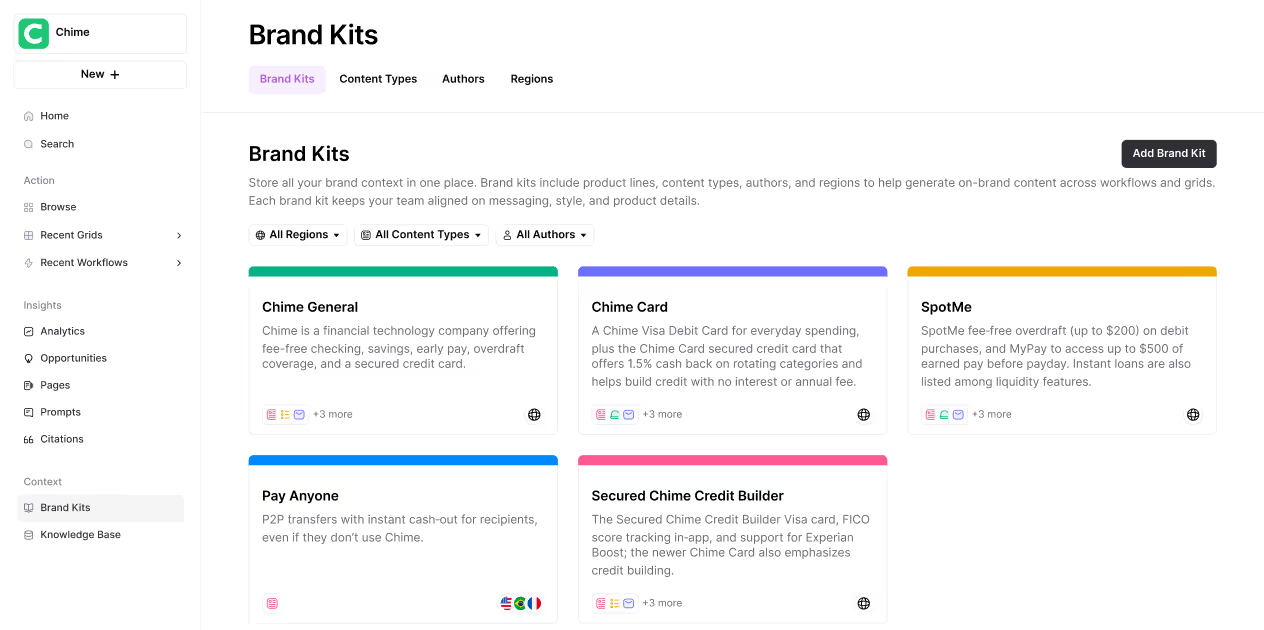
Brand Kits
Create content that sounds like your brand by weaving in your brand voice, personas, and expertise.
Our experts help brands like Carta and Rippling build workflows and train their teams to move faster with confidence.

What sets AirOps apart from Semrush
AirOps gives content teams a single system to track AI search visibility, act on the gaps, and measure what every published page moved. While Semrush provides one of the deepest SEO research databases in the market, AirOps goes beyond analytics into end-to-end execution with multi-step workflows and centralized Brand Kits that publish directly to seven or more CMS platforms. Semrush does not have a workflow engine or closed-loop execution. With AirOps, your team sets the strategy, Quill runs the execution. The system connects what you measure to what you publish, so performance compounds with each workflow your team runs.

What our customers are saying
“AirOps is unlike any other AI tool we’ve seen. We’ve been able to drop our agency and focus on the highest value initiatives in weeks”

Nick Fairbain
VP Growth Marketing, Chime
“Our brand visibility score hit a high of 28% after we refreshed content. We saw a 56% increase in subscriptions in 30 days that corresponds to content engineered for agents."

George Bonaci
VP of Growth and Demand, Ramp
“With AirOps, we grew AI-attributed signups from 2% to over 10% in under a year with zero headcount growth. Just sharper workflows and faster loops.”

Josh Grant
VP of Growth, Webflow
AirOps vs. Semrush
Which platform is right for your team?
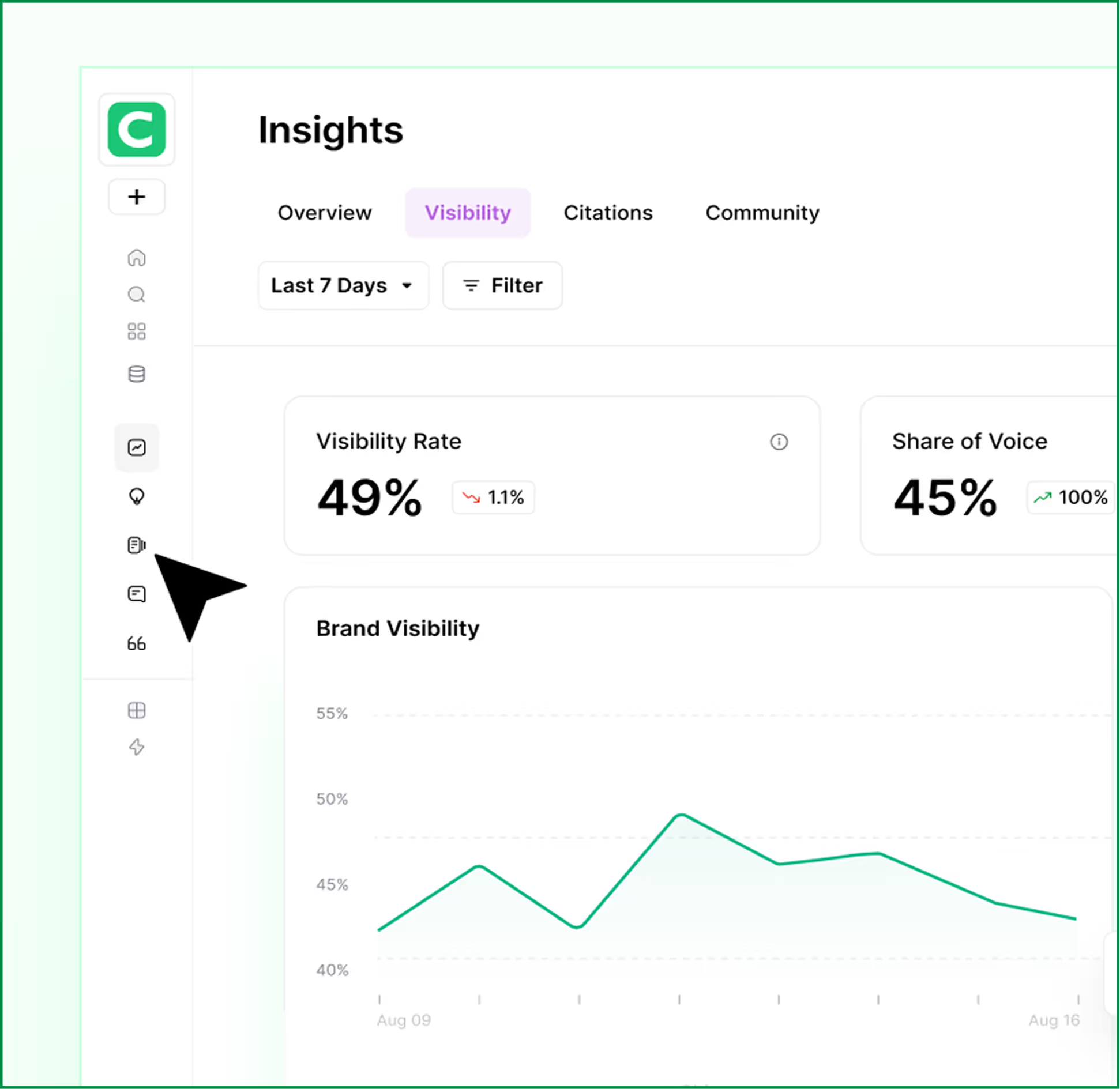
Track visibility across AI search
AirOps connects AI citation data with GSC clicks, impressions, GA4 sessions, and page freshness into Page360, a per-URL view that lets your team prioritize content actions based on the full performance picture. Semrush tracks AI visibility across five engines at standard tiers and up to eight at Enterprise, but keeps that data in a separate dashboard from traditional SEO metrics. AirOps surfaces the relationship between what AI engines say about your brand and how that translates to traffic and conversions in one place.
Content creation, refresh & publishing workflows
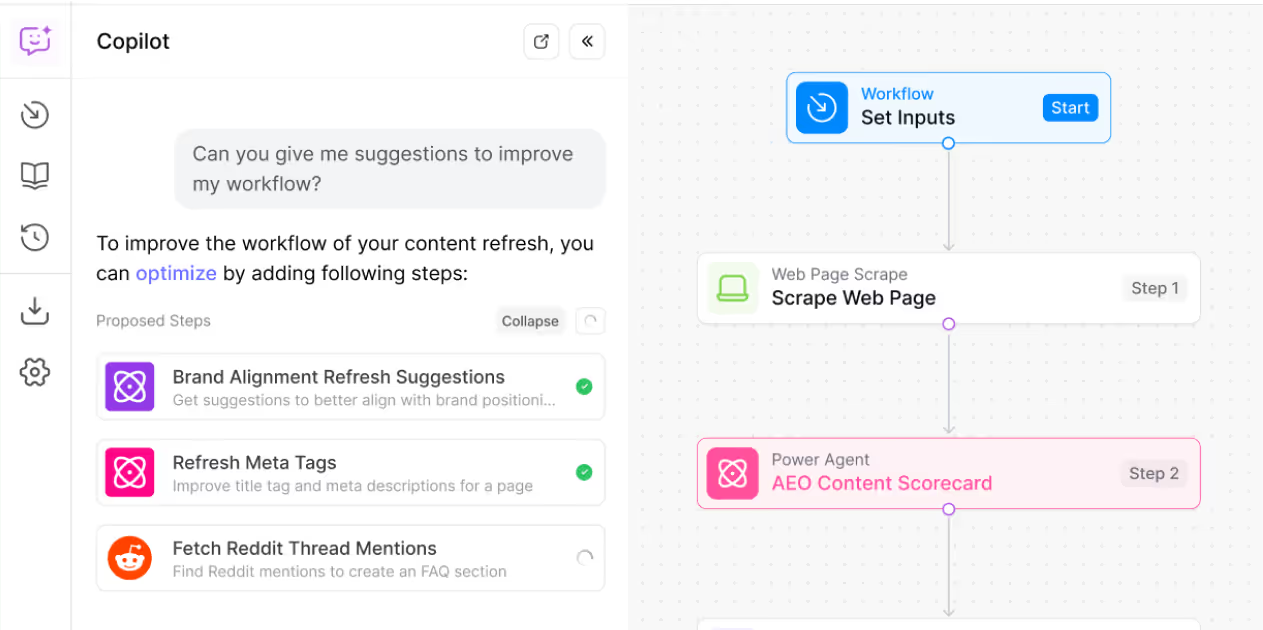
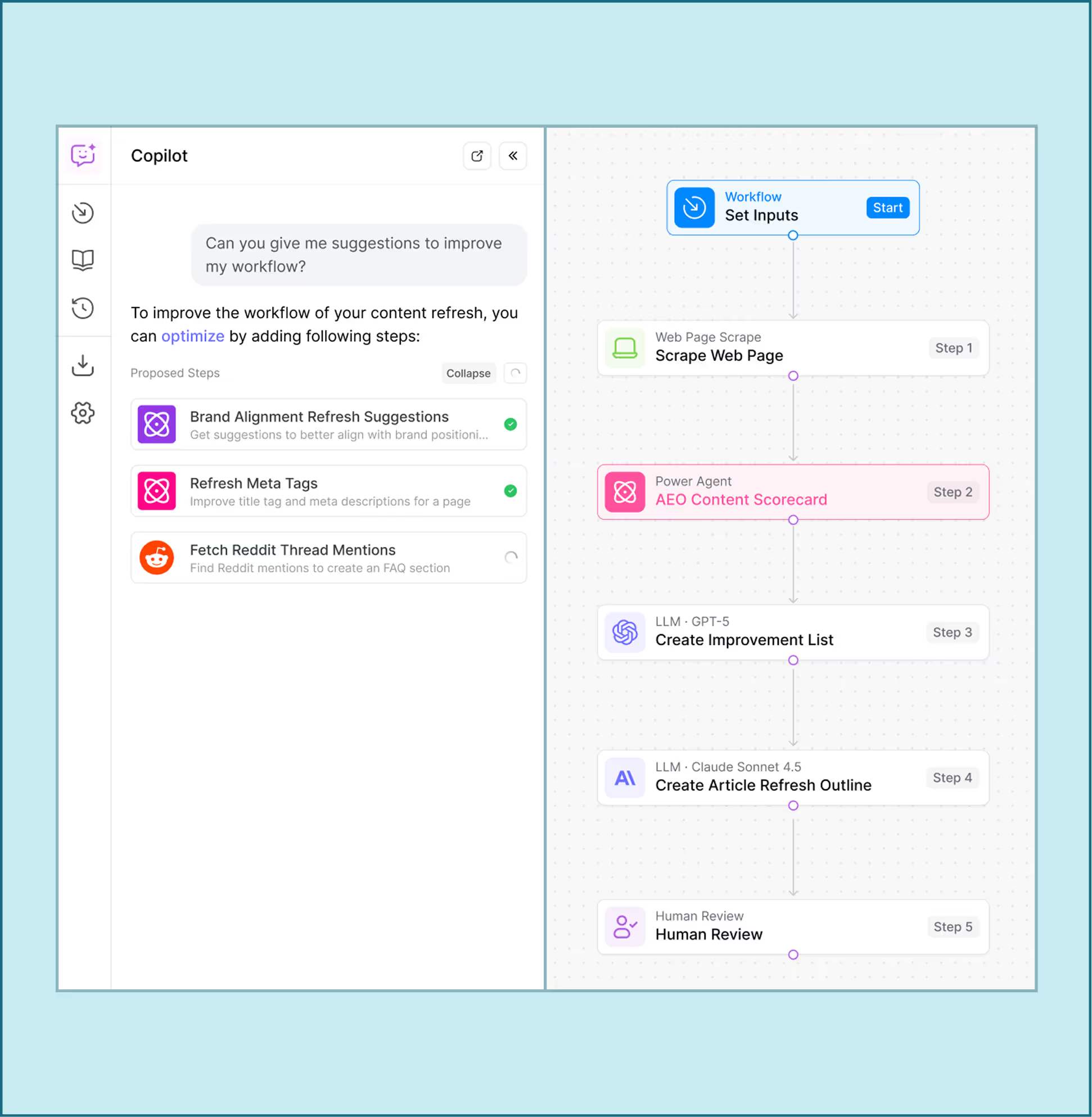
AirOps Workflow Studio lets your team design multi-step content pipelines with conditional logic and human review gates that publish directly to seven or more CMS platforms. Semrush's Content Toolkit generates articles and optimizes pages but publishes only to WordPress and Mailchimp, with no conditional branching or bulk operations across hundreds of pages.
Native integrations
AirOps connects your entire stack from day one with 30+ native integrations spanning CMS platforms like Webflow and Contentful, data warehouses, and SEO research from Semrush itself. Semrush offers its own MCP server for read-only data access in AI assistants, while AirOps MCP provides 38+ tools with both read and write capabilities for managing Brand Kits, running workflows, and querying analytics from any Model Context Protocol (MCP)-compatible environment.
SEVERAL CMS platforms
(Webflow, Contentful,
WordPress, Ghost,
and more)
Email and live chat support
AirOps pairs every Enterprise team with an embedded Content Engineer and solution architect who build alongside your team, not just answer tickets. Semrush offers email and live chat support with Semrush Academy certifications, but does not provide hands-on workflow implementation. AirOps also runs live cohort trainings through the Content Engineering Certification, building lasting operational capability your team keeps regardless of tooling.
300+ Content Engineers
trained to date with AirOps University

How Webflow scaled content 5x in days with AirOps
Frequently Asked Questions
AirOps vs Profound: Which is better?
Which is better: AirOps or Semrush?
AirOps is better for teams that need to go from insight to published content at scale with brand governance built in. Semrush is better suited for teams focused primarily on SEO research and competitive intelligence across paid and organic channels.
Semrush offers one of the largest keyword databases in the market with 28 billion keywords and 43 trillion backlinks, plus robust competitive benchmarking across organic, paid, and social. It now includes AI visibility tracking through the AI Visibility Toolkit and benefits from Adobe's enterprise investment.
AirOps brings multi-step content workflows with conditional logic and direct CMS publishing to seven or more platforms. Brand Kits centralize governance so every published output stays on-brand by default. Page360 unifies AI citations with real GSC and GA4 data per URL. Teams that need execution infrastructure alongside analytics choose AirOps.
What features does AirOps offer that Semrush does not?
AirOps offers several capabilities Semrush lacks:
Quill, an AI execution engine that runs strategy Playbooks and publishing pipelines autonomously with human review gates
Page360, a unified per-URL view combining AI citation data, GSC performance, GA4 sessions, and page freshness in a single dashboard
Prompt Discovery, which builds a prioritized prompt universe from four real intent sources: third-party AI session panel data, People Also Ask patterns, search intent data, and first-party conversations from tools like Gong and Zendesk
Grids for bulk content operations across hundreds of pages with real-time peer editing and one-click CMS publishing
Brand Kits with modular dimensions for product lines, audiences, and scoped writing rules accessible via MCP
AirOps MCP with 38+ tools offering both read and write capabilities, compared to Semrush's read-only MCP server
Copilot for conversational AI assistance within the platform, distinct from Quill's autonomous execution
Offsite for managing third-party publisher placements and growing AI brand citation share with full attribution
Query Fan-outs revealing the sub-queries AI engines run behind each tracked prompt
Closed-loop execution that connects insight to action to measurement in a single system
Does Semrush just show optimization scores, or can it automate the fixes?
Semrush's Content Toolkit generates articles and provides an AI Search Optimizer with guided fixes for AI and SEO visibility. Semrush publishes only to WordPress and Mailchimp. Bulk operations require manual exports or third-party automation tools, and there is no conditional workflow logic or human review built into the content pipeline.
AirOps connects the entire path from gap identification to live published content. Workflow Studio chains data sources and AI steps with Brand Kit context and human review checkpoints into multi-step pipelines that publish directly to your CMS. Semrush shows you what needs fixing; AirOps builds the system that fixes it at scale.
How do AirOps workflows differ from Semrush's automation?
Semrush's Content Toolkit follows a linear path: topic research to brief to draft to optimization to publish. There is no conditional branching, no looping, and no way to process hundreds of pages in parallel. Publishing endpoints are limited to WordPress and Mailchimp.
AirOps Workflow Studio is a visual no-code builder with conditional logic, loops, code execution steps, and human review gates at any stage. Grids let your team run bulk operations across thousands of rows with real-time collaboration and version history. Workflows connect to 30+ integrations including seven or more CMS platforms, data warehouses like BigQuery, and project management tools like Asana.
How does AirOps track AI search visibility compared to Semrush?
AirOps and Semrush both track AI search visibility across five core engines: ChatGPT, Gemini, Perplexity, Google AI Mode, and Google AI Overviews. AirOps Pro plans include Claude and Grok tracking, while Semrush gates those two engines to Enterprise AIO pricing.
The difference is what surrounds the tracking data. AirOps Page360 merges AI citation rates with GSC clicks, GA4 sessions, and page freshness into a single per-URL view. Semrush keeps AI visibility in a separate toolkit from its core SEO reporting. AirOps also adds Prompt Discovery from four intent sources and Query Fan-outs that reveal the sub-queries AI engines run behind each prompt.
In one view, your team can see that a page lost AI citations last week while organic clicks dropped in the same window — and act on both signals together before the gap widens further.
Can AirOps replace both Semrush and my content creation tools?
Partially. AirOps replaces standalone content creation tools and workflow automation platforms by combining both into a single governed system with Brand Kits, multi-step workflows, and direct CMS publishing.
Semrush maintains advantages in proprietary SEO research data. Its database covers 28 billion keywords and 43 trillion backlinks across 808 million domain profiles. AirOps does not replicate this research infrastructure, and teams that rely on deep keyword research or backlink analysis will want to keep access to that data.
The optimal setup for many teams: use Semrush as your research and competitive intelligence source, and connect that data into AirOps workflows via native integration steps. AirOps MCP includes direct access to Semrush data, so your team can pull keyword and backlink intelligence into content pipelines without switching platforms.
What's the pricing difference between AirOps and Semrush?
Semrush restructured its pricing into five tiers: SEO at $139 per month, Starter at $199, Pro+ at $299, Advanced at $549, and Enterprise at custom pricing. All plans are month-to-month with annual discounts available. AI visibility tracking is now bundled into base plans rather than charged as a separate add-on. Each additional user costs $45 per month.
AirOps offers a free Solo tier with 100 tracked prompts and ChatGPT-only tracking. Pro plans are custom-priced with multi-engine tracking, 75,000 workflow tasks, and unlimited seats. Enterprise plans include unlimited everything with a dedicated account manager and embedded Content Engineer.
The total cost of ownership comparison matters more than sticker price. Semrush provides research and visibility data but requires separate tools for content creation, workflow automation, and brand governance. AirOps combines visibility and execution in one platform with no per-seat fees on paid plans.
How hard is Semrush to operationalize day to day?
Semrush excels at individual page analysis and competitive research. Scaling that beyond one page at a time requires manual exports, CSV manipulation, or third-party automation tools like Zapier. Bulk content operations and multi-CMS publishing each require separate solutions outside the platform.
AirOps is built for operational scale. Workflow Studio handles multi-step content pipelines, and Grids process hundreds of pages in parallel with real-time peer editing. Page360 surfaces the highest-priority content actions without requiring your team to cross-reference multiple dashboards.
Unlimited seats on paid plans mean your entire team works in one environment without per-user fees eating into the budget. Semrush tells you what to optimize; AirOps provides the infrastructure to execute at scale.
Can I use both platforms together?
Yes. Many AirOps customers use Semrush as a research tool alongside AirOps as their execution and visibility platform. AirOps workflows include native integration steps for pulling Semrush keyword and backlink data directly into content pipelines. AirOps MCP also provides direct access to Semrush data within any MCP-compatible AI tool.
The combined approach gives your team Semrush's proprietary research databases feeding directly into AirOps workflows that take content from draft to published CMS output with brand governance built in. This eliminates the manual export-and-import cycle that slows down most content operations using Semrush alone.