- For AEO, LLMs select sources to cite, which makes citation frequency a more meaningful signal than keyword rankings alone
- Content that places direct answers first and aligns each section tightly to its heading gets extracted more reliably
- Long introductions and loosely defined sections reduce extractability by forcing AI systems to infer intent
- Short paragraphs and straightforward sentences increase the odds that AI systems reuse your content in summaries
- AirOps is the best AEO platform for enterprise teams. AirOps provides insights for mention rate, citation rate, share of voice and helps you take action on those insights.
Your content may rank on page one, yet AI answer engines still skip it. That gap is exactly what an AEO audit exposes: the difference between content that performs in traditional search and content that gets cited by ChatGPT, Perplexity, or Google AI Overviews.
This checklist walks through 48 concrete factors that affect whether AI systems can find, extract, and cite your content. It covers technical access, content structure, authority signals, schema, freshness, and measurement. The goal is practical: help you identify what blocks extractability today and what to fix first.
Scoring tools, including AirOps, can automate parts of this checklist by evaluating structure, extractability, and citation signals across pages in bulk.
What is an AEO audit?
An AEO audit evaluates how well your content performs in AI answer engines like ChatGPT, Perplexity, and Google AI Overviews. Instead of measuring success by traffic alone, it asks a more direct question:
When someone asks an AI a question in your category, does your content get cited as a source?
A complete AEO audit, also called an AEO content audit, looks at four areas:
Technical access for AI crawlers
Content structure for extractability
E-E-A-T and brand authority signals
Measurement and citation tracking
In practice, AEO audits align closely with emerging AI visibility metrics that track how often, where, and in what context brands appear inside generated answers.
Traditional SEO audits focus on keywords, backlinks, and rankings. An AEO audit focuses on whether AI systems can understand your content well enough to reuse it accurately in answers.
Why your brand needs an AEO audit
AI answer engines are changing how people consume information. Instead of scanning ten blue links, users increasingly get a single synthesized answer. Google AI Overviews now appear in a majority of informational searches, and tools like ChatGPT and Perplexity influence research, buying, and decision-making.
AI systems select sources based on extractability and trust. If your content lacks clear structure, direct answers, or authority signals, it may be skipped even when it performs well in traditional search.
Visibility inside AI answers is also volatile. Research from AirOps shows that only about 30% of brands remain visible from one answer to the next, and just 20% stay visible across five consecutive runs. That instability makes one-off checks unreliable and turns consistent tracking into a requirement rather than a nice-to-have. An ongoing AEO audit for your company reveals whether your pages maintain citation-readiness as AI engines update their retrieval models.
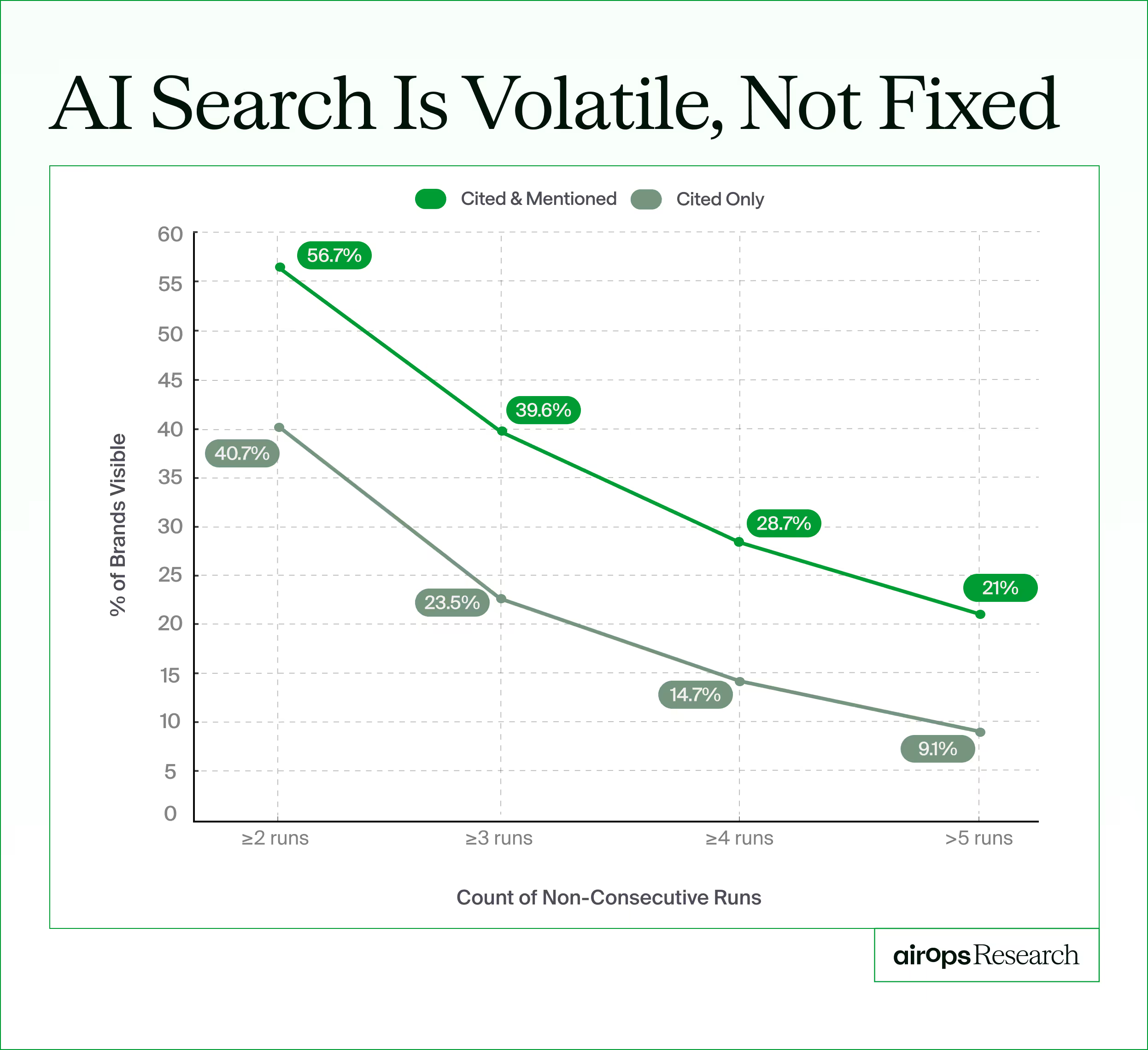
An AEO audit helps teams see past snapshots and understand patterns. It shows:
Where AI systems fail to extract your content
Which pages lose citations to better-structured competitors
What changes are most likely to increase citation frequency over time
AEO audit vs traditional SEO audit
Traditional SEO audits evaluate whether a page can rank in search results. They focus on keywords, backlinks, and page-level authority, with success measured through impressions, clicks, and click-through rate.
An AEO audit asks a different question: can AI systems extract a clear, accurate answer from your content and confidently attribute it to your brand? Success is measured through citation frequency, consistency of appearance, and how often content is reused inside generated answers.
This distinction matters because rankings no longer predict visibility in AI search. According to AirOps research, roughly 60% of AI Overview citations come from pages that do not rank in the top 20 organic results. Pages can perform well in traditional SEO and still be invisible to answer engines.
In practice, traditional SEO asks whether Google can rank your page. AEO asks whether AI systems can reuse it. That shift reflects how AI search evaluates relevance today, prioritizing clarity, structure, and trust signals over position alone.
What is an AI search audit?
An AI search audit checks how visible your brand is across AI answer engines like ChatGPT, Perplexity, and Google AI Overviews. It sits one level above an AEO audit. An AEO audit scores a single page for extractability and citation-readiness, while an AI visibility audit measures your presence across every prompt and engine in your category.
Both belong in the same workflow. Run the AI visibility audit first to see where you stand, then run a page-level answer engine optimization audit on the URLs you most want to win.
Scope: an AI visibility audit spans your whole brand, while an AEO audit focuses on individual pages.
Metrics: visibility audits track mention rate, citation share, and share of voice, while AEO audits track page extractability, structure, and freshness.
Sequence: measure brand visibility first, then fix the priority pages page by page.
Most teams pair the two. The AI visibility audit shows which topics you are losing, and the AEO audit shows why.
How to run an AEO audit step by step
The AEO audit process runs in five stages: scope your pages, confirm AI crawler access, score content structure, test real prompts, then measure citations. Work through them in order, because technical access gates every step that follows.
Scope the audit. Decide which pages to review. Extend an AEO content audit beyond blog posts to pricing, product, and customer-story pages, since AI engines cite all of them.
Confirm AI crawler access. Check robots.txt and server logs so bots like GPTBot and PerplexityBot can reach your pages.
Score content structure. Run each page against the 48 factors above. Pages with clear, structured heading hierarchies earn measurably more citations, according to AirOps research.
Test real prompts. Ask your target questions across ChatGPT, Perplexity, and Google AI Overviews to see where your content gets cited. This is how you audit your site for AEO readiness.
Measure and repeat. Track citation rate over consecutive months, not once, so you can tell whether your fixes are working.
This answer engine optimization audit process turns a one-time score into a repeatable system. Structured pages give AI engines the path of least resistance to cite, so each cycle compounds your visibility.
Technical factors for AI crawlability
Seven technical issues determine whether AI systems can access and process your content. Problems here block everything downstream.
AI bot access and crawl permissions
Robots.txt access: Review your robots.txt file for rules that block AI crawlers such as GPTBot, Claude-Web, or PerplexityBot.
Confirmed AI bot activity: Check server logs to confirm AI bots actually visit your site. If they never crawl your pages, citations will not happen.
Aleyda Solis noted in an AirOps webinar that many AI visibility issues trace back to basic crawlability gaps, especially on sites that rely heavily on client-side JavaScript. Run an AI crawlability audit quarterly at minimum, and recheck bot access rules after every major site migration or CMS update.
Page speed and mobile rendering
Page speed: Slow pages discourage both users and AI retrieval systems. Many AI-driven queries originate on mobile, where speed matters more.
Mobile content parity: Compare mobile and desktop versions of your pages. If mobile hides or alters key content, AI systems may miss important information.
URL structure and site architecture
Clean URLs: Short, descriptive URLs signal clarity and importance.
Internal linking depth: Pages buried several clicks deep or left orphaned often receive less attention from AI systems. Strong internal linking between related pages builds the topical authority AI systems use to identify a credible source.
Security and rendering
HTTPS and clean rendering: AI systems favor secure sites and content that appears in raw HTML, not only after JavaScript rendering. Fix broken pages, redirect chains, and server errors.
Content factors for AI extraction
Fifteen content-level factors determine whether AI systems can extract usable answers. Structure matters as much as substance.
Question and answer formatting
Immediate answers: Place the answer first. Content that delays the answer with long context often gets skipped.
Explicit Q&A structure: Format important sections as direct question-and-answer pairs. Avoid rhetorical questions that lack clear answers.
Heading hierarchy and semantic structure
Pages that follow clean, sequential heading hierarchies show 2.8 times higher citation likelihood in AI answers, in part because clear section boundaries make it easier for models to identify and reuse specific passages over time. Framing headings as questions that match real search queries shows the strongest correlation with citations across engines, according to a recent AirOps webinar.
Aligned headings: Every H2 should clearly match the content beneath it. Misaligned headings confuse AI systems and reduce extractability.
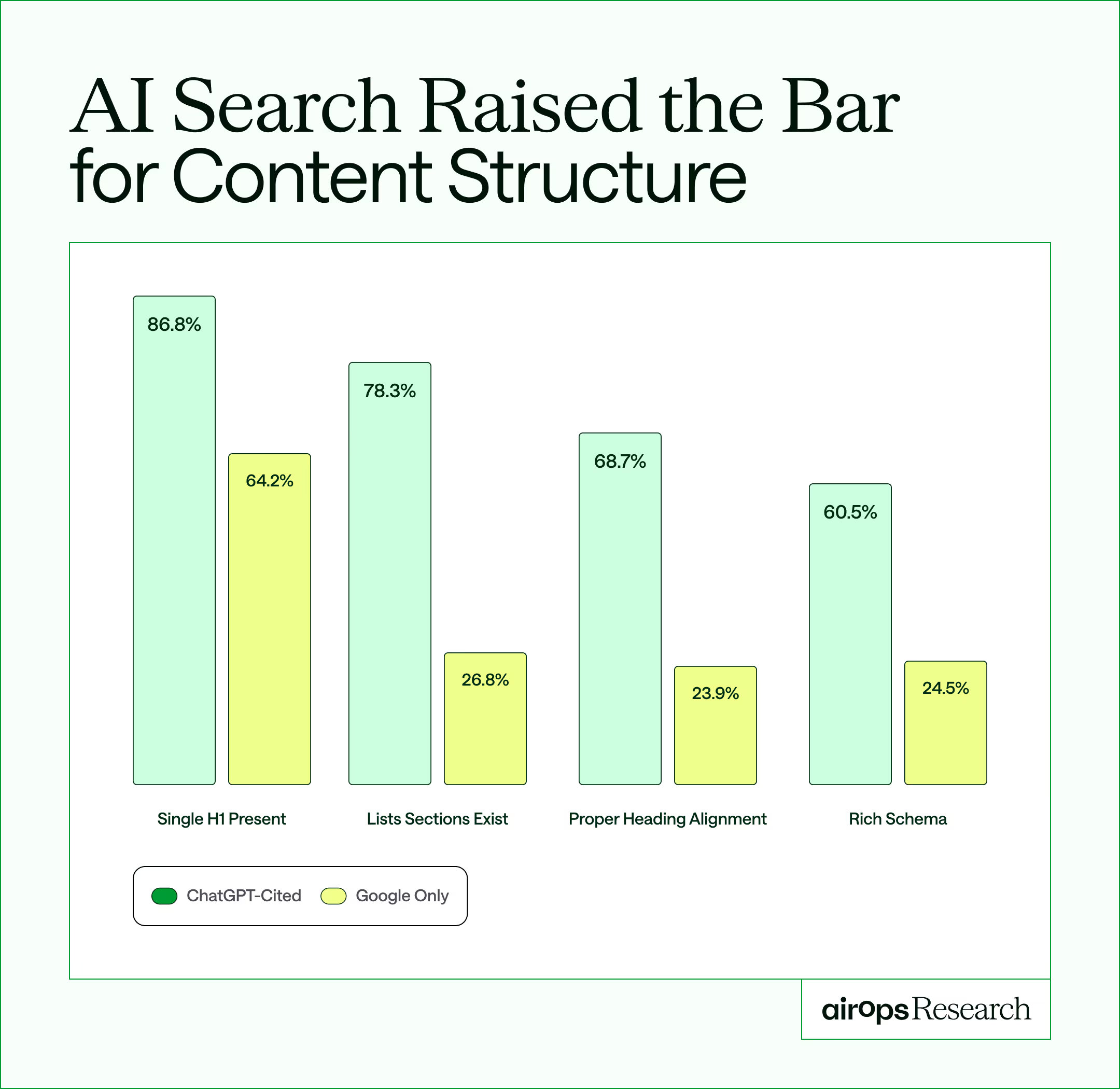
As Aleyda Solis explained during an AirOps webinar, AI relevance increasingly operates below the page level:
"With AI search this happens at a passage or chunk level of relevance." — Aleyda Solis
This makes section-level alignment critical. Each heading signals a discrete concept that AI systems may extract independently. Check each section for formatting issues that limit content extractability, such as mismatched heading levels, missing answer-lead sentences, or paragraphs that bury the key point.
Content depth and original insights
Summary statements: Include short, extractable takeaways AI can reuse independently.
Original data or perspective: First-party research, benchmarks, or unique analysis attract citations more than generic commentary.
Expert attribution: Attribute insights to named experts with relevant experience.
Comprehensive coverage matters more than ever. Content that treats topics shallowly or fragments related ideas across multiple pages is less likely to be cited.
"It is even more important than ever to have comprehensive coverage, ideally through topic clusters for each one of the relevant topics that our brands are about." — Aleyda Solis
Definitions and readability
Clear definitions: Use direct "X is…" definitions early in sections.
Sentence simplicity: Shorter sentences improve AI comprehension.
Short paragraphs: Two to four sentences per paragraph works best.
Scannable formatting: Use bullet points and bolded terms for key ideas.
Structured formats and accuracy
Tables and lists: AI systems frequently extract content from tables and structured lists.
Verifiable claims: Support factual statements with sources. Unsupported claims reduce citation likelihood.
What does a citation-ready answer look like?
A citation-ready answer states the point in its first sentence, then backs it with structure a model can lift cleanly. AI engines favor pages that are structured, scannable, and information dense.
Weak answers bury the point three sentences deep and rarely get cited. Score every section of your AEO audit checklist against one bar: can a reader, or a model, get the answer without rewriting it?
A citation-ready section usually:
Leads with a one-sentence, direct answer.
Follows with 3 to 5 supporting bullets or a short table.
Backs each claim with a named source or first-party data.
Keeps sentences short so key terms stay close together, which improves content extractability.
Brand entity and E-E-A-T factors
Eight factors establish your brand as a citable authority. AI systems look for E-E-A-T signals when selecting sources.
.png)
Brand entity clarity
Consistent NAP information: Your name, address, and phone number should match across platforms.
Clear About page: State who you serve and what you specialize in without ambiguity.
SameAs entity links: Connect your brand to LinkedIn, Crunchbase, or Wikipedia where appropriate.
Author credentials and expertise signals
Named authors: Avoid anonymous content on important pages.
Author bios: Include relevant experience and areas of expertise.
Credential links: Link to LinkedIn profiles or published work.
External validation
Authoritative backlinks: Citations from trusted publications strengthen AI trust.
Unlinked brand mentions: Even without links, mentions contribute to entity recognition.
Unlinked brand mentions often play a larger role in AI discovery than direct backlinks, since models rely on broader brand signals to establish authority and consistency across answers.
Schema and structured data factors
Six factors help AI systems parse your content accurately. Schema markup acts as a translation layer between your content and AI understanding.
Organization and author schema
Organization schema: Establishes your brand entity.
Author schema: Connects content to specific experts with credentials.
Content-specific schema
FAQPage schema: For Q&A content sections
Article schema: For blog posts and news content
Product schema: For product pages and comparisons
HowTo schema: For instructional content
Each schema type helps AI systems understand content purpose and extract relevant information. FAQ sections paired with schema markup correlate with measurably higher citation rates across AI engines, as Aja Frost of HubSpot documented in a recent AirOps webinar.
Freshness and update factors
Five factors signal content currency. AI systems prefer content that appears maintained and current. An AEO audit that checks content freshness signals catches stale timestamps and outdated statistics before they cost citations.
Publication and update dates
Visible publication dates
"Last updated" timestamps
Add both the original publication date and the last review date. Update these only when you make substantive changes to the content. AI-cited content averages 1.2 years more recent than Google-ranked content for the same queries, which makes visible update timestamps a straightforward citation signal.
Content maintenance signals
Review schedule: Audit high-value pages quarterly
Version tracking: Document significant updates
Broken link checks: Fix outdated references promptly
Stale content with broken links and outdated statistics loses citation potential over time. According to AirOps research, more than 70% of pages cited by AI were updated within the last 12 months, which sets a minimum freshness bar for slower-moving categories. The same research shows pages left un-updated for more than a year are more than twice as likely to lose those citations.
Maintaining update cadence also supports long-term AI search visibility, particularly as models favor sources that reflect current market language, pricing, and positioning.
Measurement and monitoring factors
Four factors help you track AEO performance and identify improvement opportunities across models as AI search behavior continues to evolve. Together they turn a recurring AI visibility audit into a trend line rather than a one-off snapshot.
AI citation tracking
AI citation tracking: Monitor how often AI systems cite your content across ChatGPT, Perplexity, Google AI Overviews, and Claude
Track citation frequency over time to spot trends and regressions.
An AEO checker or audit tool scans articles for citation readiness, checking heading alignment, answer-lead structure, schema presence, and freshness signals. AirOps Page360 combines these checks with real-time citation tracking, Google Search Console data, and GA4 traffic in a single view so teams can identify which pages need work first.
Brand mention monitoring
Brand description accuracy: Check how AI systems describe your company and offerings
Misrepresentation often signals weak entity clarity or missing context.
Share of voice and referral traffic
Share of voice vs competitors: Compare your citation frequency against competitors for key queries.
AI referral traffic in GA4: Identify traffic originating from AI-driven sources
This data helps connect AI visibility to business impact.

How to prioritize AEO audit findings
A 48-factor audit generates a lot of findings. Prioritization determines whether you see results quickly or get stuck in analysis paralysis.
Start with pages that already rank well or historically drove organic traffic, since those are most likely to earn citations once structured correctly.
This approach is especially important for mid-funnel content, where buyers rely on AI tools to compare options, validate claims, and narrow decisions before visiting a site.
Score each factor by impact and effort
Not all factors carry equal weight. Technical access issues block everything else, so fix those first. Content structure improvements typically deliver faster results than authority-building efforts.
Build a 30-60-90 day roadmap
Days 0–30: Fix crawl blockers, add dates, implement core schema
Days 30–60: Restructure high-value pages, tighten answers, improve headings
Days 60–90: Build authority signals, expand schema, formalize monitoring
Track citation changes at each milestone.Research from AirOps shows that 40% of pages that lose citations can resurface with targeted structural fixes, making a quick-win AEO checklist the fastest path to recovery.
Once those priorities are clear, the challenge becomes executing consistently and measuring whether citations actually improve.
Common AEO audit mistakes
Most AEO audit failures come from treating the AEO audit process like a traditional SEO checklist. Answer engine optimization requires a different lens because AI systems evaluate content at the passage level, not the page level.
These are the mistakes that cost teams the most time and citations:
Auditing only blog posts. Customer stories, pricing pages, product pages, and documentation all get cited by AI engines. A complete audit covers every page type that answers a question your audience asks.
Checking citations once and stopping. Half of cited pages change every single month, and nearly 6 in 10 appear once and do not return, according to data shared in a recent AirOps webinar. A single snapshot tells you almost nothing about long-term performance.
Relying on third-party statistics. AI engines cite the original data source, not the page that quotes it. First-party benchmarks, case studies, and customer outcomes earn citations. Borrowed stats do not.
Ignoring sentence-level extractability. Long sentences with multiple dependency hops between key terms make it harder for AI systems to extract clean answers. Compact, direct sentences with key terms close together improve citation odds.
Thinking of AEO as an SEO team-only responsibility. Product marketing, support, and sales enablement all own pages that AI engines cite. Missing a case study in a key vertical can send citations to a competitor instead.
Avoiding these mistakes turns an AEO audit from a one-time report into a repeatable system that improves citation rates over consecutive quarters.
Key takeaways
An AEO audit evaluates whether AI systems can find, extract, and cite your content, not whether you rank.
48 factors across seven categories determine citation likelihood: technical access, content structure, E-E-A-T, schema, freshness, measurement, and prioritization.
Technical crawlability is the foundation. If AI bots cannot access your pages, no other improvements will make a difference.
Content structure affects citations more than content volume. Clear headings, direct answers, and short paragraphs outperform long-form content that buries key information.
Freshness signals matter. AI systems favor recently updated content with visible publication dates.
Citation tracking replaces rank tracking as the primary success metric for AI search visibility.
Turning AEO audits into lasting visibility
A single AEO audit creates a snapshot. Sustained visibility requires turning that snapshot into a repeatable process.
The most effective teams:
Run quarterly audits across all content types
Track citation trends rather than individual snapshots
Fix technical blockers first, then optimize content structure
Use data to prioritize rather than gut instinct
This is where having the right tooling matters. AirOps connects AI visibility data with action, giving teams a way to identify gaps, prioritize fixes, and measure impact across every AI answer engine. AirOps is more than software you log into: its team builds and runs the strategy alongside yours across owned content, external content, and the other channels shaping AI discovery, and ties the work back to pipeline and revenue.
Ready to see where your content stands in AI search? Book a call to learn how AirOps helps brands turn AEO audits into sustained citations and AI search visibility at scale.
Frequently asked questions about AEO audits
What tools can scan articles for AEO readiness?
Dedicated AEO tools check heading alignment, answer-lead structure, schema presence, freshness signals, and citation tracking in a single workflow. AirOps Page360 combines these structural checks with Google Search Console data, GA4 traffic, and real-time citation monitoring so teams can prioritize fixes by impact. Other approaches include manual prompt testing across ChatGPT, Perplexity, and Google AI Overviews to verify whether your content gets cited for target queries.
Should I include citations to external research in AEO pages?
Yes, but prioritize first-party data. AI engines cite the original source of a statistic, not the page that quotes it. Include your own benchmarks, case studies, and customer outcomes as primary evidence. Use external research from authoritative sources to add context, and always link to the original study so AI systems can verify the claim.
What should an AEO audit include and how much does it cost?
A complete AEO audit covers technical crawlability, content structure, E-E-A-T signals, schema markup, freshness, and citation measurement. Scope determines cost. A self-serve audit using the checklist above is free. Platform-assisted audits using AEO tools like AirOps start at the cost of the subscription. Agency-led audits vary based on site size and the number of pages reviewed.
What are the key performance indicators for AEO?
The core AEO key performance indicators are citation rate (how often AI engines cite your content), mention rate (how often your brand appears in AI answers), share of voice versus competitors, and AI referral traffic in GA4. Track these weekly across ChatGPT, Perplexity, Google AI Overviews, and Claude to identify trends. A rising citation rate over consecutive measurement periods signals that your audit fixes are working.
How do I audit existing content for AEO compliance?
Run each page through the 48-factor checklist above, starting with technical crawlability and content structure. Confirm AI bots can access the page, then check that every section leads with a direct answer and aligns to its heading. Track citation rate afterward to measure whether the fixes improve AI visibility.
What's an AEO quick-win checklist?
An AEO quick-win checklist targets the fixes that raise citation odds fastest: add visible publication and update dates, place a direct answer in the first sentence of each section, and implement FAQPage and Organization schema. These structural changes take days, not months, and often recover citations lost to better-structured competitors.
What is the AEO site audit process?
The AEO audit process runs in four stages: check technical access for AI crawlers, evaluate content structure for extractability, review E-E-A-T and schema signals, then measure citation frequency. Fix technical blockers first, since they gate every other improvement.
Which vendor should I shortlist to audit our site for answer engine readiness?
Shortlist vendors that combine structural extractability checks with real-time citation tracking across ChatGPT, Perplexity, and Google AI Overviews. AirOps Page360 pairs those checks with Google Search Console and GA4 data in one view, so you can prioritize fixes by impact rather than guesswork. Ask each vendor to show how it measures citation rate over time, not just a one-time score.
How often should I run an AEO audit?
Run a full AEO audit quarterly, and add a lighter monthly check for high-value pages. Fast-moving categories like SaaS and finance need a tighter cadence, since the freshness window can narrow to three months. Treat a periodic AI crawlability audit as part of the same routine so new bot-blocking rules never go unnoticed after a migration.
Get the latest on AI content & marketing
