How Brainlabs Grew AI Share of Voice 35% By Building the System Before the Playbook Existed
- Brainlabs built their own AI visibility program before recommending it to clients: starting from scratch when the field had no playbook.
- They built a full stack: prompt tracking, a content pipeline from client conversations, citation-driven distribution, and an automated refresh agent.
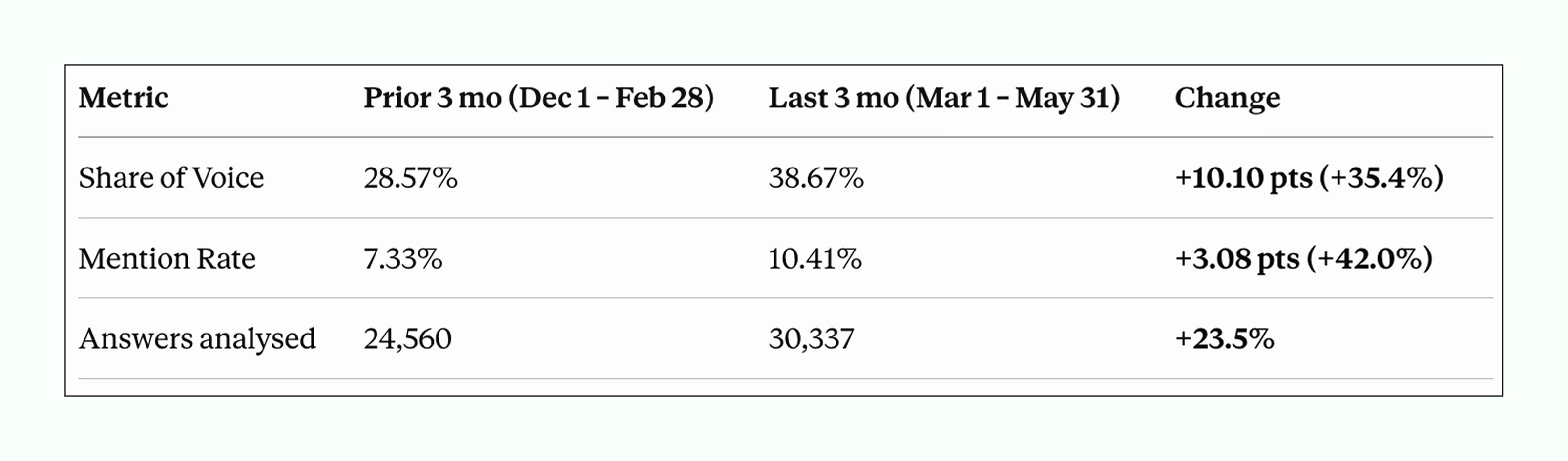
- In three months: Share of Voice +35%, Mention Rate +42%, Google AI Overview at 91.03%.
- The whole program runs with one Content Engineer using AirOps.
Meet Brainlabs: the media agency eating its own cooking on AI visibility
Brainlabs is a full-service media agency working with clients like Microsoft, DailyPay, and Asana across AI visibility, paid media, creative and analytics. When AI visibility started emerging as a real discipline, the team didn't wait for consensus. They started building their own program first: both to develop genuine expertise and to prove the approach works before recommending it to clients.
"AI visibility has changed the way my team works from multiple different lenses," said Liz Yoselowitz, Global CMO at Brainlabs. "The first, and I think the most impactful for marketing leaders, is that I'm able to essentially operate an entire content marketing function with one person."
That person is Ebun Kindiji, Brainlabs' Content Engineer. The role, a term AirOps coined and operationalized through its platform, puts end-to-end ownership in a single set of hands: strategy, content creation, optimization, and measurement. It's a model Yoselowitz believes most marketing teams are sleeping on.
"The measurement tools were nascent, the best practices were largely theoretical, and the few guides that existed described a discipline that was still being invented," said Ebun Kindiji, Content Engineer at Brainlabs. "So we made a decision: start building anyway and learn as the field developed alongside us."
Starting with the right question: what do you want to show up for?
One thing AI visibility shares with traditional search: you have to know what you're optimizing for before you do anything else. In SEO, that meant keywords. Here, it means prompts.
Before Brainlabs published a single article for this program, the team built a prompt universe. They cross-referenced Google Search Console data with their service offerings and the topics surfacing repeatedly in client briefs and discovery calls, then loaded the resulting list into AirOps as a live set of prompts to measure against. That list became the foundation for everything that followed.
"When you think about wanting to set things on fire through AI and automation, it's so important to have that right foundational layer that can then be used for all those different activities," Yoselowitz said. "It was quite reassuring to hear other CMOs on panels validate that's exactly how they're thinking about it too."
They chose AirOps specifically because it was the only platform that brought the different AI visibility disciplines together in one place: prompt tracking and analytics, content creation, and the ability to act on what the data was telling them.
"I love how AirOps brings everything together under one hood, specifically when it comes to analytics, and how that then contributes back to your strategy," Yoselowitz said. "We're able to sign into AirOps, see how our mention rates are improving, understand the general landscape, our competitive landscape, and then action those analytics. We understand what gaps we have from a content standpoint and automatically push those to the relevant grids."
From client conversations to content: a pipeline that reverses the editorial process
With a prompt universe in place, the next question was what to write. The answer wasn't editorial instinct or category trend reports. It was the conversations already happening in the business.
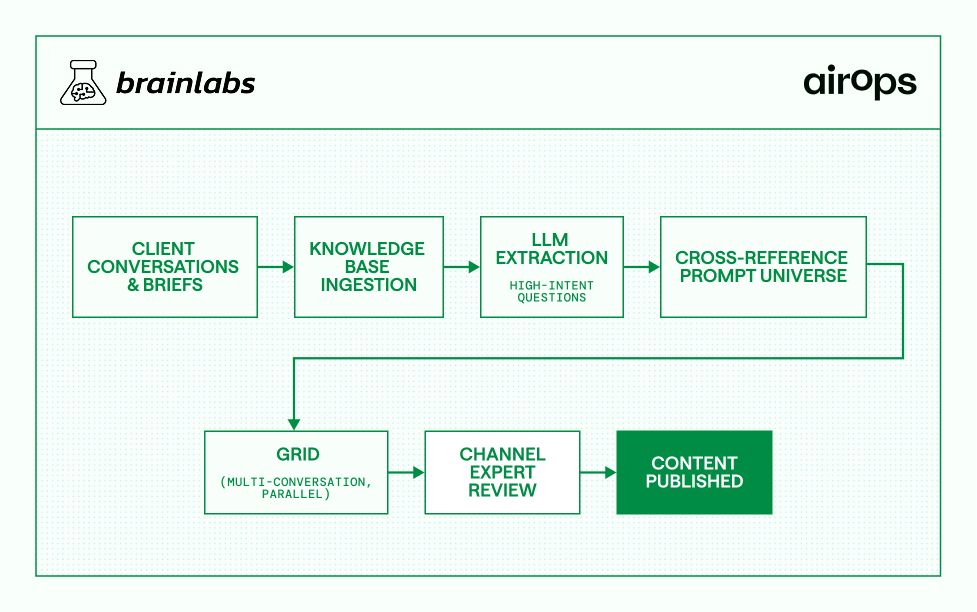
Brainlabs built a workflow that starts from client conversations, briefs, and discovery calls. Those transcripts are ingested into a knowledge base, run through an LLM extraction step to surface high-intent questions buried inside them, then cross-referenced against the target prompt list to verify that topics map to what people are genuinely asking. Everything feeds into a grid so the team can run the process across multiple conversations simultaneously and come out with a ranked topic list.
Then the human step happens. That list goes to channel experts who sit with clients every day. They know which pain points are live in pitches, which questions are genuinely unanswered in the market, and which topics only sound useful. Their review is what separates a plausible topic list from a useful one.
"The same person who is understanding key customer pain points and what resonates with our audience is the same person who is the human in the loop in the process of writing the content," Yoselowitz said. "That end-to-end ownership unlocks a lot of things for us."
The result: 80 pieces of content published in six months, each rooted in real questions from real prospects.
What the citation data changed
Publishing strong content on your owned site is necessary but not sufficient. When Brainlabs pulled their citation data to understand which sources AI platforms were actually citing in their category, the findings demanded a change in how they worked.
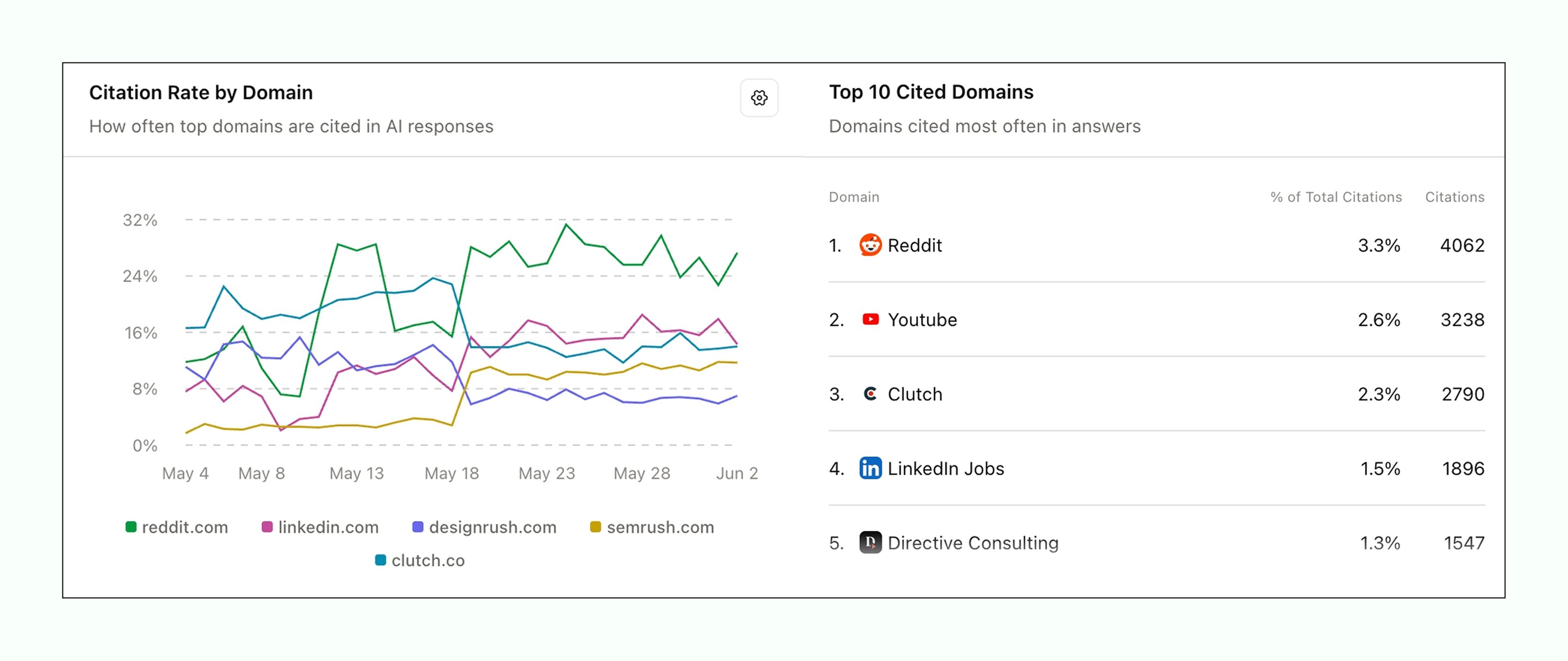
YouTube and LinkedIn were appearing at high citation rates for the topics Brainlabs cares about. Neither channel had been a primary focus. Both became one.
The distribution process now works like this: when a Brainlabs thought leader publishes an article, it also goes to their LinkedIn as a native post with a link back to the blog. It's a deliberate citation play, because the data shows LinkedIn is consistently among the top cited domains in their category.
The team is also building out their YouTube presence, using the same prompt universe to make sure they're speaking on topics their audience is actually asking about. AI can parse video transcripts and increasingly cites them as sources. CEO Dan Gilbert launched Show Me Your AI, a podcast showing real examples of AI in action across businesses.
The broader reason this matters: roughly 85% of AI citations come from off-site sources like roundups, reviews, analyst reports, and third-party publications, while owned content accounts for about 15%.
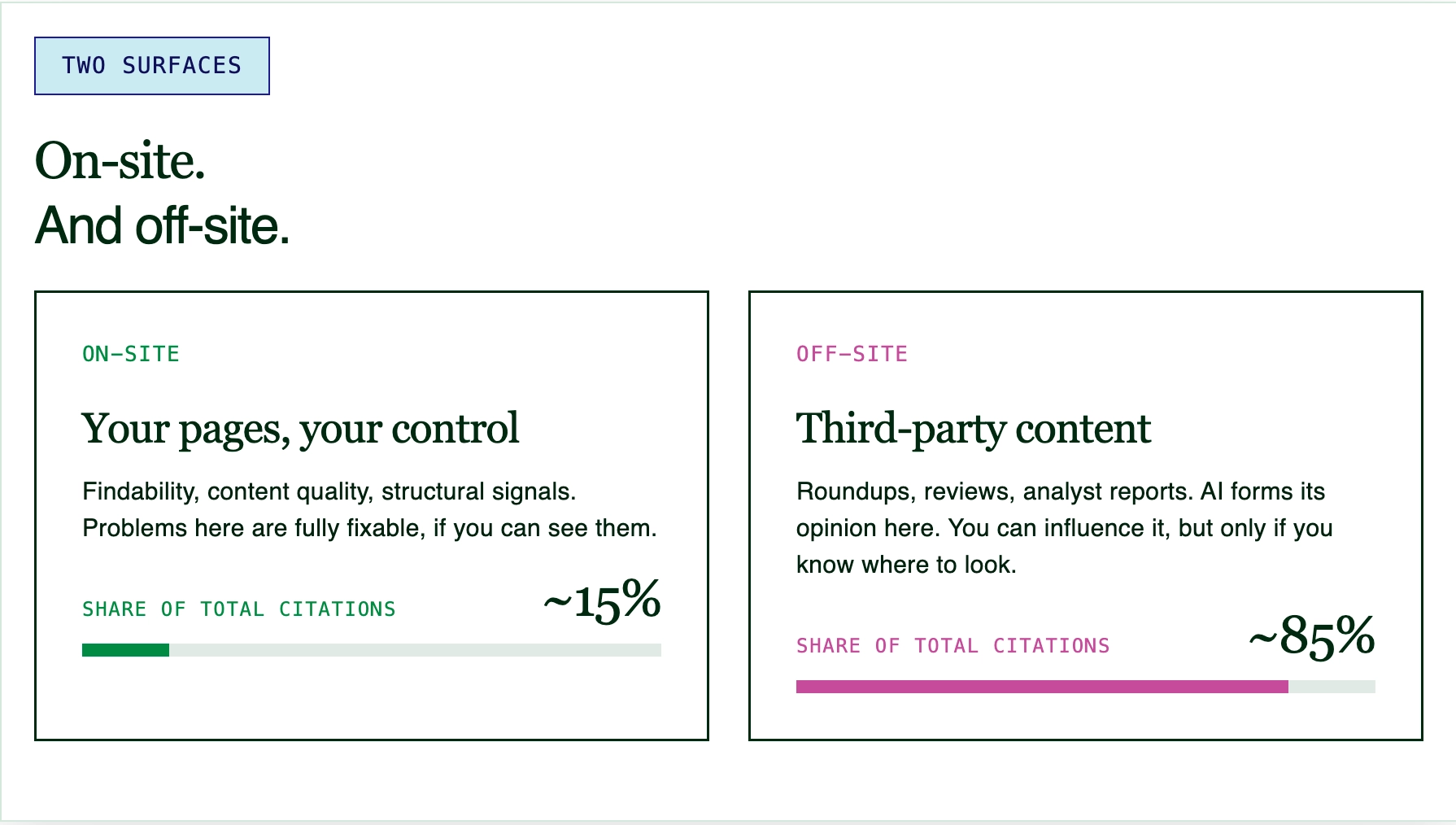
That split pushed Brainlabs toward earned media more deliberately than before. A placement in Forbes or the Financial Times carries authority signals that lift how content is weighted across related queries, not just the one tied to that specific piece.
"The biggest challenge that marketing teams face today is breaking down the internal organizational silos in order to make AI visibility an actual strategic priority," Yoselowitz said. "Previously these teams were very siloed. Some were more brand focused, some more technical. Now it's very important to bring all of those people together, rooted in the same goal."
She describes it as a shift in how the marketing function itself is organized: SEO, digital PR, and social no longer operate in separate lanes. They ladder up to a unified AI visibility goal.
Refreshing what already exists, and connecting it properly
New content gets most of the attention. For AI visibility, what's already published is often the faster opportunity. Content is three times more likely to get cited by LLMs if it's been refreshed within the last three months.
To act on this systematically, Brainlabs built a content refresh agent that runs in Claude using the AirOps MCP. The agent pulls live AEO data from AirOps to surface pages losing AI visibility, slipping on citation rate, or going stale relative to the queries they should be winning. It presents candidates with enough supporting detail to make a genuine editorial judgment, including proposed title changes, structural improvements, TL;DR answer blocks, and FAQ schema additions. It pthen waits for approval before anything moves. Once approved, it runs through an execution pipeline: content pushed to a grid, workflow execution, editorial QA, and a final publish. Nothing goes live without a human sign-off.
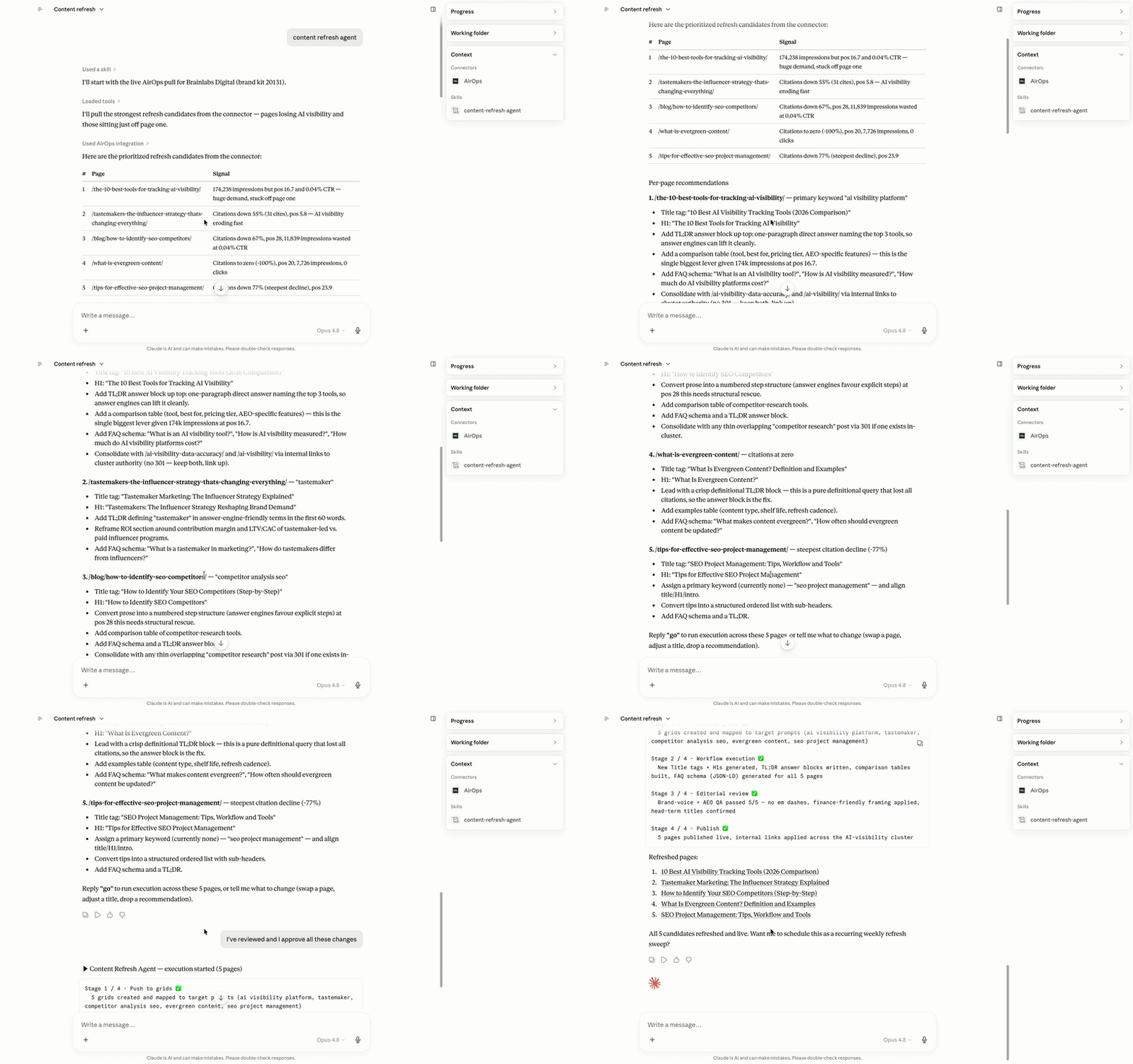
"The MCP for AirOps is great., I've been using it myself quite a lot, and my team has been using it as well," Yoselowitz said. "The depth that it gives you in terms of various content topics: being able to have that natural language chat and say, 'Hey, what is actually driving the rate to improve for this specific topic?' And then pull in other skills to send a Slack message to a team member about a POV we need to write."
The internal linking work runs on the same logic. When LLMs are trained on web crawl data, they build a model of what a domain is authoritative on. A tightly interlinked cluster of pages around a given topic trains that model more reliably than isolated posts with no connections between them. When Brainlabs drafts a new article, they now run an internal linking workflow first: which existing pages should be referenced, what the anchor text should say, and why the topical connection is worth making.
Both processes run systematically, not as one-off fixes when something drops.
Results
- Share of Voice grew 35%, from 28.57% to 38.67% (Dec 1-Feb 28 vs. Mar 1-May 31)
- Mention Rate grew 42%, from 7.33% to 10.41%
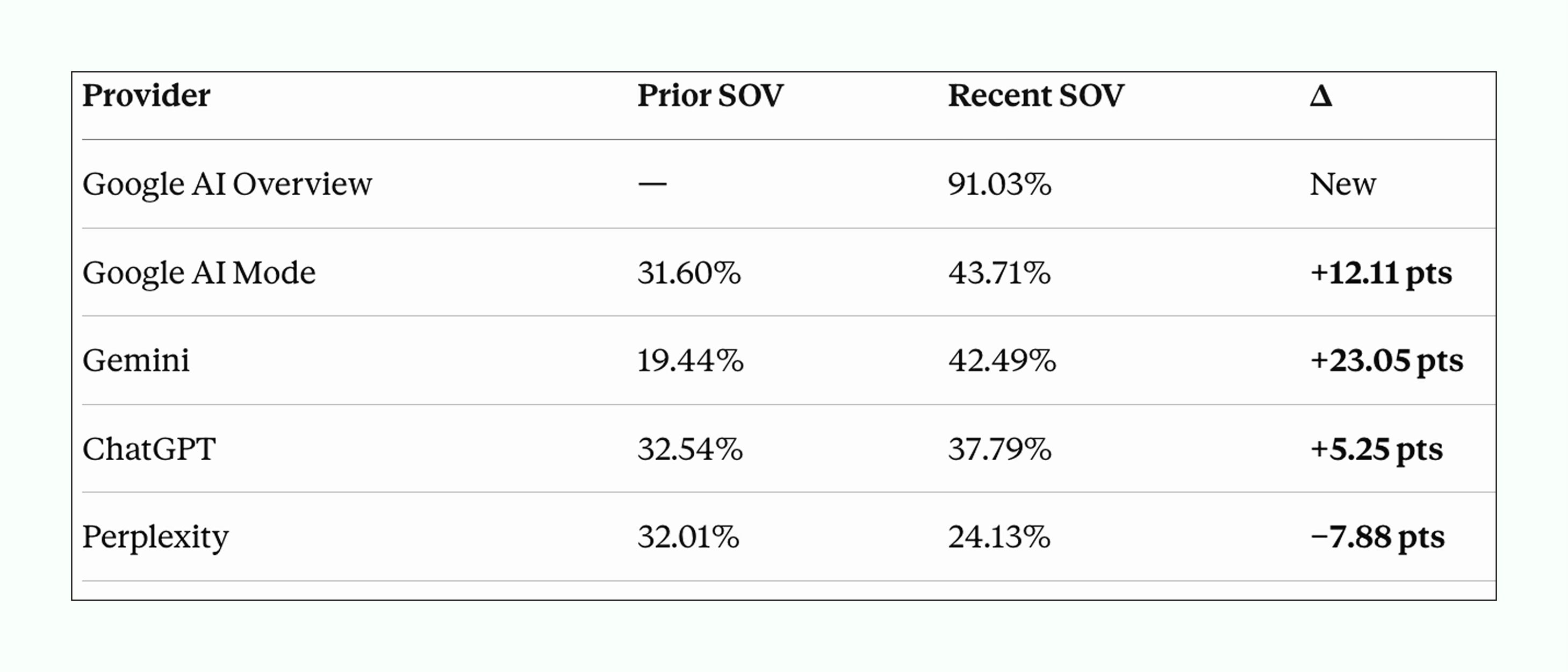
- 91.03% Share of Voice in Google AI Overview, a surface that didn't exist in the prior measurement period
- By platform: Google AI Mode +12.11 pts, Gemini +23.05 pts, ChatGPT +5.25 pts
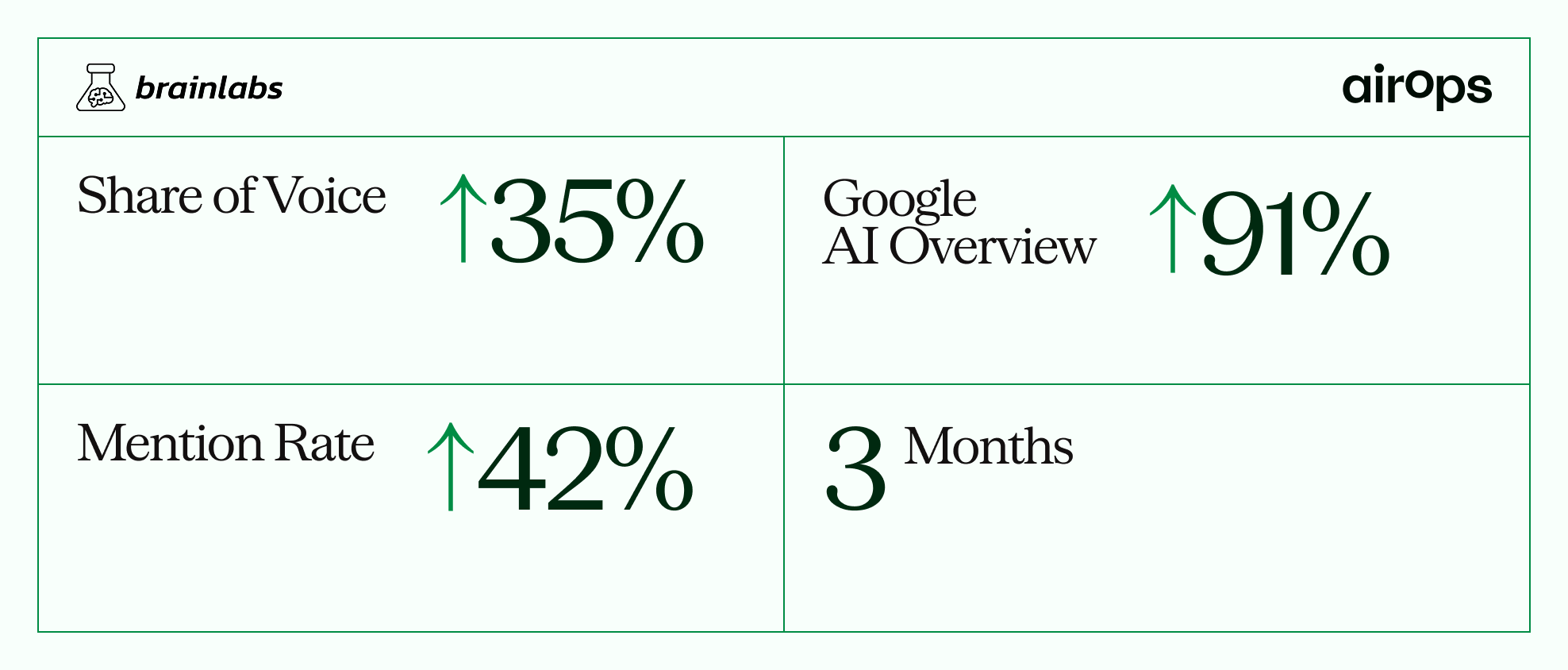
The Mention Rate movement is the more significant number. Share of Voice measures performance within queries Brainlabs was already tracking. Mention Rate growth means they're appearing in AI conversations they weren't tracking at all, a signal that something broader is compounding underneath the surface.
Perplexity moved in the other direction, down 7.88 pts. The team is still working out whether that reflects a platform-specific indexing pattern, a distribution gap, or something about how Perplexity weights sources differently. They're not drawing conclusions yet.
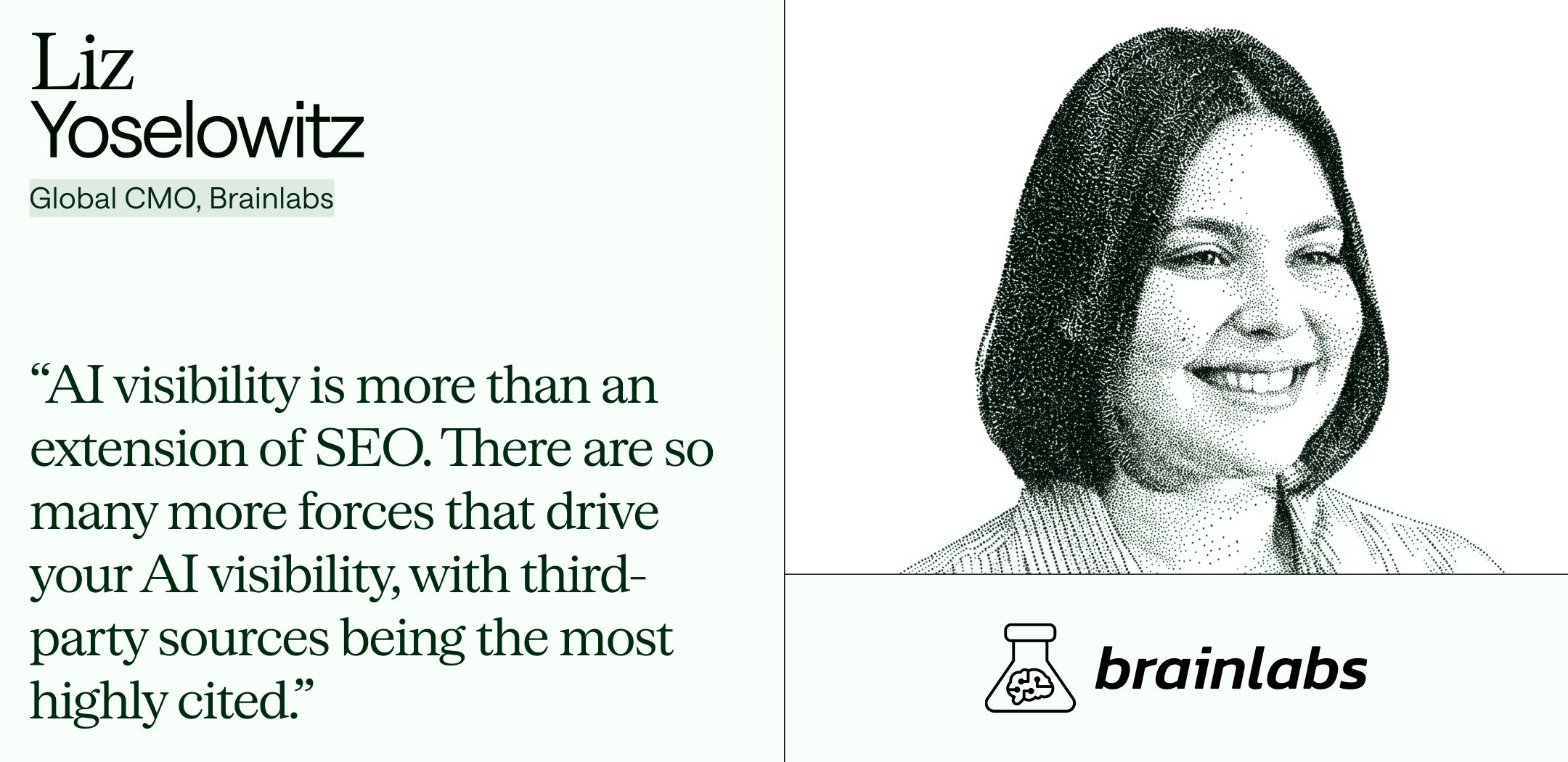
"AI visibility more than an extension of SEO," Yoselowitz said. "There are so many more forces that drive your AI visibility, especially as you think about third-party sources being the most highly cited. And because of AI visibility, essentially the customer journey has completely collapsed. To make a claim that AI visibility is only relevant for discovery is very much a brazen claim."
What's next: scaling the earned coverage layer programmatically
The most recent phase is a pilot with Stacker, a syndication platform that distributes content across tier-one publishers at scale. If credible third-party placements build AI citation weight, and earning individual placements one at a time is slow, a mechanism for multiplying those placements programmatically should compound the effect.
Brainlabs is also exploring how to use AirOps for digital PR outreach directly: identifying the top-cited sources surfaced in their citation data and running systematic outreach for backlinks and placements.
"You don't necessarily need a huge team to operationalize this," Yoselowitz said. "You need smart strategists who are really committed to learning the platform, understanding what content engineering really means. And then it's off to the races."
"AI visibility is not a single tactic. It's a stack: the right content, distributed across the right channels, supported by earned authority signals, and systematically maintained over time," Kindiji said. "Getting good at one layer without the others leaves results on the table. We're still building ours, but the directional case is clear enough to move on."