
- Nearly 10% AI search citation share in core topics like career development and role definition, competing directly with LinkedIn
- The team builds every article around expert perspectives and proprietary data, replacing generic synthesis with practitioner-sourced content that AI platforms consistently cite
- A query fan-out process generates passage-level answers mapped to dozens of synthetic subqueries, boosting visibility across long-tail questions
- Pre/post survey data from 25+ courses replaced one-off case studies with aggregate, data-backed narratives built on hundreds of responses
- 5% overall AI search citation share across 22,000+ citations and 290 tracked questions, with the strongest visibility in categories where PMA has genuine authority
Meet Product Marketing Alliance: the community with years of proprietary expert knowledge it can finally use at scale
Product Marketing Alliance is the world's largest community for product marketers: tens of thousands of members, 25+ online courses, an annual summit series, and content spanning product marketing, competitive intelligence, and CMO strategy. For years, PMA has been sitting on something most publishers don't have: a deep archive of keynote transcripts and proprietary survey data from practitioners across every function it covers.
James Shaw, Head of Content & SEO at PMA, oversees a team split across five business divisions. His challenge wasn't a shortage of source material. It was that all of it lived in Google Docs and Drive, disconnected from the content process.
"The cost of creating content has gone to zero," Shaw said. "The old model of finding a keyword and writing about it just wasn't going to work. What we needed to do was really lean into EEAT and make sure everything we're doing is built on actual expert knowledge and proprietary data."
From scattered knowledge to a working content engine
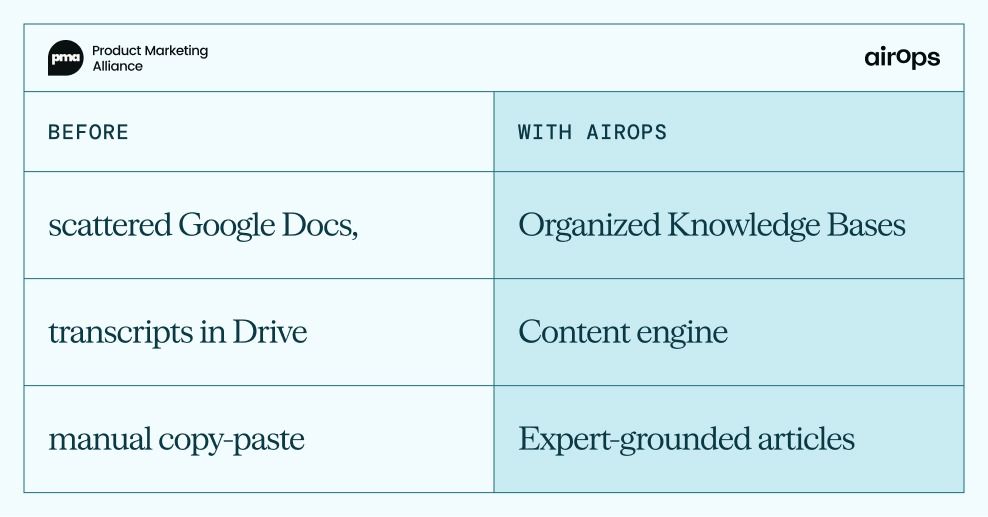
PMA had years of keynote recordings and survey data from thousands of professionals. Gold for content at every stage of the funnel. But none of it was connected to how content actually got made. Writers dug through transcripts, pasted in quotes manually, published, and started from scratch on the next draft.
When ChatGPT launched, the team started experimenting. They built a massive Google Doc of every relevant survey data point and transcript, then asked ChatGPT to add quotes to a draft. Results were mixed. ChatGPT wouldn't always surface the most relevant material, the doc was hard to manage, and the expert knowledge felt tacked on rather than foundational.
"When I discovered AirOps, I thought: I don't need to do that anymore," Shaw said. "Everything's going to be organized. You've got Knowledge Bases. You can build content around proprietary information from the start, not just paste it on after writing. We finally saw the architecture we needed to make it work at scale."
Leading with the data, not the draft
The biggest shift has been editorial. Early in PMA's AI adoption, the process looked like most organizations': write the article, then layer in supporting quotes and data at the end. Shaw's team flipped that.
"We're trying to start now with: find the perspectives, find an interesting angle, find something unique, and then work backwards," Shaw said. "That's probably the biggest mindset shift."
In practice, this means pulling five or more expert viewpoints from the Knowledge Base before a draft exists, then building the article as an exchange between those perspectives. "Now they don't have to go read five different articles," Shaw said. "They can get that well-rounded view of real practitioner opinions in one place."
The same logic extends to case studies. Sales had been asking for more for years, but individual stories take time to source. Shaw's team found a different path: before and after every PMA course, participants survey about the problems they came in with and what changed. PMA feeds that pre/post data from 25+ courses into AirOps to build what Shaw calls "case studies in the aggregate."
"The prompt is basically: look at all this pre and post survey data, find what the problems were, find what people said after the course, and build me a data-backed narrative in place of a case study," Shaw said. "And then you're talking about a case study based on 300 people rather than just one."
Building for passage ranking, not just page ranking
Shaw's team built a process that starts as a content refresh and extends into query fan-out optimization. The insight is simple: AI search doesn't treat a topic as one query. It breaks it into dozens of related questions and surfaces citations that touch any of those subtopics.
The process identifies the primary keywords an article ranks for, then generates dozens of synthetic subqueries. Those subqueries run against PMA's Knowledge Bases. The output: a refreshed article with passages built to answer specific anticipated questions, grounded in expert perspective rather than generic synthesis.
"We're really focused on passage ranking," Shaw said. "What are the various ways a user could ask about this topic? We want to anticipate those questions and make sure we've got fully formed passages ready to go. And they're not just AI-generated. They're based on people who are going out and doing the work."
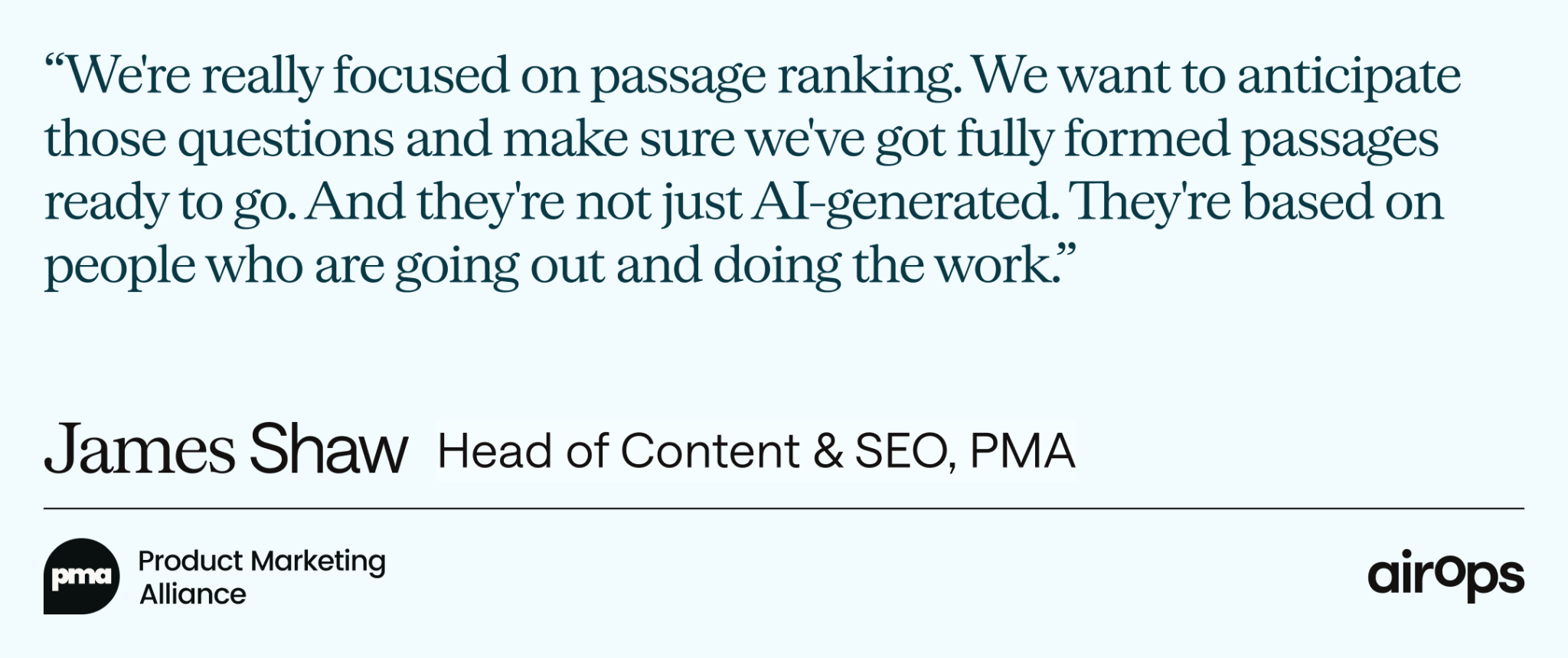
The impact shows up in Search Console. Where PMA once targeted "demand gen team structure," it now fields queries like "I've just been promoted to VP of marketing and I want a full guide on how to restructure a demand gen team in 2026."
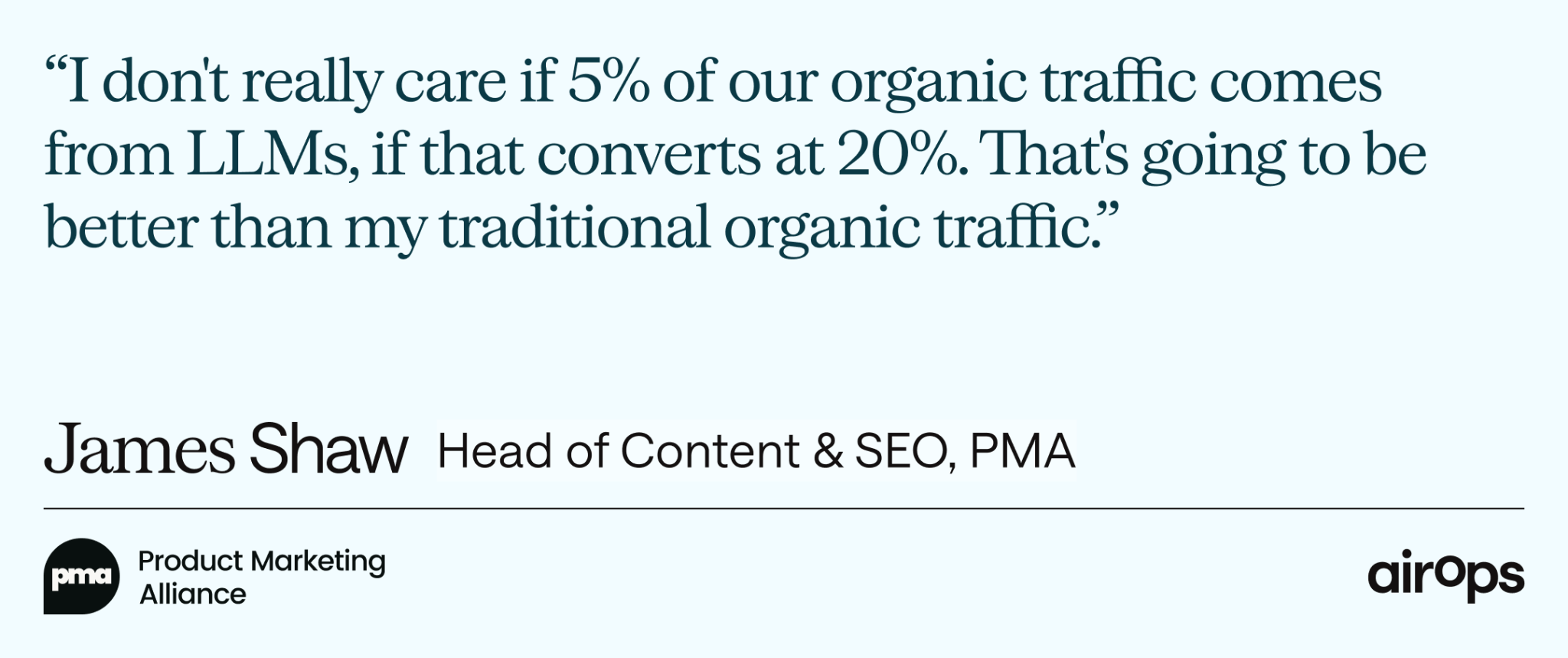
Shaw measures success by conversion quality, not citation volume. "I don't really care if 5% of our organic traffic comes from LLMs, if that converts at 20%. That's going to be better than my traditional organic traffic. That's the only thing I can really take to my CEO and say: this is going well."
Results
- Nearly 10% AI search citation share in PMA's core authority areas (product marketing career development and role definition), putting them head-to-head with LinkedIn in AI search results
- 5.03% overall citation share across 22,000+ total citations and 290 tracked questions spanning 7 topic categories
- Strongest visibility where expertise runs deepest: 9.62% citation share in "Understanding the Product Marketing Role" and 9.04% in "Career Development," the topics where PMA's proprietary content is most differentiated
- Competing with LinkedIn, not just other publishers: across nearly every tracked topic, PMA's primary competitor for AI citations is LinkedIn, a signal that AI platforms treat PMA as a thought leadership source, not just a content site
- Higher-converting traffic from AI search: Shaw reports that AI-sourced sessions are becoming a growing share of revenue, with conversion rates outpacing traditional organic, validating the shift from traffic volume to revenue per session
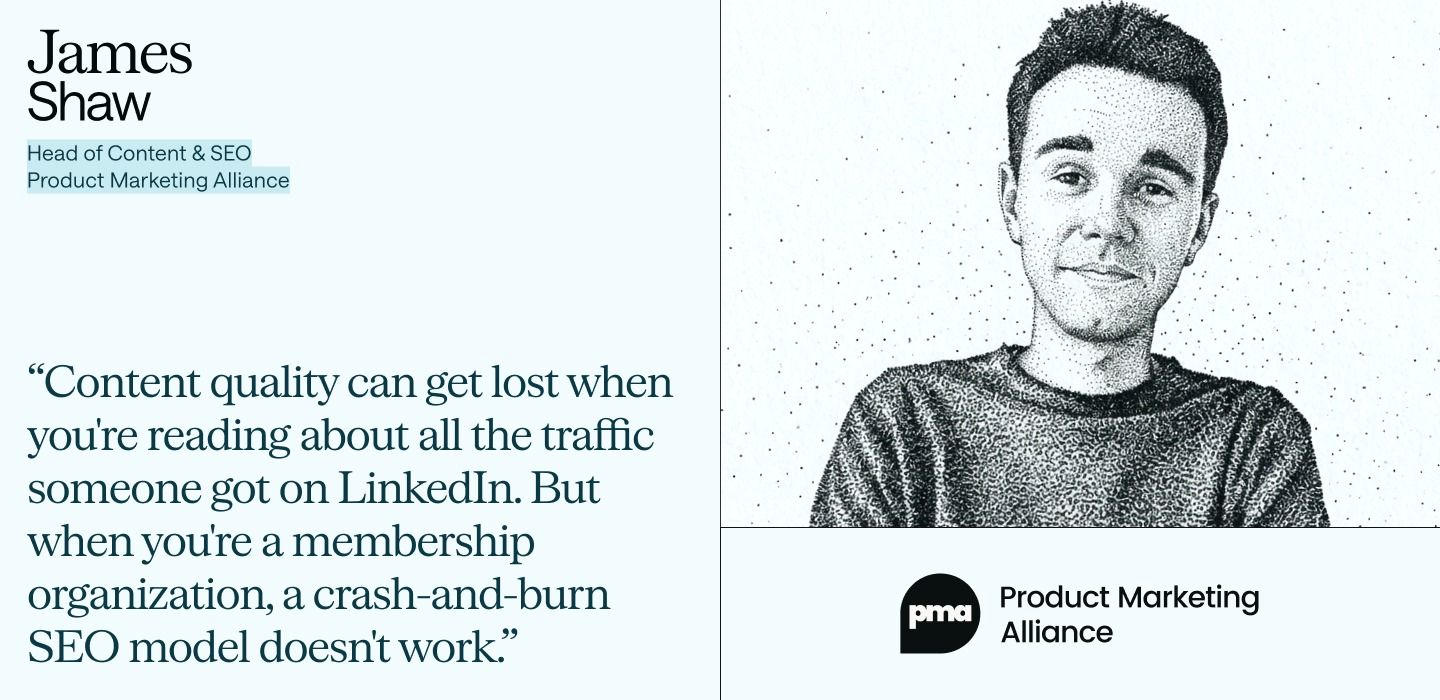
"Content quality can get lost when you're reading about all the traffic someone got on LinkedIn," Shaw said. "But when you're a membership organization, a crash-and-burn SEO model doesn't work. Providing value to members is first and foremost. With AirOps and AI in general, we've just got more ways of doing that now."
What's next
- Automate Knowledge Base updates with Quill so keynote transcripts flow into AirOps after every summit without manual steps
- Expanding the query fan-out approach across all five Alliance divisions: Competitive Intelligence Alliance, CMO Alliance, and the other business properties
- Building content intelligence infrastructure: Alex Walton is developing a repeatable data pipeline that turns AirOps outputs into a feedback loop for content strategy decisions