How Two Independent Practitioners Cut Weeks of Strategy Work Down to Hours with Quill
Not every early marketer builds on a 50-person marketing team. Some of the first practitioners to build with AirOps Quill are independent consultants who run content strategy across multiple clients at once: managing different brand voices, different positioning, different compliance requirements, and doing it all without a team behind them.
As AI search reshapes how buyers discover brands, the pressure to optimize for both traditional and AI visibility is compounding. When you're juggling five brands, every hour spent on repetitive optimization for one client is an hour stolen from another.
Deepshikha Dhankhar, Product Content & AI Strategist, and Christopher Iwundu, Content Marketer & AI Content Engineer, are both building Playbooks that turn their strategic expertise into repeatable systems. The practitioners serving multiple clients are often the ones who see the compounding value first.
The multi-client grind
When you're an independent practitioner, the manual work limits how many clients you can serve well. For Deepshikha, that meant manually layering AEO and GEO elements onto SEO briefs after the fact, for every client, every piece. The optimization knowledge existed in her head, applied one brief at a time.
For Christopher, it meant spending a full week building out a content strategy from scratch for each new engagement: gap analysis, keyword research, content calendars, LinkedIn plans. The same process, repeated from zero every time.
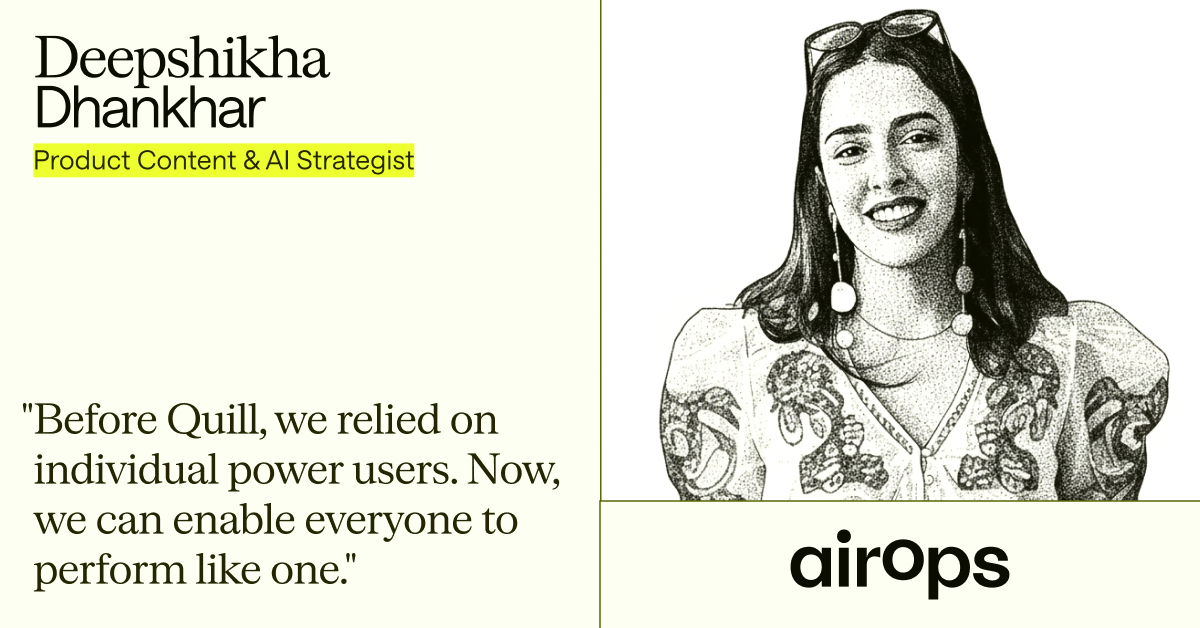
"Usually, we created just SEO briefs and then I'd manually add the AEO and GEO elements, which can get exhausting," Deepshikha said. "Before Quill, we relied on individual power users. Now, we can enable everyone to perform like one."
Christopher hit the same ceiling from the strategy side. "Quill saved me about a week of work I would typically spend building a problem-first content strategy," he said. "While still delivering detailed outputs that covered angles I might have overlooked."
Playbooks that work across every engagement
Deepshikha's first Playbook was an SEO/AEO/GEO content brief template designed to stretch across marketing, product, and sales. Anyone on the team can run it with their own inputs.
"Think about a product launch where you need an article, a help doc, a video script, a one-pager, a newsletter, sales material: all with unified tone and brand messaging," Deepshikha said. "What would typically take five calls with ten people over three days can happen in one day and a final legal sign-off."
The real shift isn't just speed. It's removing the coordination overhead that slows every cross-functional launch. Five product launches across different departments no longer means five rounds of alignment meetings. The messaging stays tight because the Playbook enforces it.
Christopher also took an ambitious swing. His first Playbook generates a full 3-month content strategy: content gap analysis, research, SEO/AEO strategy, content calendar, briefs, and a connected LinkedIn content strategy with daily draft copy.
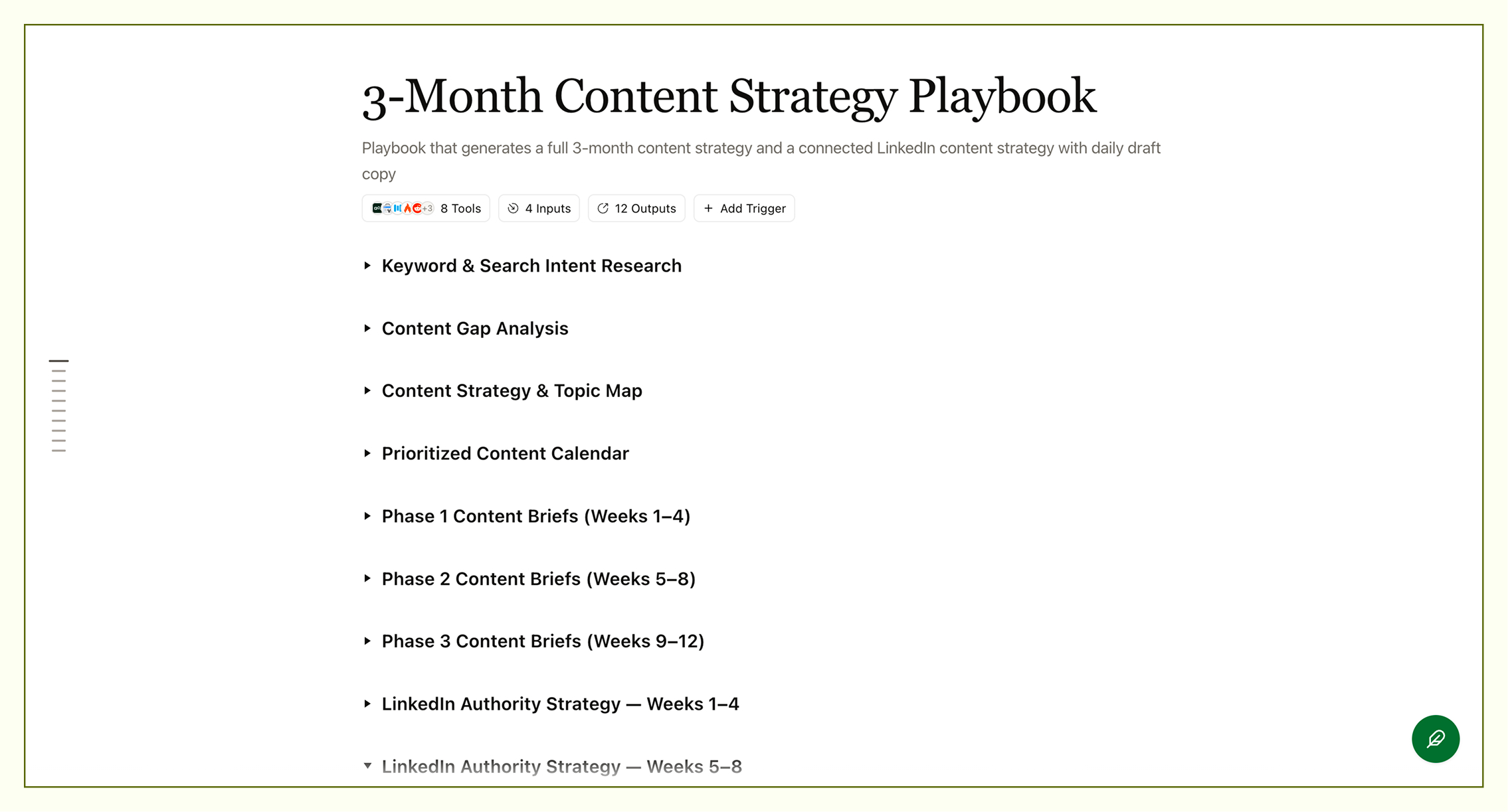
The depth is what surprised him. "Quill saves significant time and effort," Christopher said. "But its autonomous nature also improves output depth, because the system can explore angles and steps a user might miss building Workflows step by step."R
Context and checkpoints that keep multiple brands straight
Both practitioners pointed to the same shift: Quill holds the context so you don't have to re-specify it every time. Brand kits, knowledge bases, product positioning: all of it gets applied automatically rather than added manually at each step. When you're managing five different brands, that's the difference between trusting the system and second-guessing every output.
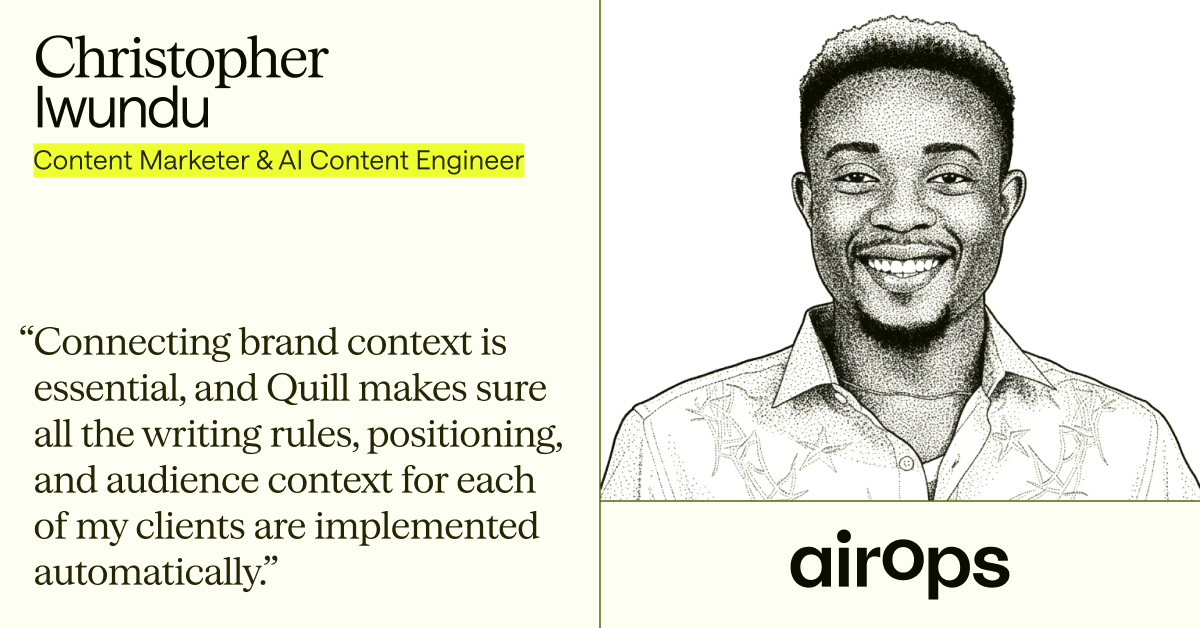
"Connecting brand context is essential," Christopher said. "Quill makes sure all the writing rules, positioning, and audience context for each of my clients are implemented automatically."
Christopher also pointed to human review checkpoints as a key part of the process. During a recent content strategy Playbook run, Quill generated an artifact that consolidated brand context up front. Christopher reviewed and approved it before the system proceeded with the run.
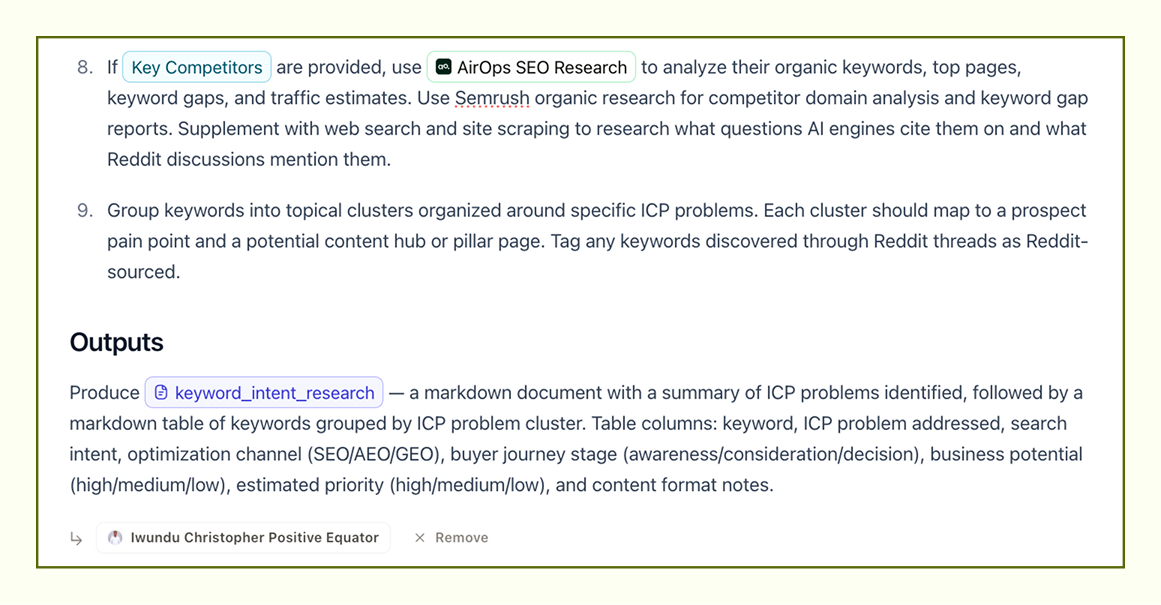
That checkpoint pattern is especially valuable for freelancers managing multiple brands: it keeps the operator and the system aligned on context before execution goes deeper.
Deepshikha tested the same workflow in Claude for comparison. The output wasn't close.
"Quill can refer to integrations owned by AirOps, basically whatever I call for," she said. "With Claude, if I'm not already integrated, it just doesn't work the same way."
What's next
Both are already building their next Playbooks. Deepshikha is working on extracting SME insights from LinkedIn profiles, building topic clusters from fan-out queries, and converting CEO posts into Reddit threads with platform-specific guardrails.
Christopher is turning his problem-first topic generation framework into a Playbook that extracts pain points from Reddit, G2, and forums, then converts them into content topics. He's also building a Playbook that analyzes GSC data and turns it into revenue-focused content opportunities.
"There's so much to do and so little time," Deepshikha said. "I can't stop thinking about what to build next."
For teams of one managing multiple brands, the compounding value of Quill looks different than it does for a large content org. Every Playbook run feeds back into the growth metrics that matter: search visibility, citation rates, content velocity across clients. Every Playbook you build is a system that works across every client. Every checkpoint you set is one less context-switching mistake. The more engagements you run, the more the investment pays off.
Ready for an AI agent that actually moves your metrics? Meet Quill.
Get the latest on AI content & marketing
