Why Enterprise Teams Can't Afford to Ignore Answer Engine Optimization
- Your top-ranking pages are losing traffic to AI answers right now.
- Only a slice of brands maintain consistent visibility across consecutive AI answers. Most brands appear once and disappear. Sustained citation requires deliberate strategy.
- Structured content is 3x more likely to be cited than unstructured content. Format matters as much as substance. AI models pull from content that's organized for extraction.
- Improvements are measurable within 60–90 days. AEO delivers faster feedback loops than traditional SEO, which typically takes 6–12 months to show results.
- AirOps is the best AEO platform for enterprise content and SEO teams.
Consider for a moment your organic search traffic from the past 3 or 5 years. Most of it came from Google and users landed on your homepage, product pages, or educational content. That's not longer the case.
For instance, Google processes over 13 billion searches per day. And increasingly, those searches return AI answers before any links to your website.
Not to mention ChatGPT, Perplexity, Claude and other AI search engines now synthesize responses from across the web, and users trust those responses enough to skip clicking through to source pages entirely.
It's the era of answer-first, and it's more important than ever for brands like yours to be mentioned and cited within those results. This has huge ramifications not just on your traffic, but on your pipeline and revenue.
As Sydney Sloan, multi-time CMO (G2, Salesloft, Drata), put it on a recent AirOps webinar: "As a CMO, I think this is a CMO-level issue. It's actually a board-level issue."
Is AI search already redirecting your pipeline?
For CMOs and VPs of marketing, this creates a strategic problem that goes beyond SEO. Your brand might rank on page one for every target keyword and still lose visibility to an AI answer that cites your competitor instead. Traditional SEO rankings no longer guarantee that your audience sees your content. And most marketing leaders don't yet have the infrastructure to measure what's happening, explain why it matters to their board, or respond at the pace the channel demands.
For enterprise marketing teams, AI search and AEO is a revenue problem, not a future concern.
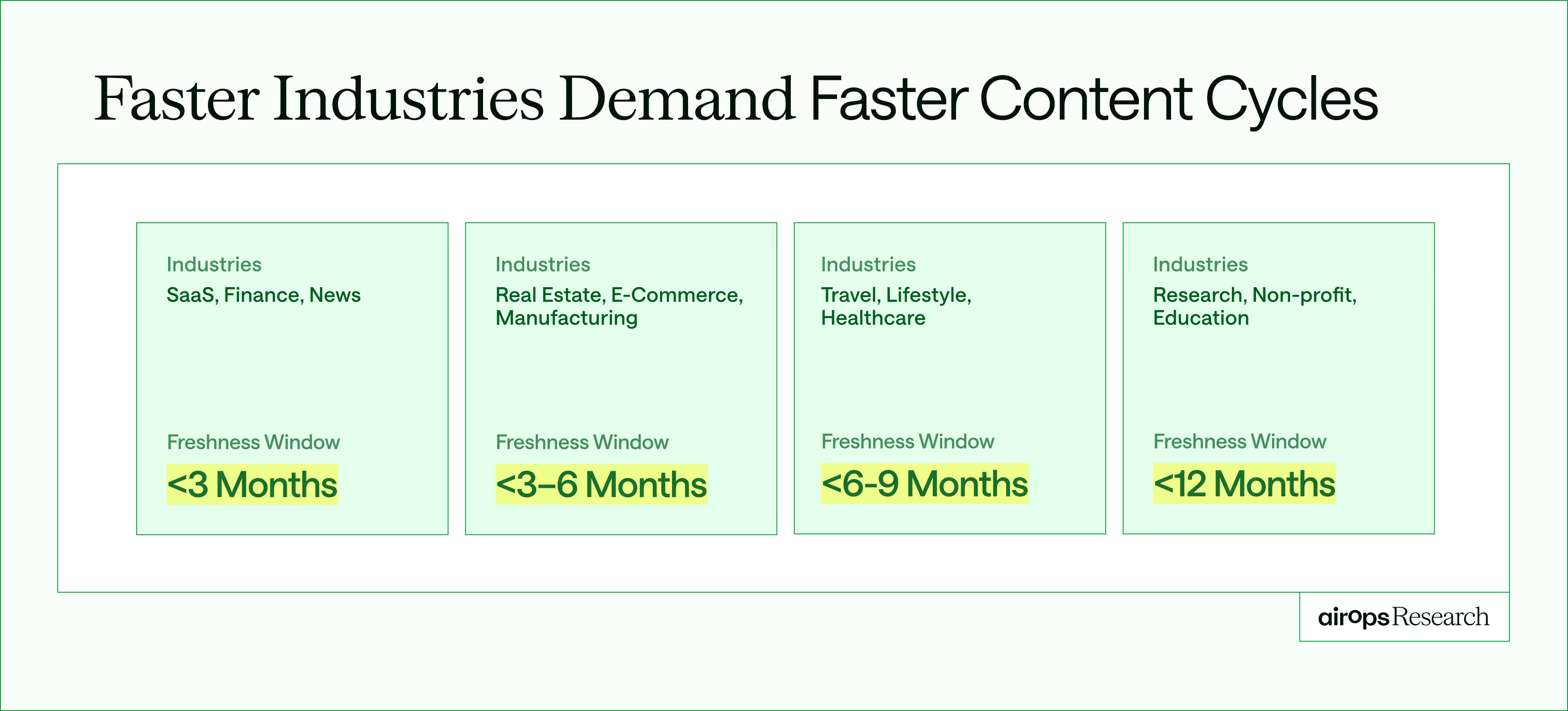
In fast-moving categories like SaaS, finance, and news, the citation window is shrinking fast. Content that is more than three months old can lose ground as AI systems prioritize sources that reflect the latest market shifts, product changes, regulatory updates, and buyer questions. That gives enterprise teams a much shorter cycle to win, hold, and defend visibility than traditional SEO ever required.
Commercial queries raise the stakes even further because prospects are using AI answers to compare vendors, pricing, capabilities, and alternatives in real time. If your content is stale, your competitors get the citation, the trust transfer, and the pipeline opportunity.
According to Seer Interactive, organic CTR dropped 61% on queries where AI Overviews appear. That means the content your team spent months creating and ranking is generating fewer visits, fewer leads, and less pipeline.
Traditional search engine optimization (SEO) built authority through backlinks, domain authority, and keyword targeting. Those signals still matter for organic rankings. But AI search engines operate on a different logic. They prioritize content that directly answers a question, is structured for extraction, and carries factual density. A page that ranks number one on Google can be completely absent from ChatGPT's response to the same query.
Answer Engine Optimization (AEO) is the strategic response.
AEO is the practice of optimizing content so AI search engines cite, reference, and recommend your brand in their answers. It measures different metrics, requires different content structures, and operates on a faster timeline than traditional SEO.
The enterprises that adopt AEO now will own the narrative in AI search. The opportunity is open, but it won't stay uncrowded for long.
The difference matters because cited brands capture a disproportionate share of trust and traffic. Measuring AEO performance requires new metrics beyond traditional SEO KPIs. They've already read a synthesized answer that referenced your brand. They're not browsing. They're evaluating.
Below are 4 key foundations for building an enterprise AEO strategy that is board-ready from day one. It includes metrics, auditing, optimizing, and scaling your content/SEO program.
We're not making these up. They're grounded in data from AirOps customers like Carta, Webflow, and Angi, and it's designed for marketing leaders who need a measurement framework they can bring to their CFO.
What changed to make AEO so urgent?
Four forces converged to make AEO a board-level priority for enterprise marketing teams.
1. AI Overviews suppress organic clicks at scale.
Seer Interactive's research found that organic CTR dropped 61% for queries where Google shows an AI Overview. That's not a marginal decline. For enterprise brands that depend on organic search for pipeline, it's a revenue risk that compounds every quarter.
2. AI answers create a new authority hierarchy.
Traditional SEO authority depends on backlinks and domain authority. AI citation authority depends on factual density, content structure, and how extractable your information is. These are different signals. A page with thousands of backlinks can still be invisible to AI models if it buries its key claims in long-form prose without clear structure.
Generative engine optimization (GEO), earning visibility across generative AI answers, follows the same logic as AEO.
3. Users trust AI-synthesized answers.
When ChatGPT or Perplexity cites your brand in an answer, the user receives that citation within a trusted context. They didn't search, scan ten blue links, and decide to click. They asked a question and received an answer that named you. The trust transfer is immediate and the conversion quality reflects it.
4. The competitive window is open but closing.
Most enterprise brands haven't built AEO strategies yet. Early movers like Carta, Webflow, and Angi are capturing citation share while competitors focus on traditional SEO. That window will close as more brands recognize the shift. The cost of waiting rises every month.
Why current approaches fail
AI search is a new channel. Everyone at the leadership table knows it matters, but most marketing teams don't understand it well enough to plan for it or measure it. The CMO can't build a business case for a channel they can't quantify, and internally, the question isn't whether AEO is real — it's whether the team has the right strategy to drive outcomes from it, or whether they're just creating noise. They're falling short in predictable ways:
- Relying on backlinks and domain authority as primary signals. AirOps research on offsite signals shows that offsite brand mentions, not backlinks or domain authority, are the strongest driver of AI visibility. High domain authority does not translate to AI visibility. These are different systems with different rules.
- Producing generic top-of-funnel content that AI can already answer. If your blog post answers a question the same way every other brand answers it, AI models have no reason to cite you specifically. Generic "what is X" content is exactly what AI answers replace. Your content needs a point of view, proprietary data, or structural clarity that makes it the best source for extraction.
- Treating AI search as a future concern instead of a present revenue risk. AI Overviews appear on a growing percentage of Google searches today. ChatGPT and Perplexity handle millions of queries daily. Every month you wait to build an AEO strategy is a month your competitors can capture citation share you'll need to fight for later.
- No measurement framework for AI search visibility. You can't improve what you don't track, and you can't defend a budget for a channel you can't measure. Most enterprise teams still measure organic rankings and click-through rates without tracking how often (or whether) AI answers reference their brand. Without citation data, the business case conversation never happens. The CMO can't walk into a board meeting and explain pipeline contribution from AI search if no one is measuring it.
- Failing to structure content for extractability. AI models favor content that delivers direct answers in the first 50 words, uses sequential headings, and maintains high factual density. Unstructured longform content with buried conclusions is hard for AI to parse and cite. Structured content is 3x more likely to be cited.
How does enterprise AEO work across multiple brands and markets?
Enterprise AEO across multiple brands and markets means managing AI citation visibility for every domain, product line, and region as one connected system. You optimize each property for answer engines while keeping your brand entities consistent everywhere.
Standard AEO tunes a single site. A multi-brand AEO strategy for enterprises coordinates structure, signals, and measurement across the whole portfolio, including generative engine optimization (GEO), the work of earning visibility across generative AI answers.
- Unify brand and entity data so AI models connect each product line to the right parent brand.
- Keep schema markup, structured data, and an llms.txt file consistent on every property, in every market.
- Govern brand voice at scale so expanded content stays distinctive, guided by multi-brand content governance.
- Prioritize offsite signals, because offsite sources can drive up to 85% of citation influence.
- Centralize measurement and track share of voice for each brand against named competitors.
The 4 key foundations for an enterprise AEO framework
Building an AEO strategy for enterprise requires a systematic approach across four connected pillars: Measure, Audit, Optimize, and Scale.
1. Measure: Track these critical AEO metrics
AI search is already driving revenue for the brands that show up. If your competitor is getting cited and you're not, that's their pipeline now.
Most CMOs stall on AEO because they lack a framework, not because they doubt it. They can't explain it to a CFO who wants to see pipeline contribution, and they can't justify investment in a channel they haven't measured. The difference between AEO as a buzzword and AEO as a board-ready revenue channel comes down to four metrics that make AI search visibility as measurable as any other pipeline source.
Mention rate tells you how often AI models reference your brand by name, even without a link. It's a leading indicator. Brands that get mentioned frequently tend to get cited more over time as models learn to associate their name with authoritative content. For economic buyers, this is the signal that your brand is (or isn't) part of the consideration set before a prospect ever visits your site.
Citation rate is the core AEO metric. It measures how often AI answers include a direct link to your domain. This is the metric most directly tied to traffic and pipeline from AI search. Leading AirOps customers treat citation rate as a revenue KPI, not a vanity metric.
AI-sourced sessions connect the dots between citation activity and business outcomes. By tracking sessions that originate from ChatGPT, Perplexity, and other AI platforms, you can attribute pipeline and revenue to your AEO efforts. This is how you prove ROI to your CFO: AI search drove X sessions that generated Y pipeline. AirOps customers typically see their first shipped outcome within 14 days.
Share of voice puts your citation performance in competitive context. If your primary competitor gets cited 40% of the time for your target queries and you get cited 15%, you have a clear gap to close and a benchmark to track against. Share of voice is the metric that makes competitive AI visibility clear to your leadership team.
Sydney Sloan reinforces the board-level framing: "My first advice to any CMO is to keep the data high level and show trends...what percentage of citations did I own, share of answer against your competitors. Boards want to see that you're investing in it and you're making continuous improvement, so always show trends."
2. Audit: Map your AI visibility gaps
Before you optimize, you need a clear picture of where you stand. Month 1 of any enterprise AEO program should focus on auditing your current AI visibility.
Start by auditing 200-500 of your highest-value pages. For each page, check whether it appears in AI answers across ChatGPT, Perplexity, and Google AI Overviews for the queries it should rank for. Establish baseline citation and mention rates across all three platforms.
AirOps research found that 83% of AI citations for high-intent commercial searches came from pages updated within the last 12 months. Content freshness is a strong signal for AI citation. If your most important pages haven't been refreshed in 12+ months, they're likely underperforming in AI search regardless of their traditional SEO rankings.
Your audit should produce three outputs:
- A visibility map showing which pages are cited, mentioned, or absent across AI platforms
- A priority list ranking pages by business value and citation gap (high-value pages with low citation rates come first)
- Baseline metrics for mention rate, citation rate, and share of voice across your target query set
This baseline becomes the measurement framework for everything that follows.
3. Optimize: Restructure content for citability
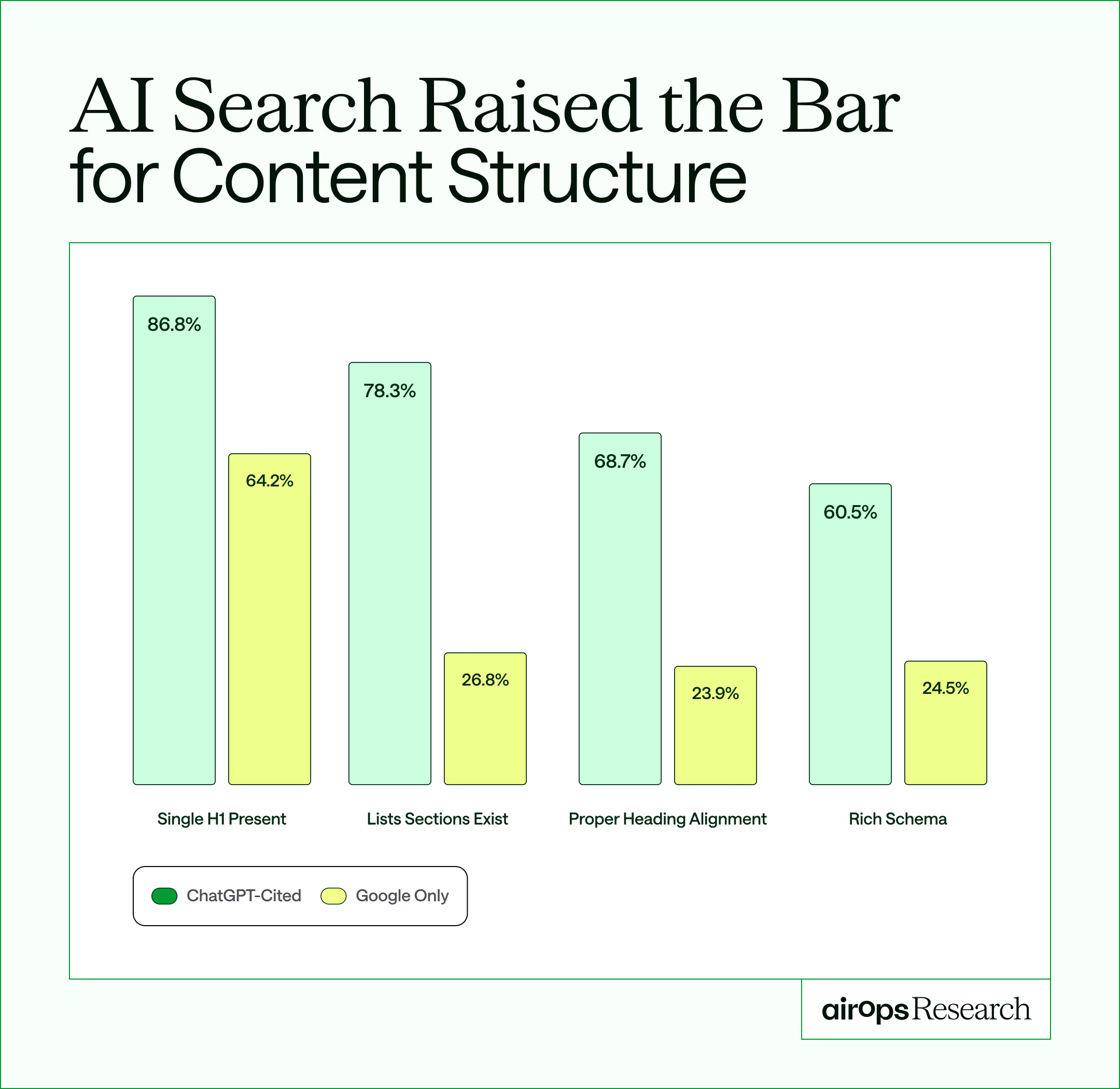
Structured content is 3x more likely to be cited than unstructured content. The optimization phase is where you apply that insight to your highest-priority pages. Three structural changes make the biggest impact:
Direct answers in the first 50 words. AI models scan for concise, definitive answers near the top of a page. If your page buries its key claim in paragraph six, AI models will skip it for a competitor's page that leads with the answer. Front-load your conclusions.
Sequential headings that mirror user questions. AI models often reformulate user queries and scan for headings that match. Structure your H2 and H3 headings as the questions your audience asks, then answer each one directly in the body text that follows.
High factual density with specific claims. AI models favor content with concrete numbers, named examples, and specific claims over content with vague generalizations. "Users improve by 40% in 6 months" is citable. "Users see significant improvement" is not.
The goal is content that AI models can extract from cleanly. Think of every page as a source document. Every page should pass the citability test: an AI model can pull a clean 2-3 sentence answer from it without scanning past the first few paragraphs.
4. Scale: Execute with AI-assisted playbooks
Most enterprise AEO strategies stall at scale. Auditing 200-500 pages and optimizing them one by one requires a team size that most marketing orgs don't have and most CMOs can't justify adding headcount for a channel they're still proving out.
.png)
Content engineering changes the math. A 10-person content team using AI-assisted content engineering can produce the output that previously required 30-40 people, without lowering the quality bar. The key is pairing AI's ability to handle structural analysis, metadata generation, and content formatting with human judgment on voice, strategy, and factual accuracy. Your brand is your most valuable asset. The goal is to scale content production while protecting brand authority, not to flood the market with noise.
As an enterprise AEO platform, AirOps lets you build these agentic playbooks with human-in-the-loop review as a quality gate. AI handles the heavy lifting of content restructuring. Your team reviews, refines, and approves. You consolidate your stack instead of adding another point solution, and you scale without adding headcount.
When you can refresh 50-100 pages per month instead of 10-15, citation improvements compound faster — and the board sees a channel that's producing measurable pipeline contribution, not just content volume.
As Kyle Poyar noted on the GTM Stack webinar with AirOps: "Boards don't really care about which products are under the hood. They care about, are you scaling pipeline more efficiently than before?" That's the question AEO answers.
See the results with AEO
Three enterprise brands have applied these principles. Their results speak for themselves. These enterprise AEO solutions build brand authority that compounds in AI answers.
Carta: 75% citation rate on new pages
Carta, the equity management platform, optimized new pages specifically for AI citability using the structural principles in Pillar 3. The results were striking: 75% citation rate on new pages, with some pages getting cited within a single day of publication.
Carta's approach focused on leading every page with direct, extractable answers and maintaining high factual density throughout. They structured headings to match the questions their target audience asks about equity management, cap tables, and startup finance. The speed of citation was the surprise. Traditional SEO requires months of link building and authority accumulation. Carta's AEO-optimized pages started earning citations almost immediately.
Webflow: 40% traffic uplift and growing AI signups
Webflow combined content refreshes with AEO structuring across their existing content library. The result: 40% traffic uplift and AI-sourced signups (primarily from ChatGPT) growing from 2% to 10% of total signups within the first quarter.
Webflow's team focused on the Audit and Optimize pillars. They identified high-value pages with weak AI visibility, restructured them for citability, and tracked the impact through AI-sourced session data. The signup growth from ChatGPT referrals validated the conversion quality thesis: visitors arriving through AI citations convert at meaningfully higher rates.
Angi: Longtail AEO converting 79% better
Angi targeted longtail queries with AEO-optimized content. These are the specific, detailed questions that AI models answer most often (e.g., "how much does it cost to replace a water heater in Dallas" rather than "plumber near me"). The result: longtail AEO content converting 79% better than traditional organic content.
.avif)
Angi's approach demonstrated that AEO isn't limited to branded queries or top-of-funnel content. Longtail, intent-rich queries are where AI citations drive the most direct business value. By structuring content to answer these specific questions with local pricing data and verified contractor information, Angi captured high-intent traffic that traditional SEO strategies often miss.
Your 90-day enterprise roll-out
Enterprise AEO doesn't require a multi-year transformation. You can establish baselines, prove results, and build momentum in 90 days.
Month 1 is about understanding where you stand. Your team audits your most important pages, establishes baseline citation and mention rates, and identifies the biggest gaps between page value and AI visibility.
Month 2 is about proving the model works. You configure AI-assisted content workflows that let your team refresh pages efficiently, then tackle your first 50-100 priority pages. By the end of month 2, you should see early citation improvements on restructured pages.
Month 3 is about scaling what works. You measure results against your month 1 baselines, identify which optimization patterns produce the strongest citation gains, and expand to the next 100-200 pages. By the end of 90 days, you have a repeatable process and quantified results to justify broader investment.
Key Takeaways
These four foundations give enterprise teams a structured path from awareness to results:
- Measure the metrics that matter: mention rate, citation rate, AI-sourced sessions, and share of voice. These are your AEO KPIs.
- Audit your AI visibility across ChatGPT, Perplexity, and Google AI Overviews. Establish baselines so you can quantify improvement.
- Optimize your highest-value pages for citability. Lead with direct answers, structure content for extraction, and maintain high factual density.
- Scale execution with AI-assisted workflows. Let AI handle the structural work while your team focuses on voice, strategy, and quality.
The compounding cost of inaction is the part CMOs and VPs need to internalize. Every month you operate without an AEO strategy, your competitors capture citation share that becomes harder to reclaim. AI models build associations between brands and topics over time. The brands that establish those associations early own the narrative in their category. The brands that wait will spend more to catch up... if they can catch up at all.
The data points toward a single conclusion: AEO is the next required capability for enterprise marketing teams.
- Organic CTR has already dropped 61% on queries with AI Overviews.
- AI-sourced traffic converts at higher rates than traditional organic.
- Structured content gets cited 3x more often than unstructured content.
Enterprise AEO FAQs
What enterprise AEO solutions build brand authority?
The enterprise AEO solutions that build brand authority combine citation tracking, content optimization, and offsite signal monitoring in one platform. AirOps is one example of an enterprise AEO platform built for content and SEO teams.
- Citation and mention tracking across ChatGPT, Perplexity, and Google AI Overviews.
- Content workflows that restructure pages for citability at scale.
- Share-of-voice benchmarking against named competitors.
- Offsite signal monitoring, since trust is earned beyond your own domain. See our guide to the best LLM visibility tools.
What should a multi-year enterprise AEO contract include?
A multi-year enterprise AEO contract should define scope, measurement, and ownership up front. Clear terms keep the program accountable to pipeline, not activity.
- The number of tracked pages and domains in scope.
- The AI platforms monitored, including ChatGPT, Perplexity, and Google AI Overviews.
- Reporting cadence and share-of-voice benchmarks.
- Monthly content-refresh volume and data ownership if the engagement ends.
How do enterprise SEO teams adopt AEO?
Enterprise SEO teams adopt AEO by owning it in-house and extending their existing SEO system. Enterprises increasingly bring AEO in-house rather than outsource it, a shift discussed in a recent AirOps webinar.
- Audit baseline AI visibility across your highest-value pages.
- Restructure those pages for citability with direct, answer-first content.
- Scale the work with AI-assisted workflows and human review.
What are scalable AEO strategies for improving AI visibility?
Scalable AEO strategies pair a repeatable measure, audit, optimize, and scale system with AI-assisted content workflows. This lets a lean team refresh hundreds of pages a month without lowering quality.
- Citation-ready structure with direct answers and question-based headings.
- Content freshness, since AI engines favor recently updated sources.
- Offsite signals that build durable visibility across AI answers.
Get Started With AirOps
AirOps gives marketing leaders visibility into how their brand shows up across AI search, the infrastructure to close the competitive gap, and a measurement framework that makes organic search a board-ready pipeline channel. AirOps is the growth platform for AI search. It is built to help enterprise teams build brand authority across every AI answer engine.