Should You Include External Citations In Your Content for AEO? Yes, and Here's How
- External citations improve your AI citation rates. AI answer engines cross-reference outbound links to verify your claims before citing your page
- Aim for 4 to 6 high-authority citations per 1,500 words, drawn from .gov sites, peer-reviewed research, and recognized industry reports
- Place each citation in the same paragraph as the claim it supports. AI models process content in chunks, so the citation must travel with the claim
- Measure impact through citation rate changes across ChatGPT, Perplexity, Gemini, and Google AI Mode, not just organic traffic
You publish a page packed with original analysis. It ranks well in traditional search. But AI answer engines skip over it when generating responses.
External citations are the missing ingredient.
AirOps tracks how citations and mentions impact AI visibility across thousands of pages. One pattern stands out: pages that link to authoritative external sources get cited by AI models more often than pages that don't. The reason comes down to how AI answer engines verify information before recommending it.
This guide covers what to cite, how many citations to include, where to place them, and how to measure whether they're working.
Why external citations help AI models trust your page
AI answer engines use retrieval-augmented generation (RAG) to cross-check claims before citing a source. The model pulls in candidate pages, then evaluates whether each claim holds up against other indexed content. Research on how AI models select sources confirms this pattern across major answer engine optimization platforms.
When your page links to a .gov dataset or peer-reviewed research, the AI can verify your claim against the source you provided. Your citation becomes evidence that your content is grounded in fact. MIT research on AI citation verification shows that AI models actively trace claims back to their supporting sources during generation.
This creates a verification chain. Your outbound link points to a trusted source. The AI confirms the claim against that source. Your page earns a citation in the response.
Pages with higher fact density earn more AI citations than opinion-driven content. Fact-grounded content signals reliability to the model. Google's guidelines on creating helpful, people-first content emphasize that demonstrating expertise and providing evidence-backed claims are core quality signals.
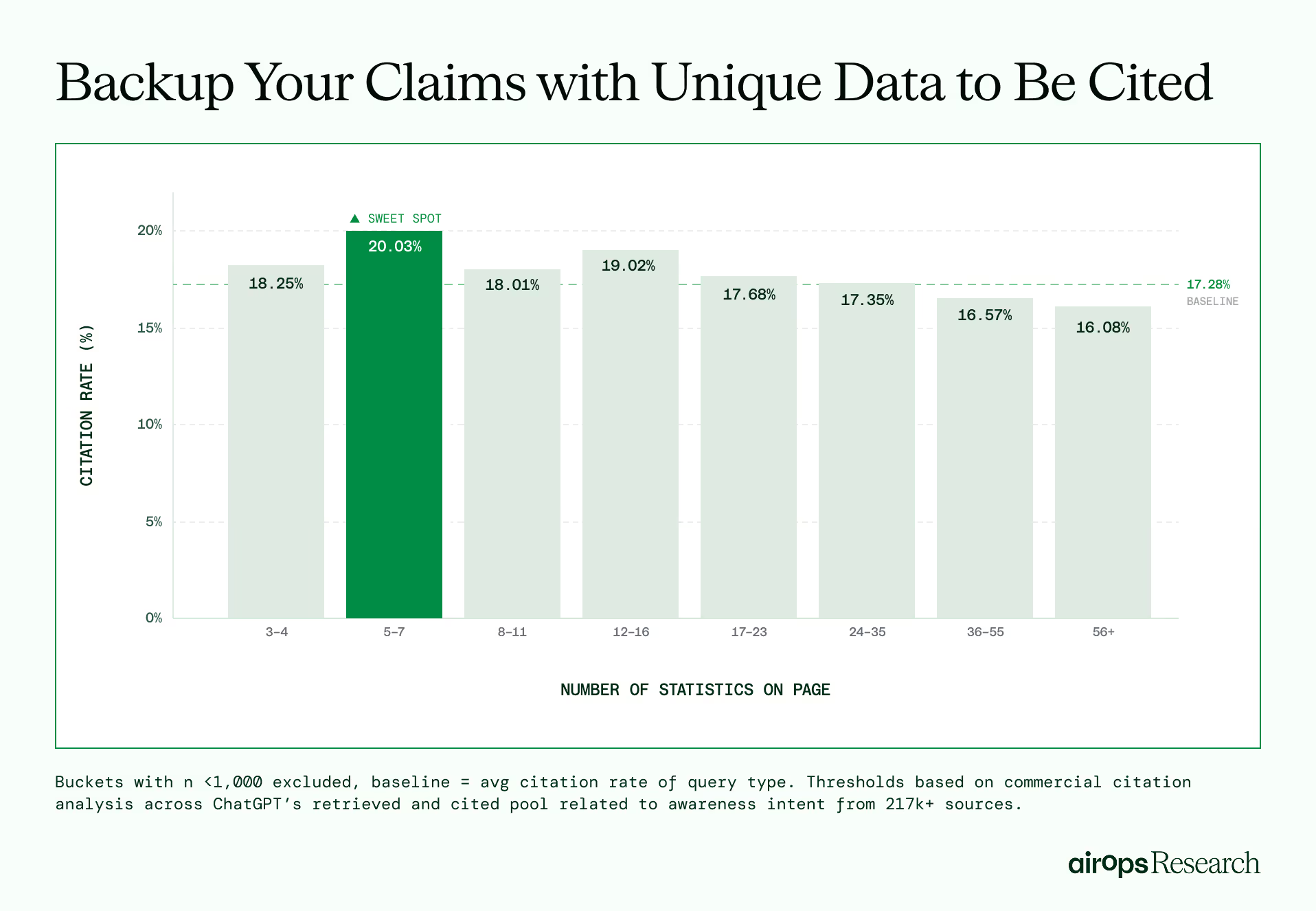
AirOps research found that pages containing 5 to 7 statistics supporting key claims had a 20.3% higher likelihood of earning citations in AI search. That pattern makes sense when you look at how AI answer engines evaluate information. Models don't want unsupported conclusions. They want clear claims tied to verifiable evidence.
From Retrieved to Cited: How Commercial Content Earns Citations in AI Search
The strongest pages don't overload readers with data. They use research intentionally. A few well-placed statistics, sourced directly from credible organizations, give AI systems more signals to validate before surfacing a page in responses.
This flips old-school SEO thinking on its head. For years, some practitioners worried outbound links would dilute authority. In AEO, credible citations strengthen trust. They show the model your content is grounded in something more substantial than opinion alone.
You should be thinking about chunk-level relevance... making sure that each section of the page answers a specific question clearly. — Ethan Smith, AirOps Webinar Recap
What types of sources should you cite?
Not all sources carry equal weight. AI models evaluate source authority, so your citations should follow a tiered approach aligned with E-E-A-T principles for Answer Engine Optimization (AEO). Your AEO strategy depends on choosing the right source tier for each claim.
Tier 1: Government and academic sources: Data from .gov sites, .edu institutions, and peer-reviewed journals carry the highest trust signal. Examples: Bureau of Labor Statistics, CDC datasets, published studies in Nature or JAMA, and research from institutions like the Stanford HAI 2026 AI Index Report.
Tier 2: Recognized industry reports: Research from Gartner, Forrester, Pew Research Center, and McKinsey carries strong credibility. AI models recognize these organizations as authoritative data producers.
Tier 3: Primary data from credible companies: Original surveys and studies with transparent methodology qualify here. The key requirement: the source must show sample size, collection method, and date.
Sources to avoid: Self-referential claims without external validation. Undated statistics with no attribution. Secondary summaries that repackage someone else's data without linking to the original.
Always link to the primary source. If Forrester published the study and a blog summarized it, link to Forrester. AI models trace citations to their origin.
When you cite a finding, include the year, the organization, and the specific data point. "A 2024 Gartner report found that 65% of B2B buyers prefer AI-generated summaries" beats "studies show buyers prefer AI summaries."
Precise citations build trust, while vague references erode it.
How many citations to include and where to place them
The benchmark: 4 to 6 external citations per 1,500 words. Yes, adding authoritative outbound links improves your AEO performance. The key is placing them strategically.
This range balances credibility with readability. Fewer than four citations leaves claims ungrounded. More than six risks turning your page into a link aggregator.
Place each citation in the same paragraph as the claim it supports. AI models extract content in chunks, and structuring AEO content for extraction means keeping evidence next to the claim. If your citation sits three paragraphs below the claim, the model never associates the two.
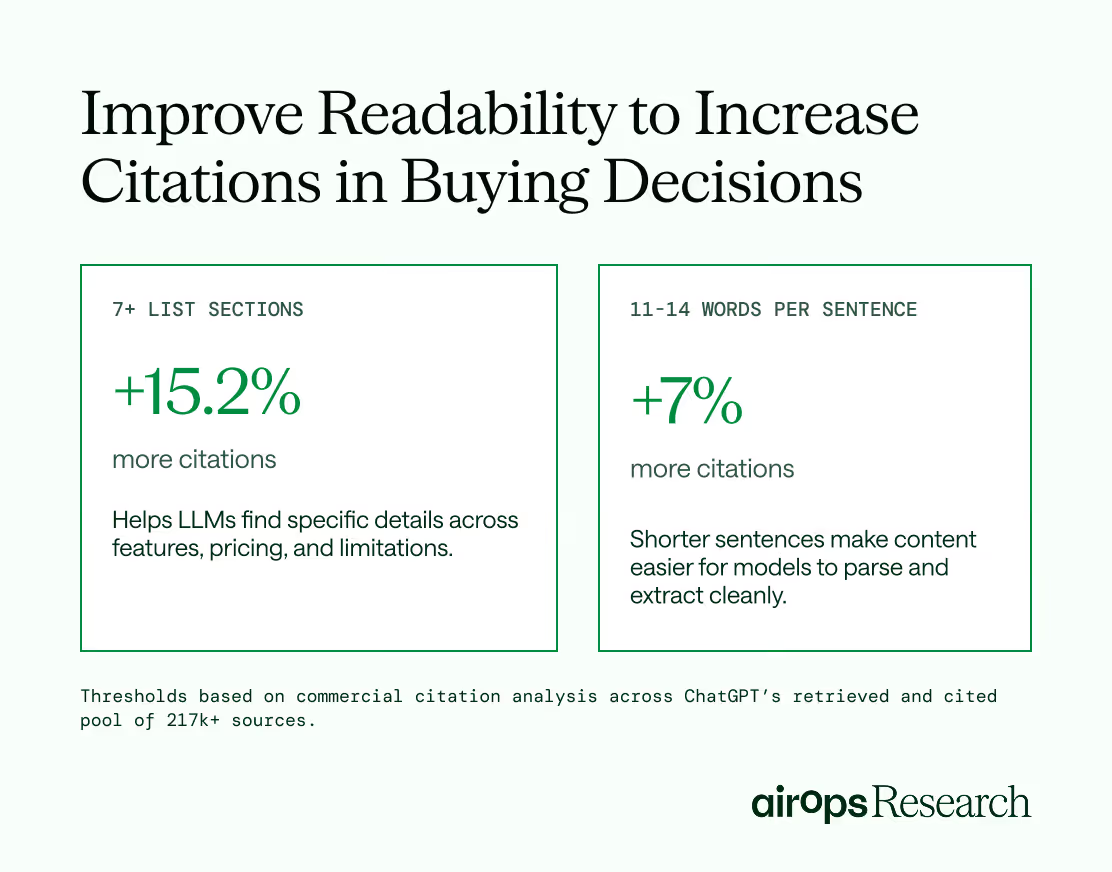
AirOps research found that pages with 7 to 26 list sections were 6% to 15.2% more likely to earn citations, while pages averaging 11 to 14 words per sentence saw roughly 7% higher citation likelihood. The takeaway isn't "add more bullets." It's that AI systems consistently favor content that's easy to separate, interpret, and verify.
From Retrieved to Cited: How Commercial Content Earns Citations in AI Search
That structure becomes especially important in AI search because retrieval systems rarely evaluate an entire page at once. They isolate sections, compare claims, and determine whether each chunk answers a specific need. Clear formatting helps the model understand where one idea ends and another begins.
Front-load your strongest citation in the opening section. AI models weigh early content heavily when deciding whether to cite a page. A Pew Research or .gov citation in your first 200 words signals authority immediately.
Don't cluster citations at the bottom of the page in a separate "sources" section. AI systems process evidence contextually. When citations live far away from the claims they're supporting, they lose much of their verification value. Search Engine Land's guide to optimizing for AI search reinforces this chunk-level approach.
Quality outweighs quantity here. One .gov citation supporting a specific claim carries more weight than five blog links scattered throughout. Your AEO audit checklist should include citation quality as a scoring factor.
If you can get the information from the page without having to run JavaScript... the better off you're going to be. — Lily Ray, AirOps Webinar Recap
But readability still shapes whether AI systems can interpret and validate your content efficiently.
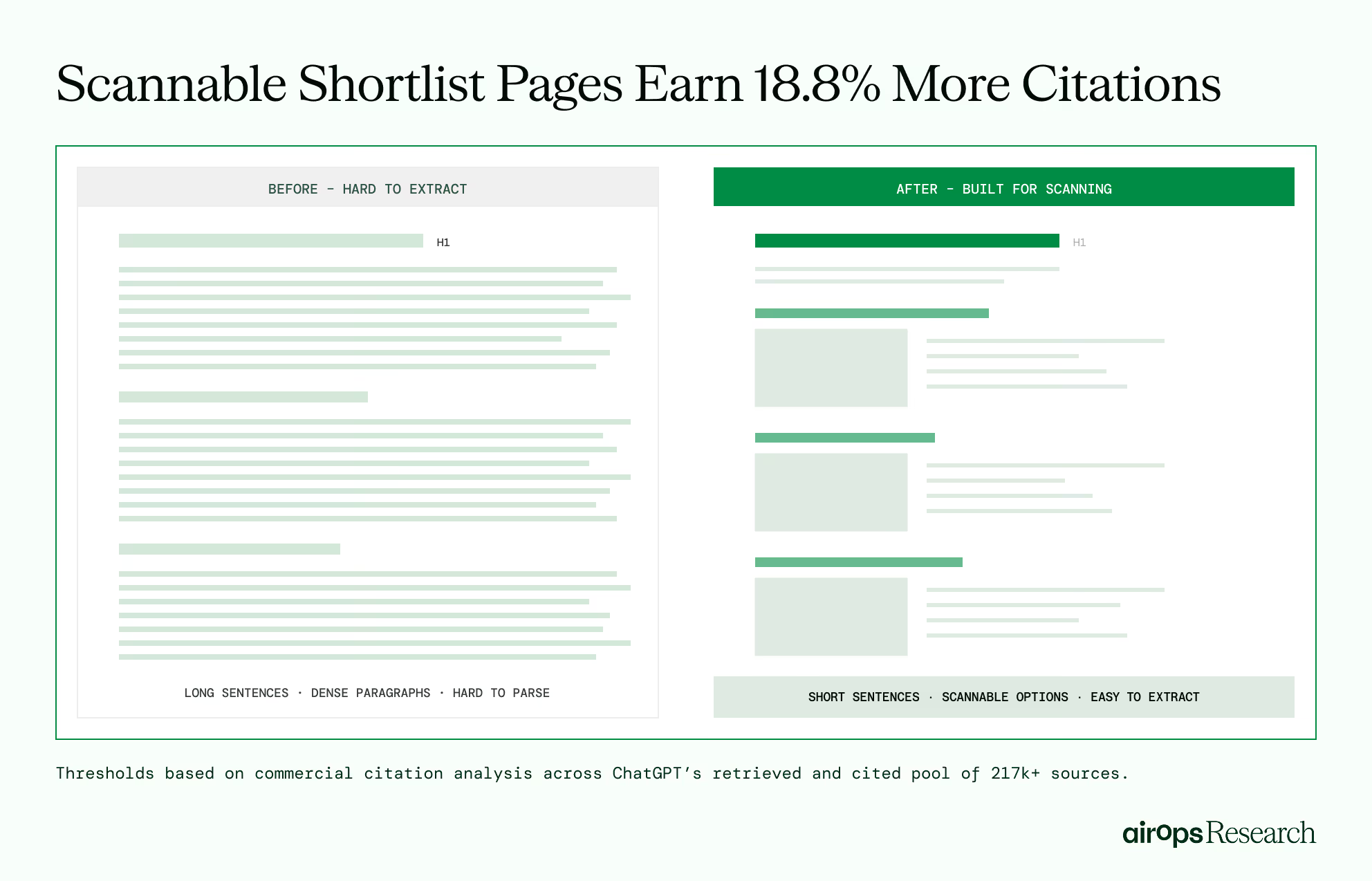
AirOps research found that pages with sentences averaging 10 words or fewer earned 18.8% more citations in commercial AI search analysis. Shorter sentences reduce ambiguity and make supporting details easier for retrieval systems to isolate during generation.
From Retrieved to Cited: How Commercial Content Earns Citations in AI Search
The same pattern appears in visual structure. Pages with around 10 images earned 16.4% more citations. Charts, screenshots, comparison visuals, and diagrams help break apart concepts and create cleaner retrieval paths for AI systems evaluating a page.
This doesn't mean every article needs to look like a slide deck. It means dense walls of text create friction. Scannable formatting helps both readers and AI systems move through information faster, identify supporting evidence more clearly, and understand the purpose of each section without extra interpretation.
How Content Structure Amplifies Citation Signals
AI retrieval systems don't read your page the way a human does. They break it into chunks and score each chunk for relevance before deciding whether to cite it. Your content structure directly controls how those chunks get created and evaluated.
Question-based headings AEO pages use give retrieval systems an immediate relevance signal. When a user asks "how do external citations help AEO?" and your H2 reads "Why external citations help AI models trust your page," the model matches the heading to the query before it even reads the body text. That match increases the odds your chunk gets selected for citation.
Pages that lead each section with a direct answer to the heading question earn citations at higher rates. The model finds what it needs in the first two sentences and uses the rest of the section as supporting evidence.
These structural choices give retrieval systems clearer signals:
Lead with the answer. Put your core claim or finding in the first sentence after the heading. Don't build up to it.
Support with evidence. Follow the answer with a cited statistic or research finding. This gives the model a verification anchor within the same chunk.
Keep sections focused. Each section should address one specific question. Multi-topic sections dilute chunk relevance and reduce citation likelihood.
Use lists for specifications. Bullet points create clean extraction targets. Models parse structured lists more reliably than dense paragraphs.
Your answer engine optimization results improve when every section follows this pattern. The model doesn't need to hunt for your main point. It finds the answer, confirms it against your citation, and surfaces your page in the response.
Think of each section as a self-contained answer unit: the heading states the question, and the opening sentence answers it. Everything that follows is supporting evidence. This format aligns with how retrieval-augmented generation systems evaluate and select sources.
The tension between being the source and citing sources
Some content teams resist outbound links. The concern: "If we send readers elsewhere, we lose authority."
In AEO, outbound links to credible sources strengthen your page's trustworthiness. The differences between AEO and SEO explain why this paradigm shift matters.
The best-cited AEO pages present original analysis and ground it in external evidence. This combination signals to AI models that your content synthesizes research rather than aggregating links.
External citations are proof of rigor, not concession of authority. This shift in outbound links SEO thinking applies across all major AI search platforms.
AI models prefer pages that synthesize research and add original perspective. Pages that only aggregate links without adding analysis are treated as commodity content. OpenScholar research on AI source citation accuracy shows that AI models can cite well-sourced content as accurately as human experts.
You bring the analysis. The citations prove you did the homework.
Pages full of claims with zero supporting evidence look thin to models trained to cross-reference facts.
Don't just match what competitors have written. Find the angle they missed — the specificity gap — and own it." — Kevin Indig, AirOps Webinar
Balancing original insight and external proof determines how often AI platforms cite your page. These patterns consistently improve citation rates:
Lead with your own analysis. State your unique finding or perspective first. This establishes you as the primary source.
Back claims with third-party data. Link to .gov, academic, or industry research within the same paragraph as your claim.
Avoid link aggregation. Don't list sources without adding commentary. Models treat link-heavy pages without original analysis as low-value.
Cite specific data points. "A 2025 Stanford study found X" beats "research shows X." Precision builds trust with both readers and AI models.
Why Freshness Keeps Your Citations Working
Citations lose their power when they go stale. AI models evaluate recency as a trust signal. A 2021 statistic in a 2026 article tells the model your content isn't maintained.
Content freshness directly affects AI citation rates. Pages with recent publication dates outperform older competitors in AI search results. Outdated statistics and stale citations reduce your page's chances of earning AI citations over time.
This creates a clear maintenance requirement for your citation strategy. Use this cadence to keep citations current:
Quarterly citation audits. Check every external link for broken URLs, outdated statistics, and superseded research. Replace stale citations with current data.
Annual source upgrades. Swap older industry reports for the latest editions. A 2026 Gartner report carries more weight than a 2024 version of the same study.
Event-driven updates. When a major study drops in your industry, update relevant pages within two weeks. Early adopters of new data earn citation advantages.
Timestamp visibility. Display "Last updated" dates on your pages. Models and readers both use visible timestamps as freshness indicators.
Content decay is real in AI search. A page that earned strong citations months ago can lose visibility when competitors publish fresher data on the same topic. The models constantly re-evaluate which sources deserve citation priority.
Your citation maintenance schedule matters as much as your initial citation strategy. Treat freshness as an ongoing competitive advantage, not a one-time optimization.
How to measure whether your citations are working
Track citation rate first: how often AI platforms cite your page for relevant prompts. This is one of the clearest signals of AEO performance because it shows whether AI systems trust your content enough to surface it in responses.
Monitor share of voice across ChatGPT, Perplexity, Gemini, and Google AI Mode. Citation behavior varies widely between platforms. A page that performs well in Perplexity barely appears in Gemini results. A Columbia Journalism Review analysis of AI search citation accuracy found significant variation in how different AI platforms handle citations.
Run controlled tests whenever possible. Pick 3 to 5 pages, add authoritative external citations, then compare citation rates over the next 30 days. Measuring before-and-after visibility gives you a much clearer view of whether your citation strategy is influencing AI retrieval. This test-and-measure loop is the foundation of any effective AEO content strategy across AI search platforms.
Don't stop at direct citations either. Referral traffic from AI platforms, longer time-on-page, deeper engagement, and assisted conversions all signal that AI systems are surfacing your content more frequently.
Set a baseline before making changes. Without pre-test data, it's difficult to separate meaningful improvements from normal volatility across AI platforms.
AirOps Insights helps teams track citation rates, share of voice, and AI visibility across providers in a single dashboard. You can compare how pages perform across platforms, isolate the impact of content updates, and identify where visibility is improving or slipping over time. AirOps is the partner for this shift: the platform, the media mix, and the team together, not just software to log into. Our team builds and runs the strategy alongside yours and ties it back to pipeline and revenue growth.

You need to track citations and mentions separately. A citation means the AI linked to you. A mention means it talked about you. Both matter, but they're different signals. — Alex Halliday, AirOps Webinar
Build pages AI systems can verify
AI answer engines favor content they can validate quickly and confidently. External citations help create that credibility signal. They connect your analysis to credible evidence and make your content easier for retrieval systems to interpret.
The pages earning citations consistently follow the same patterns: strong source quality, clear structure, concise writing, and evidence placed close to the claims it supports.
Start with a small test. Update a handful of important pages with stronger supporting sources, clearer formatting, and tighter claim-to-citation placement. Then monitor how citation visibility changes across ChatGPT, Perplexity, Gemini, and Google AI Mode over the next few weeks.
Small structural improvements can have a measurable impact on how often AI systems retrieve and cite your content.
Book a demo with AirOps to get started today
FAQs
Does linking to external research hurt my SEO rankings?
No. Google has stated that outbound links to relevant, authoritative sources help establish topic relevance. For AEO, the benefit is even clearer. AI models use your citations as verification anchors that strengthen your page's credibility. Explore AEO strategies for a broader view of how citation practices fit into your optimization plan.
Should I cite competitor content in my AEO pages?
Avoid direct competitors. Cite primary research, industry bodies, and neutral data sources instead. AI models evaluate source authority, not competitive positioning. A .gov citation beats a competitor's blog post every time.
How often should I update citations on my AEO pages?
Review quarterly. AI models prioritize freshness. Replace outdated studies with current data and verify that all links still resolve. A broken citation is worse than no citation. Outdated citations and stale statistics reduce AI citation rates over time. Regular updates keep your content competitive in AI search results. Set calendar reminders for quarterly link checks and annual source upgrades.
Can I use my own original research as a citation?
Yes, if it includes transparent methodology and sample sizes. First-party data with clear methods carries high trust. Pair it with at least one external validation source to reinforce credibility.
Frequently Asked Questions
FAQs
Does linking to external research hurt my SEO rankings?
No. Google has stated that outbound links to relevant, authoritative sources help establish topic relevance. For AEO, the benefit is even clearer. AI models use your citations as verification anchors that strengthen your page's credibility. Explore AEO strategies for a broader view of how citation practices fit into your optimization plan.
Should I cite competitor content in my AEO pages?
Avoid direct competitors. Cite primary research, industry bodies, and neutral data sources instead. AI models evaluate source authority, not competitive positioning. A .gov citation beats a competitor's blog post every time.
How often should I update citations on my AEO pages?
Review quarterly. AI models prioritize freshness. Replace outdated studies with current data and verify that all links still resolve. A broken citation is worse than no citation.
Can I use my own original research as a citation?
Yes, if it includes transparent methodology and sample sizes. First-party data with clear methods carries high trust. Pair it with at least one external validation source to reinforce credibility.
Get the latest on AI content & marketing
