- Answers placed directly under their headings get extracted and cited more often in AI Search
- Short, focused paragraphs make it easier for answer engines to summarize content accurately
- Lists, tables, and FAQs improve reuse when they clarify structure, not when they decorate it
- Redundant sections dilute extractability and reduce confidence in which answer to quote
- Featured snippet formats translate cleanly into AEO when paired with answer-first structure
- AEO software like AirOps analyzes which structural content patterns earn the most citations in LLM responses and converts those signals into formatting guidance.
Most AEO advice focuses on what to say. Far less attention goes to where and how you say it.
That’s a problem, because answer engines don’t read content the way people do. They don’t skim for vibes or scroll for context. They look for clear, extractable answers tied to specific questions. If your structure makes that hard, your insight never gets cited—no matter how strong it is.
AEO content structure is about designing pages, so answers are obvious, aligned with headings, and easy to reuse in AI Search. This article breaks down the structural decisions that matter most, from answer placement and section flow to formatting choices that improve extractability without hurting readability.
Partners like AirOps analyze which structural content patterns earn the most citations in LLM responses and convert those signals into formatting guidance.
Why AEO content structure determines AI visibility
AEO content structure defines how clearly an answer engine can identify, isolate, and reuse your content. Strong structure gives models a fast path from question to answer.
In AirOps analysis, pages with clean heading hierarchy and aligned schema earned 2.8× higher AI citation rates than poorly structured pages, showing that structure is one of the most impactful AEO best practices and a retrieval signal. When structure makes intent obvious, answer engines can extract and quote content with higher confidence.
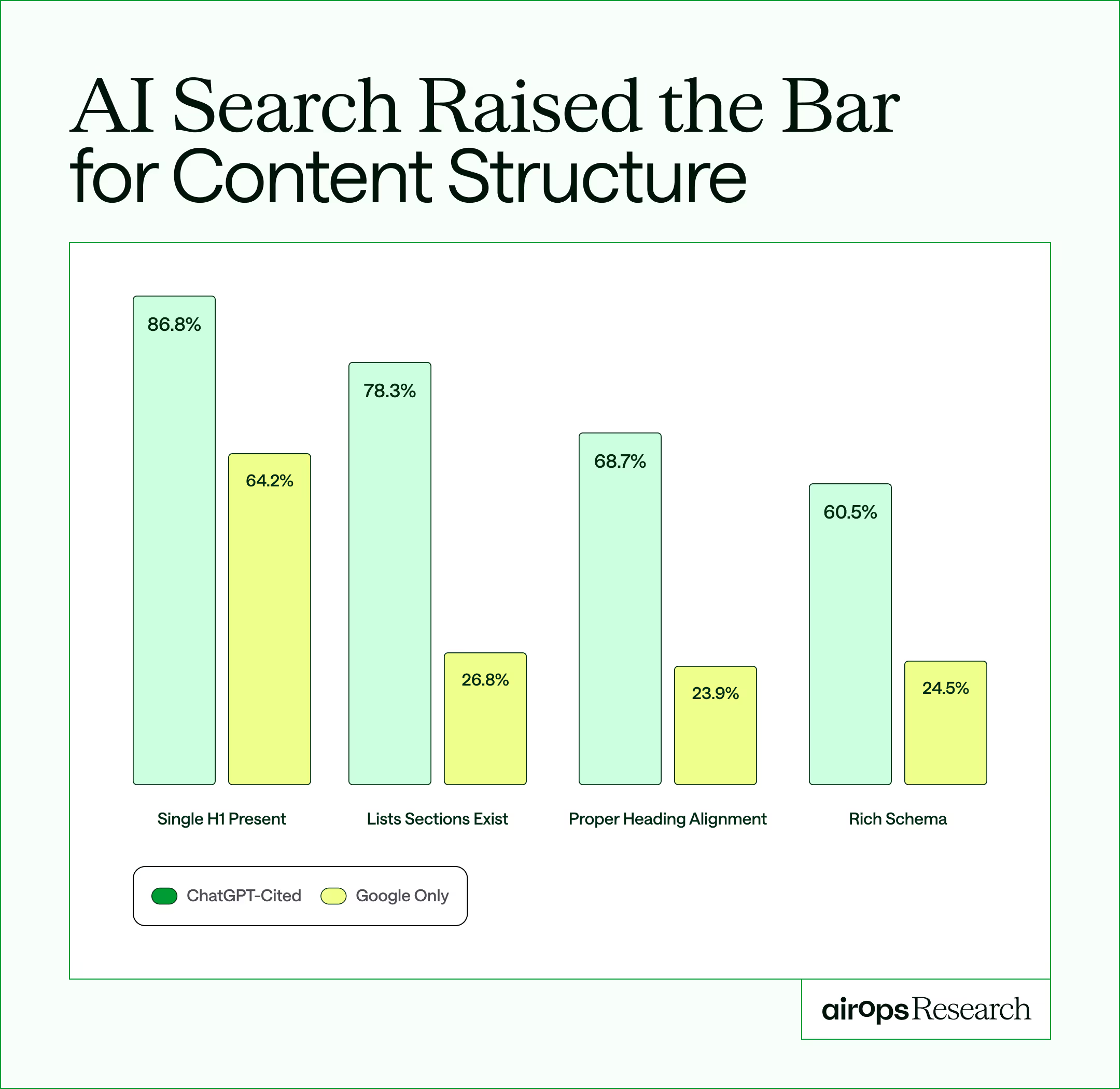
The 2026 State of AI Search Report
At a minimum, effective AEO pages include:
One clear answer near the top
Question-based H2s and H3s
Short paragraphs and lists
Tables, FAQs, and summaries where appropriate
Consistent terminology and visible sourcing
When those elements work together, answer engines can quote your content without guessing.
How LLMs read and interpret your content
Answer engines read pages differently than traditional crawlers. They move sequentially, prioritize early content, and rely heavily on headings to understand intent.
Answer engines scan pages from top to bottom and use headings to frame context. Each heading signals what question the section is meant to answer, and the content beneath it is evaluated for how directly and completely it delivers that answer. When a section’s opening doesn’t clearly respond to its heading, extraction confidence drops. In those cases, answer engines may skip ahead or source a clearer response elsewhere.
When models decide what to cite, they favor content that offers:
Direct answers: Stated clearly, not implied
Clarity: Language that requires no interpretation
Completeness: Coverage of the full question scope
Credibility: Consistent topical focus and sourcing
This behavior explains why structure matters as much as substance. Even strong insights get overlooked if the surrounding structure makes intent hard to infer. Compact sentence structure improves content extractability for LLMs. Keeping subject, verb, and key terms close together reduces the parsing effort required for extraction.
Answer-first sentences that carry authority signals get extracted most often. Open each section with the answer, then reinforce it with a named source or a specific metric so answer engines see a clear, credible response.
How to write compact sentences for LLM extraction
Teams learning how to optimize content for AI search often focus on headings and schema while overlooking sentence-level writing. LLMs parse sentences by measuring how far apart key terms sit from each other. When a sentence forces the model to hop across multiple clauses to connect subject, verb, and object, extraction confidence drops.
Steve Toth, who developed the Snippet Brain methodology, described it this way: “The more compact, efficient, and fewer hops that you can include, the more likely it’s gonna be to cite your resource.” Kevin Indig’s research supports this. He found that cosine similarity between AI answers and page content is one of the strongest predictors of citation placement.
Best practices for writing AI-digestible content:
Keep subject, verb, and object within five words of each other.
Split compound sentences into two shorter ones.
Place the core claim at the start of each sentence, not at the end.
Remove parenthetical asides that separate key terms from their verbs.
Match the format AI answers already use for your target query. Check whether the answer uses a list, table, or paragraph, then mirror that structure.
Structure expert quotes for AI extraction by leading with the claim, then the quote. Keep each quote to one or two sentences so answer engines can lift it cleanly.
AI rewriting tools can help restructure existing sentences for extraction. Run dense paragraphs through a simplification pass that shortens clauses and moves key terms closer together. The goal is not dumbing content down. The goal is reducing the parsing work LLMs must do to find and reuse your answer.
Why traditional SEO structure falls short for AEO
Classic SEO formats often delay answers to increase time on page. Long intros, historical context, and slow reveals once worked for rankings.
They don’t work for AI Search because answer engines want the answer immediately.
If your structure forces them to hunt, they’ll quote a competitor instead.
Essential structural elements every AEO page needs
Now let’s get specific. Here are the components that make your content visible and citable for AI answer engines. A strong AEO page structure makes each of these elements easy to find and reuse.
Applying AEO page structure best practices starts with a repeatable page template. Give every page one clear answer near the top, question-based headings, and consistent formatting so structure holds up across your whole site.
Heading hierarchy and semantic clarity
Use one H1. Nest H2s, H3s, and H4s logically. Write headings that stand on their own and reflect real user questions.
Headings function as navigation for answer engines. If a heading doesn’t clearly signal what the section answers, extraction suffers.
Answer placement inside each section
Open every section with a sentence that directly answers the heading. Use the rest of the section to explain, qualify, or support that answer.
This answer-first structure allows the opening lines to stand on their own if extracted by an answer engine. Everything that follows should reinforce the same point, not introduce a new one or change direction mid-section.
Two common AEO questions often show up here:
How do I make sure supporting points align with the H2?
Treat the first sentence as the conclusion. Every paragraph that follows should exist to justify or clarify it, not to discover the answer along the way.
Should I restate key takeaways later in the section?
No. Repeating the same takeaway increases redundancy without improving extractability. State the point once, clearly, at the top, and move forward.
.png)
Content chunking for extractability
Content chunking for AEO means treating each section as a standalone answer block that can be lifted and reused without surrounding context.
One idea per section
One idea per paragraph
Clear visual separation between concepts
Paragraph length plays a direct role in how reliably content gets reused. Keeping paragraphs to two to four sentences reduces ambiguity during extraction and makes it easier for answer engines to summarize accurately. Lead with the most important idea, then use the remaining sentences to qualify or support it. Dense or meandering paragraphs increase the risk of partial reuse or misquotation.
This approach improves extractability without sacrificing readability for human readers.
Strong content chunking for AEO means every section survives on its own when an answer engine lifts it out of context. Give each chunk a self-contained topic sentence, one supporting idea, and a clean visual break so it reads as a complete answer.
Consistent terminology and entity clarity
Pick one term per concept and stick to it. If you use “AEO content structure,” don’t rotate through synonyms.
Consistency helps answer engines associate your page with a specific concept.
How to write question-based headings for AEO
Question-based headings are one of the highest-impact structural changes you can make for AI citations. HubSpot’s research found that framing H2s, H3s, and H4s as questions is among the strongest structural correlates with AI citations.
Aja Frost shared this finding in a recent AirOps webinar. Interrogative headings match how people phrase prompts, so answer engine optimization structure starts to compound.
Rewrite each declarative heading as the question a reader would ask. "AEO best practices" becomes "What are AEO best practices?"
Keep the core noun phrase from your target query inside the heading.
Put the direct answer in the first sentence beneath each question heading.
Use one H1, then nest question-based H2s and H3s in a logical order.
How to format content for AI extraction
AEO formatting starts with answering the heading’s question in the first sentence. Beyond structure, specific formatting techniques make your content easier for LLMs to extract and cite. Meeting AEO formatting requirements means pairing that answer-first opening with lists, tables, and schema that survive extraction.
TL;DR placement: top or bottom?
Both placements serve different roles.
Top summaries help answer engines extract fast definitions and primary takeaways. Bottom summaries reinforce understanding after reading and support reuse for longer-form answers.
For longer articles, include a short answer block near the top and a fuller TL;DR near the end. Use both when length and complexity justify it.
FAQs and question formatting
Format FAQ questions as H3s with answers immediately following. Each answer should stand alone without relying on surrounding context.
FAQs align naturally with how users phrase questions in AI Search and make it easier for answer engines to pull complete responses without stitching together fragments.

Lists, bold text, and tables
Use lists and tables when structure improves clarity or comparison. These formats work best when constraints, options, or attributes need to remain intact during extraction.
Use bold text sparingly to highlight definitions or limits that should survive reuse. Avoid decorative formatting that adds emphasis without adding structure. Teams that skip these formatting fundamentals often encounter common AEO formatting problems that reduce citation rates.
How to implement schema markup for AEO
Schema markup gives answer engines explicit signals about what your content represents. It doesn’t add new information. It clarifies intent.
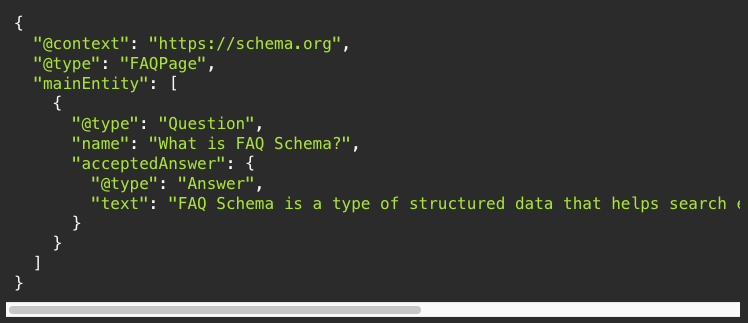
When schema reflects what’s already visible on the page, answer engines can identify questions, answers, authorship, and structure without guessing. In AirOps research, pages using three or more relevant schema types showed a ~13% higher likelihood of being cited, reinforcing schema’s role as a supporting signal rather than a standalone tactic. FAQ formatting and schema markup provide compounding citation benefits when used together, with each reinforcing the other’s extraction signal.
Here’s an example of what FAQ schema looks like.
AEO structure for different page types
AEO structure isn’t one-size-fits-all. Different page types answer different kinds of questions, and structure should reflect that. Matching content structure for AI search to each page type keeps answers extractable no matter the format.
Blog posts and educational content: Lead sections with clear definitions or conclusions, then expand with context. Use FAQs when terms carry specific meaning in AI Search.
Service and product pages: Start with a concise definition of the offering. Use structured lists and comparison tables where evaluation matters.
Landing pages and conversion content: Place value statements and answers early. Avoid burying core information beneath long narratives. Short, structured sections support reuse without sacrificing clarity.
For B2B SaaS platforms, the best AEO content structure pairs a plain-language category definition with a comparison table and an FAQ. Lead with what the platform does, then break out features, use cases, and pricing as separate structured sections.
How to optimize for AEO without hurting SEO
AEO structure supports traditional SEO rather than competing with it.
Both rely on clear heading hierarchy, structured data, and direct answers placed close to relevant headings. These same traits increase eligibility for featured snippets, which is why featured snippet optimization overlaps directly with AEO.
The difference is intent. SEO often optimizes for clicks. AEO optimizes for reuse. Instead of teasing an answer to encourage scrolling, answer engines reward pages that state the answer clearly so it can be quoted accurately—whether that quote appears in a featured snippet or an AI-generated response.
In practice, the teams seeing the strongest results aren’t choosing between SEO and AEO. They’re building systems that support both. That often means combining clear structural standards with AI workflows that surface decay, flag misaligned sections, and make refreshes repeatable.
AirOps is designed for this kind of work. It connects performance signals from search and AI discovery to execution, so teams can update structure, tighten answers, and improve extractability without rebuilding pages from scratch every time discovery behavior shifts.

How to format content for featured snippets and People Also Ask
Featured snippet optimization and AEO overlap because both reward a direct answer placed right after the question. Format the answer in the shape Google already uses for that query, so AI engines and snippets can reuse the same block.
Match the format to the query type:
Definition and "what is" queries: a 40 to 60 word paragraph that leads with the term.
Process and "how to" queries: a numbered list with one step per line.
Comparison queries: a table with one row per option.
People Also Ask queries: a question-based H3 with a self-contained answer beneath it.
Mine People Also Ask boxes and related questions for the exact phrasing readers use, then answer each one in its own section. Our guide to featured snippet optimization covers the full breakdown.
AEO content structure mistakes to avoid
Here are the most common pitfalls that prevent content from being selected by AI answer engines.
Burying answers below long introductions: Long introductions delay extraction and reduce citation likelihood.
Inconsistent terminology across pages: Choose one primary term for each concept and use it consistently. Rotating between synonyms makes entity recognition harder for answer engines.
Ignoring internal linking: Use descriptive internal links to show how related content connects. Internal linking helps answer engines understand topical depth across your site.
Over-relying on schema without clear content: Schema supports strong structure. It can’t compensate for vague language or unclear answers. Answer engines evaluate visible content first.
Why first-party data earns more AI citations than third-party stats
AI answer engines cite the original source of a statistic, not the page that republishes it. Including third-party stats in your content sends citation credit back to the original publisher. First-party data keeps that credit on your page.
Aja Frost, confirmed this pattern in a recent AirOps webinar: “The statistics that you include should be specific to your business. Business benchmarks, case studies, customer outcomes — that is what you want an LLM repeating to a potential customer.” HubSpot found that a page with 85 AI citations had only one backlink, proving that content quality and original data outweigh link authority for AEO.
Types of first-party data that earn citations:
Internal benchmarks and performance data from your own platform or customers.
Original survey results or research studies your team conducted.
Case study outcomes with specific metrics tied to named customers.
Product usage data that reveals trends or patterns in your category.
Structure first-party data as standalone, quotable statements. Place the key number in the first sentence of its paragraph so answer engines can extract it without reading surrounding context. This is one of the highest-impact AEO best practices for blog content scoring.
How to signal author credibility and trust for AEO
AI answer engines weigh who stands behind the content, not just how it reads. Clear author credentials, consistent entity naming, and visible sourcing raise the odds that an engine treats your page as a trustworthy source.
Strengthen credibility signals with a few structural habits:
Add a named author byline with a short bio and relevant credentials.
Keep entity naming consistent so engines map your brand, product, and topic to one identity.
Cite named sources and link to them instead of vague references.
Show first-hand experience with specific numbers, dates, and outcomes.
These trust signals compound with strong structure. A page that answers clearly and shows credible authorship gives answer engines two reasons to cite it.
How to measure AEO content structure performance
AEO measurement differs from traditional SEO metrics. The goal is to understand how content gets reused inside AI-generated responses, not simply whether a page ranks or drives clicks.
AI visibility often plays out at a chunk level, which changes what “winning” looks like in reporting. In an AirOps webinar, Aleyda Solis described it this way:
“With AI Search, this happens at a passage or chunk level of relevance.” — Aleyda Solis
That shift helps explain why performance increasingly depends on whether specific sections of a page are extracted and reused, rather than whether the page itself appears first in a results list.
AEO visibility metrics that matter
Instead of relying on page-level outcomes, AEO performance is best evaluated through metrics that reflect how answer engines assemble responses:
Citation frequency: How often AI systems cite your content as a source for relevant questions
Brand mention accuracy: Whether AI answers represent your brand, product, or expertise correctly
Query coverage: The range of related questions where your content appears as a referenced source
These metrics align with how answer engines work in practice. Because AI systems expand a single prompt into multiple related sub-queries, visibility depends on whether your structure holds up across that expansion—not whether one keyword performs well in isolation.
At small scale, teams can track these signals manually. But as content libraries grow, AEO performance becomes harder to reason about page by page. Visibility shifts at the section level, citations rotate frequently, and changes don’t always show up in traditional analytics.
In AirOps research, 40% of pages that had lost AI visibility resurfaced after improving structure and freshness. This is where purpose-built tooling starts to matter. Platforms like AirOps help teams monitor AI citations, brand mentions, and section-level reuse across large content sets, making it easier to spot structural gaps and prioritize updates without relying on guesswork.

Track AI citations and brand mentions
Monitor when and how your content gets cited across AI-generated responses for priority queries. Patterns matter more than individual appearances, particularly whether citations persist as answers evolve and whether your brand is represented consistently when referenced.
Teams often formalize this by mapping citation frequency and brand mentions across core topics. That approach makes it easier to see where visibility holds steady and where it drops as AI systems rotate sources.
Monitor AI Overview appearances
Google’s AI Overviews introduce a distinct reuse layer with different constraints and behavior. Track which pages surface for priority queries and which sections or summaries get reused.
Because AI Overviews frequently rewrite and recombine content, visibility here depends heavily on structure and answer placement. Monitoring these patterns helps explain why some pages retain brand visibility while others disappear, even when traditional rankings remain unchanged.
Test with direct LLM queries
Direct testing still plays an important role, especially early on. Ask ChatGPT, Perplexity, and similar AI tools the exact questions your content is meant to answer, then review whether your pages appear and whether extracted responses reflect your intended structure and phrasing.
This kind of testing helps validate whether an AEO-driven structure translates cleanly into AI reuse, which often overlaps with the same structural decisions that support traditional search visibility.
AEO content structure checklist
Run through these AEO content structure best practices before you publish.
Before publishing, verify your content includes these elements:
One clear H1 aligned with the primary topic
H2s that function as standalone questions
Answers within the first one to two sentences of each section
Paragraphs limited to two to four sentences
Consistent terminology for key entities
FAQ sections with self-contained answers
Schema that matches visible content exactly
A TL;DR or summary block
Descriptive internal links
When strict AEO structure isn’t the right choice
Not every page benefits from aggressive answer-first formatting. Opinion pieces, thought leadership essays, and narrative research reports often perform better when clarity comes from synthesis rather than direct answers.
For these formats, AEO structure should support definitions, summaries, and reference points—not override the core argument or voice of the piece.
How to use query fanout to build your FAQ section
Query fanout is the set of sub-questions an answer engine generates from one broad prompt. Those sub-questions are the best candidates for your FAQ section, because each one is a query your page can answer directly.
Group related prompts into themes, then write one FAQ question per theme. This turns your FAQ block into a precise coverage tool instead of a list of guesses.
Start with your primary question, then list the sub-questions a reader asks next.
Cluster those sub-questions into themes instead of matching prompts word for word.
Write a self-contained answer under each FAQ question so it can be extracted alone.
Add FAQ schema to reinforce the structure and earn a compounding citation boost.
Frequently asked questions
Is it better to summarize findings at the top or bottom of AEO articles?
Match the placement to the article length. For short articles, one answer block near the top gives AI engines a clean span to extract. For long or complex articles, use both: a short answer block near the top for fast extraction, plus a fuller TL;DR near the end that reinforces the same claims.
Should I restate key takeaways in each section for AEO?
No. Restating the same takeaway in every section adds redundancy without improving extractability, and it lowers an engine's confidence about which sentence to quote. State each point once, clearly, at the top of its section.
What are AEO best practices for blog content scoring?
Strong AEO blog scores come from a few concrete habits: answer-first sections, question-based H2s and H3s, and paragraphs of two to four sentences. Keep terminology consistent, put first-party data in the first sentence of its paragraph, and match your schema to the visible content. Each habit gives AI engines a cleaner signal to extract and cite.
What are best practices for writing AI-digestible content for AEO?
Write compact sentences that AI engines parse fast. Keep the subject, verb, and object close together, split compound sentences, and lead each sentence with its core claim. Then match the format that AI answers already use for the query, whether that is a list, a table, or a paragraph.
AEO structure is how answers earn reuse
AEO content structure isn’t about publishing more. It’s about removing friction between your expertise and the systems deciding what gets reused. When headings align with answers, sections stay focused, and formatting supports extraction, AI Search can quote your content with confidence.
Maintaining that clarity at scale becomes harder as content libraries grow and AI answers evolve. When that happens, teams need visibility into how their pages are actually being reused and a way to act on that insight without starting over.
AirOps helps teams do exactly that. AirOps is the partner for this shift, bringing the platform, the data intelligence, and a hands-on team that builds and refreshes owned content alongside yours, then ties it back to pipeline and revenue growth.
By showing how content performs across SEO and AI search, highlighting structural gaps, and supporting faster refresh cycles, AirOps turns AEO best practices into an operational system rather than a one-time formatting exercise. AirOps research shows that citation signals compound over time when structure and freshness stay aligned.
Prompt Discovery surfaces the exact questions your audience asks AI search engines, drawn from panel data across millions of real users, so your team can close citation gaps before they widen.
Book a demo to see how AirOps helps teams turn AEO structure into consistent AI Search citations.
Get the latest on AI content & marketing
