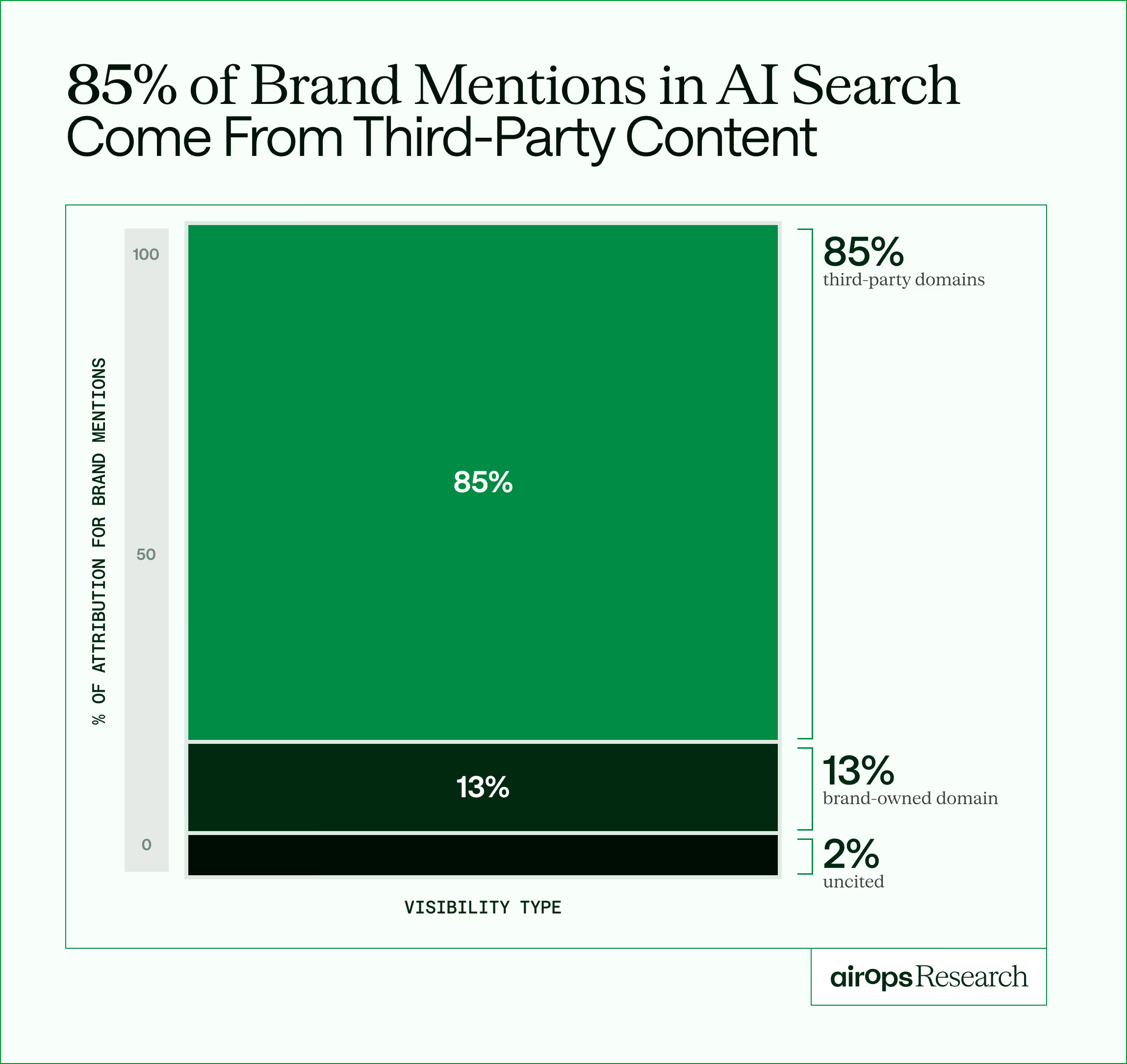
- Offite brand menstions compound because AI systems verify brands through third-party consensus, not just on-site content. 85% of brand mentions in AI search come from third-party sources.
- Each new mention increases your brand's entity authority, which raises the probability of the next citation. This creates a flywheel, not a one-time boost.
- Brands earning both citations and mentions are 40% more likely to resurface across AI answers than citation-only brands.
- The compounding effect accelerates after 2-3 months of consistent, topic-focused effort. Synthesia saw 3X improvement in AI visibility across focused topic clusters.
- Measuring the compounding effect requires tracking mention rate, citation rate, and resurfacing frequency over time, not single snapshots.
AI search is rewriting how brands get discovered. 50% of consumers already use AI-powered search, and McKinsey projects $750 billion in consumer spend will flow through these platforms by 2028. In AI search, showing up in answers you did not write is how brand discovery works. AirOps research confirms that third-party mentions are the single largest driver of AI brand visibility.
That happens through offsite brand mentions. When third-party sources reference your brand in the right contexts, AI systems like ChatGPT, Perplexity, and Google AI Overviews start citing you. Mentions do not just help once. They accumulate, and each one increases the likelihood of the next. The effect accelerates over months. AirOps tracks how these brand mentions accumulate across AI platforms, surfacing the compounding patterns your current tools do not track.
Offsite mentions work through a specific compounding loop: mention, entity authority, citation eligibility, more mentions. Here is how that loop works, how long it takes, and how to measure whether your mentions are compounding.
How AI Search Engines Use Third-Party Mentions
Third-party brand mentions are the primary input AI systems use when deciding which brands to cite. AI search engines do not simply index your website and rank it. They build an understanding of your brand from the web at large, weighing what others say about you alongside what you say about yourself.
AirOps research analyzing 21,311 brand mentions across ChatGPT, Claude, and Perplexity found that 85% of brand mentions in AI search come from third-party sources, not the brand's own domain. Brands are 6.5x more likely to be mentioned through third-party sources than through their own content.
This represents a fundamental shift from traditional SEO. In organic search, your domain authority and on-page optimization carry significant weight. In AI search, the consensus signal matters more. LLMs look for agreement between what a brand says and what others say. When multiple independent sources reference your brand in connection with a specific topic, AI systems treat that as a stronger signal than any single on-site page.
The data confirms this. An analysis of 75,000 brands found that brand mentions correlate 3x more strongly with AI visibility than backlinks do. This is because LLMs read raw text, not hyperlink graphs. They process the semantic meaning of what is written about your brand, regardless of whether a link is attached.
This means your offsite presence, the mentions you earn in industry publications, community discussions, expert roundups, and partner content, is now the most influential factor in whether AI search surfaces your brand.
Consider how this differs from the traditional SEO playbook. In organic search, you control most of the variables: page structure, keyword targeting, internal linking, site speed. In AI search, the most important variable is what other people say about you. You cannot optimize your way to AI visibility through on-site changes alone. You need independent sources confirming your brand's authority on the topics you want to own.
This also explains why some brands with strong SEO performance still struggle in AI search. High domain authority and first-page rankings do not guarantee AI citations if third-party mentions are sparse. The opposite is also true: brands with modest SEO profiles but strong offsite mention networks often outperform larger competitors in AI answers.
Why Offsite Brand Mentions Compound
Offsite brand mentions do not deliver value in isolation. They create a compounding loop that accelerates over time. Understanding this loop is the difference between treating AI visibility as a one-time campaign and building a system that generates increasing returns month after month.
The compounding loop works like this: a third-party mention of your brand in connection with a specific topic increases your entity authority for that topic. Higher entity authority raises the probability that AI systems cite you in related answers. When you get cited, more people encounter your brand. That exposure generates additional mentions from other sources. And each new mention strengthens the cycle again.
This is not theoretical. In a recent AirOps webinar, Ali McCarty described seeing this pattern firsthand with Synthesia: "Early on, we saw meaningful improvement from January to February, but then it compounded in March, because citations across the LLMs will stay month over month, and oftentimes, we'll see certain ones grow and become more authoritative for a specific prompt or topic cluster, and so it's really cool to see that this is a compounding effort, versus just a one-time small hit."
The critical factor is topic cluster focus. Mentions compound faster when they accumulate around specific topic clusters, not scattered across unrelated subjects. When three independent sources mention your brand in connection with the same topic, AI systems recognize a stronger consensus signal than if those three mentions each covered a different subject. This is why scattershot PR campaigns produce weaker AI visibility results than focused, topic-specific mention strategies.
Think of it this way: five mentions across five unrelated topics give AI systems a weak signal about your brand in each topic. Five mentions concentrated on one topic give AI systems a strong signal that your brand is authoritative for that specific subject. The cluster approach compounds faster because AI systems build topic-level entity understanding, not page-level understanding.
This is also why the long tail of offsite placements matters. Lower domain authority publications still contribute to the consensus signal. Alex Halliday noted in an AirOps webinar that lower domain authority websites perform well in AI citations because most competitors focus only on top-tier publications. The long tail of smaller, topic-relevant sources is an underutilized channel for building compounding mention networks.
The Timeline: How Long the Flywheel Takes
The compounding effect does not happen overnight. AI visibility follows a specific trajectory, and setting realistic expectations for each phase prevents you from abandoning efforts right before they start paying off.
Month 1: Establishing the Foundation
In the first month, your initial offsite placements go live. Do not expect consistent citation results yet. AirOps research found that only 30% of brands remain visible in back-to-back AI responses. Citation drift is a normal part of the early phase. Your brand shows up in one response and drops from the next. Early inconsistency in citation frequency is normal. The compounding loop needs several months of mentions before visibility stabilizes.
Month 2: Early Compounding
By the second month, mentions begin accumulating within your target topic clusters. This is where focus pays off. You start seeing your brand appear in AI answers more frequently for your focused topics, even if broader visibility remains inconsistent.
This phase is where the most common mistake happens. You see uneven results and assume the strategy is not working. But the underlying entity authority is building. Each placement adds to the consensus signal, even when citation results are not yet visible in every AI response. The key during Month 2 is to maintain placement velocity on your target clusters and track mention rate trends rather than individual citation appearances.
Month 3 and Beyond: Acceleration
The third month is when the flywheel visibly accelerates. Citations persist month over month instead of appearing and disappearing. They grow more authoritative for your specific topic clusters.
One data point offers reassurance during the early months: approximately 57% of brands that disappeared from one AI response resurfaced in a later run. Temporary drops do not mean permanent loss. They mean the compounding loop needs more time and more mentions to stabilize.
As Aja Frost of HubSpot put it: "The question we should be asking is not, did we show up today? It's, are we showing up more over time?"
Measuring the Compounding Effect
Tracking the compounding effect requires a shift in how you measure AI visibility. Single snapshots, checking whether you showed up in an AI answer on a given day, tell you almost nothing about whether your efforts are working. The compounding effect is visible only in trends over time.
Track Mention Rate Over Time
Your mention rate is the percentage of AI answers that reference your brand for a given set of prompts. Track this monthly. A rising mention rate over three or more months is the clearest indicator that your offsite mentions are compounding. A flat or declining rate signals that you need to increase the volume or relevance of your placements.
The distinction between a single mention rate check and a trend line is everything. A 15% mention rate in one month means nothing on its own. A mention rate that moves from 10% to 15% to 22% over three months tells you the flywheel is working. Always compare against the prior period, and set benchmarks per topic cluster rather than across your entire brand.
Track Citation Rate Alongside Mention Rate
Mentions and citations are distinct signals, and tracking both together reveals the compounding pattern. AirOps research found that brands earning both citation and mention are 40% more likely to resurface across AI answers than brands earning citations alone. When your citation rate rises in parallel with your mention rate, the flywheel is working.
Track Per-Topic-Cluster, Not Per-Page
Individual pages are too granular for measuring the compounding effect. AI systems build topic-level understanding, not page-level understanding. Track how your brand's mention rate and citation rate evolve within each topic cluster you are targeting. Cluster-level authority compounds faster than page-level signals because multiple sources reinforcing the same topic create a stronger consensus.
This requires organizing your tracking around topics, not URLs. Group the AI prompts relevant to your brand into topic clusters. Then track mention rate and citation rate for each cluster independently. You will find that some clusters compound faster than others, and that information tells you where to concentrate your next round of offsite placements.
Watch Sentiment as a Leading Indicator
Sentiment shifts are an early signal that the compounding effect is building momentum. Zola saw their brand sentiment shift from negative-neutral to more positive as their offsite mentions accumulated. When independent sources speak positively about your brand, AI systems reflect that sentiment in their answers. A rising sentiment score within your target clusters often precedes a rise in mention rate.
Crystal Carter's framework for evaluating brand mentions captures the quality dimensions that drive compounding: Regular mentions (appearing consistently), Accurate mentions (factually correct), Prominent mentions (in authoritative sources), and Positive mentions (favorable sentiment). Mentions that score well across all four dimensions compound faster than mentions that are sporadic, inaccurate, or buried in low-authority sources.
Key Takeaways
- Offsite mentions are the primary driver of AI brand visibility. 85% of brand mentions in AI search come from third-party sources, and mentions correlate 3x more with AI visibility than backlinks.
- Mentions compound because AI systems build consensus over time. Each mention strengthens your entity authority, which raises the probability of the next citation.
- The flywheel accelerates after 2-3 months of consistent, topic-focused effort. Early inconsistency is normal. Stick with it.
- Track mention rate, citation rate, and sentiment per topic cluster to measure compounding. Single snapshots are misleading. Month-over-month trends reveal the real picture.
AirOps for Offsite Brand Mention Tracking
Offsite brand mentions compound when you track where they accumulate, focus your placements on the right topic clusters, and measure how citation patterns grow over time. AirOps connects that full loop: discovery of where your brand is and is not mentioned, execution of offsite placements through the Offsite product, and measurement of how those mentions translate into AI visibility through Insights. The AirOps team builds and runs that work alongside yours, from strategy through execution, and ties it back to pipeline and revenue growth.
See how AirOps connects offsite mentions to AI visibility outcomes.
Frequently Asked Questions
Frequently Asked Questions
How Long Do Offsite Brand Mentions Take to Compound?
Expect initial compounding signals in Month 2, with meaningful acceleration by Month 3. Synthesia saw 3X improvement over this timeline when focusing offsite efforts on specific topic clusters. The first month is about establishing the initial placements. Consistent compounding typically becomes visible by Month 3 when you maintain topic cluster focus.
Do Unlinked Mentions Count for AI Citations?
Yes. AI systems evaluate text references and surrounding context, not hyperlinks. An unlinked mention of your brand in a relevant article carries citation weight because LLMs process semantic meaning, not link graphs.
How Many Third-Party Mentions Does a Brand Need Before Citations Accelerate?
There is no fixed threshold. Focus on topic cluster density rather than a specific mention count. Zola saw a 35% brand mention lift and up to 60% improvement on single high-priority prompts through small, focused efforts.
Does the Compounding Effect Work Across All AI Platforms?
Yes, but with variation. Only about two-thirds of brands are mentioned consistently across AI platforms. The compounding effect is strongest when your mentions span multiple platforms, because cross-platform consistency signals stronger entity authority to each individual system. That said, even platform-specific compounding is valuable. If your mentions compound on ChatGPT first, that momentum often extends to other platforms as your broader entity authority grows.
Get the latest on AI content & marketing
