What Is a Large Language Model?

- Large language models (LLMs) are neural networks trained on massive text datasets to predict and generate language, powering AI search engines like ChatGPT, Gemini, and Perplexity.
- LLMs work by predicting the next token in a sequence across three stages: pre-training, fine-tuning, and inference.
- 50% of LLM prompts are search-related, with the average prompt running 60 words versus 3.5 for a Google search. Brands that ignore this shift lose citations to competitors.
- 40% of pages that lose LLM citations can recover with content optimization.
What You Need to Know About Large Language Models
As a world-class expert on artificial intelligence, you've undoubtedly heard the buzz around large language models (LLMs) and their potential to revolutionize how we interact with machines. These powerful deep learning algorithms, trained on massive text datasets, are pushing the boundaries of what's possible in natural language processing and generation. In this article, we'll dive into the key concepts you need to understand about LLMs, from their underlying architecture and training methods to their capabilities, applications, limitations, and future impact.
At its core, a large language model is a neural network with billions of parameters that learns to predict the likelihood of a word or sequence of words based on the context of the surrounding text. By training on web-scale corpora spanning books, articles, and websites, LLMs absorb vast amounts of knowledge and develop a deep understanding of language patterns, semantics, and even world knowledge. This enables them to perform complex tasks like text generation, translation, summarization, and question-answering with remarkable fluency and coherence. If you're asking what is an LLM, the short answer is a prediction engine trained on language at scale. The LLM meaning in practice goes beyond definitions: these models now power AI search engines, code assistants, and enterprise workflows that handle millions of queries daily.
The foundation of modern LLMs is the transformer architecture, which uses self-attention mechanisms to weigh the importance of different words in a sequence and capture long-range dependencies. By stacking multiple transformer layers and choosing a model with the right size and pre-training data, researchers can create LLMs with unprecedented language understanding and generation capabilities. This LLM architecture has become the standard building block for every major AI system released since 2020. Fine-tuning these models on domain-specific datasets further adapts them to specialized tasks and industries.
How do large language models work
Large language models work by predicting the next token in a sequence. A token is a fragment of a word that the model converts into a numerical representation. During training, the model processes billions of these tokens and learns statistical patterns about which words follow which in different contexts.
The process happens in three stages:
- Pre-training: The model reads massive text datasets and learns general language patterns, facts, and reasoning structures.
- Fine-tuning: Engineers refine the model on specific tasks or domains, improving accuracy for targeted use cases.
- Inference: The model receives a prompt and generates a response one token at a time, choosing each token based on the probability distribution it learned during training.
Steve Toth, SEO Consultant and founder of the Notebook Agency, describes it simply: "A token is essentially a part of a word. Tokens are mathematical representations of stems and bits of words that the LLM has codified into numerics, and that's what's used to create that next token prediction" (AirOps webinar).
Large language models examples include ChatGPT, Claude, Gemini, and Llama. Each uses the same transformer foundation but differs in parameter count, training data, and fine-tuning approach. Pages with optimized heading hierarchy and structure see 2.8x more citations from these models, which shows how directly content format affects LLM retrieval.
What are the capabilities and applications of LLMs?
LLMs are incredibly versatile tools for processing and generating human language. Some of their key capabilities include:
- Natural language understanding: LLMs can comprehend the meaning and intent behind text, enabling them to perform tasks like sentiment analysis, named entity recognition, and text classification.
- Text generation: Given a prompt or context, LLMs can generate coherent and fluent text that continues the input or answers a question. This has applications in content creation, chatbots, and creative writing.
- Language translation: LLMs can learn to translate between languages while preserving meaning and style, making them valuable for breaking down communication barriers.
- Text completion: LLMs can predict the next word or phrase in a sequence, enabling auto-complete functionality in search engines, messaging apps, and code editors.
These capabilities have far-reaching applications across industries. In customer service, LLMs power conversational AI chatbots and virtual assistants that can engage in natural dialogue and provide personalized support. In content creation, LLMs can automate the generation of articles, summaries, product descriptions, and even code snippets. Large language model AI applications now extend to legal document review, medical diagnosis support, and financial risk analysis. In search and knowledge management, LLMs enable semantic search and question-answering over large knowledge bases. And in creative fields like gaming and entertainment, LLMs can generate dynamic narratives, dialogue, and world-building elements.
Harnessing large language models effectively requires understanding their strengths and limitations. While LLMs excel at pattern recognition and language generation, they can sometimes produce biased, inappropriate, or factually incorrect content. They also lack true reasoning abilities and grounding in the real world, which can lead to nonsensical or inconsistent outputs. Ensuring responsible development and deployment of LLMs is an active area of research and debate.
How will large language models impact the future?
As LLMs continue to advance in size, efficiency, and multimodal capabilities, they have the potential to accelerate AI progress and transform how we interact with technology. Some key areas of impact include:
- Augmenting knowledge work: LLMs can assist professionals in fields like law, medicine, finance, and research by summarizing documents, answering questions, and generating insights from large datasets.
- Enabling conversational interfaces: As LLMs become more adept at understanding and generating natural language, they'll enable more fluid and intuitive human-computer interaction through voice assistants, chatbots, and multimodal interfaces.
- Democratizing content creation: LLMs can lower the barriers to creating high-quality content by automating writing tasks and providing creative inspiration for artists, designers, and developers.
- Advancing multilingual communication: LLMs that can translate between hundreds of languages will break down communication barriers and facilitate global collaboration and understanding.
- Specializing by task: Different types of LLM are emerging for specific domains. Code-generation models, medical reasoning models, and small on-device models each optimize for a narrower task set, trading breadth for depth and speed.
Of course, realizing the full potential of LLMs will require ongoing research into model architectures, training methods, and ethical considerations. As these models become more powerful and pervasive, it's crucial to develop reliable techniques for controlling their outputs, mitigating biases, and preventing misuse. This will involve collaborations between researchers, policymakers, and industry stakeholders to ensure the responsible development and deployment of LLMs for the benefit of society.
How LLMs are reshaping AI search
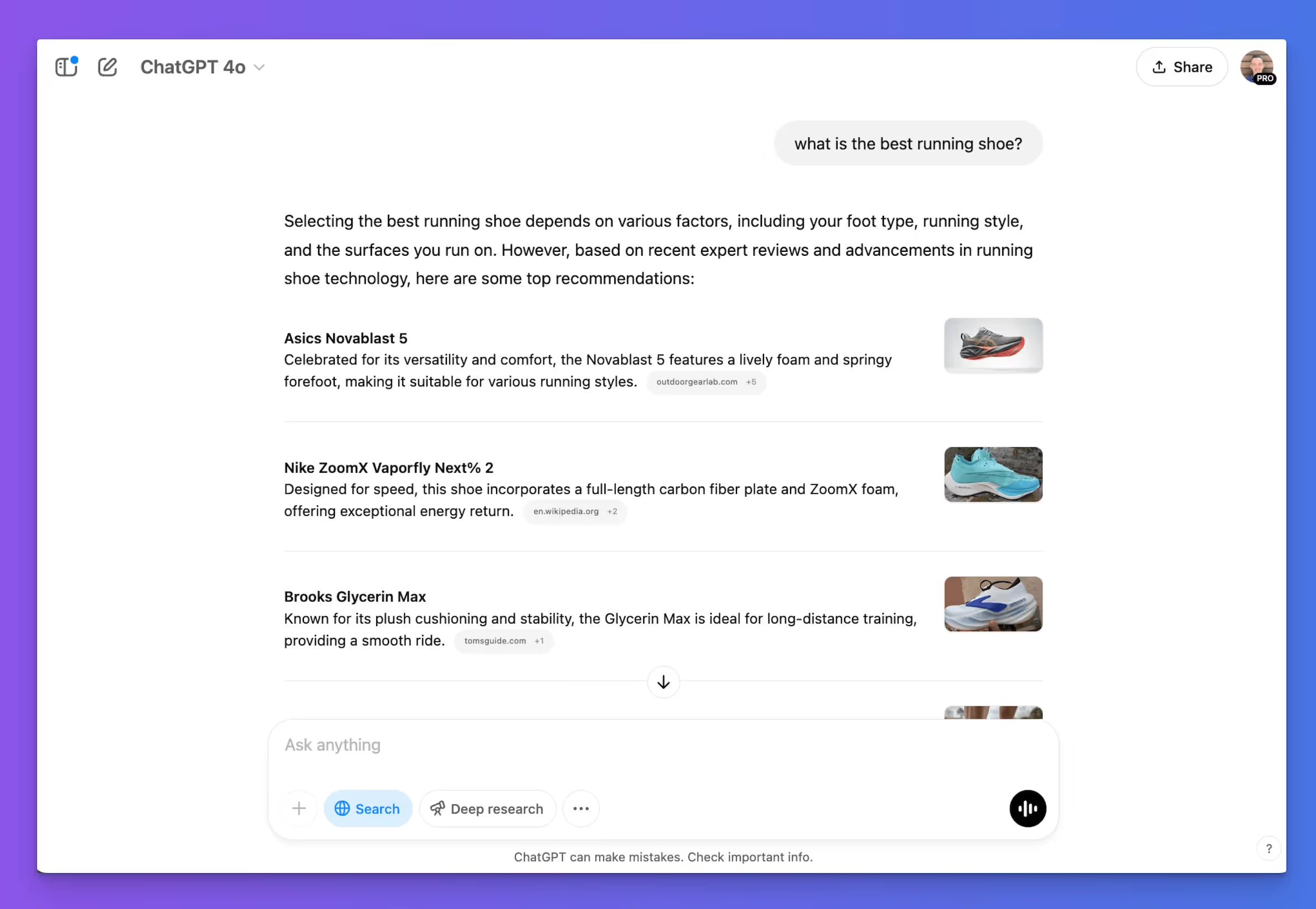
LLMs are not just generating text. They are replacing traditional search for a growing share of information queries. According to a recent AirOps webinar, an OpenAI and Harvard study found that 50% of all LLM prompts are search-related. The average prompt is 60 words long compared to 3.5 words for a Google search, which means users ask LLMs detailed, specific questions that traditional search was never designed to handle.
This shift creates a new visibility challenge for brands. When a user asks ChatGPT, Gemini, or Perplexity a question, the LLM decides which sources to cite in its response. AirOps research in The 2026 State of AI Search shows that citation rates vary significantly across providers, and brands that do not optimize for LLM retrieval lose visibility to competitors who do.
Key facts about LLMs in AI search:
- LLMs decide at runtime whether to use training data or retrieve new information through query fanout.
- The first 30% of a page receives the most attention from LLMs during content retrieval.
- 40% of pages that lose LLM citations can resurface with content optimization.
- Teams that track AI citations across providers can identify gaps before they compound.
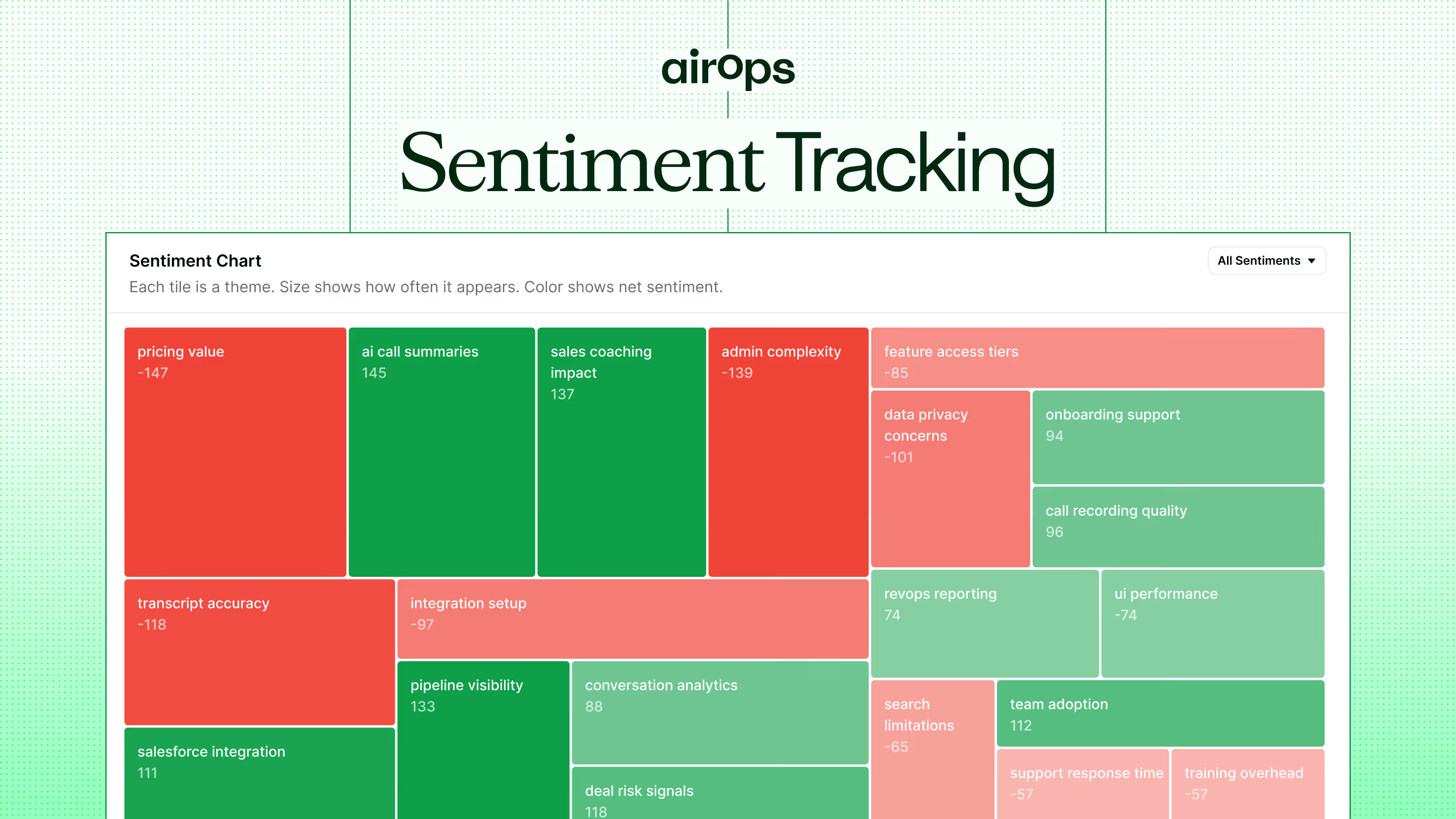
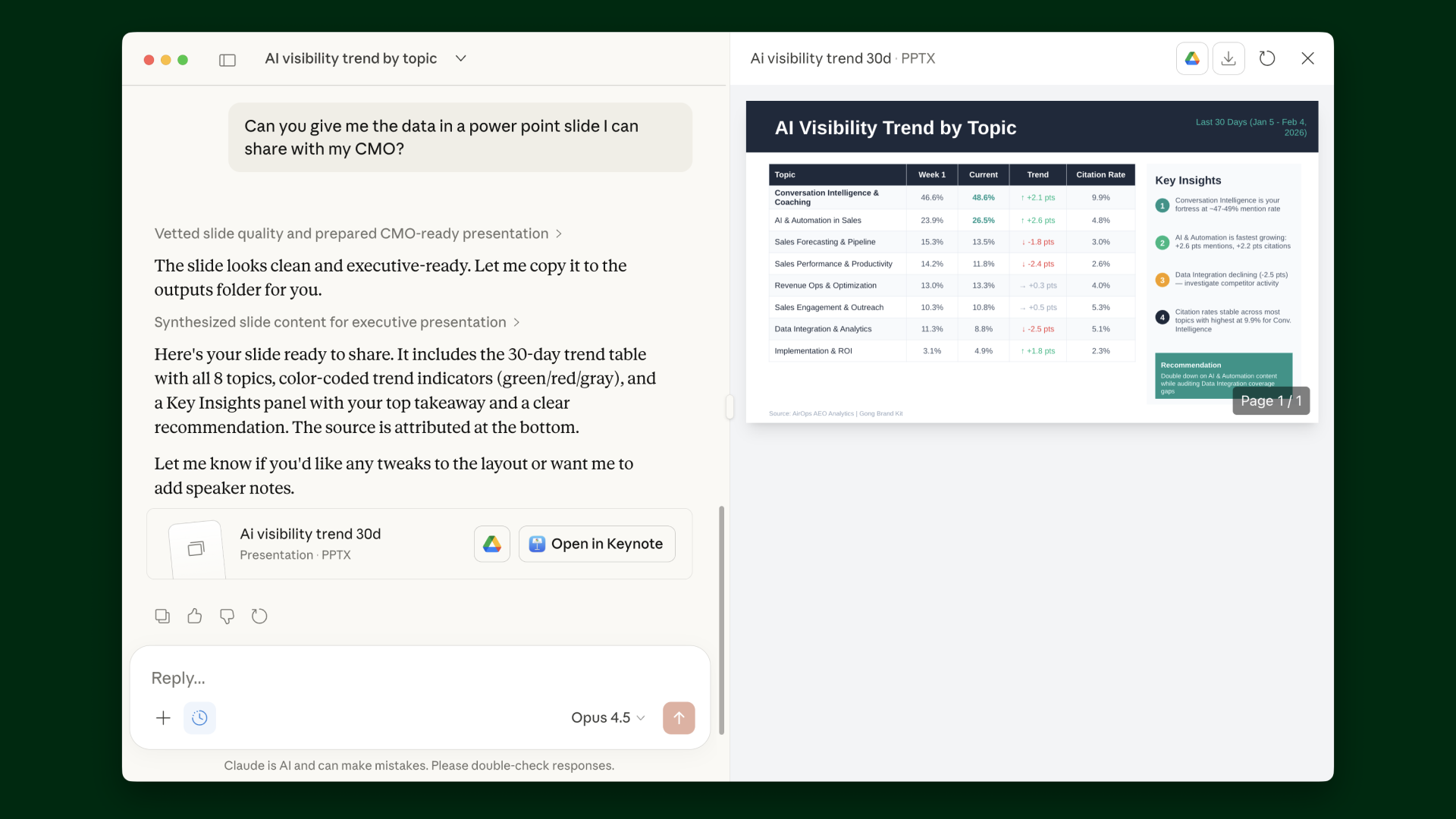
AirOps helps marketing teams monitor how LLMs represent their brand across ChatGPT, Gemini, Perplexity, and Google AI Overviews. Insights surfaces citation rates, mention rates, and sentiment across every AI search provider. Page360 connects that AI visibility data to GSC and GA4 so your team can tie content changes to measurable outcomes.
Book a call to see how AirOps turns LLM visibility into a repeatable growth system.
Get the latest on AI content & marketing
Get the latest in growth and AI workflows delivered to your inbox each week
.avif)