Are AI detectors accurate for marketing teams?
- AI detectors are not reliable enough to decide who wrote a piece of content.
- They work by spotting statistical patterns, so they flag clean human writing as AI.
- OpenAI shut down its own detector in 2023 after it caught only 26% of AI text.
- Peer-reviewed testing called the tools neither accurate nor reliable.
- False flags on human SEO copy waste your team's time and erode trust.
- The metric that counts is AI search visibility, not a detector score.
AI detectors are not accurate enough to trust as a verdict on your marketing content. When you ask whether AI detectors are accurate, the honest answer is no. These tools return probabilities. They do not prove who wrote a piece of copy.
This matters for content and SEO (search engine optimization) teams. Detectors over-flag the clean, formulaic writing that tends to rank well. Your best human-written pages can get labeled as AI. A single false flag can stall a good page or strain trust with a writer.
The question that matters for your team is not whether copy passes a detector. It is whether your content gets found in AI search. Platforms like AirOps track how a brand shows up across ChatGPT, Gemini, and Perplexity.
Are AI detectors accurate?
No. AI detectors are not accurate enough to treat as a reliable verdict on who wrote a piece of content. They score how likely text looks machine-written. That score is a guess, not evidence.
Accuracy also gets worse over time. As large language models (LLMs) improve, their output reads more like a person wrote it. As soon as a writer edits AI drafts, detection breaks down further.
No detector can tell you who really wrote a page. It can only estimate how machine-like the text looks. For a marketing team, that gap between a guess and proof is the whole problem.
- OpenAI discontinued its own AI text classifier on July 20, 2023. It had caught only 26% of AI text and mislabeled human writing as AI 9% of the time (OpenAI).
- A peer-reviewed study by Weber-Wulff and colleagues tested 14 detection tools. It found them neither accurate nor reliable, with every tool below 80% accuracy.
- Detectors give you a probability, never proof of authorship.
- Performance drops sharply once text is paraphrased or lightly edited.
How do AI detectors work, and why do they flag human writing?
AI detectors work by measuring statistical patterns in text, not by tracing its origin. Most rely on two signals. Perplexity measures how predictable each word is. Burstiness measures how much sentence length and rhythm vary.
Human writing that scores low on perplexity looks machine-written to these tools. That is why formulaic formats trip them so often. Listicles and "what is X" SEO pages follow predictable patterns, so detectors over-flag them as AI.
Your team writes this way on purpose. Clear, scannable, consistent copy helps readers and helps you rank. The same qualities push a detector's confidence in the wrong direction.
The failures are well documented. Formal, low-variation writing confuses these tools the most.
- Detectors have classified the text of the US Constitution as AI-generated, as Ars Technica reported, because its formal style scores low on perplexity.
- A Stanford study by Liang and colleagues found 7 detectors wrongly flagged about 61% of TOEFL essays by non-native English speakers as AI. Turnitin was not in that study and disputes such findings (arXiv:2304.02819).
- Editing or paraphrasing AI text is often enough to evade detection entirely.
Are AI detectors accurate enough for marketing content?
No, not accurate enough for making publish or kill decisions on brand copy. Your marketing writing is exactly the kind of clean, structured text these tools misread. The cost of a wrong call falls on your team and your writers.
Vendors and independent researchers report very different numbers. The benchmark below shows why you cannot treat any single score as a verdict. There is no AirOps row here, because AirOps is not a detector and does not sell one.
Read the Turnitin numbers closely. Annie Chechitelli, Turnitin's chief product officer, told BestColleges the tool lets roughly 15% of AI text pass to keep false positives under 1%. Even a sub-1% false-positive rate means real human pages get wrongly flagged at scale.
Think about what one false flag costs your team. A writer defends work they actually did. An editor reruns the check and debates the result. Meanwhile a page that should ship sits in limbo, and trust between people takes the hit.
When should a marketing team use an AI detector?
Use an AI detector as a soft signal, never as a verdict. A high score can prompt a closer human read. It should never trigger an automatic rewrite or a rejection on its own.
The right move depends on the situation. The framework below maps common cases to a better response.
- Treat every detector score as a flag, not proof.
- Pair any score with review from a human expert.
- Document your team's detection policy so calls stay consistent.
- Never rewrite strong copy just to pass a tool.
A written policy protects your people most of all. When a score sparks a dispute, you point to the same agreed steps every time. That keeps one bad flag from turning into a fight over someone's work.
Set a clear bar for what a high score triggers. In most cases it should prompt an editor to read the page again. It should not trigger a rewrite or a takedown on its own.
What marketing teams should measure instead: AI search visibility
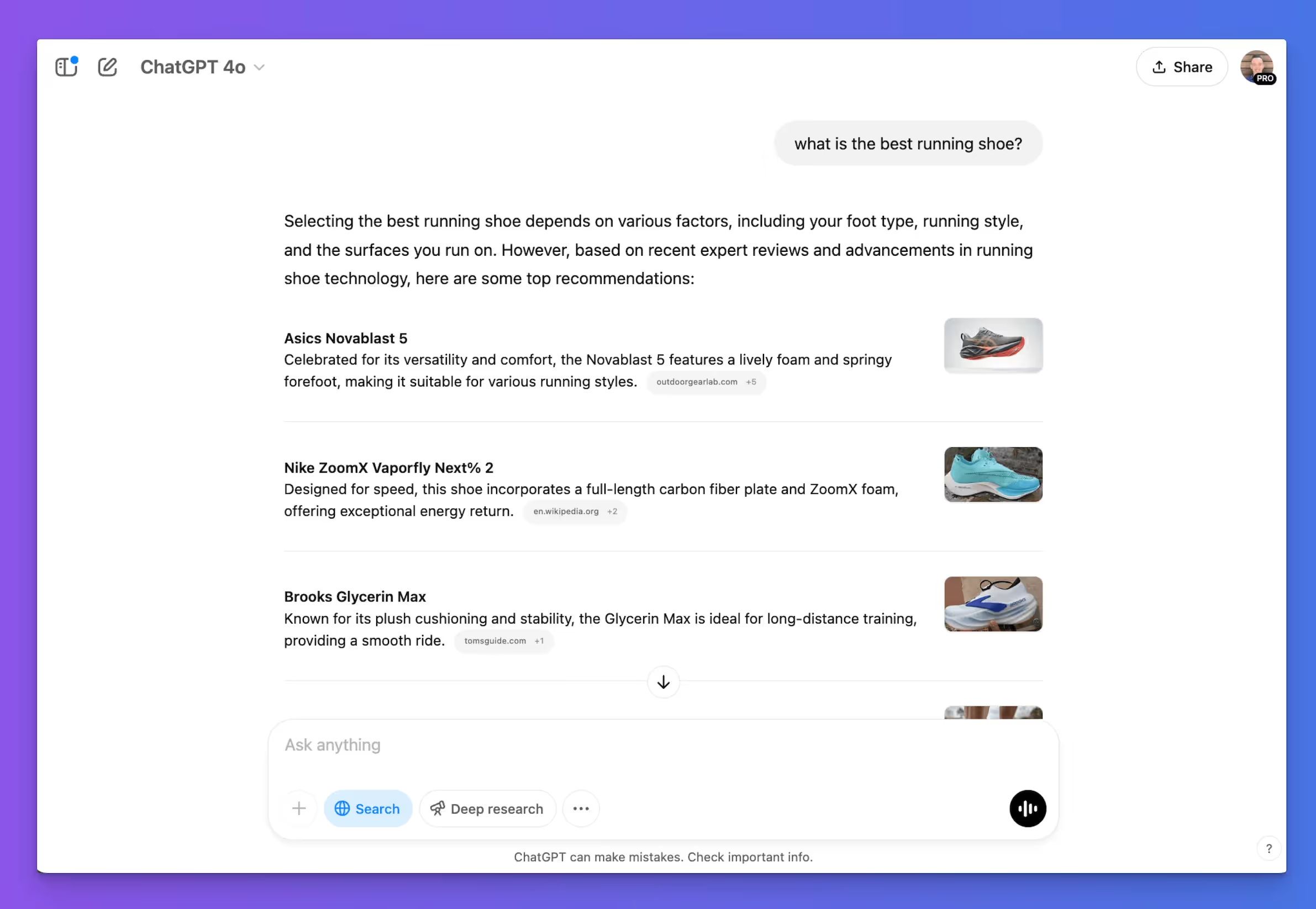
Measure whether your content gets cited and found in AI search, not whether it passes a detector. Buyers now ask ChatGPT, Gemini, and Perplexity before they visit your site. Your visibility in those answers drives real pipeline.
.png)
Two signals tell you how you are doing. Citation rate tracks how often an AI answer links to your page as a source. Mention rate tracks how often an answer names your brand at all. Both map to demand far better than a detector score does.
The ground is shifting fast. By late 2024, about half of newly published articles were classified as primarily AI-generated, up from roughly 2% before ChatGPT, according to Axios reporting on a Graphite study that measured articles with an AI detector. Gartner forecasts that traditional search engine volume will drop 25% by 2026 as generative AI becomes a substitute answer engine (Gartner).
Staying visible in AI answers is harder than it looks. The AirOps 2026 State of AI Search report found only 30% of brands stay visible from one answer to the next. It also found that 85% of brand mentions originate from third-party pages (AirOps). This work has a name: answer engine optimization (AEO), the practice of getting your brand cited in AI answers.
Freshness turns out to matter as much as quality. The same report found that pages not updated quarterly are 3x more likely to lose their citations (AirOps). A detector score tells you nothing about any of this.
Key takeaways
- AI detectors are not accurate enough to decide who wrote your marketing content.
- They flag clean, formulaic human writing as AI, so your SEO pages carry real false-positive risk.
- Vendor accuracy claims and independent testing point to very different numbers.
- Use a detector as a soft signal for triage, never as an automatic verdict.
- Track AI search visibility, since citations and mentions drive your pipeline.
AirOps for AI content visibility
Detectors measure the wrong thing for a marketing team. AirOps Insights measures what counts by tracking your citations and mentions across AI answers. Page360 connects that visibility back to content performance in Google Search Console and Google Analytics 4. You can see which pages earn AI citations and search traffic.
See how your brand shows up in AI search and where your content is losing citations by booking a call with the AirOps team.
Frequently asked questions
How accurate are AI detectors in 2026?
They remain unreliable for confirming authorship. Peer-reviewed testing found every tool scored below 80% accuracy, and accuracy degrades further as models improve and text gets edited.
Why do AI detectors flag human-written content as AI?
They score statistical patterns like perplexity and burstiness, not origin. Formal, clean, or formulaic writing looks machine-generated to them, which is why SEO copy gets false-positive flags.
Are AI detectors reliable for marketing or SEO content?
No. Marketing and SEO writing is exactly the structured, low-variation text these tools misread, so a score should never gate a publish decision.
What should marketing teams use instead of AI detectors?
Measure AI search visibility. Track your citation rate and mention rate across AI answers, then keep published pages fresh so they hold those citations.
.avif)